Ghana Condensed, Evaporated and Dry Milk Market Summary
The ghana condensed, evaporated and dry milk market was estimated at USD 1290 Million in 2025 and is projected to reach USD 2425 Million by 2032, growing at a CAGR of 10.9% from 2026 to 2032.
Ghana Condensed, Evaporated and Dry Milk Market Year-wise Growth Rate and Key Drivers
This graph highlights how the Ghana Condensed, Evaporated and Dry Milk Market has steadily grown over the past five years, supported by major growth factors.
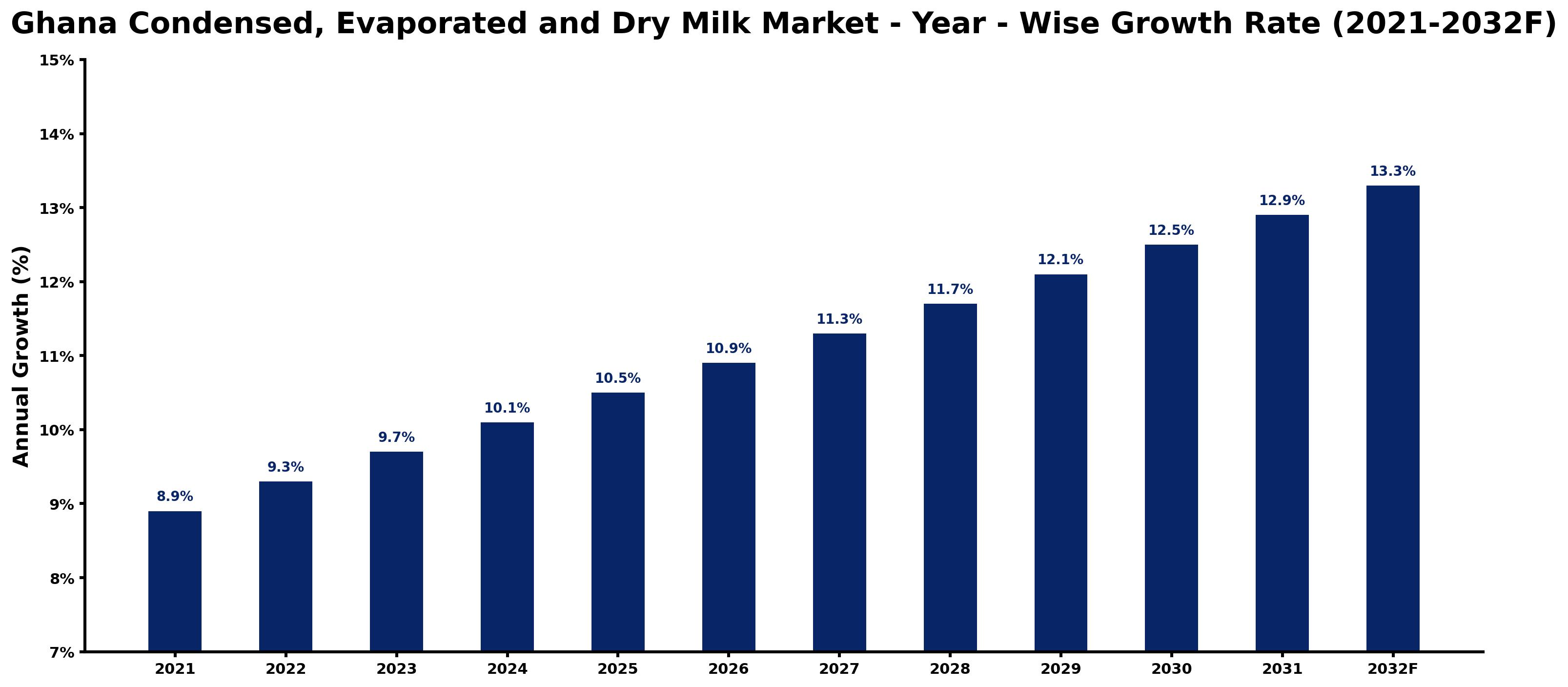
The table below presents the year wise growth rates along with the key drivers influencing the market
| Year | Growth Rate | Major Drivers |
| 2021 | 8.9% | Consumer preferences shifted towards convenience foods, boosting milk product consumption significantly. |
| 2022 | 9.3% | Local dairy farms improved production efficiencies, enhancing quality and reducing costs for consumers. |
| 2023 | 9.7% | Urbanization trends accelerated demand for packaged milk products among city dwellers. |
| 2024 | 10.1% | Health-conscious consumers increasingly favor fortified milk options for nutritional benefits. |
| 2025 | 10.5% | Innovative marketing campaigns successfully targeted youth demographics, expanding market reach. |
| 2026 | 10.9% | E-commerce platforms gained traction, enabling easier access to milk products for households. |
| 2027 | 11.3% | Rising middle-class income levels increased spending on premium milk products significantly. |
| 2028 | 11.7% | Local processing units emerged, reducing supply chain costs and enhancing freshness perception. |
| 2029 | 12.1% | Growing awareness of lactose intolerance led to increased demand for lactose-free options. |
| 2030 | 12.5% | Sustainability initiatives encouraged environmentally friendly practices in dairy farming and production. |
| 2031 | 12.9% | Technological advancements in food preservation extended shelf life of milk products effectively. |
| 2032 | 13.3% | Collaborations between dairy producers and retailers enhanced product visibility and availability. |
Note - Market size estimations and growth projections presented in this report are based on 6Wresearch's advanced forecasting approach, validated with industry datasets as of June 2026.
Ghana Condensed, Evaporated and Dry Milk Market Synopsis
The Ghana Condensed, Evaporated and Dry Milk Market is projected to reach 10.9% and witness significant growth during the forecast period (2026-2032). The anticipated growth rate of the market is supported by various economic and social factors that are reshaping consumer behaviors and preferences. Key drivers include the increasing disposable income of households, the urbanization trend leading to higher demand for convenience food products, and evolving dietary habits among consumers. Furthermore, strategic government initiatives aimed at enhancing dairy farming practices are expected to propel market expansion.
Ghana Condensed, Evaporated and Dry Milk Market Growth Drivers
The growth of the Ghana Condensed, Evaporated and Dry Milk Market is primarily influenced by a variety of interconnected factors that point towards a thriving market landscape. Firstly, the rise in disposable income enables consumers to explore a broader range of food products, including premium dairy items. Secondly, the rapid urbanization in Ghana has contributed to changing lifestyles, where convenience foods are increasingly favored by busy urban dwellers.
- Urban consumers exhibit a growing preference for easy-to-prepare meals, driving demand for condensed and evaporated milk as essential ingredients.
- The health-conscious segment of the population is also seeking nutritious milk options, creating a surge in interest in dry milk products.
- Increased distribution channels, including modern retail formats, are making these dairy products more accessible to consumers across various regions.
- Moreover, marketing campaigns highlighting the nutritional benefits of milk are effectively educating consumers and influencing purchasing decisions.
- The overall enhancement of agricultural policies directed at dairy farming is ensuring higher quality and quantity of milk production, further boosting the market.
Ghana Condensed, Evaporated and Dry Milk Market Challenges and Restraints
Despite the promising growth trajectory, the Ghana Condensed, Evaporated and Dry Milk Market does face certain challenges that could impede its progress. One significant issue is the fluctuation in raw milk prices, which impacts production costs for condensed and evaporated milk. Additionally, competition from imported dairy products poses a threat to local manufacturers, potentially affecting market share.
- Quality control remains a concern, as not all dairy products meet the safety and nutritional standards required by consumers.
- Limited infrastructure for cold storage and distribution in some regions can hinder market growth by affecting product availability.
- The prevalence of alternative milk products, such as plant-based options, is reshaping consumer preferences, which may divert attention from traditional dairy offerings.
- Consumers are also becoming increasingly price-sensitive, which could pressure manufacturers to lower prices, adversely affecting profit margins.
- Lastly, the lack of awareness in rural areas regarding the benefits of condensed and evaporated milk hampers potential market expansion.
Ghana Condensed, Evaporated and Dry Milk Market Trends and Opportunities
As the Ghana Condensed, Evaporated and Dry Milk Market continues to evolve, several trends and opportunities are emerging that could shape its future landscape. The trend toward healthier eating is prompting manufacturers to innovate by introducing low-fat and fortified versions of milk products to cater to health-conscious consumers.
- Increased focus on sustainable dairy farming practices is attracting consumer attention, promoting products that align with environmental values.
- Digital marketing strategies are being leveraged to engage younger consumers, thereby expanding the market reach.
- Collaboration with local farmers by manufacturers is fostering production quality and transparency, enhancing brand loyalty.
- The growth of e-commerce platforms is providing new avenues for distribution, enabling consumers to purchase products conveniently.
- Research and development are paving the way for the introduction of specialized dairy products, including lactose-free options and flavored milk, thereby broadening the consumer base.
Ghana Condensed, Evaporated and Dry Milk Market Government Investment and Initiatives
The Ghanaian government has recognized the importance of strengthening its dairy sector and is committed to various initiatives aimed at supporting the growth of the condensed, evaporated, and dry milk market. Policies promoting vocational training in dairy farming are being implemented to enhance the skillset of farmers and improve product quality.
- Investments in agricultural research institutions are being prioritized to develop better dairy farming practices and breed improved livestock.
- The government is also establishing cooperatives that facilitate access to resources, ensuring smallholder farmers can participate in the dairy market.
- There are initiatives aimed at providing financial support and subsidies to farmers, which foster greater production capabilities and investment in technology.
- Regulatory frameworks are being put in place to ensure the enforcement of quality standards in dairy products, enhancing consumer trust.
- Public awareness campaigns are being launched to educate consumers on the nutritional benefits of dairy, aiming to stimulate local demand.
Ghana Condensed, Evaporated and Dry Milk Market Latest Developments (May 2025 - June 2026)
In the period from May 2025 to June 2026, the Ghana Condensed, Evaporated and Dry Milk Market experienced notable developments that reflect its dynamic nature. There has been a marked increase in consumer interest and demand for premium and specialized dairy products, prompting manufacturers to expand their product lines.
- The introduction of online sales channels has gained traction, enabling consumers to access a wider array of milk products conveniently from home.
- In response to changing dietary preferences, the market has seen a rise in lactose-free and organic milk offerings catering to health-conscious segments.
- Collaborations between manufacturers and local farmers have intensified, focusing on sustainable sourcing practices and enhancing product transparency.
- Government policies promoting agricultural investment have begun to show positive results, with increased production levels reported across various regions.
- Marketing campaigns targeting urban consumers are becoming more sophisticated, utilizing digital platforms to reach a broader audience.
Ghana Condensed, Evaporated and Dry Milk Market - Key Attractiveness of the Report
- 10 Years of Market Numbers
- Historical Data Starting from 2022 to 2025
- Base Year: 2025
- Forecast Data until 2032
- Key Performance Indicators Impacting the Market
- Major Upcoming Developments and Projects
Key Highlights of the Report:
- Ghana Condensed, Evaporated and Dry Milk Market Outlook
- Market Size of Ghana Condensed, Evaporated and Dry Milk Market, 2025
- Forecast of Ghana Condensed, Evaporated and Dry Milk Market, 2032F
- Historical Data and Forecast of Ghana Condensed, Evaporated and Dry Milk Revenues & Volume for the Period 2022-2032F
- Ghana Condensed, Evaporated and Dry Milk Market Trend Evolution
- Ghana Condensed, Evaporated and Dry Milk Market Drivers and Challenges
- Ghana Condensed, Evaporated and Dry Milk Price Trends
- Ghana Condensed, Evaporated and Dry Milk Porter's Five Forces
- Ghana Condensed, Evaporated and Dry Milk Industry Life Cycle
- Historical Data and Forecast of Ghana Condensed, Evaporated and Dry Milk Market Revenues & Volume By Product Type for the Period 2022-2032F
- Historical Data and Forecast of Ghana Condensed, Evaporated and Dry Milk Market Revenues & Volume By Dry Milk Product for the Period 2022-2032F
- Historical Data and Forecast of Ghana Condensed, Evaporated and Dry Milk Market Revenues & Volume By Condensed Milk Product for the Period 2022-2032F
- Historical Data and Forecast of Ghana Condensed, Evaporated and Dry Milk Market Revenues & Volume By Evaporated Milk Product for the Period 2022-2032F
- Historical Data and Forecast of Ghana Condensed, Evaporated and Dry Milk Market Revenues & Volume By Applications for the Period 2022-2032F
- Historical Data and Forecast of Ghana Condensed, Evaporated and Dry Milk Market Revenues & Volume By Food for the Period 2022-2032F
- Historical Data and Forecast of Ghana Condensed, Evaporated and Dry Milk Market Revenues & Volume By Beverages for the Period 2022-2032F
- Historical Data and Forecast of Ghana Condensed, Evaporated and Dry Milk Market Revenues & Volume By Intermediate Products for the Period 2022-2032F
- Historical Data and Forecast of Ghana Condensed, Evaporated and Dry Milk Market Revenues & Volume By Condiments for the Period 2022-2032F
- Historical Data and Forecast of Ghana Condensed, Evaporated and Dry Milk Market Revenues & Volume By Other for the Period 2022-2032F
- Ghana Condensed, Evaporated and Dry Milk Import Export Trade Statistics
- Market Opportunity Assessment By Product Type
- Market Opportunity Assessment By Applications
- Ghana Condensed, Evaporated and Dry Milk Top Companies Market Share
- Ghana Condensed, Evaporated and Dry Milk Competitive Benchmarking By Technical and Operational Parameters
- Ghana Condensed, Evaporated and Dry Milk Company Profiles
- Ghana Condensed, Evaporated and Dry Milk Key Strategic Recommendations






































