Ghana Confectionery Processing Equipment Market Size, Share & Growth Rate
The Ghana Confectionery Processing Equipment Market was estimated at USD 420 Million in 2025 and is projected to reach USD 594 Million by 2032, growing at a CAGR of 5.1% from 2026 to 2032. This growth trajectory is primarily fueled by an expanding confectionery industry that is increasingly embracing automation and technological advancements. As consumer preferences shift toward diverse and high-quality confectionery products, manufacturers are investing in modern processing equipment to enhance efficiency and meet evolving market demands.
Ghana Confectionery Processing Equipment Market Year-wise Growth Rate and Key Drivers
This graph highlights how the Ghana Confectionery Processing Equipment Market has steadily grown over the years, supported by major growth factors.
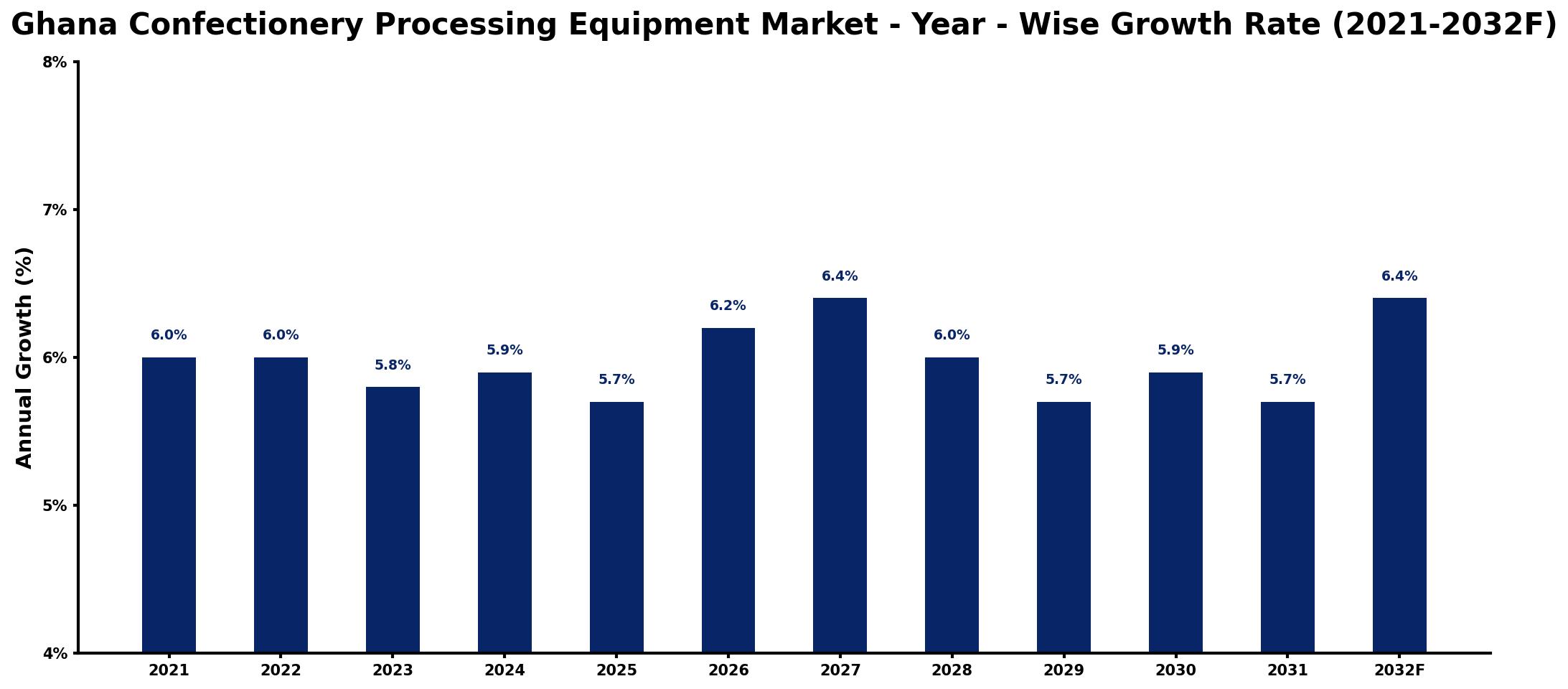
The table below presents the year‑wise growth rates along with the key drivers influencing the market
| Year | Growth Rate | Major Drivers |
| 2021 | 6.0% | Rising consumer demand for snacks |
| 2022 | 6.0% | Increased investment in food sector |
| 2023 | 5.8% | Expansion of retail distribution channels |
| 2024 | 5.9% | Growing popularity of healthy alternatives |
| 2025 | 5.7% | Emerging local brands entering market |
| 2026 | 6.2% | Technological advancements in production |
| 2027 | 6.4% | Surge in export opportunities |
| 2028 | 6.0% | Increased urbanization driving consumption |
| 2029 | 5.7% | Diverse flavor trends gaining traction |
| 2030 | 5.9% | Strengthened supply chain partnerships |
| 2031 | 5.7% | Growing focus on sustainability practices |
| 2032 | 6.4% | Rising disposable income among consumers |
Note: Market size estimations and growth projections presented in this report are based on 6Wresearch's proprietary forecasting methodology, utilizing the latest available industry data, government publications, and primary research inputs.
Ghana Confectionery Processing Equipment Market Synopsis
The strongest force currently shaping the Ghana Confectionery Processing Equipment Market is the rising demand for innovative and customized confectionery products. As consumers increasingly seek unique flavors and textures, producers are turning to advanced equipment that allows for greater flexibility in production processes.
Additionally, the ongoing growth of the food processing industry in Ghana is reinforcing the market for confectionery processing equipment. With a focus on improving production efficiency and product quality, manufacturers are adopting modern technologies, ultimately fostering a competitive environment that benefits both producers and consumers.
Ghana Confectionery Processing Equipment Market Key Takeaways
- The market is projected to grow significantly, with a CAGR of 5.1% from 2026 to 2032.
- Technological advancements are enhancing production efficiency and product quality.
- The market is characterized by a diverse range of equipment catering to both small-scale and large-scale manufacturers.
- Changing consumer preferences for innovative products are driving equipment demand.
- Government policies are likely to support modernization and skills development in the confectionery sector.
Evaluation of Restraints in Ghana Confectionery Processing Equipment Market
Despite its promising growth, the Ghana Confectionery Processing Equipment Market faces significant restraints. Limited access to advanced processing technologies poses a challenge for many local manufacturers, hindering their ability to compete on a larger scale. Furthermore, a lack of technical expertise in operating sophisticated machinery can impede production efficiency. Strict hygiene and sanitation standards in the confectionery industry also require equipment to be designed with specific regulatory compliance, potentially increasing the complexity and costs of manufacturing and maintenance.
Ghana Confectionery Processing Equipment Market Trends
Current trends in the Ghana Confectionery Processing Equipment Market include a pronounced shift towards automation and digitalization. Producers are increasingly investing in automated systems that not only streamline operations but also reduce labor costs. Additionally, sustainability is gaining traction, with equipment suppliers focusing on energy-efficient designs that align with global trends toward environmentally responsible production.
Ghana Confectionery Processing Equipment Market Opportunities
The opportunities for growth in the Ghana Confectionery Processing Equipment Market are significant. With the government likely to introduce policies that support investment in modern technologies, manufacturers can take advantage of grants or incentives aimed at enhancing productivity. Furthermore, as consumer preferences continue to evolve, there is potential for investment in niche segments such as organic or functional confectionery, providing an avenue for equipment suppliers to innovate and cater to new demand.
Government Initiatives in the Ghana Confectionery Processing Equipment Market
The government of Ghana recognizes the vital role of advanced processing equipment in boosting productivity and enhancing product quality. There are initiatives underway that aim to promote investment in modern processing technologies, including automated mixing and packaging systems. Incentives are expected for adopting energy-efficient equipment, along with regulations that ensure high hygiene and safety standards in the industry. Additionally, efforts to improve skills development in confectionery manufacturing are likely to foster a knowledgeable workforce capable of leveraging modern equipment.
Future Insights of the Ghana Confectionery Processing Equipment Market
Looking ahead to 2026-2032, the Ghana Confectionery Processing Equipment Market is poised for robust growth driven by innovation and modernization. As the confectionery industry continues to expand, manufacturers will likely invest heavily in cutting-edge technologies to enhance production efficiency and product diversity. The focus on automation will not only streamline manufacturing processes but also position Ghana as a competitive player in the global confectionery market, catering to both local and export demands.
Ghana Confectionery Processing Equipment Market Latest Developments (2025 - 2026)
Recent developments in the Ghana Confectionery Processing Equipment Market indicate a growing trend towards the adoption of advanced technologies. Several manufacturers are exploring partnerships with international suppliers to enhance their technical capabilities. Additionally, there has been an uptick in local training programs aimed at equipping operators with the necessary skills to manage sophisticated confectionery machinery, ensuring alignment with industry standards and improving overall productivity.
Ghana Confectionery Processing Equipment Market - Key Attractiveness of the Report
- 10 Years of Market Numbers
- Historical Data Starting from 2022 to 2025
- Base Year: 2025
- Forecast Data until 2032
- Key Performance Indicators Impacting the Market
- Major Upcoming Developments and Projects
Key Highlights of the Report:
- Ghana Confectionery Processing Equipment Market Outlook
- Market Size of Ghana Confectionery Processing Equipment Market, 2025
- Forecast of Ghana Confectionery Processing Equipment Market, 2032
- Historical Data and Forecast of Ghana Confectionery Processing Equipment Revenues & Volume for the Period 2022-2032F
- Ghana Confectionery Processing Equipment Market Trend Evolution
- Ghana Confectionery Processing Equipment Market Drivers and Challenges
- Ghana Confectionery Processing Equipment Price Trends
- Ghana Confectionery Processing Equipment Porter's Five Forces
- Ghana Confectionery Processing Equipment Industry Life Cycle
- Historical Data and Forecast of Ghana Confectionery Processing Equipment Market Revenues & Volume By Product for the Period 2022-2032F
- Historical Data and Forecast of Ghana Confectionery Processing Equipment Market Revenues & Volume By Soft Confectionery for the Period 2022-2032F
- Historical Data and Forecast of Ghana Confectionery Processing Equipment Market Revenues & Volume By Hard Candies for the Period 2022-2032F
- Historical Data and Forecast of Ghana Confectionery Processing Equipment Market Revenues & Volume By Chewing Gums for the Period 2022-2032F
- Historical Data and Forecast of Ghana Confectionery Processing Equipment Market Revenues & Volume By Gummies & Jellies for the Period 2022-2032F
- Historical Data and Forecast of Ghana Confectionery Processing Equipment Market Revenues & Volume By Others for the Period 2022-2032F
- Historical Data and Forecast of Ghana Confectionery Processing Equipment Market Revenues & Volume By Type for the Period 2022-2032F
- Historical Data and Forecast of Ghana Confectionery Processing Equipment Market Revenues & Volume By Thermal for the Period 2022-2032F
- Historical Data and Forecast of Ghana Confectionery Processing Equipment Market Revenues & Volume By Mixers for the Period 2022-2032F
- Historical Data and Forecast of Ghana Confectionery Processing Equipment Market Revenues & Volume By Blenders And Cutters for the Period 2022-2032F
- Historical Data and Forecast of Ghana Confectionery Processing Equipment Market Revenues & Volume By Extrusion for the Period 2022-2032F
- Historical Data and Forecast of Ghana Confectionery Processing Equipment Market Revenues & Volume By Cooling for the Period 2022-2032F
- Historical Data and Forecast of Ghana Confectionery Processing Equipment Market Revenues & Volume By Coating for the Period 2022-2032F
- Historical Data and Forecast of Ghana Confectionery Processing Equipment Market Revenues & Volume By Others for the Period 2022-2032F
- Historical Data and Forecast of Ghana Confectionery Processing Equipment Market Revenues & Volume By Mode Of Operation for the Period 2022-2032F
- Historical Data and Forecast of Ghana Confectionery Processing Equipment Market Revenues & Volume By Automatic for the Period 2022-2032F
- Historical Data and Forecast of Ghana Confectionery Processing Equipment Market Revenues & Volume By Semi-automatic for the Period 2022-2032F
- Ghana Confectionery Processing Equipment Import Export Trade Statistics
- Market Opportunity Assessment By Product
- Market Opportunity Assessment By Type
- Market Opportunity Assessment By Mode Of Operation
- Ghana Confectionery Processing Equipment Top Companies Market Share
- Ghana Confectionery Processing Equipment Competitive Benchmarking By Technical and Operational Parameters
- Ghana Confectionery Processing Equipment Company Profiles
- Ghana Confectionery Processing Equipment Key Strategic Recommendations






































