Ghana Construction and Mining Equipment Market Size, Share & Growth Rate
The Ghana Construction and Mining Equipment Market was estimated at USD 210 Million in 2025 and is projected to reach USD 295 Million by 2032, growing at a CAGR of 5.0% from 2026 to 2032. This promising trajectory is primarily driven by substantial investments in infrastructure development, fueled by urbanization trends and ongoing mineral extraction initiatives. As the country continues to modernize its construction practices and extract natural resources efficiently, demand for advanced machinery will undoubtedly rise.
Ghana Construction and Mining Equipment Market Year-wise Growth Rate and Key Drivers
This graph highlights how the Ghana Construction and Mining Equipment Market has steadily grown over the years, supported by major growth factors.
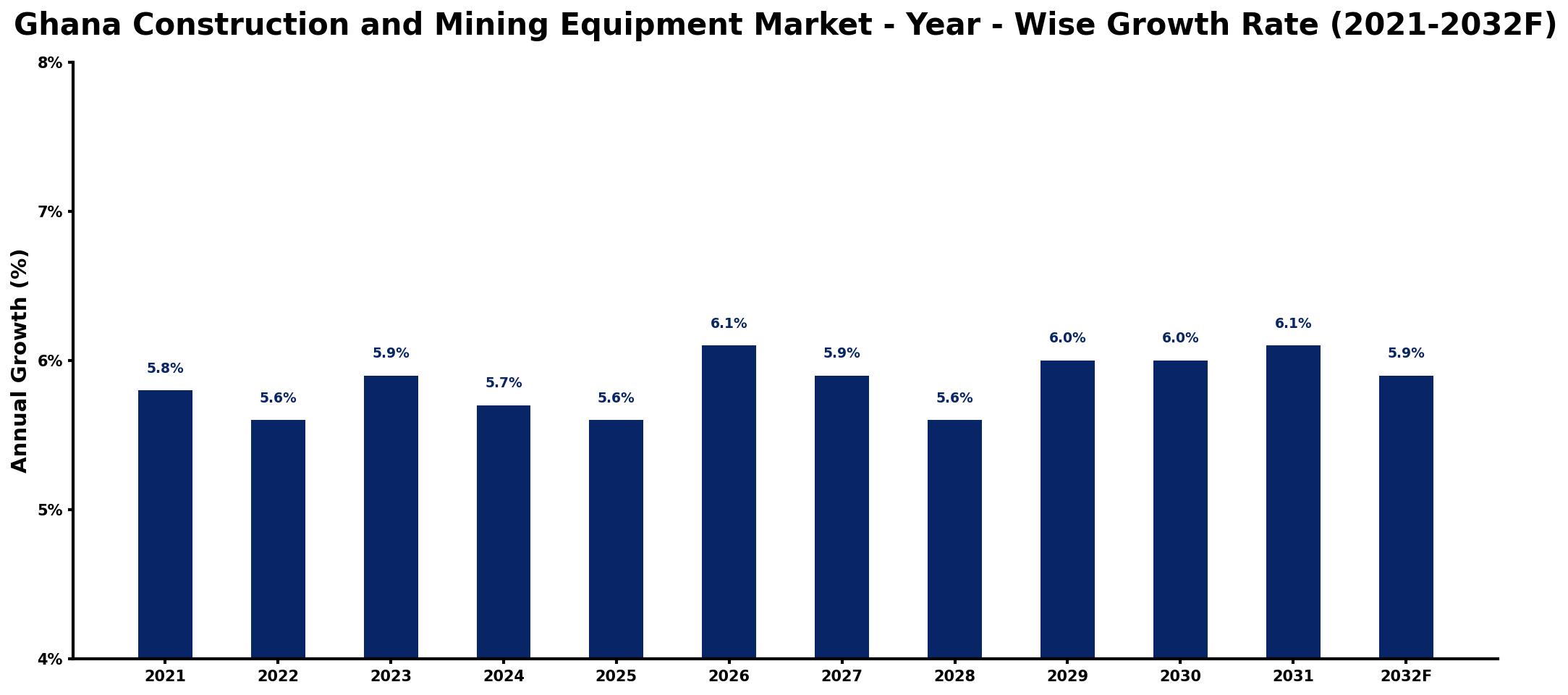
The table below presents the year‑wise growth rates along with the key drivers influencing the market
| Year | Growth Rate | Major Drivers |
| 2021 | 5.8% | Infrastructure investments drive market demand |
| 2022 | 5.6% | Growing urbanization increases requirements |
| 2023 | 5.9% | Government projects enhance sector growth |
| 2024 | 5.7% | Expansion in renewable energy projects |
| 2025 | 5.6% | Rising private sector investments boost |
| 2026 | 6.1% | Technological advancements improve efficiency |
| 2027 | 5.9% | Increased foreign direct investments observed |
| 2028 | 5.6% | Sustainable practices gaining popularity |
| 2029 | 6.0% | Public-private partnerships stimulate growth |
| 2030 | 6.0% | Demand from residential development rises |
| 2031 | 6.1% | Emerging markets create new opportunities |
| 2032 | 5.9% | Regulatory support fosters industry expansion |
Note: Market size estimations and growth projections presented in this report are based on 6Wresearch's proprietary forecasting methodology, utilizing the latest available industry data, government publications, and primary research inputs.
Ghana Construction and Mining Equipment Market Synopsis
The current surge in infrastructure development represents the most significant force shaping the Ghana Construction and Mining Equipment Market. With numerous government projects and private sector investments underway, construction companies are increasingly seeking advanced and reliable equipment to enhance their operational efficiency.
Alongside infrastructure projects, the mining sector also plays a pivotal role in driving market dynamics. The extraction of various minerals remains a key economic driver in Ghana, necessitating the deployment of specialized equipment to ensure safety, productivity, and sustainability in operations.
Ghana Construction and Mining Equipment Market Key Takeaways
- Infrastructure investments are a primary growth catalyst in the Ghana Construction and Mining Equipment Market.
- Urbanization trends are rapidly increasing demand for advanced construction machinery.
- Reliable financing and maintenance services are crucial for the sustained efficiency of equipment utilization.
- Government initiatives may bolster investments in technology and skills development for the industry.
- Emerging trends in equipment technology are influencing operational standards in construction and mining.
Evaluation of Restraints in Ghana Construction and Mining Equipment Market
Despite its robust growth, the Ghana Construction and Mining Equipment Market faces significant restraints, primarily due to limited access to financing options for potential buyers. This financial barrier can inhibit both the procurement of new machinery and the ability to maintain existing equipment effectively. Furthermore, skills shortages in equipment operation and maintenance can lead to inefficiencies and reduced productivity, thereby affecting overall market performance.
Ghana Construction and Mining Equipment Market Trends
The market is witnessing a shift toward advanced technologies, including automation and telematics, which enhance equipment performance and operational safety. Additionally, eco-friendly and energy-efficient machinery is gaining traction as stakeholders increasingly focus on sustainability and environmental compliance. Furthermore, the rise of rental services is reshaping equipment access, allowing companies to optimize costs while leveraging high-performance machinery as needed.
Ghana Construction and Mining Equipment Market Opportunities
Genuine growth opportunities lie in the expansion of rental and leasing services, which present a cost-effective solution for construction firms hesitant to make large capital expenditures. Furthermore, investment in local manufacturing capabilities could enhance market competitiveness and reduce dependency on imports. Training programs aimed at skill development can also create a well-qualified workforce, aligning with the increasing demand for sophisticated machinery.
Government Initiatives in the Ghana Construction and Mining Equipment Market
The Ghanaian government recognizes the importance of a robust construction and mining equipment sector for national development. Policies aimed at promoting investment in local manufacturing, coupled with incentives for equipment rental and leasing, are being considered. Furthermore, initiatives focused on improving standards and regulations regarding equipment safety, emissions, and efficiency are crucial for ensuring sustainable industry growth.
Future Insights of the Ghana Construction and Mining Equipment Market
Looking ahead to 2026-2032, the Ghana Construction and Mining Equipment Market is poised for significant transformation. As urbanization accelerates and infrastructure needs intensify, demand for advanced machinery will continue to rise. Technological innovations, particularly in automation and green technologies, will likely define future market dynamics, enabling enhanced productivity and operational efficiency across the industry.
Ghana Construction and Mining Equipment Market Latest Developments (2025 - 2026)
Recent developments in the Ghana Construction and Mining Equipment Market indicate a strong focus on technological advancements. Industry stakeholders are increasingly investing in telematics and smart machinery to improve operational efficiency. Additionally, initiatives aimed at enhancing skill sets among workers are gaining momentum, as companies strive to adapt to rapidly evolving equipment technologies and operational demands.
Ghana Construction and Mining Equipment Market - Key Attractiveness of the Report
- 10 Years of Market Numbers
- Historical Data Starting from 2022 to 2025
- Base Year: 2025
- Forecast Data until 2032
- Key Performance Indicators Impacting the Market
- Major Upcoming Developments and Projects
Key Highlights of the Report:
- Ghana Construction and Mining Equipment Market Outlook
- Market Size of Ghana Construction and Mining Equipment Market, 2025
- Forecast of Ghana Construction and Mining Equipment Market, 2032
- Historical Data and Forecast of Ghana Construction and Mining Equipment Revenues & Volume for the Period 2022-2032F
- Ghana Construction and Mining Equipment Market Trend Evolution
- Ghana Construction and Mining Equipment Market Drivers and Challenges
- Ghana Construction and Mining Equipment Price Trends
- Ghana Construction and Mining Equipment Porter's Five Forces
- Ghana Construction and Mining Equipment Industry Life Cycle
- Historical Data and Forecast of Ghana Construction and Mining Equipment Market Revenues & Volume By Product Type for the Period 2022-2032F
- Historical Data and Forecast of Ghana Construction and Mining Equipment Market Revenues & Volume By Loaders for the Period 2022-2032F
- Historical Data and Forecast of Ghana Construction and Mining Equipment Market Revenues & Volume By Dozers for the Period 2022-2032F
- Historical Data and Forecast of Ghana Construction and Mining Equipment Market Revenues & Volume By Excavators for the Period 2022-2032F
- Historical Data and Forecast of Ghana Construction and Mining Equipment Market Revenues & Volume By Crushing for the Period 2022-2032F
- Historical Data and Forecast of Ghana Construction and Mining Equipment Market Revenues & Volume By Pulverizing & Screening Equipment for the Period 2022-2032F
- Historical Data and Forecast of Ghana Construction and Mining Equipment Market Revenues & Volume By Others for the Period 2022-2032F
- Historical Data and Forecast of Ghana Construction and Mining Equipment Market Revenues & Volume By Application for the Period 2022-2032F
- Historical Data and Forecast of Ghana Construction and Mining Equipment Market Revenues & Volume By Infrastructure for the Period 2022-2032F
- Historical Data and Forecast of Ghana Construction and Mining Equipment Market Revenues & Volume By Mineral Mining for the Period 2022-2032F
- Historical Data and Forecast of Ghana Construction and Mining Equipment Market Revenues & Volume By Residential Building for the Period 2022-2032F
- Historical Data and Forecast of Ghana Construction and Mining Equipment Market Revenues & Volume By Metal Mining for the Period 2022-2032F
- Historical Data and Forecast of Ghana Construction and Mining Equipment Market Revenues & Volume By Others for the Period 2022-2032F
- Ghana Construction and Mining Equipment Import Export Trade Statistics
- Market Opportunity Assessment By Product Type
- Market Opportunity Assessment By Application
- Ghana Construction and Mining Equipment Top Companies Market Share
- Ghana Construction and Mining Equipment Competitive Benchmarking By Technical and Operational Parameters
- Ghana Construction and Mining Equipment Company Profiles
- Ghana Construction and Mining Equipment Key Strategic Recommendations






































