Ghana Crystal Lighting Market Summary
The ghana crystal lighting market was estimated at USD 720 Million in 2025 and is projected to reach USD 1043 Million by 2032, growing at a CAGR of 6.1% from 2026 to 2032.
Ghana Crystal Lighting Market Year-wise Growth Rate and Key Drivers
This graph highlights how the Ghana Crystal Lighting Market has steadily grown over the past five years, supported by major growth factors.
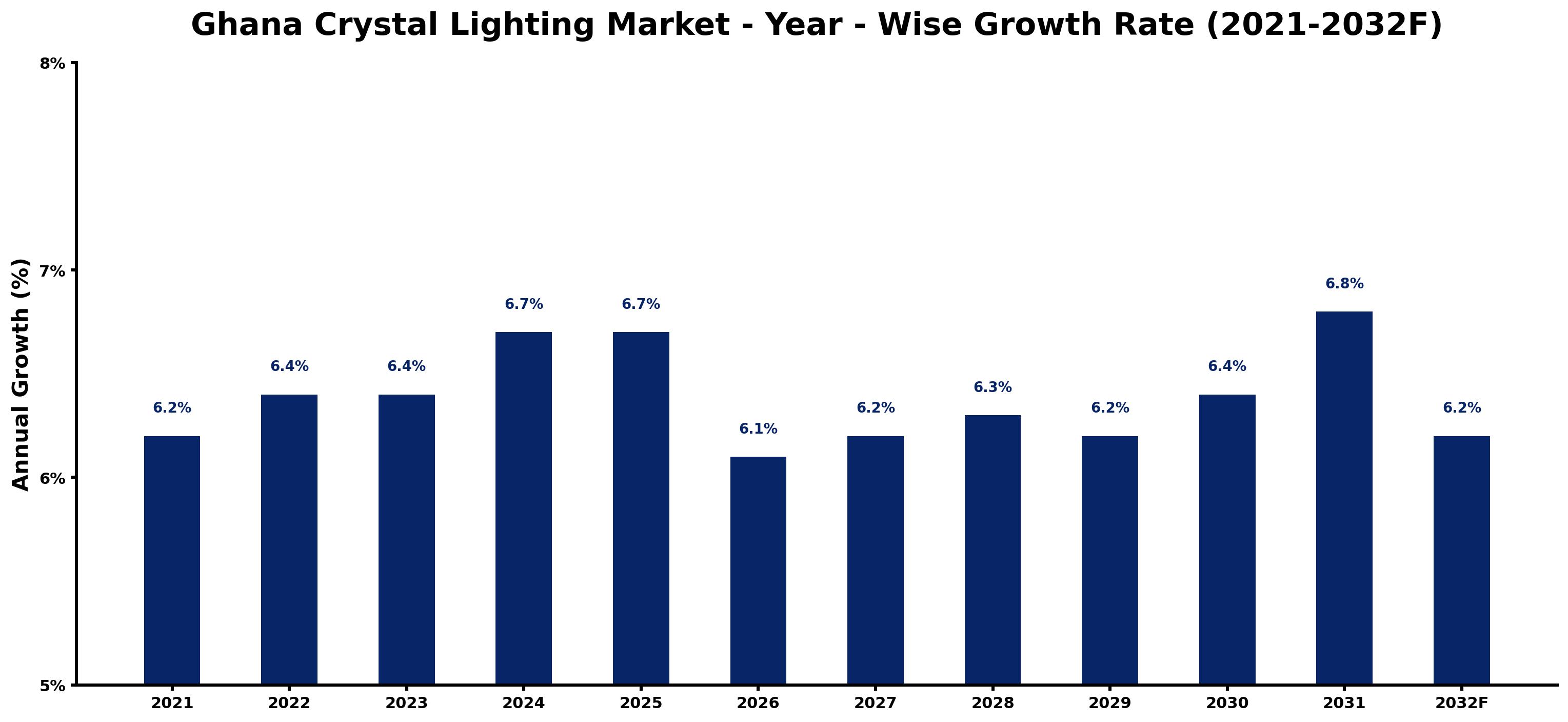
The table below presents the year wise growth rates along with the key drivers influencing the market
| Year | Growth Rate | Major Drivers |
| 2021 | 6.2% | Consumer preferences shifted towards energy-efficient lighting solutions in Ghana's urban centers. |
| 2022 | 6.4% | Local manufacturers began producing affordable crystal lighting options catering to emerging middle-class consumers. |
| 2023 | 6.4% | Tourism recovery prompted hospitality sectors to enhance ambiance with luxury lighting installations. |
| 2024 | 6.7% | New residential developments in major cities increased demand for stylish and functional lighting. |
| 2025 | 6.7% | Public awareness campaigns highlighted the benefits of sustainable lighting solutions for households. |
| 2026 | 6.1% | E-commerce platforms facilitated easier access to a wider range of crystal lighting products. |
| 2027 | 6.2% | Architectural trends emphasized the integration of modern lighting in both commercial and residential designs. |
| 2028 | 6.3% | Investments in renewable energy sources improved the reliability of grid power for lighting applications. |
| 2029 | 6.2% | Social media influencers showcased crystal lighting, expanding market reach among younger consumers. |
| 2030 | 6.4% | Economic stability encouraged a surge in luxury home decor spending, including premium lighting. |
| 2031 | 6.8% | Partnerships between local artisans and retailers cultivated unique, handcrafted crystal lighting collections. |
| 2032 | 6.2% | Technological innovations enabled smart lighting solutions, attracting tech-savvy consumers in urban areas. |
Note - Market size estimations and growth projections presented in this report are based on 6Wresearch's advanced forecasting approach, validated with industry datasets as of June 2026.
Ghana Crystal Lighting Market Synopsis
The Ghana Crystal Lighting Market is projected to reach 6.1% and witness significant growth during the forecast period (2026-2032). This growth trajectory is driven by several key factors that are reshaping the lighting landscape in Ghana. The increasing demand for modern and decorative lighting solutions plays a crucial role, as both residential and commercial sectors seek to enhance aesthetic values through innovative designs. Additionally, the expansion of the hospitality sector is stimulating demand for premium lighting installations, as hotels and restaurants aim to create inviting atmospheres.
Furthermore, rising disposable income levels among the population are enabling consumers to invest in higher-quality lighting products. With urbanization on the rise, urban centers are experiencing a shift toward contemporary lighting technologies that complement modern architecture. As consumers become more environmentally conscious, the trend towards energy-efficient lighting solutions, particularly LED technology, is expected to further elevate the Ghana Crystal Lighting Market during the forecast period.
Ghana Crystal Lighting Market Growth Drivers
The growth of the Ghana Crystal Lighting Market is supported by various drivers that collectively enhance market potential. The following factors play a central role:
- Increasing Demand for Aesthetic Lighting: With a growing emphasis on interior design across a range of sectors, the demand for stylish and decorative crystal lighting fixtures is on the rise. Consumers are increasingly aware of the impact that lighting has on the overall ambiance of spaces.
- Expansion of the Hospitality Sector: The rapid development within Ghana's hospitality industry is a significant contributor to market growth. Hotels and dining establishments are increasingly investing in sophisticated lighting solutions to enhance customer experiences.
- Rising Urbanization: Urban migration is a trend that continues to shape the demand for advanced lighting systems. As more people move to cities, there is an accompanying rise in the need for modern living spaces equipped with contemporary lighting.
- Heightened Disposable Income: As economic conditions improve and disposable income levels rise, consumers are more willing to invest in high-quality lighting products that offer both functionality and style.
- Adoption of Energy-Efficient Solutions: The shift towards sustainability in the lighting sector is driving the adoption of energy-efficient technologies. Government incentives and public awareness campaigns are promoting the use of LED lighting, which is increasingly favored by consumers.
Ghana Crystal Lighting Market Trends and Opportunities
The Ghana Crystal Lighting Market is characterized by notable trends that present several opportunities for growth. As consumer preferences evolve, manufacturers are adapting their product lines to cater to changing demands. The following trends are particularly relevant:
- Emergence of Smart Lighting Solutions: The integration of smart technology into lighting fixtures is becoming increasingly popular. Consumers are showing a preference for lighting systems that can be controlled via mobile applications or smart home devices.
- Focus on Customization: Growing awareness of personal branding and style is leading to an increased demand for customized lighting solutions that cater to specific consumer tastes and preferences.
- Sustainability in Product Development: As consumers become more environmentally aware, there is a rising demand for products made from sustainable materials, prompting manufacturers to innovate accordingly.
- Integration of Multi-Functional Lighting: Consumers are gravitating towards lighting designs that serve multiple purposes, combining aesthetics with functionality, such as fixtures that can be adjusted for different moods and settings.
- Increased Online Sales Channels: The growth of e-commerce is providing new avenues for consumers to explore and purchase crystal lighting products, making it essential for manufacturers to enhance their online presence.
Ghana Crystal Lighting Market Government Investment and Initiatives
Government policies and initiatives play a pivotal role in shaping the Ghana Crystal Lighting Market. The Ghanaian government has been proactive in promoting energy efficiency and sustainability within the lighting sector. This is evidenced by initiatives aimed at facilitating the adoption of energy-efficient lighting technologies, including potential subsidies for LED lighting installations.
Additionally, public spending on infrastructure development has led to significant investments in urban lighting projects that incorporate modern crystal lighting solutions. The government's commitment to enhancing public spaces through innovative lighting reflects a broader vision for urban regeneration, making significant contributions to the overall growth of the market.
Ghana Crystal Lighting Market Latest Developments (May 2025 - June 2026)
Recent developments within the Ghana Crystal Lighting Market from May 2025 to June 2026 indicate a robust direction towards modernization and technological integration. The industry is witnessing an acceleration in the adoption of smart lighting solutions, with a growing number of products incorporating advanced technology for convenience and efficiency.
Moreover, an increasing number of strategic partnerships between local manufacturers and international distributors are emerging, aimed at enhancing product offerings and expanding market reach. These collaborations are expected to not only improve the availability of crystalline lighting products but also stimulate innovation within the sector.
In addition, public awareness campaigns highlighting the benefits of energy-efficient lighting are gaining momentum. These initiatives are fostering a shift in consumer behavior towards sustainable lighting solutions, thereby aligning with global trends focusing on environmental responsibility.
Ghana Crystal Lighting Market - Key Attractiveness of the Report
- 10 Years of Market Numbers
- Historical Data Starting from 2022 to 2025
- Base Year: 2025
- Forecast Data until 2032
- Key Performance Indicators Impacting the Market
- Major Upcoming Developments and Projects
Key Highlights of the Report:
- Ghana Crystal Lighting Market Outlook
- Market Size of Ghana Crystal Lighting Market, 2025
- Forecast of Ghana Crystal Lighting Market, 2032F
- Historical Data and Forecast of Ghana Crystal Lighting Revenues & Volume for the Period 2022-2032F
- Ghana Crystal Lighting Market Trend Evolution
- Ghana Crystal Lighting Market Drivers and Challenges
- Ghana Crystal Lighting Price Trends
- Ghana Crystal Lighting Porter's Five Forces
- Ghana Crystal Lighting Industry Life Cycle
- Historical Data and Forecast of Ghana Crystal Lighting Market Revenues & Volume By Product Type for the Period 2022-2032F
- Historical Data and Forecast of Ghana Crystal Lighting Market Revenues & Volume By Ceiling Crystal Lights for the Period 2022-2032F
- Historical Data and Forecast of Ghana Crystal Lighting Market Revenues & Volume By Crystal Chandeliers for the Period 2022-2032F
- Historical Data and Forecast of Ghana Crystal Lighting Market Revenues & Volume By Others for the Period 2022-2032F
- Historical Data and Forecast of Ghana Crystal Lighting Market Revenues & Volume By Applications for the Period 2022-2032F
- Historical Data and Forecast of Ghana Crystal Lighting Market Revenues & Volume By Commercial for the Period 2022-2032F
- Historical Data and Forecast of Ghana Crystal Lighting Market Revenues & Volume By Designer for the Period 2022-2032F
- Historical Data and Forecast of Ghana Crystal Lighting Market Revenues & Volume By Superior Residential for the Period 2022-2032F
- Ghana Crystal Lighting Import Export Trade Statistics
- Market Opportunity Assessment By Product Type
- Market Opportunity Assessment By Applications
- Ghana Crystal Lighting Top Companies Market Share
- Ghana Crystal Lighting Competitive Benchmarking By Technical and Operational Parameters
- Ghana Crystal Lighting Company Profiles
- Ghana Crystal Lighting Key Strategic Recommendations






































