Ghana Data Classification Market Size & Growth Rate (2026-2032)
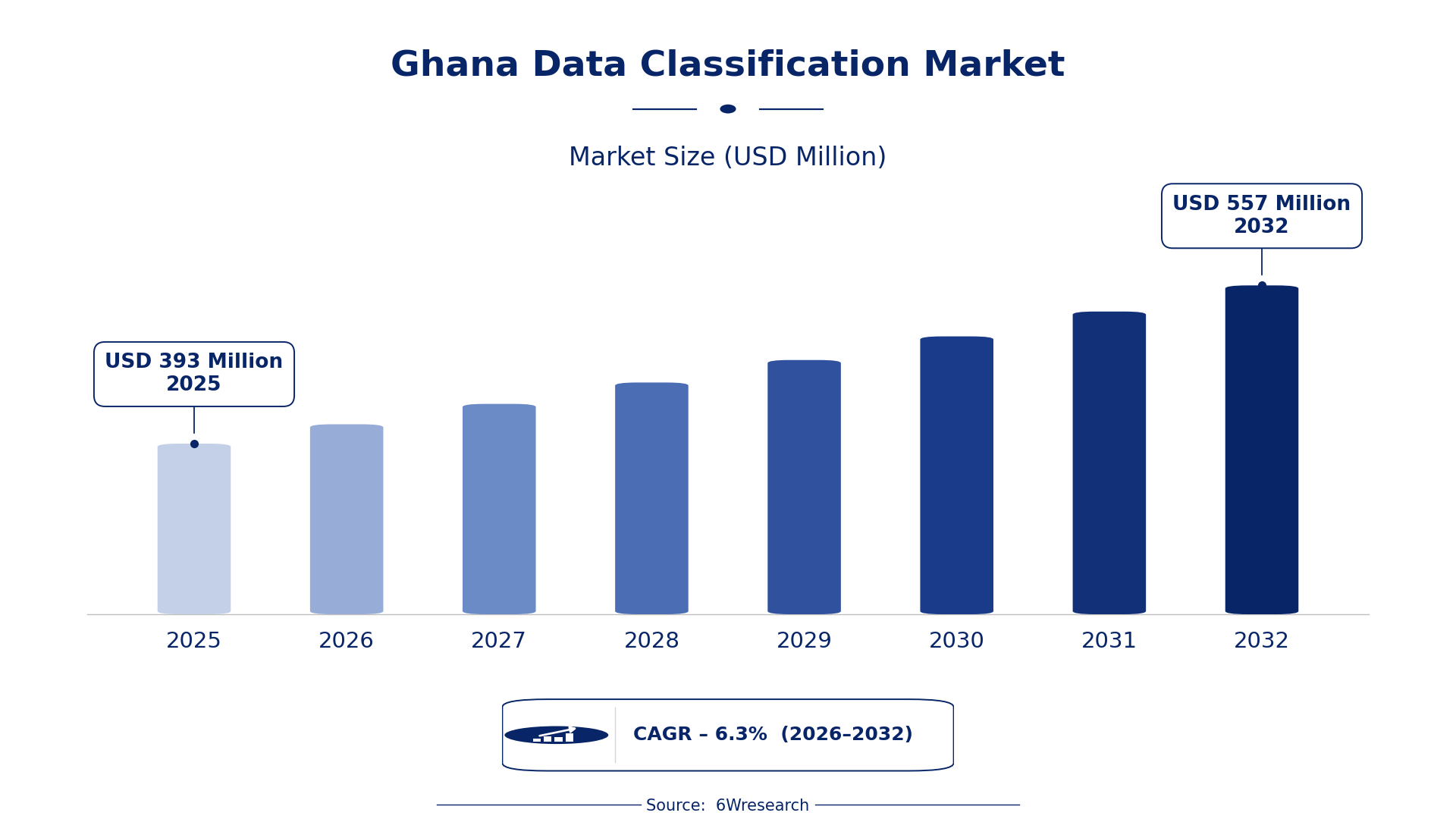
The Ghana Data Classification Market was estimated at USD 393 Million in 2025 and is projected to reach USD 557 Million by 2032, growing at a CAGR of 6.3% from 2026 to 2032.
Ghana Data Classification Market Synopsis
A surge in data governance requirements is currently the most influential factor shaping the Ghana Data Classification Market. Organizations across various sectors are increasingly prioritizing effective data management to comply with local regulations and global standards.
As data assets continue to grow in volume and complexity, companies recognize the necessity for automated classification solutions. These tools enhance security and compliance by categorizing data according to sensitivity and importance, effectively mitigating associated risks.
Ghana Data Classification Market Year-wise Growth Rate and Key Drivers
This graph illustrates the annual growth rates of the Ghana Data Classification Market from 2021 to 2032, highlighting a steady upward trajectory and projected expansion over the forecast period.
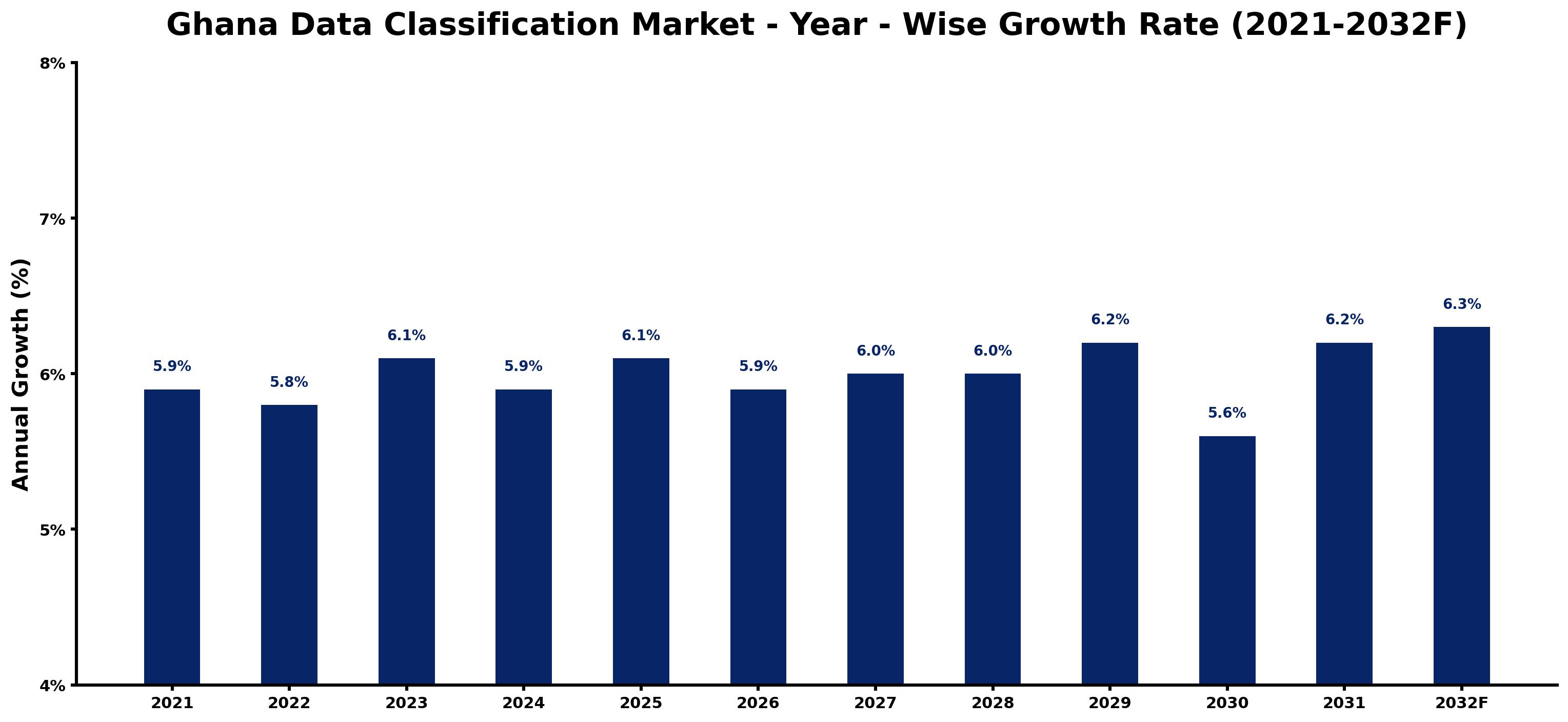
The table below presents the year‑wise growth rates along with the key drivers influencing the market
| Year | Growth Rate | Major Drivers |
| 2021 | 5.9% | Implementation of Ghana's Data Protection Act gains traction. |
| 2022 | 5.8% | Increased foreign investment in Ghana's tech sector drives demand. |
| 2023 | 6.1% | Growth of local startups requiring robust data governance. |
| 2024 | 5.9% | Emerging AI applications demand enhanced data classification. |
| 2025 | 6.1% | Rising consumer awareness about data privacy encourages investments. |
| 2026 | 5.9% | Local universities increasing data management program enrollments. |
| 2027 | 6.0% | Healthcare sector digitization requires better patient data handling. |
| 2028 | 6.0% | Government push for e-governance sparks data regulation needs. |
| 2029 | 6.2% | Corporate mandates for data compliance spur industry growth. |
| 2030 | 5.6% | Non-profits advocating for data ethics gain local prominence. |
| 2031 | 6.2% | Tech-savvy youth demographic driving digital data initiatives. |
| 2032 | 6.3% | Partnerships between tech firms and universities strengthen data careers. |
Note: Market size estimations and growth projections presented in this report are based on 6Wresearch's proprietary forecasting methodology, utilizing the latest available industry data, government publications, and primary research inputs.
Ghana Data Classification Market Key Takeaways
Below are some of the specific key takeaways from the market, including:
- The demand for automated classification tools is rising rapidly due to increased data complexity.
- Regulatory compliance is a critical driver for organizations seeking data classification solutions.
- Investment in training programs for workforce capacity building in data management is underway.
- Government initiatives aim to foster collaboration between industry and public sector stakeholders.
- Companies are focusing on enhancing data visibility and control to manage risks effectively.
Evaluation of Restraints in Ghana Data Classification Market
Despite positive growth, several factors limit the Ghana Data Classification Market's potential. Key among these are the challenges surrounding data governance policies. Organizations often struggle with accurately enforcing classification policies, leading to inconsistencies in data management practices. Additionally, the reliance on automation for data discovery can sometimes compromise the accuracy needed for regulatory compliance. Addressing these issues is vital for market players aiming to enhance their classification processes.
Ghana Data Classification Market Trends
Current trends indicate a marked shift toward integrating AI and machine learning technologies in data classification solutions. Organizations are investing in advanced analytics to improve data tagging and categorization efficiency. on top of that, there is an increasing emphasis on real-time data monitoring, which helps businesses respond promptly to compliance and security threats.
Another notable trend is the rising importance of data sovereignty, as local regulations demand stricter control over data handling practices. This change is driving businesses to adopt solutions tailored to their specific regulatory environments, enhancing their overall data governance frameworks.
Ghana Data Classification Market Opportunities
Genuine growth opportunities exist primarily in developing automated classification technologies that cater to local needs. As organizations increasingly recognize the need for robust data governance frameworks, the demand for tailored solutions is likely to increase. Collaborations with educational institutions for training programs can also present a unique avenue for market players to enhance workforce capabilities.
Investments in cloud-based data classification services are also emerging as a lucrative opportunity. As more businesses migrate to cloud environments, the need for solutions that ensure compliance and data integrity within these platforms will continue to rise, making it essential for providers to focus on this segment.
Government Initiatives in the Ghana Data Classification Market
Government policy is actively shaping the Ghana Data Classification Market through a focus on enhancing data governance frameworks. This includes promoting compliance with regulatory requirements and ensuring the protection of sensitive information. Current public-sector priorities revolve around establishing clear standards and regulations that will guide data classification methodologies and tools.
- A national data governance policy was recently launched to streamline data management practices across various sectors.
- Ongoing initiatives involve training programs aimed at building expertise in data classification within government agencies and private organizations.
- A regulatory framework introduced in 2025 mandates improved transparency in data classification practices among companies.
- Plans for a public-private partnership are underway, expected to foster innovation in automated data classification technologies by 2028.
Future Insights of the Ghana Data Classification Market
Looking ahead to the period from 2026 to 2032, the Ghana Data Classification Market is likely to see substantial changes driven by technological advancements and regulatory updates. The integration of AI into classification tools will streamline processes, reducing the burden of manual categorization. As data protection regulations become more stringent, organizations will increasingly invest in sophisticated classification solutions to remain compliant.
on top of that, the trend toward cloud adoption will significantly influence data classification strategies, necessitating solutions that can effectively manage data across diverse environments. The collaboration between government bodies and industry stakeholders will also be crucial in shaping best practices and driving innovation.
Ghana Data Classification Market Latest Developments
Over the past 12-14 months, the Ghana Data Classification Market has witnessed a wave of initiatives aimed at improving data governance and compliance practices. Companies are focusing on enhancing their data classification capabilities to meet both local and international standards, reflecting the increasing awareness of data privacy issues among consumers and regulators alike.
- A major technology vendor rolled out a new data classification solution in Q1 2025, designed to support organizations in meeting compliance requirements efficiently.
- An initiative aimed at developing an automated classification framework began in mid-2025 and remains underway, with participation from several key stakeholders in the tech industry.
- A recently launched awareness campaign focuses on the importance of data governance, encouraging companies to adopt better data classification practices.
- Plans for a nationwide workshop series to educate organizations about best practices in data classification are expected to begin in early 2026.
Ghana Data Classification Market - Key Attractiveness of the Report
- 10 Years of Market Numbers
- Historical Data Starting from 2022 to 2025
- Base Year: 2025
- Forecast Data until 2032
- Key Performance Indicators Impacting the Market
- Major Upcoming Developments and Projects
Key Highlights of the Report:
- Ghana Data Classification Market Outlook
- Market Size of Ghana Data Classification Market, 2025
- Forecast of Ghana Data Classification Market, 2032
- Historical Data and Forecast of Ghana Data Classification Revenues & Volume for the Period 2022-2032F
- Ghana Data Classification Market Trend Evolution
- Ghana Data Classification Market Drivers and Challenges
- Ghana Data Classification Price Trends
- Ghana Data Classification Porter's Five Forces
- Ghana Data Classification Industry Life Cycle
- Historical Data and Forecast of Ghana Data Classification Market Revenues & Volume By Component for the Period 2022-2032F
- Historical Data and Forecast of Ghana Data Classification Market Revenues & Volume By Solutions (Standalone and Integrated) for the Period 2022-2032F
- Historical Data and Forecast of Ghana Data Classification Market Revenues & Volume By Services for the Period 2022-2032F
- Historical Data and Forecast of Ghana Data Classification Market Revenues & Volume By Application for the Period 2022-2032F
- Historical Data and Forecast of Ghana Data Classification Market Revenues & Volume By Access Control for the Period 2022-2032F
- Historical Data and Forecast of Ghana Data Classification Market Revenues & Volume By GRC for the Period 2022-2032F
- Historical Data and Forecast of Ghana Data Classification Market Revenues & Volume By Web for the Period 2022-2032F
- Historical Data and Forecast of Ghana Data Classification Market Revenues & Volume By Mobile & Email Protection for the Period 2022-2032F
- Historical Data and Forecast of Ghana Data Classification Market Revenues & Volume By Centralized Management for the Period 2022-2032F
- Historical Data and Forecast of Ghana Data Classification Market Revenues & Volume By Methodology for the Period 2022-2032F
- Historical Data and Forecast of Ghana Data Classification Market Revenues & Volume By Content-based Classification for the Period 2022-2032F
- Historical Data and Forecast of Ghana Data Classification Market Revenues & Volume By Context-based Classification for the Period 2022-2032F
- Historical Data and Forecast of Ghana Data Classification Market Revenues & Volume By User-based Classification for the Period 2022-2032F
- Historical Data and Forecast of Ghana Data Classification Market Revenues & Volume By Vertical for the Period 2022-2032F
- Historical Data and Forecast of Ghana Data Classification Market Revenues & Volume By BFSI for the Period 2022-2032F
- Historical Data and Forecast of Ghana Data Classification Market Revenues & Volume By Healthcare and Lifesciences for the Period 2022-2032F
- Historical Data and Forecast of Ghana Data Classification Market Revenues & Volume By Government and Defense for the Period 2022-2032F
- Historical Data and Forecast of Ghana Data Classification Market Revenues & Volume By Education for the Period 2022-2032F
- Historical Data and Forecast of Ghana Data Classification Market Revenues & Volume By Telecom for the Period 2022-2032F
- Historical Data and Forecast of Ghana Data Classification Market Revenues & Volume By Media and Entertainment for the Period 2022-2032F
- Historical Data and Forecast of Ghana Data Classification Market Revenues & Volume By Others (Retail and Ecommerce, Manufacturing, and Energy and Utilities) for the Period 2022-2032F
- Ghana Data Classification Import Export Trade Statistics
- Market Opportunity Assessment By Component
- Market Opportunity Assessment By Application
- Market Opportunity Assessment By Methodology
- Market Opportunity Assessment By Vertical
- Ghana Data Classification Top Companies Market Share
- Ghana Data Classification Competitive Benchmarking By Technical and Operational Parameters
- Ghana Data Classification Company Profiles
- Ghana Data Classification Key Strategic Recommendations






































