Ghana Data Masking Market Size & Growth Rate (2026-2032)
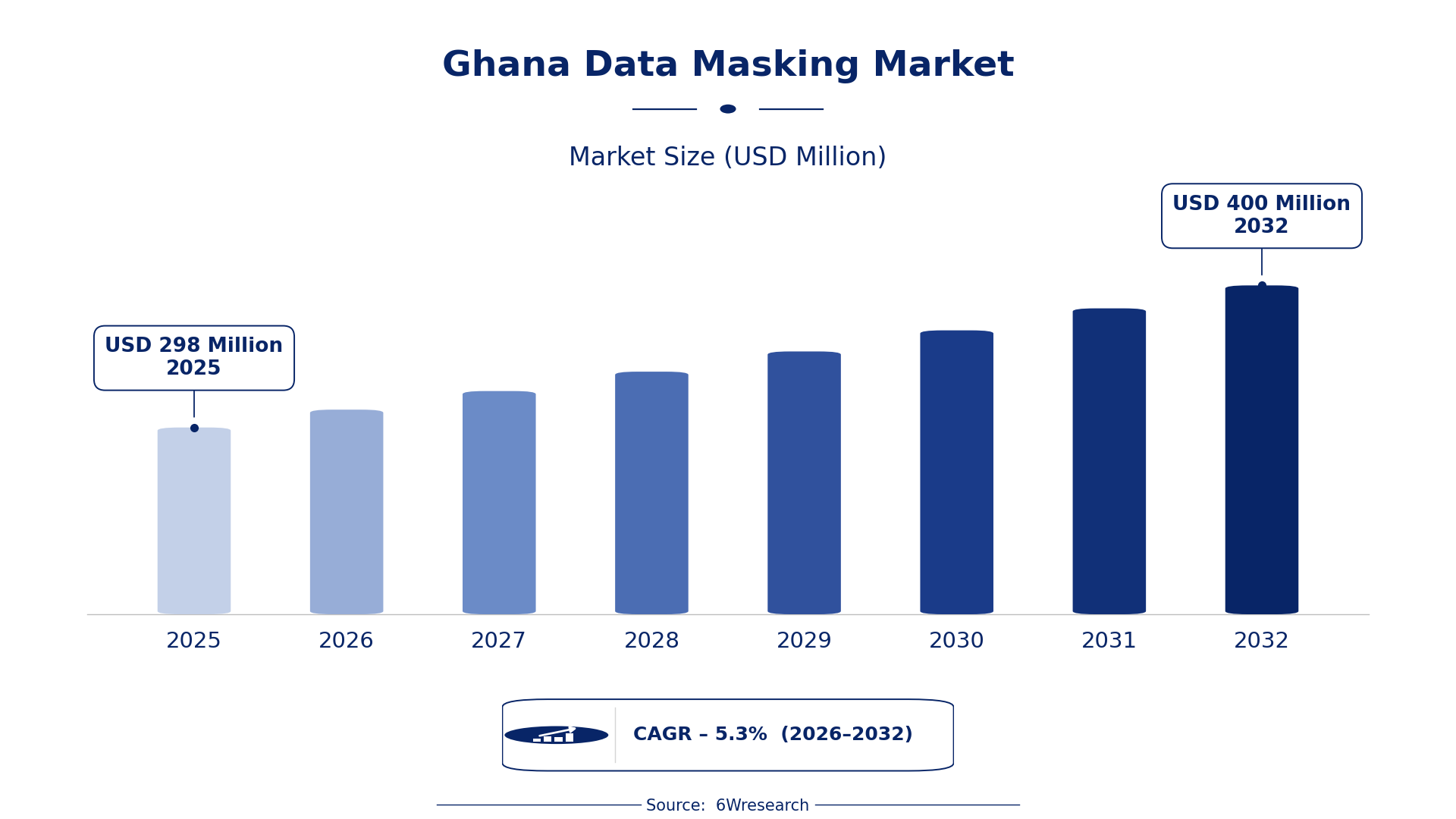
The Ghana Data Masking Market was estimated at USD 298 Million in 2025 and is projected to reach USD 400 Million by 2032, growing at a CAGR of 5.3% from 2026 to 2032.
Ghana Data Masking Market Synopsis
Recent developments in the Ghana Data Masking Market reflect a growing awareness of the critical need for data privacy. As organizations grapple with increased regulatory scrutiny, they are turning to sophisticated data masking solutions to protect sensitive information. This shift is indicative of a market that is not only expanding but also maturing, as businesses adopt technology to address compliance and security challenges.
Looking ahead, the market is anticipated to undergo significant evolution. With the push for stronger data protection measures and compliance with global standards like GDPR, stakeholders in Ghana are likely to prioritize investments in data masking technologies. This trajectory points towards a future where data privacy is not just a regulatory checkbox but a fundamental component of business strategy.
Ghana Data Masking Market Year-wise Growth Rate and Key Drivers
This graph illustrates the annual growth rates of the Ghana Data Masking Market from 2021 to 2032, highlighting a steady upward trajectory and projected expansion over the forecast period.
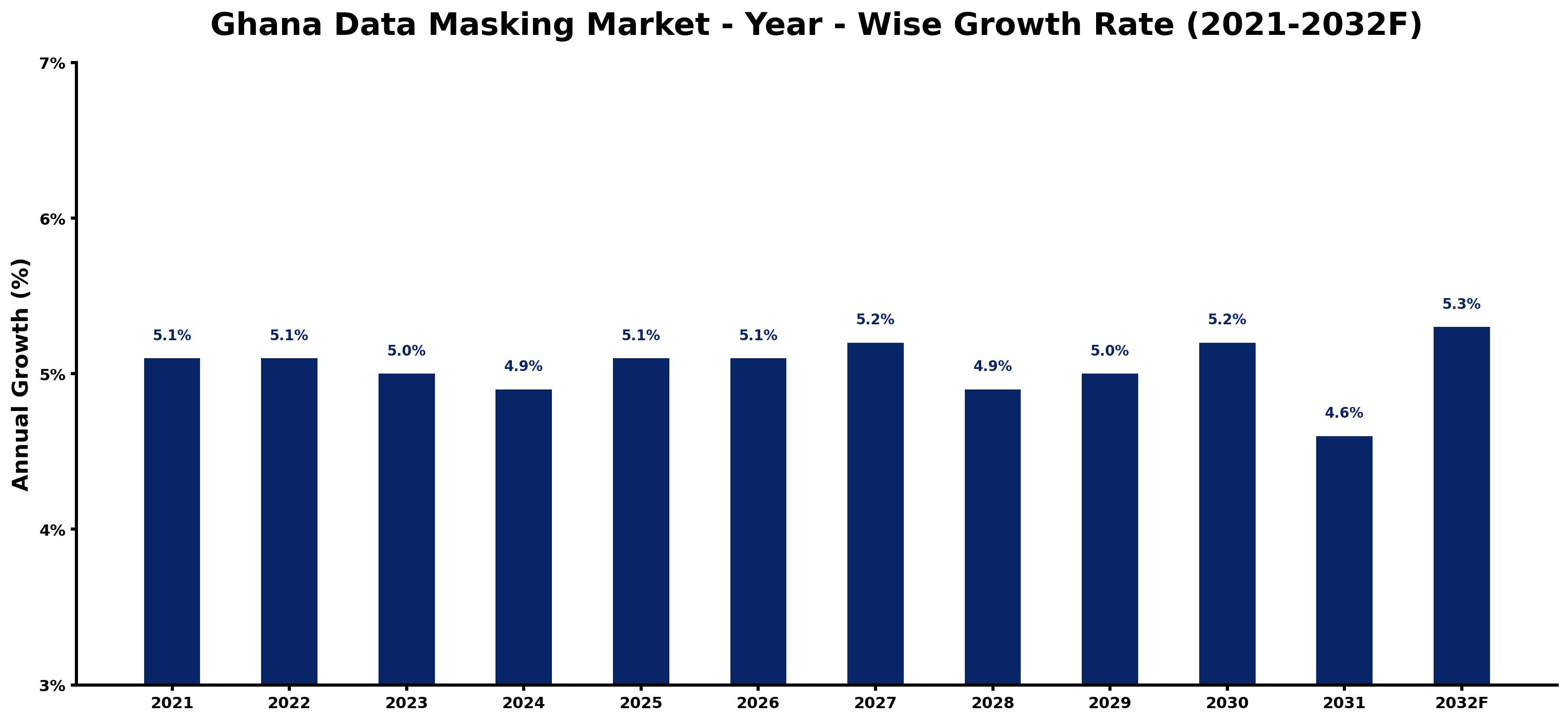
The table below presents the year‑wise growth rates along with the key drivers influencing the market
| Year | Growth Rate | Major Drivers |
| 2021 | 5.1% | Implementation of Ghana's Data Protection Act benefits companies. |
| 2022 | 5.1% | Surge in online banking drives data security needs. |
| 2023 | 5.0% | Telecommunications expansion increases data privacy awareness. |
| 2024 | 4.9% | Government campaigns promote cybersecurity education initiatives. |
| 2025 | 5.1% | Growth of fintech startups boosts data masking demand. |
| 2026 | 5.1% | Rising incidences of data breaches motivate protective measures. |
| 2027 | 5.2% | Investment in local tech hubs enhances data security solutions. |
| 2028 | 4.9% | Increased foreign investment prioritizes data protection compliance. |
| 2029 | 5.0% | Emerging e-commerce sector necessitates robust data privacy. |
| 2030 | 5.2% | Local businesses face stricter data governance requirements. |
| 2031 | 4.6% | Heightened consumer concerns lead to stronger data protection. |
| 2032 | 5.3% | Adoption of mandatory KYC processes stimulates market growth. |
Note: Market size estimations and growth projections presented in this report are based on 6Wresearch's proprietary forecasting methodology, utilizing the latest available industry data, government publications, and primary research inputs.
Ghana Data Masking Market Key Takeaways
Below are some of the specific key takeaways from the market, including:
- Growing adoption of data masking solutions driven by compliance with data protection regulations.
- Emphasis on risk mitigation and ensuring data privacy across various sectors.
- Technical challenges in implementing consistent data masking practices across diverse environments.
- Government policies increasingly supporting data protection initiatives in businesses.
- Expansion opportunities fueled by rising awareness and technological advancements in data privacy.
Evaluation of Restraints in Ghana Data Masking Market
A few key limitations are keeping the Ghana Data Masking Market from reaching its full potential. Organizations often struggle to strike the right balance between stringent data privacy regulations and the necessity for data accessibility. These conflicting requirements can lead to operational inefficiencies. Additionally, the technical hurdles of implementing uniform data masking solutions across various platforms and applications pose real challenges. Without a streamlined approach, companies may find it difficult to ensure consistent and effective data protection.
Ghana Data Masking Market Trends
Several trends are currently shaping the Ghana Data Masking Market. First, there’s an increasing emphasis on automation in data masking processes to enhance efficiency and accuracy. Organizations are also exploring advanced techniques like tokenization and format-preserving encryption, which offer improved data utility. Alongside this, cloud-based solutions are gaining traction, enabling more flexible and scalable data masking strategies. These trends highlight an industry keen on innovation while adhering to necessary compliance mandates.
Ghana Data Masking Market Opportunities
Significant growth opportunities lie ahead for stakeholders in the Ghana Data Masking Market. As businesses continue to prioritize compliance with stringent data protection regulations, the demand for sophisticated masking solutions will surge. Companies focused on developing tailored solutions for specific industries, such as finance and healthcare, are likely to find lucrative prospects. Additionally, public-private partnerships can foster innovation and drive advancements in masking technologies, creating a robust ecosystem for growth.
Government Initiatives in the Ghana Data Masking Market
Government action is increasingly shaping the Ghana Data Masking Market, emphasizing the need for robust data protection frameworks. As authorities recognize the importance of data privacy, policies are being introduced to guide organizations in implementing effective masking solutions. The focus is on creating a regulatory environment that not only promotes compliance but also encourages investment in new technologies.
- A regulatory framework was introduced in 2025 mandating businesses to adopt data masking solutions as part of their compliance strategies.
- Currently ongoing initiatives include government-led training programs aimed at enhancing workforce skills in data privacy and masking techniques.
- Planned public-private partnerships are expected to facilitate the development of new standards and tools for effective data masking by 2027.
- Recent legislation has been enacted to provide incentives for companies investing in data protection technologies, including masking solutions.
- The government is collaborating with industry leaders to establish best practices in data handling and privacy management, set for rollout in late 2026.
Future Insights of the Ghana Data Masking Market
As we look towards 2026 and beyond, the Ghana Data Masking Market is set to witness substantial growth. The increasing complexity of data protection regulations will drive demand for advanced masking solutions, with organizations seeking to enhance their compliance frameworks. With technological advancements making data masking more efficient and accessible, the market will likely see a broadening of its application across various sectors. Investing in this market not only reflects a commitment to data privacy but also signals a proactive approach to managing regulatory risks and challenges.
Ghana Data Masking Market Latest Developments
In the last year, the Ghana Data Masking Market has witnessed notable developments that underline its growth trajectory. As businesses become more aware of the critical need for data protection, industry players are ramping up their efforts to provide innovative solutions. These advancements are a response to both regulatory requirements and the demands of an increasingly data-driven economy.
- A major technology vendor launched a new line of data masking solutions in early 2025, focused on enhancing automation in data security processes.
- An initiative aimed at improving data privacy compliance began in mid-2025 and remains underway, involving partnerships between local businesses and tech experts.
- A collaborative project aimed at developing standardized data masking protocols is planned to kick off by early 2026, involving key stakeholders from various sectors.
- Recently, a comprehensive evaluation of data masking practices among financial institutions was completed in late 2025, providing valuable insights into current compliance status.
- Upcoming workshops and seminars aimed at educating organizations about best practices in data masking are set for Q3 2026, fostering greater awareness.
Ghana Data Masking Market - Key Attractiveness of the Report
- 10 Years of Market Numbers
- Historical Data Starting from 2022 to 2025
- Base Year: 2025
- Forecast Data until 2032
- Key Performance Indicators Impacting the Market
- Major Upcoming Developments and Projects
Key Highlights of the Report:
- Ghana Data Masking Market Outlook
- Market Size of Ghana Data Masking Market, 2025
- Forecast of Ghana Data Masking Market, 2032
- Historical Data and Forecast of Ghana Data Masking Revenues & Volume for the Period 2022-2032F
- Ghana Data Masking Market Trend Evolution
- Ghana Data Masking Market Drivers and Challenges
- Ghana Data Masking Price Trends
- Ghana Data Masking Porter's Five Forces
- Ghana Data Masking Industry Life Cycle
- Historical Data and Forecast of Ghana Data Masking Market Revenues & Volume By Data Masking Type for the Period 2022-2032F
- Historical Data and Forecast of Ghana Data Masking Market Revenues & Volume By Static for the Period 2022-2032F
- Historical Data and Forecast of Ghana Data Masking Market Revenues & Volume By Dynamic for the Period 2022-2032F
- Historical Data and Forecast of Ghana Data Masking Market Revenues & Volume By Component for the Period 2022-2032F
- Historical Data and Forecast of Ghana Data Masking Market Revenues & Volume By Software for the Period 2022-2032F
- Historical Data and Forecast of Ghana Data Masking Market Revenues & Volume By Services for the Period 2022-2032F
- Historical Data and Forecast of Ghana Data Masking Market Revenues & Volume By Business Function for the Period 2022-2032F
- Historical Data and Forecast of Ghana Data Masking Market Revenues & Volume By Finance for the Period 2022-2032F
- Historical Data and Forecast of Ghana Data Masking Market Revenues & Volume By Marketing & Sales for the Period 2022-2032F
- Historical Data and Forecast of Ghana Data Masking Market Revenues & Volume By Operations for the Period 2022-2032F
- Historical Data and Forecast of Ghana Data Masking Market Revenues & Volume By Legal for the Period 2022-2032F
- Historical Data and Forecast of Ghana Data Masking Market Revenues & Volume By Organization Size for the Period 2022-2032F
- Historical Data and Forecast of Ghana Data Masking Market Revenues & Volume By Small and Medium-sized Enterprises (SMEs) for the Period 2022-2032F
- Historical Data and Forecast of Ghana Data Masking Market Revenues & Volume By Large enterprises for the Period 2022-2032F
- Historical Data and Forecast of Ghana Data Masking Market Revenues & Volume By Deployment Type for the Period 2022-2032F
- Historical Data and Forecast of Ghana Data Masking Market Revenues & Volume By On-premises for the Period 2022-2032F
- Historical Data and Forecast of Ghana Data Masking Market Revenues & Volume By Cloud for the Period 2022-2032F
- Historical Data and Forecast of Ghana Data Masking Market Revenues & Volume By Vertical for the Period 2022-2032F
- Historical Data and Forecast of Ghana Data Masking Market Revenues & Volume By BFSI for the Period 2022-2032F
- Historical Data and Forecast of Ghana Data Masking Market Revenues & Volume By Healthcare and life sciences for the Period 2022-2032F
- Historical Data and Forecast of Ghana Data Masking Market Revenues & Volume By Retail and eCommerce for the Period 2022-2032F
- Historical Data and Forecast of Ghana Data Masking Market Revenues & Volume By Telecommunications and IT for the Period 2022-2032F
- Historical Data and Forecast of Ghana Data Masking Market Revenues & Volume By Government and defense for the Period 2022-2032F
- Historical Data and Forecast of Ghana Data Masking Market Revenues & Volume By Media and entertainment for the Period 2022-2032F
- Historical Data and Forecast of Ghana Data Masking Market Revenues & Volume By Manufacturing for the Period 2022-2032F
- Ghana Data Masking Import Export Trade Statistics
- Market Opportunity Assessment By Data Masking Type
- Market Opportunity Assessment By Component
- Market Opportunity Assessment By Business Function
- Market Opportunity Assessment By Organization Size
- Market Opportunity Assessment By Deployment Type
- Market Opportunity Assessment By Vertical
- Ghana Data Masking Top Companies Market Share
- Ghana Data Masking Competitive Benchmarking By Technical and Operational Parameters
- Ghana Data Masking Company Profiles
- Ghana Data Masking Key Strategic Recommendations






































