Ghana Decentralized Identity Market Size & Growth Rate (2026-2032)
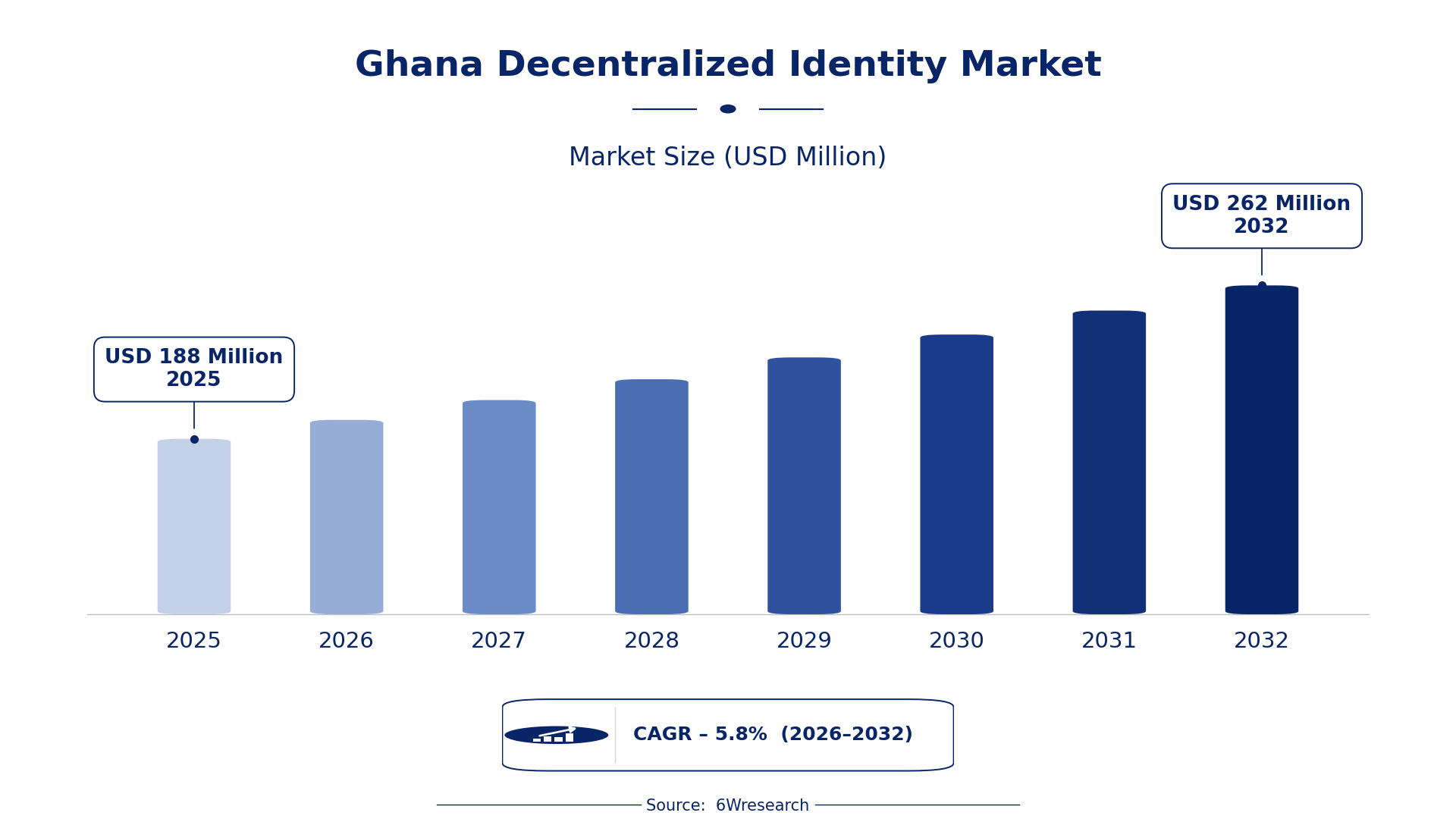
The Ghana Decentralized Identity Market was estimated at USD 188 Million in 2025 and is projected to reach USD 262 Million by 2032, growing at a CAGR of 5.8% from 2026 to 2032.
Ghana Decentralized Identity Market Synopsis
The Ghana Decentralized Identity Market is gaining momentum as individuals seek greater control over their personal data. A growing number of organizations are recognizing the benefits of blockchain-based identity solutions to enhance security and user trust. The demand for privacy-centric identity management is proving to be a powerful catalyst in the market's development.
As concerns regarding data privacy and identity theft intensify, decentralized identity solutions are becoming essential. Ghana's unique socio-economic landscape is shaping how businesses and governmental bodies approach digital identity, with an eye toward empowering citizens and fostering security in digital transactions.
Ghana Decentralized Identity Market Year-wise Growth Rate and Key Drivers
This graph illustrates the annual growth rates of the Ghana Decentralized Identity Market from 2021 to 2032, highlighting a steady upward trajectory and projected expansion over the forecast period.
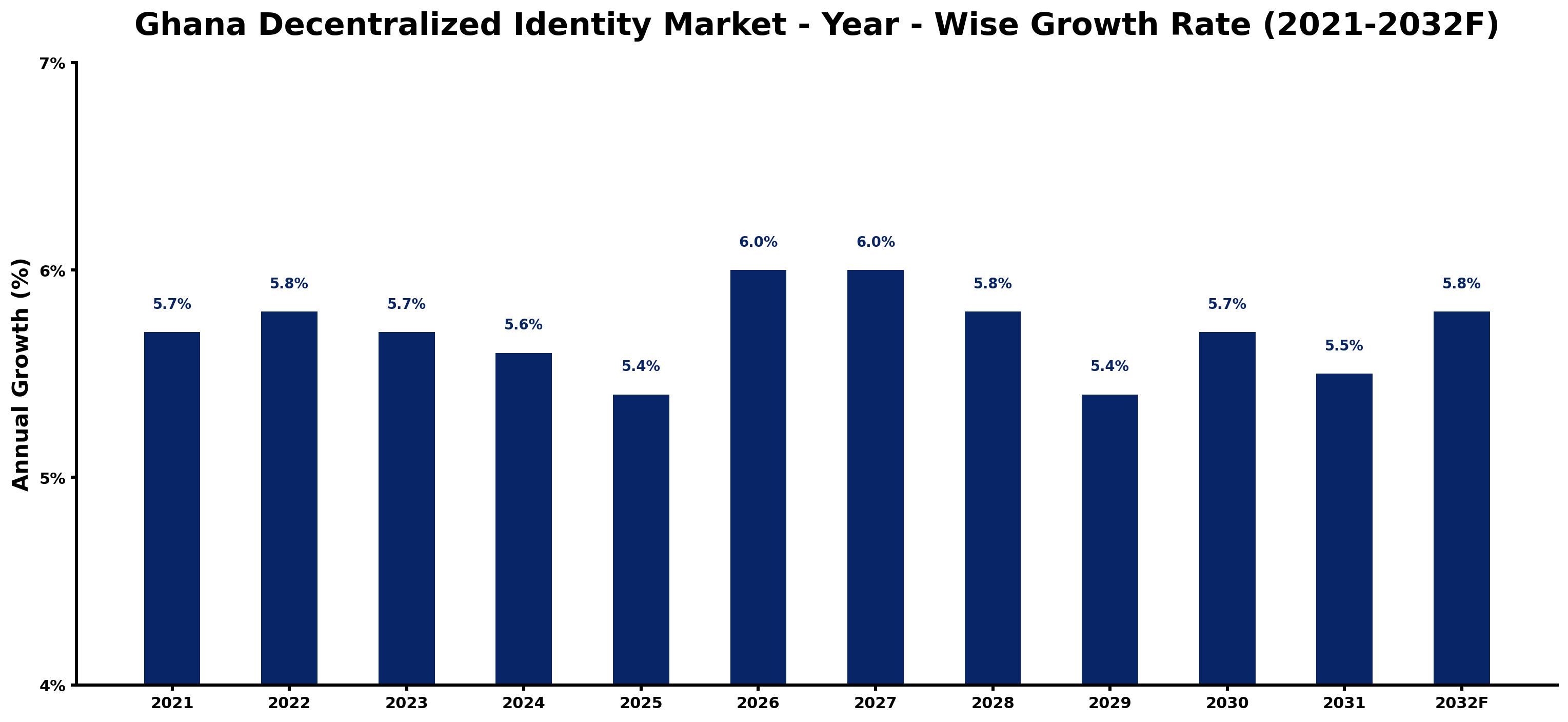
The table below presents the year‑wise growth rates along with the key drivers influencing the market
| Year | Growth Rate | Major Drivers |
| 2021 | 5.7% | National Identification Authority promoting digital ID adoption. |
| 2022 | 5.8% | Increased trade facilitation via digital identity solutions. |
| 2023 | 5.7% | Government collaboration with fintech for identity verification. |
| 2024 | 5.6% | Regulatory support for blockchain applications in identity. |
| 2025 | 5.4% | Rising mobile penetration fostering decentralized ID usage. |
| 2026 | 6.0% | Awareness campaigns on online security boosting demand. |
| 2027 | 6.0% | Corporate partnerships for biometric identity solutions expansion. |
| 2028 | 5.8% | Youth demographic driving demand for digital identity access. |
| 2029 | 5.4% | Local agencies standardizing ID verification processes. |
| 2030 | 5.7% | E-commerce growth necessitating robust identity verification systems. |
| 2031 | 5.5% | International donor support for digital identity initiatives. |
| 2032 | 5.8% | Government incentives for data privacy compliance technologies. |
Note: Market size estimations and growth projections presented in this report are based on 6Wresearch's proprietary forecasting methodology, utilizing the latest available industry data, government publications, and primary research inputs.
Ghana Decentralized Identity Market Key Takeaways
Below are some of the specific key takeaways from the market, including:
- Increasing focus on user privacy is driving demand for decentralized identity solutions.
- Regulatory initiatives are expected to shape the market's growth trajectory significantly.
- Interoperability remains a critical challenge that needs addressing for widespread adoption.
- Organizations are seeking innovative methods to securely manage digital identities.
- Partnerships between tech firms and governmental agencies are emerging as a vital trend.
Evaluation of Restraints in Ghana Decentralized Identity Market
Despite the positive growth outlook, several restraints impede the progress of the Ghana Decentralized Identity Market. A lack of standardization across platforms leads to interoperability issues, which can hinder broader adoption. Furthermore, navigating regulatory compliance presents a challenge, as organizations must ensure they meet privacy and security requirements. These hurdles need to be overcome for the market to flourish sustainably.
Ghana Decentralized Identity Market Trends
Several trends are currently shaping the Ghana Decentralized Identity Market. A notable shift towards user-centric identity solutions is emerging, where individuals can dictate how their data is managed. Technology advancements, particularly in blockchain, are enabling more secure identity management options. Furthermore, the rise in digital transactions among consumers highlights the necessity for enhanced identity verification methods, fueling market expansion.
Ghana Decentralized Identity Market Opportunities
Opportunities abound in the Ghana Decentralized Identity Market. Companies can tap into the increasing need for secure, user-controlled identity solutions, particularly in sectors like banking and healthcare. There's also room for growth in collaborative initiatives involving public and private sectors to develop standardized identity frameworks. As regulatory environments mature, organizations that innovate around compliance will find avenues for competitive advantage.
Government Initiatives in the Ghana Decentralized Identity Market
Government policy is crucial in steering the Ghana Decentralized Identity Market towards a secure and user-friendly future. Initiatives are focusing on privacy, security, and individual control over personal data in digital transactions. By fostering collaboration among stakeholders, the government is setting a foundation for widespread adoption and best practices in identity management.
- A national framework for digital identity standards was introduced in early 2025 to enhance security and user privacy.
- Currently, a project is underway aimed at training government officials and industry professionals on decentralized identity technologies.
- A planned public-private partnership aims to establish regulations for decentralized identity systems by 2026, ensuring compliance and interoperability.
- An initiative to upgrade digital infrastructure, enhancing access to decentralized identity solutions, is expected to begin in late 2025.
- The government is also promoting research and development efforts focused on identity protocols tailored to the needs of data centers.
Future Insights of the Ghana Decentralized Identity Market
Looking ahead, the Ghana Decentralized Identity Market is set for transformative growth from 2026 to 2032. With increased government investment in digital identity infrastructure and growing public awareness, adoption rates are expected to rise. Organizations will likely prioritize decentralized identity solutions, paving the way for a more secure digital environment. The intersection of technology and regulatory frameworks will define the market's path as stakeholders work towards a comprehensive identity management ecosystem.
Ghana Decentralized Identity Market Latest Developments
In the past year, the Ghana Decentralized Identity Market has witnessed notable developments that reflect its dynamic growth. Industry players are increasingly prioritizing digital identity solutions, and partnerships are forming to address common challenges. These initiatives indicate a strong commitment to enhancing security and privacy for users in a digital-first economy.
- A leading technology provider launched a blockchain-based identity management platform in Q1 2025, targeting businesses in fintech and healthcare.
- An ongoing collaboration between multiple stakeholders aims to create standardized protocols for decentralized identity solutions, expected to yield results by late 2025.
- A major initiative focused on enhancing public awareness and education about decentralized identities was rolled out in early 2025.
- Plans are underway for a new regulatory framework that mandates data privacy measures, anticipated to be released in mid-2026.
- A pilot project testing decentralized identity solutions in public service delivery is currently in its trial phase and expected to conclude by the end of 2025.
Ghana Decentralized Identity Market - Key Attractiveness of the Report
- 10 Years of Market Numbers
- Historical Data Starting from 2022 to 2025
- Base Year: 2025
- Forecast Data until 2032
- Key Performance Indicators Impacting the Market
- Major Upcoming Developments and Projects
Key Highlights of the Report:
- Ghana Decentralized Identity Market Outlook
- Market Size of Ghana Decentralized Identity Market, 2025
- Forecast of Ghana Decentralized Identity Market, 2032
- Historical Data and Forecast of Ghana Decentralized Identity Revenues & Volume for the Period 2022-2032F
- Ghana Decentralized Identity Market Trend Evolution
- Ghana Decentralized Identity Market Drivers and Challenges
- Ghana Decentralized Identity Price Trends
- Ghana Decentralized Identity Porter's Five Forces
- Ghana Decentralized Identity Industry Life Cycle
- Historical Data and Forecast of Ghana Decentralized Identity Market Revenues & Volume By Vertical for the Period 2022-2032F
- Historical Data and Forecast of Ghana Decentralized Identity Market Revenues & Volume By BFSI for the Period 2022-2032F
- Historical Data and Forecast of Ghana Decentralized Identity Market Revenues & Volume By Government for the Period 2022-2032F
- Historical Data and Forecast of Ghana Decentralized Identity Market Revenues & Volume By Healthcare and Life Sciences for the Period 2022-2032F
- Historical Data and Forecast of Ghana Decentralized Identity Market Revenues & Volume By Retail and eCommerce for the Period 2022-2032F
- Historical Data and Forecast of Ghana Decentralized Identity Market Revenues & Volume By Telecom and IT for the Period 2022-2032F
- Historical Data and Forecast of Ghana Decentralized Identity Market Revenues & Volume By Transport and Logistics for the Period 2022-2032F
- Historical Data and Forecast of Ghana Decentralized Identity Market Revenues & Volume By Real Estate for the Period 2022-2032F
- Historical Data and Forecast of Ghana BFSI Decentralized Identity Market Revenues & Volume By Others for the Period 2022-2032F
- Historical Data and Forecast of Ghana Decentralized Identity Market Revenues & Volume By Identity Type for the Period 2022-2032F
- Historical Data and Forecast of Ghana Decentralized Identity Market Revenues & Volume By Non- biometrics for the Period 2022-2032F
- Historical Data and Forecast of Ghana Decentralized Identity Market Revenues & Volume By Biometrics for the Period 2022-2032F
- Historical Data and Forecast of Ghana Decentralized Identity Market Revenues & Volume By End User for the Period 2022-2032F
- Historical Data and Forecast of Ghana Decentralized Identity Market Revenues & Volume By Enterprises for the Period 2022-2032F
- Historical Data and Forecast of Ghana Decentralized Identity Market Revenues & Volume By Individual for the Period 2022-2032F
- Historical Data and Forecast of Ghana Decentralized Identity Market Revenues & Volume By Organization Size for the Period 2022-2032F
- Historical Data and Forecast of Ghana Decentralized Identity Market Revenues & Volume By Large Enterprises for the Period 2022-2032F
- Historical Data and Forecast of Ghana Decentralized Identity Market Revenues & Volume By SMEs for the Period 2022-2032F
- Ghana Decentralized Identity Import Export Trade Statistics
- Market Opportunity Assessment By Vertical
- Market Opportunity Assessment By Identity Type
- Market Opportunity Assessment By End User
- Market Opportunity Assessment By Organization Size
- Ghana Decentralized Identity Top Companies Market Share
- Ghana Decentralized Identity Competitive Benchmarking By Technical and Operational Parameters
- Ghana Decentralized Identity Company Profiles
- Ghana Decentralized Identity Key Strategic Recommendations






































