Ghana Dehydrated Onions Market Size, Share & Growth Rate
The Ghana Dehydrated Onions Market was estimated at USD 418 Million in 2025 and is projected to reach USD 564 Million by 2032, growing at a CAGR of 4.4% from 2026 to 2032. This robust growth trajectory can be attributed to the increasing consumer preference for convenience foods, as well as the growing awareness of the practical benefits associated with dehydrated onions, such as their extended shelf life and ease of storage. Moreover, the expansion of the food processing industry in Ghana plays a significant role in driving demand for quality dehydrated onion products.
Ghana Dehydrated Onions Market Year-wise Growth Rate and Key Drivers
This graph highlights how the Ghana Dehydrated Onions Market has steadily grown over the years, supported by major growth factors.
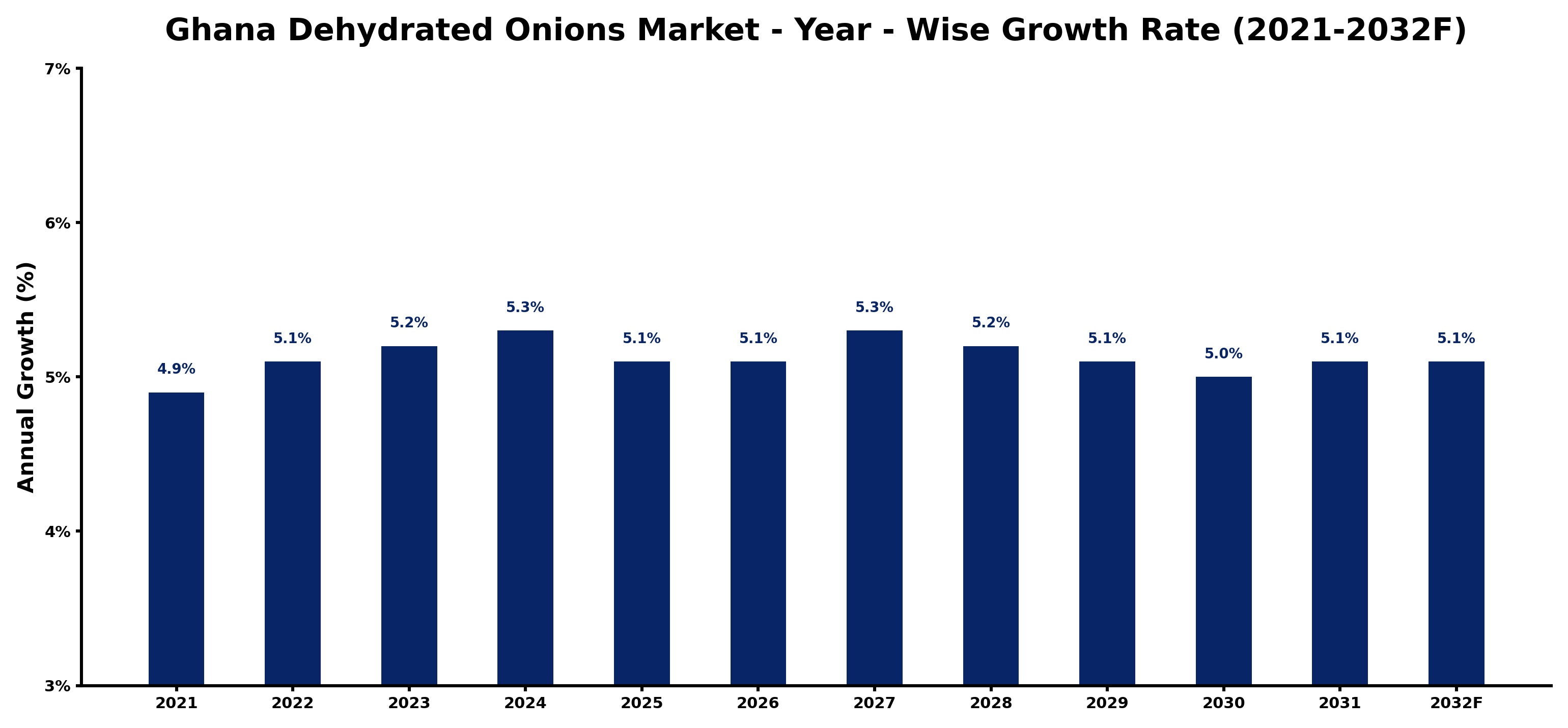
The table below presents the year‑wise growth rates along with the key drivers influencing the market
| Year | Growth Rate | Major Drivers |
| 2021 | 4.9% | Rising demand for convenience foods |
| 2022 | 5.1% | Increased health consciousness among consumers |
| 2023 | 5.2% | Growing popularity of plant-based diets |
| 2024 | 5.3% | Expansion of food processing industry |
| 2025 | 5.1% | Rising export opportunities for products |
| 2026 | 5.1% | Innovative packaging solutions emerged |
| 2027 | 5.3% | Increased culinary tourism experiences |
| 2028 | 5.2% | Sustainability trends influenced purchasing |
| 2029 | 5.1% | Technological advancements in production |
| 2030 | 5.0% | Enhanced distribution networks developed |
| 2031 | 5.1% | Collaboration with local farmers increased |
| 2032 | 5.1% | Consumer education on nutrition improved |
Note - Market size estimations and growth projections presented in this report are based on 6Wresearch’s advanced forecasting approach, validated with industry datasets as of June 2026.
Ghana Dehydrated Onions Market Synopsis
Recently, the Ghana dehydrated onions market has gained momentum, driven by changing consumer habits and the rise of the convenience food sector. However, the future holds even more promise as advancements in processing technologies and distribution networks are set to enhance product availability and quality.
While local suppliers currently dominate the market, the competitive landscape is evolving, with increasing interest from larger players in both local and export markets. This shift indicates a dynamic environment, ripe for innovation and investment, which could lead to a more diverse product range and enhanced market stability.
Ghana Dehydrated Onions Market Key Takeaways
- The market is heavily influenced by rising demand for convenience and ready-to-eat food products.
- Local suppliers are committed to improving quality to meet the needs of both domestic and international consumers.
- Advanced drying technologies are being adopted to enhance production efficiency.
- The Ghanaian government is actively promoting agriculture, which positively impacts the dehydrated onions sector.
- Investment opportunities abound in processing and infrastructure to support market expansion.
Evaluation of Restraints in Ghana Dehydrated Onions Market
Despite its growth potential, the Ghana dehydrated onions market faces several constraints that could limit its development. Fluctuations in raw material prices and inconsistent supply due to variable onion production can hinder overall market stability. Poor infrastructure for processing and storage further complicates quality assurance, often resulting in subpar products. Additionally, competition from imported dehydrated onions presents a significant challenge, particularly as consumer awareness and acceptance of local alternatives remain underdeveloped. Addressing these issues will be essential for sustainable market growth.
Ghana Dehydrated Onions Market Trends
A notable trend within the Ghana dehydrated onions market is the increasing demand for convenience-driven products. Consumers are gravitating towards dehydrated onions due to their ease of use and longer shelf life, making them an appealing option for both households and food service establishments. Furthermore, the rise of ready-to-eat meals is further accentuating this demand. The industry is also witnessing a shift towards modern drying technologies, which are essential for improving production quality and enhancing product appeal in the competitive market.
Ghana Dehydrated Onions Market Opportunities
The Ghana dehydrated onions market presents considerable investment opportunities, particularly in establishing processing facilities that cater to local and export demands. With its conducive climate for onion cultivation, Ghana is well-positioned to become a significant player in the dehydrated onions market regionally and globally. Investments in modern processing and packaging technologies can elevate product quality and extend shelf life, thus enhancing competitiveness. Additionally, exploring value-added products, such as onion powder or flakes, can diversify offerings and further increase market reach.
Government Initiatives in the Ghana Dehydrated Onions Market
The Ghanaian government has introduced several initiatives to bolster the dehydrated onions market. Programs like Planting for Food and Jobs aim to enhance agricultural productivity, food security, and employment opportunities. Furthermore, subsidies for inputs such as fertilizers and improved seeds have been initiated to support onion farmers. Export promotion efforts are also underway to facilitate access to international markets, alongside infrastructural improvements designed to reduce post-harvest losses and maintain product quality. These initiatives provide a supportive framework for market growth.
Future Insights of the Ghana Dehydrated Onions Market
Looking ahead to the period from 2026 to 2032, the Ghana dehydrated onions market is poised for significant growth, driven by factors such as the increasing consumer demand for convenience foods, a rising appreciation for the health benefits of dehydrated onions, and the expanding food processing industry. The government's continued support and investment in agricultural productivity and export initiatives will further facilitate market expansion. By focusing on innovation, quality standards, and sustainability, the market is likely to adapt to changing consumer needs, creating a promising future.
Ghana Dehydrated Onions Market Latest Developments (May 2025 - June 2026)
In the recent months leading up to June 2026, the Ghana dehydrated onions market has experienced several noteworthy developments. There is a marked increase in collaborations between local farmers and processing companies aimed at ensuring consistent supply and quality. Additionally, advancements in processing techniques are being adopted widely, enhancing the efficiency and effectiveness of dehydrated onion production. This momentum is coupled with a greater push towards export, as more players look to tap into international markets, signaling a robust evolution within the industry.
Ghana Dehydrated Onions Market - Key Attractiveness of the Report
- 10 Years of Market Numbers
- Historical Data Starting from 2022 to 2025
- Base Year: 2025
- Forecast Data until 2032
- Key Performance Indicators Impacting the Market
- Major Upcoming Developments and Projects
Key Highlights of the Report:
- Ghana Dehydrated Onions Market Outlook
- Market Size of Ghana Dehydrated Onions Market, 2025
- Forecast of Ghana Dehydrated Onions Market, 2032
- Historical Data and Forecast of Ghana Dehydrated Onions Revenues & Volume for the Period 2022-2032F
- Ghana Dehydrated Onions Market Trend Evolution
- Ghana Dehydrated Onions Market Drivers and Challenges
- Ghana Dehydrated Onions Price Trends
- Ghana Dehydrated Onions Porter's Five Forces
- Ghana Dehydrated Onions Industry Life Cycle
- Historical Data and Forecast of Ghana Dehydrated Onions Market Revenues & Volume By Nature for the Period 2022-2032F
- Historical Data and Forecast of Ghana Dehydrated Onions Market Revenues & Volume By Organic for the Period 2022-2032F
- Historical Data and Forecast of Ghana Dehydrated Onions Market Revenues & Volume By Conventional for the Period 2022-2032F
- Historical Data and Forecast of Ghana Dehydrated Onions Market Revenues & Volume By Variety for the Period 2022-2032F
- Historical Data and Forecast of Ghana Dehydrated Onions Market Revenues & Volume By White Onion for the Period 2022-2032F
- Historical Data and Forecast of Ghana Dehydrated Onions Market Revenues & Volume By Red Onion for the Period 2022-2032F
- Historical Data and Forecast of Ghana Dehydrated Onions Market Revenues & Volume By Pink Onion for the Period 2022-2032F
- Historical Data and Forecast of Ghana Dehydrated Onions Market Revenues & Volume By Hybrid for the Period 2022-2032F
- Historical Data and Forecast of Ghana Dehydrated Onions Market Revenues & Volume By Form for the Period 2022-2032F
- Historical Data and Forecast of Ghana Dehydrated Onions Market Revenues & Volume By Chopped for the Period 2022-2032F
- Historical Data and Forecast of Ghana Dehydrated Onions Market Revenues & Volume By Minced for the Period 2022-2032F
- Historical Data and Forecast of Ghana Dehydrated Onions Market Revenues & Volume By Granules for the Period 2022-2032F
- Historical Data and Forecast of Ghana Dehydrated Onions Market Revenues & Volume By Powder for the Period 2022-2032F
- Historical Data and Forecast of Ghana Dehydrated Onions Market Revenues & Volume By Flakes for the Period 2022-2032F
- Historical Data and Forecast of Ghana Dehydrated Onions Market Revenues & Volume By Kibbled for the Period 2022-2032F
- Historical Data and Forecast of Ghana Dehydrated Onions Market Revenues & Volume By Sliced for the Period 2022-2032F
- Historical Data and Forecast of Ghana Dehydrated Onions Market Revenues & Volume By End-use for the Period 2022-2032F
- Historical Data and Forecast of Ghana Dehydrated Onions Market Revenues & Volume By Food Proccessing for the Period 2022-2032F
- Historical Data and Forecast of Ghana Dehydrated Onions Market Revenues & Volume By Food Service Providers for the Period 2022-2032F
- Historical Data and Forecast of Ghana Dehydrated Onions Market Revenues & Volume By Retail/Household for the Period 2022-2032F
- Historical Data and Forecast of Ghana Dehydrated Onions Market Revenues & Volume By Technology for the Period 2022-2032F
- Historical Data and Forecast of Ghana Dehydrated Onions Market Revenues & Volume By Air Drying for the Period 2022-2032F
- Historical Data and Forecast of Ghana Dehydrated Onions Market Revenues & Volume By Vaccum Drying for the Period 2022-2032F
- Historical Data and Forecast of Ghana Dehydrated Onions Market Revenues & Volume By Freeze Drying for the Period 2022-2032F
- Historical Data and Forecast of Ghana Dehydrated Onions Market Revenues & Volume By Microwave Drying for the Period 2022-2032F
- Historical Data and Forecast of Ghana Dehydrated Onions Market Revenues & Volume By Spray Drying for the Period 2022-2032F
- Historical Data and Forecast of Ghana Dehydrated Onions Market Revenues & Volume By Others for the Period 2022-2032F
- Historical Data and Forecast of Ghana Dehydrated Onions Market Revenues & Volume By Distribution Channel for the Period 2022-2032F
- Historical Data and Forecast of Ghana Dehydrated Onions Market Revenues & Volume By B2B for the Period 2022-2032F
- Historical Data and Forecast of Ghana Dehydrated Onions Market Revenues & Volume By B2C for the Period 2022-2032F
- Ghana Dehydrated Onions Import Export Trade Statistics
- Market Opportunity Assessment By Nature
- Market Opportunity Assessment By Variety
- Market Opportunity Assessment By Form
- Market Opportunity Assessment By End-use
- Market Opportunity Assessment By Technology
- Market Opportunity Assessment By Distribution Channel
- Ghana Dehydrated Onions Top Companies Market Share
- Ghana Dehydrated Onions Competitive Benchmarking By Technical and Operational Parameters
- Ghana Dehydrated Onions Company Profiles
- Ghana Dehydrated Onions Key Strategic Recommendations






































