Ghana Deli Meat Market Size, Share & Growth Rate
The Ghana Deli Meat Market was estimated at USD 398 Million in 2025 and is projected to reach USD 556 Million by 2032, growing at a CAGR of 4.9% from 2026 to 2032. This upward trajectory reflects a notable shift in consumer preferences towards convenient, high-quality meal options. As Ghanaians increasingly seek out flavorful deli meats for various culinary applications, including sandwiches and charcuterie boards, both retail and foodservice sectors stand to benefit significantly from this trend.
Ghana Deli Meat Market Year-wise Growth Rate and Key Drivers
This graph highlights how the Ghana Deli Meat Market has steadily grown over the years, supported by major growth factors.
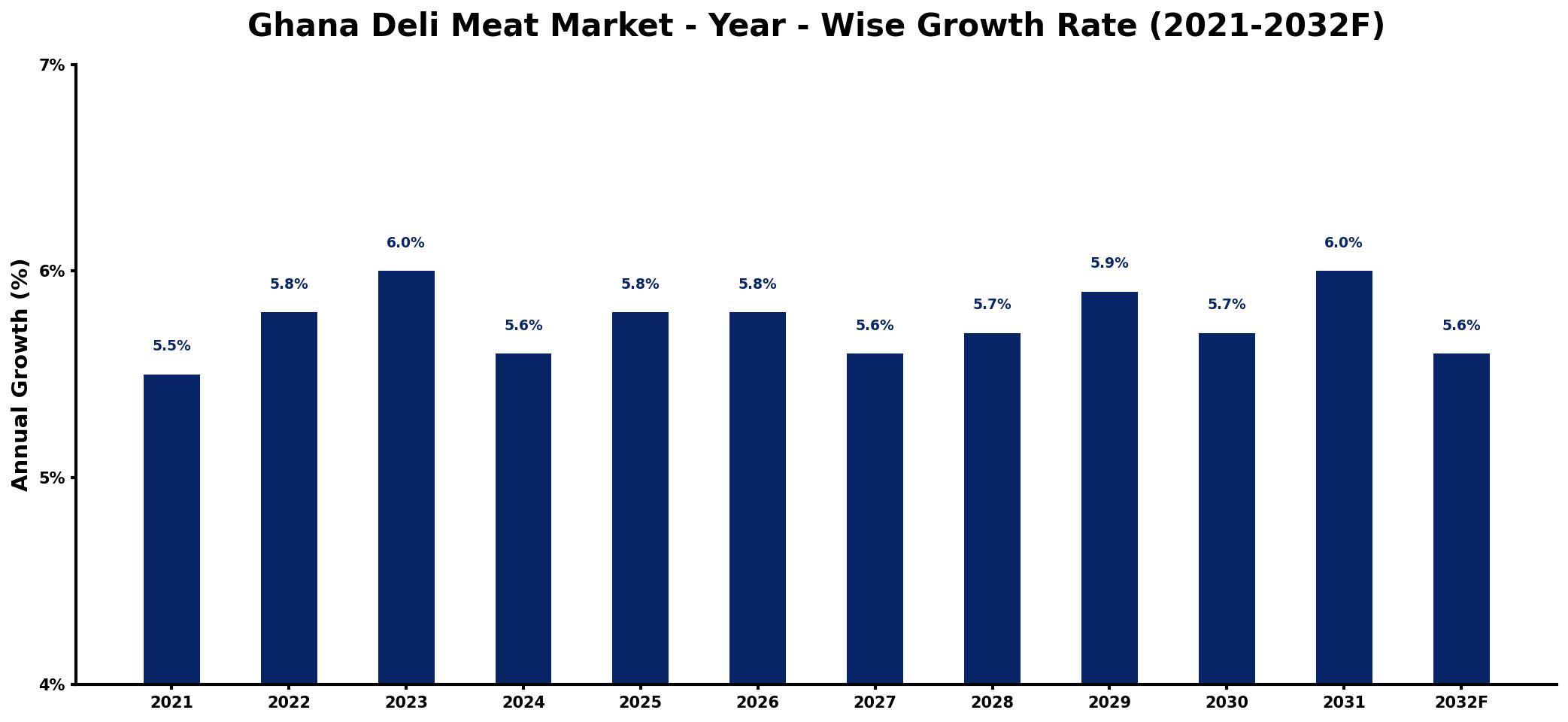
The table below presents the year‑wise growth rates along with the key drivers influencing the market
| Year | Growth Rate | Major Drivers |
| 2021 | 5.5% | Rising consumer demand for convenience |
| 2022 | 5.8% | Increased investment in production technologies |
| 2023 | 6.0% | Expansion of retail distribution channels |
| 2024 | 5.6% | Growing popularity of ready-to-eat options |
| 2025 | 5.8% | Surge in health-conscious consumer trends |
| 2026 | 5.8% | Enhanced marketing strategies and promotions |
| 2027 | 5.6% | Diversification of product offerings available |
| 2028 | 5.7% | Strengthening supply chain efficiencies |
| 2029 | 5.9% | Emergence of new market players |
| 2030 | 5.7% | Innovations in flavor and packaging |
| 2031 | 6.0% | Growing e-commerce sales platforms |
| 2032 | 5.6% | Increased focus on sustainability practices |
Note: Market size estimations and growth projections presented in this report are based on 6Wresearch's proprietary forecasting methodology, utilizing the latest available industry data, government publications, and primary research inputs.
Ghana Deli Meat Market Synopsis
In Ghana, the growing popularity of ready-to-eat deli meats has reshaped consumer eating habits, with ham, turkey, and salami emerging as favored choices among consumers. The demand is particularly pronounced in urban areas, where busy lifestyles drive a preference for quick meal solutions without compromising on taste or nutrition.
Additionally, the deli meat segment is experiencing a burgeoning interest in charcuterie as a social dining option, enhancing its appeal across various demographics. As more consumers experiment with diverse cuisines, deli meats play a vital role in fostering culinary creativity, further propelling market growth.
Ghana Deli Meat Market Key Takeaways
- The market is expanding rapidly, driven by urbanization and changing consumer preferences.
- Deli meats are increasingly featured in both retail and foodservice settings, from casual dining to gourmet experiences.
- High-quality, fresh, and locally sourced options are becoming more vital to consumer choices.
- Government regulations are expected to enhance product safety and quality standards, influencing market dynamics.
- Educational initiatives about the nutritional benefits of deli meats are poised to impact consumption positively.
Evaluation of Restraints in Ghana Deli Meat Market
Despite the promising growth of the Ghana deli meat market, several key challenges persist. Ensuring product safety and maintaining stringent quality standards across the supply chain remain paramount. There is also a notable consumer inclination towards fresh and locally sourced meat products. This preference can create a tension for manufacturers and retailers who must navigate sourcing and processing challenges while meeting consumer demands for quality and freshness. Furthermore, economic fluctuations and infrastructure limitations may hinder the market's growth potential if not adequately addressed.
Ghana Deli Meat Market Trends
The trend toward health-conscious eating is prominently shaping the deli meat landscape in Ghana. As consumers become more aware of nutritional values, there is an increasing demand for lower-fat and organic options. Additionally, innovative culinary practices, such as gourmet charcuterie boards, are gaining traction among younger demographics, encouraging the inclusion of specialty and artisan deli meats. This evolution in consumption patterns suggests a promising future for producers who can cater to these emerging preferences while maintaining quality.
Ghana Deli Meat Market Opportunities
Significant growth opportunities are emerging in the Ghana deli meat market, especially within the realm of value-added products. The introduction of pre-packaged, portion-controlled deli meats tailored for busy lifestyles can appeal to health-conscious consumers. Additionally, tapping into the e-commerce space for direct-to-consumer sales could broaden market access. Investment in local production facilities to reduce reliance on imports may also foster economic growth while appealing to consumer preferences for locally sourced goods.
Government Initiatives in the Ghana Deli Meat Market
The Ghanaian government plays a vital role in regulating the deli meat market, primarily focusing on food safety and quality assurance. Policies are being developed to establish standards for production, processing, and labeling of deli meats, ensuring compliance with hygiene and sanitation requirements. These initiatives aim not only to protect consumer health but also to promote sustainable practices within the meat industry, thereby reinforcing consumer trust in locally produced deli products.
Future Insights of the Ghana Deli Meat Market
Looking ahead to 2026-2032, the Ghana deli meat market is anticipated to continue its upward momentum. The rising urban population will likely sustain demand, while ongoing innovation in product offerings will address evolving consumer preferences. Additionally, as health and convenience remain paramount, businesses that adapt to these trends will thrive. The integration of technology into production processes may also enhance efficiency and product quality, paving the way for a more robust market landscape.
Ghana Deli Meat Market Latest Developments (2025 - 2026)
Recent developments in the Ghana deli meat market indicate a focus on enhancing product innovation and quality. Several local producers are ramping up efforts to diversify their product lines, introducing organic and reduced-sodium options to meet health-conscious consumer demands. Moreover, partnerships between local farmers and processing companies are becoming more common, promoting the use of locally sourced ingredients. These collaborative efforts aim to strengthen supply chains and improve overall market sustainability.
Ghana Deli Meat Market - Key Attractiveness of the Report
- 10 Years of Market Numbers
- Historical Data Starting from 2022 to 2025
- Base Year: 2025
- Forecast Data until 2032
- Key Performance Indicators Impacting the Market
- Major Upcoming Developments and Projects
Key Highlights of the Report:
- Ghana Deli Meat Market Outlook
- Market Size of Ghana Deli Meat Market, 2025
- Forecast of Ghana Deli Meat Market, 2032
- Historical Data and Forecast of Ghana Deli Meat Revenues & Volume for the Period 2022-2032F
- Ghana Deli Meat Market Trend Evolution
- Ghana Deli Meat Market Drivers and Challenges
- Ghana Deli Meat Price Trends
- Ghana Deli Meat Porter's Five Forces
- Ghana Deli Meat Industry Life Cycle
- Historical Data and Forecast of Ghana Deli Meat Market Revenues & Volume By Source for the Period 2022-2032F
- Historical Data and Forecast of Ghana Deli Meat Market Revenues & Volume By Beef for the Period 2022-2032F
- Historical Data and Forecast of Ghana Deli Meat Market Revenues & Volume By Pork for the Period 2022-2032F
- Historical Data and Forecast of Ghana Deli Meat Market Revenues & Volume By Chicken for the Period 2022-2032F
- Historical Data and Forecast of Ghana Deli Meat Market Revenues & Volume By Others for the Period 2022-2032F
- Historical Data and Forecast of Ghana Deli Meat Market Revenues & Volume By Product Type for the Period 2022-2032F
- Historical Data and Forecast of Ghana Deli Meat Market Revenues & Volume By Cured Meat for the Period 2022-2032F
- Historical Data and Forecast of Ghana Deli Meat Market Revenues & Volume By Uncured Meat for the Period 2022-2032F
- Historical Data and Forecast of Ghana Deli Meat Market Revenues & Volume By Sales Channel for the Period 2022-2032F
- Historical Data and Forecast of Ghana Deli Meat Market Revenues & Volume By Hypermarkets/Supermarkets for the Period 2022-2032F
- Historical Data and Forecast of Ghana Deli Meat Market Revenues & Volume By Specialty Stores for the Period 2022-2032F
- Historical Data and Forecast of Ghana Deli Meat Market Revenues & Volume By Convenience Stores for the Period 2022-2032F
- Historical Data and Forecast of Ghana Deli Meat Market Revenues & Volume By Online Channels for the Period 2022-2032F
- Historical Data and Forecast of Ghana Deli Meat Market Revenues & Volume By Others for the Period 2022-2032F
- Ghana Deli Meat Import Export Trade Statistics
- Market Opportunity Assessment By Source
- Market Opportunity Assessment By Product Type
- Market Opportunity Assessment By Sales Channel
- Ghana Deli Meat Top Companies Market Share
- Ghana Deli Meat Competitive Benchmarking By Technical and Operational Parameters
- Ghana Deli Meat Company Profiles
- Ghana Deli Meat Key Strategic Recommendations






































