Ghana Denture cleaning products Market Size, Share & Growth Rate
The Ghana Denture cleaning products Market was estimated at USD 214 Million in 2025 and is projected to reach USD 287 Million by 2032, growing at a CAGR of 4.3% from 2026 to 2032. This growth trajectory is propelled by a rapidly aging population, increased focus on oral hygiene, and an upswing in the availability of effective and accessible cleaning solutions. Furthermore, the rising consumer awareness about the importance of maintaining oral health and hygiene is contributing significantly to the market expansion.
Ghana Denture cleaning products Market Year-wise Growth Rate and Key Drivers
This graph highlights how the Ghana Denture cleaning products Market has steadily grown over the years, supported by major growth factors.
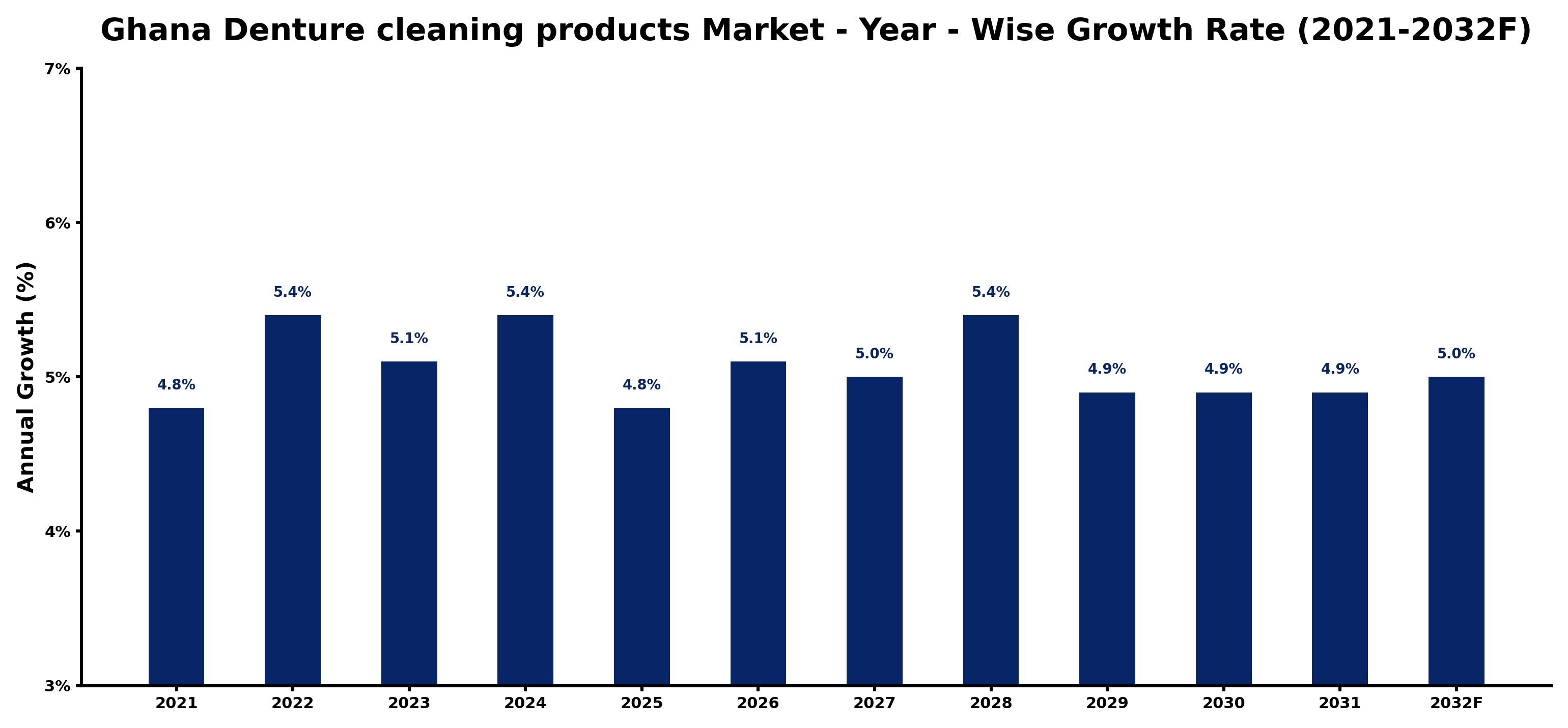
The table below presents the year‑wise growth rates along with the key drivers influencing the market
| Year | Growth Rate | Major Drivers |
| 2021 | 4.8% | Local manufacturing of denture cleaners boosted chemical supply chain efficiency |
| 2022 | 5.4% | Local manufacturing upgrades enhanced denture cleaning product availability |
| 2023 | 5.1% | Higher manufacturing investments boosted local denture cleaner production capacity |
| 2024 | 5.4% | Smart manufacturing adoption boosts denture cleaner production efficiency |
| 2025 | 4.8% | Retail partnerships boost denture cleaning product distribution efficiency |
| 2026 | 5.1% | New manufacturing plants boost local denture cleaning product supply |
| 2027 | 5.0% | Export driven demand for advanced cleaning technology boosts production capacity |
| 2028 | 5.4% | Local manufacturing investments boosted denture cleaning product output capacity |
| 2029 | 4.9% | Local manufacturers boost production capabilities for denture cleaning solutions |
| 2030 | 4.9% | Denture cleaning product manufacturers adopt advanced sustainable production methods |
| 2031 | 4.9% | Improved distribution networks boosted denture cleaning product availability |
| 2032 | 5.0% | Export driven investments in modern denture cleaning technology surged productivity |
Note - Market size estimations and growth projections presented in this report are based on 6Wresearch’s advanced forecasting approach, validated with industry datasets as of June 2026.
Ghana Denture cleaning products Market Synopsis
In recent years, the Ghana denture cleaning products market has gained momentum, driven by an increasing awareness of oral hygiene, particularly among the elderly. As consumers seek more effective solutions for denture care, the market is moving towards innovative and eco-friendly cleaning products, demonstrating a clear shift in consumer preferences.
Looking ahead, this market is poised for sustainable growth, as advancements in product formulations and distribution channels will cater to the evolving needs of consumers. With a robust demand for convenient and natural cleaning options, the market will likely see a rise in competition, pushing manufacturers to continuously innovate and adapt.
Ghana Denture cleaning products Market Key Takeaways
- The Ghana denture cleaning products market is witnessing steady growth driven by demographic changes and increasing health consciousness.
- Consumers are actively seeking eco-friendly, organic, and biodegradable cleaning products that align with global sustainability trends.
- Partnerships with dental professionals are becoming a common strategy to enhance market penetration and consumer trust.
- Investment opportunities abound in the development of innovative, multifunctional denture cleaning solutions tailored to local consumer preferences.
- Targeted marketing campaigns and improved distribution networks are essential for addressing awareness and accessibility challenges.
Evaluation of Restraints in Ghana Denture cleaning products Market
Despite its promising growth, the Ghana denture cleaning products market faces significant constraints. There exists a notable lack of awareness regarding the importance of denture hygiene among the general population, which hampers product adoption. Additionally, access to specialized cleaning products remains limited in rural areas, compounded by affordability concerns that deter potential consumers. Furthermore, cultural factors and traditional health beliefs can create skepticism regarding the efficacy and safety of modern denture cleaning solutions, necessitating focused educational campaigns to foster trust and encourage uptake.
Ghana Denture cleaning products Market Trends
The market is increasingly trending towards the use of natural and eco-friendly cleaning solutions. Consumers are now prioritizing products that are gentle on their health and environmentally sustainable. In addition, there is a growing demand for multifunctional products that not only cleanse but also offer benefits like breath freshening and teeth whitening. To meet these demands, manufacturers are innovating formulations with natural ingredients such as baking soda and activated charcoal, reflecting a broader shift towards holistic oral care solutions.
Ghana Denture cleaning products Market Opportunities
Opportunities for investment in the Ghana denture cleaning products market are abundant, particularly with the increasing elderly population and a greater emphasis on oral health awareness. There is a clear market need for innovative, user-friendly cleaning solutions that resonate with consumer preferences. Companies that establish partnerships with dental clinics and pharmacies can broaden their reach significantly. Conducting comprehensive market research to understand specific consumer needs and pricing dynamics will further enhance opportunities for success in this burgeoning market.
Government Initiatives in the Ghana Denture cleaning products Market
While there are no direct regulations specific to denture cleaning products, the Ghanaian government maintains a regulatory framework for consumer products, governed by agencies like the Food and Drugs Authority (FDA) and the Ghana Standards Authority (GSA). These agencies ensure that all consumer goods, including denture cleaning products, comply with necessary quality and safety standards. Additionally, import regulations and tariffs may impact market dynamics, influencing both product availability and pricing.
Future Insights of the Ghana Denture cleaning products Market
The outlook for the Ghana denture cleaning products market is promising, driven by increased awareness of oral hygiene and the steadily growing aging population. Continued advancements in product technology and innovation are anticipated to yield more efficient and convenient cleaning solutions. As disposable incomes rise and lifestyles evolve, consumers are likely to become more willing to invest in quality oral care products, setting the stage for steady market growth between 2026 and 2032.
Ghana Denture cleaning products Market Latest Developments (May 2025 - June 2026)
Recent industry developments suggest a pivot towards more sustainable practices within the Ghana denture cleaning products market. Companies are actively exploring natural ingredients in their formulations while enhancing their marketing strategies to emphasize the health benefits of proper denture care. Furthermore, collaboration with healthcare professionals has become a strategic priority, as firms aim to build trust and foster consumer education regarding the importance of denture hygiene.
Ghana Denture cleaning products Market - Key Attractiveness of the Report
- 10 Years of Market Numbers
- Historical Data Starting from 2022 to 2025
- Base Year: 2025
- Forecast Data until 2032
- Key Performance Indicators Impacting the Market
- Major Upcoming Developments and Projects
Key Highlights of the Report:
- Ghana Denture cleaning products Market Outlook
- Market Size of Ghana Denture cleaning products Market, 2025
- Forecast of Ghana Denture cleaning products Market, 2032
- Historical Data and Forecast of Ghana Denture cleaning products Revenues & Volume for the Period 2022-2032F
- Ghana Denture cleaning products Market Trend Evolution
- Ghana Denture cleaning products Market Drivers and Challenges
- Ghana Denture cleaning products Price Trends
- Ghana Denture cleaning products Porter's Five Forces
- Ghana Denture cleaning products Industry Life Cycle
- Historical Data and Forecast of Ghana Denture cleaning products Market Revenues & Volume By Type for the Period 2022-2032F
- Historical Data and Forecast of Ghana Denture cleaning products Market Revenues & Volume By Tablet for the Period 2022-2032F
- Historical Data and Forecast of Ghana Denture cleaning products Market Revenues & Volume By Liquid for the Period 2022-2032F
- Historical Data and Forecast of Ghana Denture cleaning products Market Revenues & Volume By Others for the Period 2022-2032F
- Historical Data and Forecast of Ghana Denture cleaning products Market Revenues & Volume By Applications for the Period 2022-2032F
- Historical Data and Forecast of Ghana Denture cleaning products Market Revenues & Volume By Dental Hospital for the Period 2022-2032F
- Historical Data and Forecast of Ghana Denture cleaning products Market Revenues & Volume By Home for the Period 2022-2032F
- Historical Data and Forecast of Ghana Denture cleaning products Market Revenues & Volume By Others for the Period 2022-2032F
- Ghana Denture cleaning products Import Export Trade Statistics
- Market Opportunity Assessment By Type
- Market Opportunity Assessment By Applications
- Ghana Denture cleaning products Top Companies Market Share
- Ghana Denture cleaning products Competitive Benchmarking By Technical and Operational Parameters
- Ghana Denture cleaning products Company Profiles
- Ghana Denture cleaning products Key Strategic Recommendations






































