Ghana Dyestuff For Cotton Market Size, Share & Growth Rate
The Ghana Dyestuff For Cotton Market was estimated at USD 467 Million in 2025 and is projected to reach USD 678 Million by 2032, growing at a CAGR of 5.5% from 2026 to 2032. This growth trajectory is largely fueled by the robust expansion of the local textile industry, coupled with increasing consumer demand for vibrant and high-quality cotton fabrics. As Ghana's economy continues to develop, local manufacturers and fashion designers are prioritizing innovative dyestuff solutions that enhance product appeal and meet evolving consumer preferences.
Ghana Dyestuff For Cotton Market Year-wise Growth Rate and Key Drivers
This graph highlights how the Ghana Dyestuff For Cotton Market has steadily grown over the years, supported by major growth factors.
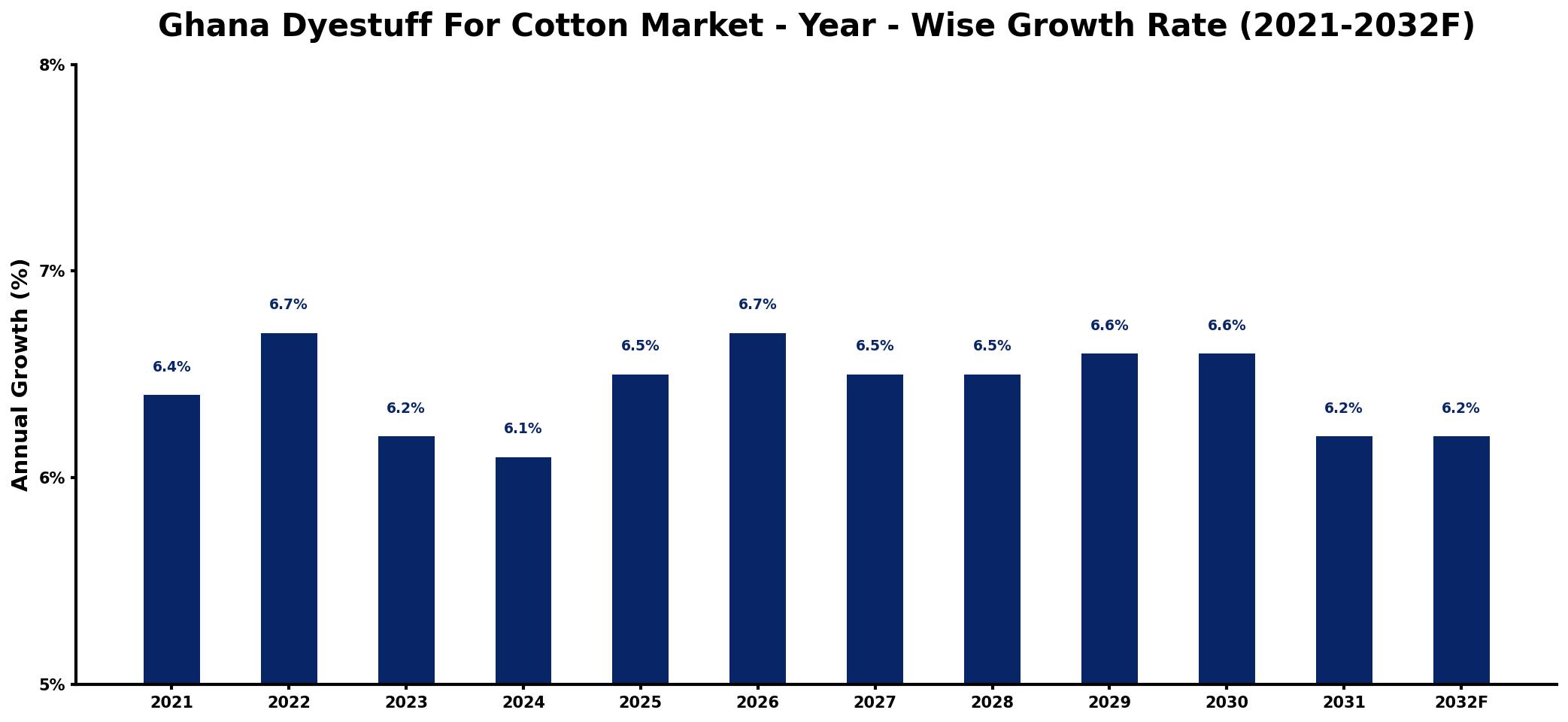
The table below presents the year‑wise growth rates along with the key drivers influencing the market
| Year | Growth Rate | Major Drivers |
| 2021 | 6.4% | Rising textile manufacturing investments |
| 2022 | 6.7% | Increased demand for vibrant colors |
| 2023 | 6.2% | Emerging fashion trends driving demand |
| 2024 | 6.1% | Growth in sustainable textile practices |
| 2025 | 6.5% | Expansion of local production facilities |
| 2026 | 6.7% | Enhancements in dyeing technologies |
| 2027 | 6.5% | Rising exports to regional markets |
| 2028 | 6.5% | Growing consumer awareness on quality |
| 2029 | 6.6% | Increased collaboration with designers |
| 2030 | 6.6% | Strengthened supply chain partnerships |
| 2031 | 6.2% | Adoption of eco-friendly alternatives |
| 2032 | 6.2% | Investment in research and development |
Note: Market size estimations and growth projections presented in this report are based on 6Wresearch's proprietary forecasting methodology, utilizing the latest available industry data, government publications, and primary research inputs.
Ghana Dyestuff For Cotton Market Synopsis
The strongest force shaping the Ghana dyestuff for cotton market today is the growing emphasis on sustainability and eco-friendly practices within the textile sector. As consumers become more environmentally conscious, there is a marked shift towards natural and organic dyes, which are seen as safer alternatives to traditional chemical options.
Additionally, the local textile industry is thriving, driven by a combination of increased fashion awareness and rising disposable incomes among consumers. This growth is prompting domestic manufacturers to invest in quality improvements and innovative dyeing techniques, further bolstering the dyestuff market in Ghana.
Ghana Dyestuff For Cotton Market Key Takeaways
- The Ghana dyestuff for cotton market is poised for steady growth, with a projected size increase from USD 467 Million in 2025 to USD 678 Million by 2032.
- There is a significant shift towards eco-friendly dyes, driven by rising consumer demand for sustainable products.
- Local manufacturers are prioritizing quality and innovation in dyestuff production, responding to the evolving needs of the textile industry.
- Government policies aimed at promoting local production and enhancing product quality are fostering a supportive business environment.
- Investment opportunities are burgeoning as the textile sector expands, propelled by population growth and changing consumer preferences.
Evaluation of Restraints in Ghana Dyestuff For Cotton Market
Despite its promising growth, the Ghana dyestuff for cotton market faces significant restraints that could hinder its full potential. One primary challenge is the limited availability of high-quality and environmentally friendly dyes, which may compromise the overall sustainability of final products. Inconsistent supply chains often result in delays, impacting production timelines and escalating costs for manufacturers. Additionally, there's a notable lack of awareness regarding eco-friendly dyes among local producers and consumers, which limits the adoption of sustainable practices. The intense competition posed by imported dyestuffs further complicates the landscape, necessitating constant innovation to remain relevant.
Ghana Dyestuff For Cotton Market Trends
Current trends indicate a robust shift towards sustainability, with an increasing preference for natural dyes sourced from organic materials. This transition is driven by heightened consumer awareness regarding environmental issues and the demand for safer textile options. Furthermore, innovative dyeing techniques that minimize water usage and waste are gaining traction, aligning with global sustainability efforts. Local manufacturers are also focusing on improving the quality and colorfastness of dyestuffs, seeking to address both aesthetic and functional consumer demands. Collectively, these trends signal a significant transformation within the Ghana dyestuff for cotton market.
Ghana Dyestuff For Cotton Market Opportunities
The Ghana dyestuff for cotton market is ripe with investment opportunities as the textile industry continues to expand. Factors such as population growth and increasing disposable incomes are driving demand for high-quality dyed fabrics. Local dyestuff manufacturers can tap into the growing trend of eco-friendly products by developing and promoting natural dyes and sustainable dyeing processes. Additionally, the government's initiatives to support the textile sector present further avenues for investment, creating a conducive environment for both domestic and international suppliers to thrive.
Government Initiatives in the Ghana Dyestuff For Cotton Market
The Ghanaian government has introduced various policies aimed at bolstering the dyestuff for cotton market. These include initiatives designed to promote local production and enhance product quality while emphasizing environmental sustainability. The government is also offering subsidies and incentives for cotton farmers and dyestuff manufacturers to encourage growth and competitiveness in the industry. By prioritizing research and development, the government aims to foster innovation and improve efficiency within the sector, which is critical for its future sustainability.
Future Insights of the Ghana Dyestuff For Cotton Market
Looking forward to the period between 2026 and 2032, the Ghana dyestuff for cotton market is set to experience dynamic growth. The increasing demand for colored cotton textiles, both domestically and internationally, will drive further expansion. The ongoing focus on sustainable production methods, especially the rising preference for natural dyes, will create unique opportunities within the market. However, stakeholders must navigate challenges such as fluctuating raw material prices and competition from synthetic dyes. With proactive strategies to overcome these hurdles, the market is expected to flourish in the coming years.
Ghana Dyestuff For Cotton Market Latest Developments (2025 - 2026)
Recent developments in the Ghana dyestuff for cotton market indicate a steady movement towards sustainability, with many manufacturers adopting eco-friendly practices in response to consumer demand. There has also been an increase in partnerships between local dye producers and textile manufacturers aimed at innovating dye solutions. Furthermore, government initiatives are increasingly focusing on enhancing infrastructure to support the textile sector, paving the way for future growth and investment in dyestuffs.
Ghana Dyestuff For Cotton Market - Key Attractiveness of the Report
- 10 Years of Market Numbers
- Historical Data Starting from 2022 to 2025
- Base Year: 2025
- Forecast Data until 2032
- Key Performance Indicators Impacting the Market
- Major Upcoming Developments and Projects
Key Highlights of the Report:
- Ghana Dyestuff For Cotton Market Outlook
- Market Size of Ghana Dyestuff For Cotton Market, 2025
- Forecast of Ghana Dyestuff For Cotton Market, 2032
- Historical Data and Forecast of Ghana Dyestuff For Cotton Revenues & Volume for the Period 2022-2032F
- Ghana Dyestuff For Cotton Market Trend Evolution
- Ghana Dyestuff For Cotton Market Drivers and Challenges
- Ghana Dyestuff For Cotton Price Trends
- Ghana Dyestuff For Cotton Porter's Five Forces
- Ghana Dyestuff For Cotton Industry Life Cycle
- Historical Data and Forecast of Ghana Dyestuff For Cotton Market Revenues & Volume By Types for the Period 2022-2032F
- Historical Data and Forecast of Ghana Dyestuff For Cotton Market Revenues & Volume By Reactive Dyes for the Period 2022-2032F
- Historical Data and Forecast of Ghana Dyestuff For Cotton Market Revenues & Volume By Disperse Dyes for the Period 2022-2032F
- Historical Data and Forecast of Ghana Dyestuff For Cotton Market Revenues & Volume By Direct Dyes for the Period 2022-2032F
- Historical Data and Forecast of Ghana Dyestuff For Cotton Market Revenues & Volume By Sulfur Dyes for the Period 2022-2032F
- Historical Data and Forecast of Ghana Dyestuff For Cotton Market Revenues & Volume By Optical Brighteners for the Period 2022-2032F
- Historical Data and Forecast of Ghana Dyestuff For Cotton Market Revenues & Volume By Applications for the Period 2022-2032F
- Historical Data and Forecast of Ghana Dyestuff For Cotton Market Revenues & Volume By Non-Woven for the Period 2022-2032F
- Historical Data and Forecast of Ghana Dyestuff For Cotton Market Revenues & Volume By Health Care for the Period 2022-2032F
- Historical Data and Forecast of Ghana Dyestuff For Cotton Market Revenues & Volume By Personal Care for the Period 2022-2032F
- Historical Data and Forecast of Ghana Dyestuff For Cotton Market Revenues & Volume By Others for the Period 2022-2032F
- Ghana Dyestuff For Cotton Import Export Trade Statistics
- Market Opportunity Assessment By Types
- Market Opportunity Assessment By Applications
- Ghana Dyestuff For Cotton Top Companies Market Share
- Ghana Dyestuff For Cotton Competitive Benchmarking By Technical and Operational Parameters
- Ghana Dyestuff For Cotton Company Profiles
- Ghana Dyestuff For Cotton Key Strategic Recommendations






































