Ghana Electric Hair Clipper & Trimmer Market Size, Share & Growth Rate
The Ghana Electric Hair Clipper & Trimmer Market was estimated at USD 361 Million in 2025 and is projected to reach USD 660 Million by 2032, growing at a CAGR of 9.0% from 2026 to 2032. This growth trajectory is largely fueled by urbanization, rising disposable incomes, and an increased focus on personal grooming, particularly among younger demographics and professionals. The convenience and efficiency of electric grooming tools are resonating well with consumers, indicating a significant shift toward these products in everyday grooming routines.
Ghana Electric Hair Clipper & Trimmer Market Year-wise Growth Rate and Key Drivers
This graph highlights how the Ghana Electric Hair Clipper & Trimmer Market has steadily grown over the years, supported by major growth factors.
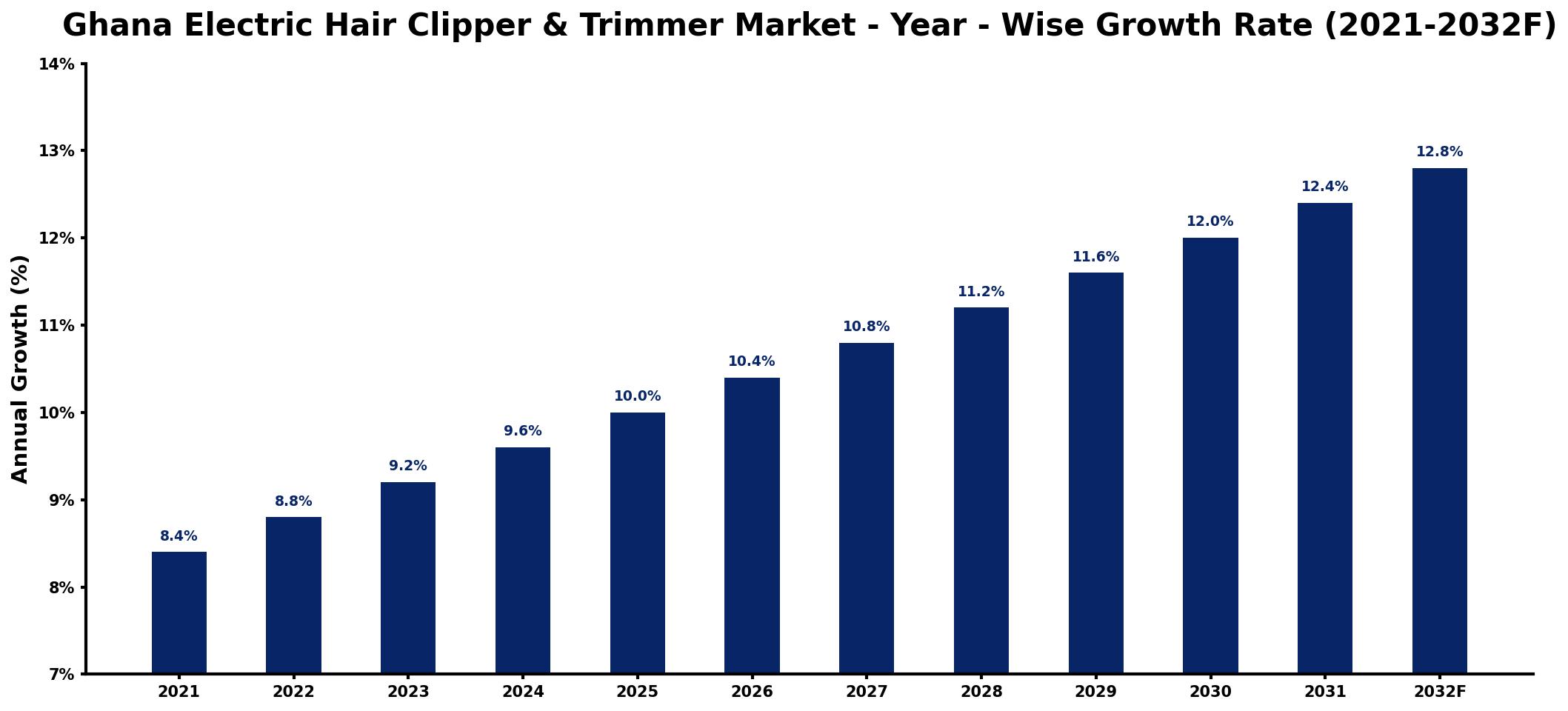
The table below presents the year‑wise growth rates along with the key drivers influencing the market
| Year | Growth Rate | Major Drivers |
| 2021 | 8.4% | Rising consumer grooming awareness |
| 2022 | 8.8% | Increased disposable income levels |
| 2023 | 9.2% | Expansion of beauty salons industry |
| 2024 | 9.6% | Growing popularity of home grooming |
| 2025 | 10.0% | Technological advancements in devices |
| 2026 | 10.4% | Emergence of online retail platforms |
| 2027 | 10.8% | Rising influence of social media |
| 2028 | 11.2% | Growth in personal care spending |
| 2029 | 11.6% | Increase in male grooming trends |
| 2030 | 12.0% | increased overall sector activity |
| 2031 | 12.4% | Investment in local manufacturing facilities |
| 2032 | 12.8% | Surge in global beauty standards |
Note: Market size estimations and growth projections presented in this report are based on 6Wresearch's proprietary forecasting methodology, utilizing the latest available industry data, government publications, and primary research inputs.
Ghana Electric Hair Clipper & Trimmer Market Synopsis
In Ghana, the demand for electric hair clippers and trimmers is notably influenced by the burgeoning population of young adults who prioritize grooming and personal style. This demographic is increasingly seeking products that deliver professional results at home, making electric solutions an attractive choice for many.
Furthermore, the market is evolving with an emphasis on eco-friendly options, as consumers become more environmentally conscious. The introduction of rechargeable, energy-efficient devices is becoming commonplace, signaling a shift toward sustainability in grooming practices across Ghana.
- The market is driven by the increasing popularity of personal grooming among various demographic segments.
- Urbanization and rising disposable incomes are key factors propelling market growth.
- Consumers exhibit a growing preference for multifunctional grooming tools that can perform multiple tasks.
- The trend toward eco-friendly products is influencing the development and marketing of new grooming technologies.
- Strategic partnerships between manufacturers and local grooming establishments are enhancing market accessibility.
Despite its growth potential, the Ghana Electric Hair Clipper & Trimmer market faces several restraints. The presence of cheaper manual clippers presents a significant challenge, especially among price-sensitive consumers. Additionally, inconsistent access to electricity in certain regions can lead to variable product usage, diminishing the appeal of electric grooming tools. The market is also impacted by counterfeit products, which undermine consumer trust and brand loyalty, complicating the landscape for legitimate manufacturers.
The trends shaping the Ghana Electric Hair Clipper & Trimmer market are dynamic and varied. A strong push towards innovative grooming technologies is evident, with many products now featuring cordless operation, enhanced battery life, and precision cutting capabilities. Moreover, consumers are increasingly gravitating towards multifunctional devices that cater to various grooming needs, such as beard trimming and body grooming.
Sustainability is also becoming a key focal point. The market is witnessing a gradual shift towards eco-friendly grooming solutions, as consumers prioritize products made from sustainable materials and energy-efficient technologies. This reflects a broader global trend towards responsible consumption.
The Ghana Electric Hair Clipper & Trimmer market presents numerous investment opportunities as consumer demand for grooming products continues to rise. Investors can benefit from the growing trend towards frequent haircuts and grooming routines, which creates a lucrative market for high-quality electric clippers and trimmers. Strategic partnerships with local barbershops and salons for distribution and training can also prove advantageous, as can the introduction of specialized grooming solutions tailored to local preferences.
The Ghanaian government has implemented various initiatives to support the Electric Hair Clipper & Trimmer market. Quality standards enforced by the Ghana Standards Authority ensure product safety and performance compliance. Import tariffs on electric clippers and trimmers are designed to protect local manufacturing while promoting domestic production. Additionally, the government actively encourages the use of electric grooming tools through awareness campaigns and incentives for local manufacturers, thereby enhancing market competitiveness.
Looking ahead to the period from 2026 to 2032, the Ghana Electric Hair Clipper & Trimmer market is positioned for robust growth. As grooming practices become increasingly integrated into daily life, the anticipated rise in disposable incomes and urban migration will contribute to a sustained demand for electric grooming solutions. Manufacturers are likely to focus on innovative features, such as cordless models and advanced cutting technologies, to meet changing consumer expectations. Overall, the market is set to expand significantly, fostering a culture of personal grooming among both men and women across Ghana.
In recent months, the Ghana Electric Hair Clipper & Trimmer market has seen notable developments, including advancements in product design focused on user experience and ease of handling. Many manufacturers are introducing enhanced ergonomic designs that prioritize comfort for users during grooming sessions. Furthermore, there is a growing emphasis on education and awareness initiatives aimed at informing consumers about the advantages of electric grooming tools over traditional methods, thereby fostering a shift in consumer behavior.
- 10 Years of Market Numbers
- Historical Data Starting from 2022 to 2025
- Base Year: 2025
- Forecast Data until 2032
- Key Performance Indicators Impacting the Market
- Major Upcoming Developments and Projects
Key Highlights of the Report:
- Ghana Electric Hair Clipper & Trimmer Market Outlook
- Market Size of Ghana Electric Hair Clipper & Trimmer Market, 2025
- Forecast of Ghana Electric Hair Clipper & Trimmer Market, 2032
- Historical Data and Forecast of Ghana Electric Hair Clipper & Trimmer Revenues & Volume for the Period 2022-2032F
- Ghana Electric Hair Clipper & Trimmer Market Trend Evolution
- Ghana Electric Hair Clipper & Trimmer Market Drivers and Challenges
- Ghana Electric Hair Clipper & Trimmer Price Trends
- Ghana Electric Hair Clipper & Trimmer Porter's Five Forces
- Ghana Electric Hair Clipper & Trimmer Industry Life Cycle
- Historical Data and Forecast of Ghana Electric Hair Clipper & Trimmer Market Revenues & Volume By Product for the Period 2022-2032F
- Historical Data and Forecast of Ghana Electric Hair Clipper & Trimmer Market Revenues & Volume By Corded for the Period 2022-2032F
- Historical Data and Forecast of Ghana Electric Hair Clipper & Trimmer Market Revenues & Volume By Cordless for the Period 2022-2032F
- Historical Data and Forecast of Ghana Electric Hair Clipper & Trimmer Market Revenues & Volume By Distribution Channel for the Period 2022-2032F
- Historical Data and Forecast of Ghana Electric Hair Clipper & Trimmer Market Revenues & Volume By Offline for the Period 2022-2032F
- Historical Data and Forecast of Ghana Electric Hair Clipper & Trimmer Market Revenues & Volume By Online for the Period 2022-2032F
- Ghana Electric Hair Clipper & Trimmer Import Export Trade Statistics
- Market Opportunity Assessment By Product
- Market Opportunity Assessment By Distribution Channel
- Ghana Electric Hair Clipper & Trimmer Top Companies Market Share
- Ghana Electric Hair Clipper & Trimmer Competitive Benchmarking By Technical and Operational Parameters
- Ghana Electric Hair Clipper & Trimmer Company Profiles
- Ghana Electric Hair Clipper & Trimmer Key Strategic Recommendations






































