Ghana Electrical and electronics Market Summary
The ghana electrical and electronics market was estimated at USD 704 Million in 2025 and is projected to reach USD 1022 Million by 2032, growing at a CAGR of 6.4% from 2026 to 2032.
Ghana Electrical and electronics Market Year-wise Growth Rate and Key Drivers
This graph highlights how the Ghana Electrical and electronics Market has steadily grown over the past five years, supported by major growth factors.
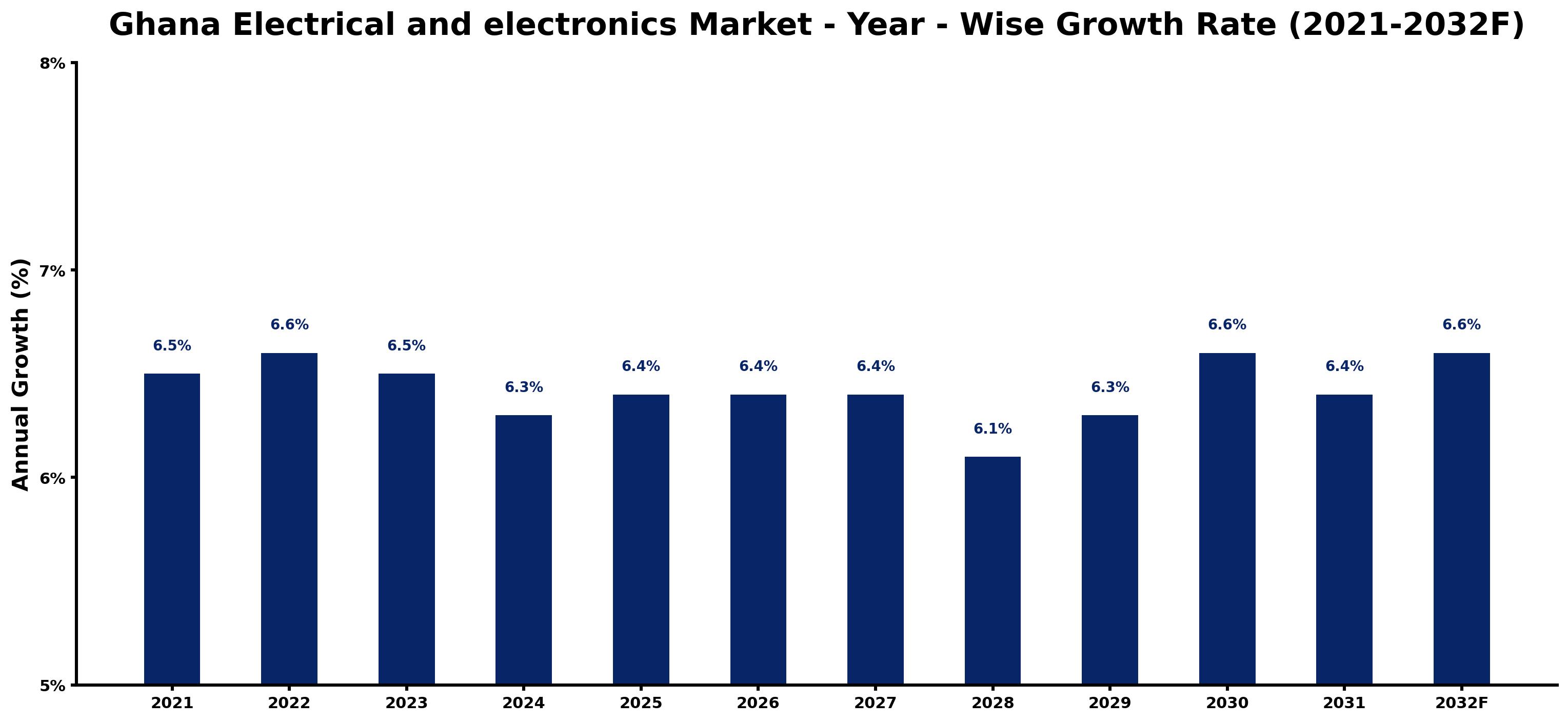
The table below presents the year wise growth rates along with the key drivers influencing the market
| Year | Growth Rate | Major Drivers |
| 2021 | 6.5% | Local manufacturers expanded operations, emphasizing affordability and product accessibility nationwide. |
| 2022 | 6.6% | Electricity reliability issues prompted investment in alternative energy solutions and localized production. |
| 2023 | 6.5% | Major urban centers experienced a surge in demand for smart home technologies. |
| 2024 | 6.3% | Investment in infrastructure projects boosted the supply chain for electrical components significantly. |
| 2025 | 6.4% | Consumer awareness campaigns about energy efficiency influenced purchasing behavior across demographics. |
| 2026 | 6.4% | Corporate partnerships with international firms enhanced technology transfer and local innovation capacity. |
| 2027 | 6.4% | Rural electrification projects intensified, increasing demand for energy-efficient appliances in underserved areas. |
| 2028 | 6.1% | Digital payment systems improved accessibility to electronics, benefiting both urban and rural consumers. |
| 2029 | 6.3% | Urban migration trends drove significant growth in residential electrical installations and renovations. |
| 2030 | 6.6% | Emerging tech startups began to dominate the electronics market with innovative product offerings. |
| 2031 | 6.4% | Consumer preferences shifted towards sustainable and eco-friendly electrical solutions and products. |
| 2032 | 6.6% | Electrification initiatives aligned with regional economic growth, enhancing market stability and expansion. |
Note - Market size estimations and growth projections presented in this report are based on 6Wresearch's advanced forecasting approach, validated with industry datasets as of June 2026.
Ghana Electrical and electronics Market Synopsis
The Ghana Electrical and electronics Market is projected to reach 6.4% and witness significant growth during the forecast period (2026-2032). This burgeoning sector is fueled by a confluence of factors, including rapid urbanization, increased disposable incomes, and proactive government initiatives aimed at enhancing infrastructure. Encompassing a diverse array of products, the market covers household appliances, consumer electronics, lighting solutions, and industrial equipment, reflecting the evolving demands of Ghana's population.
Ghana Electrical and electronics Market Growth Drivers
Key drivers underpinning the growth of the Ghana Electrical and electronics Market include:
- Urbanization is a significant factor, as more individuals migrate to urban centers, resulting in heightened demand for modern electrical and electronic products.
- Rising disposable incomes among Ghana's middle class empower consumers to invest in quality household and electronic goods, fostering market expansion.
- Government initiatives aimed at improving infrastructure and promoting energy efficiency are creating an environment conducive to market growth.
- The shift toward energy-efficient and sustainable products aligns with global trends and local consumer preferences, driving demand for innovative technologies.
- The increasing penetration of digital technologies and e-commerce platforms provides consumers with improved access to a wider range of products, further stimulating market activity.
Ghana Electrical and electronics Market Trends and Opportunities
In the Ghana Electrical and electronics Market, several emerging trends highlight the opportunities available for stakeholders:
- The adoption of renewable energy solutions, particularly solar energy systems, is growing as consumers and businesses seek sustainable alternatives and cost savings.
- Interest in smart home technologies is increasing, as consumers become more focused on energy efficiency and convenience, creating a niche for related products.
- The expanding e-commerce landscape is reshaping consumer purchasing behaviors, with more individuals opting to buy electrical and electronic goods online.
- Investment in local manufacturing practices is gaining momentum, driven by government policies promoting 'Made in Ghana' products, enhancing local industry capabilities.
- Increased availability of financing options for renewable energy projects and green technologies presents attractive opportunities for investors in the electrical and electronics sector.
Ghana Electrical and electronics Market Challenges and Restraints
Despite its positive outlook, the Ghana Electrical and electronics Market faces several challenges that could impede growth:
- Unreliable power supply remains a critical issue, affecting the performance of electrical appliances and discouraging consumer confidence.
- High import duties and taxes on electronic products restrict affordability, impacting the demand for quality goods in the market.
- Limited access to financing options for businesses hampers investment and growth potential, particularly for startups and small enterprises in the sector.
- The prevalence of counterfeit and substandard products poses a significant risk to consumer safety, eroding trust in the electrical and electronics market.
- Regulatory challenges can impact the speed and efficiency of market entry for new products, slowing overall industry growth.
Ghana Electrical and electronics Market Investment Opportunities
The Ghana Electrical and electronics market presents numerous investment opportunities reflecting the sector's dynamism:
- Investment in the renewable energy sector, particularly solar energy solutions, is poised to flourish as demand for sustainable energy options continues to rise.
- The expanding market for consumer electronics products, fueled by rising household incomes, offers substantial opportunities for electrical component suppliers.
- Innovation in smart technologies and energy-efficient solutions represents a rich area for investment as modernization becomes a national priority.
- Government initiatives to extend electricity access in rural areas create significant potential for investors focusing on off-grid and mini-grid projects.
- The increasing consumer preference for quality and reliable electrical products signals opportunities for businesses that prioritize safety and high standards.
Ghana Electrical and electronics Market Government Investment and Initiatives
The government of Ghana actively promotes several policies and initiatives to bolster the electrical and electronics market:
- The Ghana Standards Authority (GSA) Act establishes safety and quality benchmarks for electrical products, ensuring consumer protection and product reliability.
- The Energy Commission Act regulates the energy sector, overseeing electrical installations and appliances to ensure compliance with national standards.
- Government initiatives such as the Made in Ghana campaign encourage local manufacturing, which seeks to enhance industrial capabilities and create jobs.
- Investment in infrastructure development, particularly for energy generation and distribution, remains a priority for the government in promoting market growth.
- Support for the development of renewable energy projects is bolstered by incentives and financing opportunities aimed at diversifying the energy mix.
Ghana Electrical and electronics Market Latest Developments (May 2025 - June 2026)
During the period from May 2025 to June 2026, the Ghana Electrical and electronics market has seen significant developments shaping its trajectory:
- Heightened government focus on renewable energy initiatives has gained momentum, with various projects aimed at enhancing energy efficiency and sustainability.
- Increased collaboration between private and public sectors has been observed, leading to advancements in infrastructure projects that support market growth.
- Expanding e-commerce platforms have transformed consumer purchasing behaviors, enabling easier access to a broader range of electrical products.
- The growing interest in smart home technologies has influenced product development, with consumers seeking more integrated and energy-efficient solutions.
- Regulatory reforms aimed at curbing counterfeit products have seen implementation, striving to increase consumer confidence and market integrity.
Ghana Electrical and electronics Market - Key Attractiveness of the Report
- 10 Years of Market Numbers
- Historical Data Starting from 2022 to 2025
- Base Year: 2025
- Forecast Data until 2032
- Key Performance Indicators Impacting the Market
- Major Upcoming Developments and Projects
Key Highlights of the Report:
- Ghana Electrical and electronics Market Outlook
- Market Size of Ghana Electrical and electronics Market, 2025
- Forecast of Ghana Electrical and electronics Market, 2032F
- Historical Data and Forecast of Ghana Electrical and electronics Revenues & Volume for the Period 2022-2032F
- Ghana Electrical and electronics Market Trend Evolution
- Ghana Electrical and electronics Market Drivers and Challenges
- Ghana Electrical and electronics Price Trends
- Ghana Electrical and electronics Porter's Five Forces
- Ghana Electrical and electronics Industry Life Cycle
- Historical Data and Forecast of Ghana Electrical and electronics Market Revenues & Volume By Type for the Period 2022-2032F
- Historical Data and Forecast of Ghana Electrical and electronics Market Revenues & Volume By Electric Motors for the Period 2022-2032F
- Historical Data and Forecast of Ghana Electrical and electronics Market Revenues & Volume By Primary And Storage Batteries for the Period 2022-2032F
- Historical Data and Forecast of Ghana Electrical and electronics Market Revenues & Volume By Generators for the Period 2022-2032F
- Historical Data and Forecast of Ghana Electrical and electronics Market Revenues & Volume By Semiconductors for the Period 2022-2032F
- Historical Data and Forecast of Ghana Electrical and electronics Market Revenues & Volume By Household Appliances for the Period 2022-2032F
- Historical Data and Forecast of Ghana Electrical and electronics Market Revenues & Volume By Applications for the Period 2022-2032F
- Historical Data and Forecast of Ghana Electrical and electronics Market Revenues & Volume By Online for the Period 2022-2032F
- Historical Data and Forecast of Ghana Electrical and electronics Market Revenues & Volume By Offline for the Period 2022-2032F
- Ghana Electrical and electronics Import Export Trade Statistics
- Market Opportunity Assessment By Type
- Market Opportunity Assessment By Applications
- Ghana Electrical and electronics Top Companies Market Share
- Ghana Electrical and electronics Competitive Benchmarking By Technical and Operational Parameters
- Ghana Electrical and electronics Company Profiles
- Ghana Electrical and electronics Key Strategic Recommendations






































