Ghana Electrical Components Market Size, Share & Growth Rate
The Ghana Electrical Components Market was estimated at USD 523 Million in 2025 and is projected to reach USD 754 Million by 2032, growing at a CAGR of 5.4% from 2026 to 2032. This growth is predominantly fueled by ongoing infrastructure developments and a push towards urbanization, both essential for the nation's economic expansion. Additionally, the rising consumer preference for energy-efficient products significantly boosts demand, as does the government's commitment to enhancing electricity access throughout the country.
Ghana Electrical Components Market Year-wise Growth Rate and Key Drivers
This graph highlights how the Ghana Electrical Components Market has steadily grown over the years, supported by major growth factors.
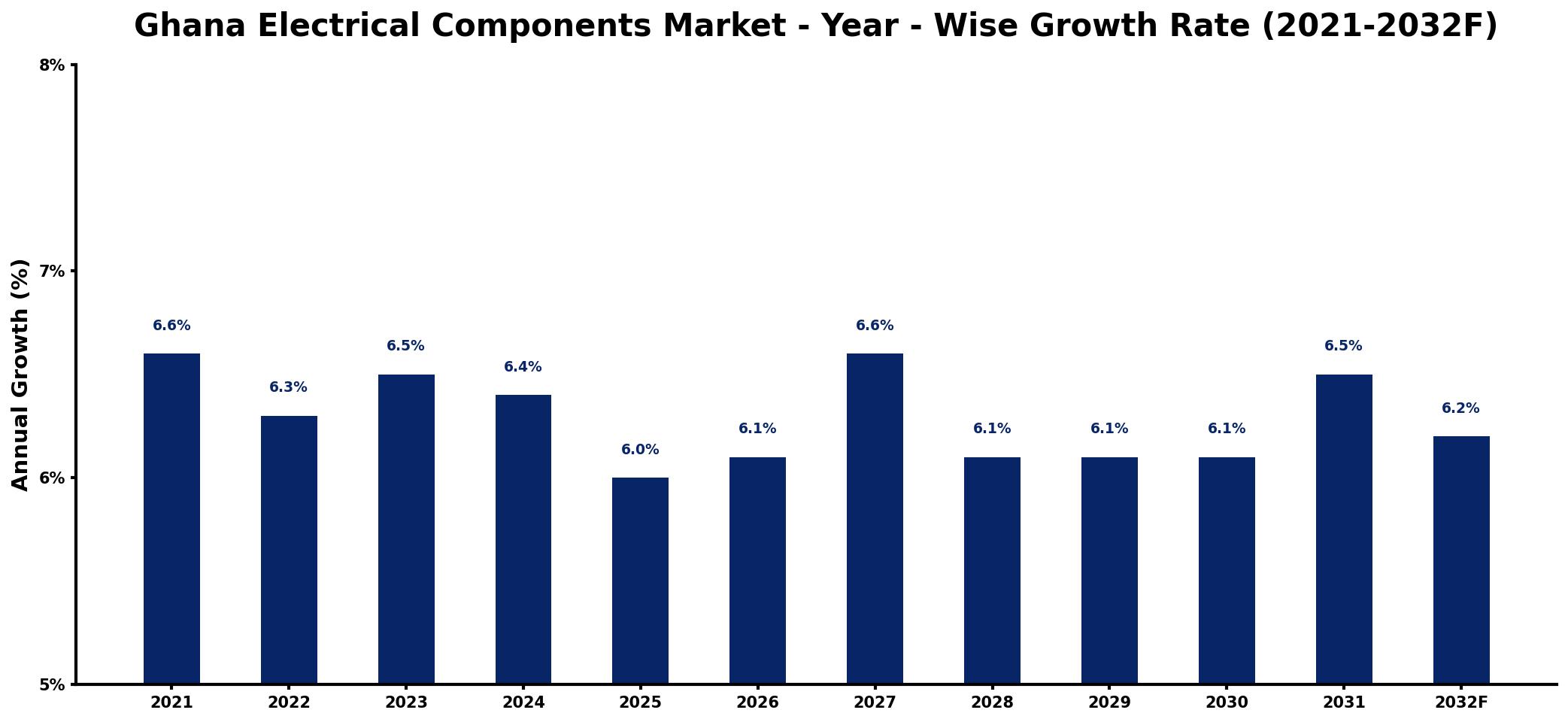
The table below presents the year‑wise growth rates along with the key drivers influencing the market
| Year | Growth Rate | Major Drivers |
| 2021 | 6.6% | Rising construction sector demand |
| 2022 | 6.3% | Increased renewable energy investments |
| 2023 | 6.5% | Expansion of manufacturing capabilities |
| 2024 | 6.4% | Growth in infrastructure projects |
| 2025 | 6.0% | Higher urbanization rates observed |
| 2026 | 6.1% | Boost in technology adoption rates |
| 2027 | 6.6% | Surge in residential developments |
| 2028 | 6.1% | Increased government infrastructure spending |
| 2029 | 6.1% | growing automotive sector requirements |
| 2030 | 6.1% | Rising demand for automation solutions |
| 2031 | 6.5% | strengthening international trade flows |
| 2032 | 6.2% | Increased focus on sustainability initiatives |
Note: Market size estimations and growth projections presented in this report are based on 6Wresearch's proprietary forecasting methodology, utilizing the latest available industry data, government publications, and primary research inputs.
Ghana Electrical Components Market Synopsis
The demand for electrical components in Ghana is steadily increasing, driven by the construction sector and a surge in urban development projects. Products such as cables, switches, and solar-related components are gaining traction, reflecting the countrys shift towards modern energy solutions.
Local manufacturers are rising to the occasion, innovating to meet diverse market needs while competing with established global players. As the market diversifies, quality and sustainability are becoming pivotal in product offerings to satisfy the growing consumer base.
Ghana Electrical Components Market Key Takeaways
- The market is set for robust growth, bolstered by government policies promoting electricity access and energy efficiency.
- Consumer preference is shifting towards smart technologies and renewable energy solutions, driving market innovation.
- The competition among local and international players is intensifying, fostering a landscape of innovation and quality.
- Infrastructure development and urbanization remain primary growth catalysts within the sector.
- Investment opportunities are emerging in sectors such as renewable energy and smart grid technologies.
Evaluation of Restraints in Ghana Electrical Components Market
While the Ghana Electrical Components Market shows promise, several restraints impede its progress. One significant issue is the inconsistent power supply, which results in voltage fluctuations and damages electrical equipment. Additionally, the prevalence of counterfeit products undermines consumer confidence and safety standards, complicating the landscape for both manufacturers and customers. Limited access to financing creates hurdles for consumers looking to adopt innovative solutions, while import duties inflate prices, making quality products less accessible. The market also grapples with a shortage of skilled technicians capable of ensuring proper installation and maintenance, ultimately affecting efficiency and safety.
Ghana Electrical Components Market Trends
The Ghana Electrical Components Market is witnessing significant trends towards sustainability and energy efficiency. There is a marked increase in demand for components associated with renewable energy, particularly solar panels and inverters. Concurrently, smart technology is gaining traction, evident in the burgeoning interest in home automation and energy management systems. This shift represents a broader global trend that is now firmly rooted within the Ghanaian market, with local manufacturers expanding their product portfolios to meet these evolving consumer preferences.
Ghana Electrical Components Market Opportunities
Investment prospects in the Ghana Electrical Components Market are particularly robust in the renewable energy sector, spurred by the countrys commitment to sustainability. As the government promotes initiatives to bolster electricity access and efficiency, theres a growing demand for energy storage systems, smart meters, and solar solutions. Collaborations with local manufacturers present a unique opportunity to tailor products specifically for the Ghanaian market, leveraging the increased interest in modern electrical components that align with global best practices.
Government Initiatives in the Ghana Electrical Components Market
The Ghanaian government has introduced numerous initiatives aimed at fostering growth in the electrical components sector. These include regulatory measures enforced by the Ghana Standards Authority to ensure that products meet quality and safety standards. Additionally, policies have been enacted to reduce import duties on electrical components, encouraging local production and making quality products more accessible to consumers. Government support for renewable energy through initiatives such as the Renewable Energy Act further promotes growth, particularly in rural electrification efforts aimed at enhancing electricity access.
Future Insights of the Ghana Electrical Components Market
Looking ahead to 2026-2032, the Ghana Electrical Components Market is poised for continued growth, driven by increasing urbanization and industrial expansion. With the governments ongoing initiatives to enhance the power sector, demand for electrical components is expected to rise significantly. The markets trajectory will likely be shaped by the growing adoption of renewable energy and a rising focus on energy efficiency, creating a fertile environment for innovative electrical solutions. As Ghana modernizes its energy infrastructure, stakeholders can anticipate substantial opportunities for investment and development.
Ghana Electrical Components Market Latest Developments (2025 - 2026)
Recent developments in the Ghana Electrical Components Market indicate a shift towards more integrated solutions as manufacturers adapt to emerging trends in technology and sustainability. Increased collaborations between local firms and international partners have been noted, particularly in the renewable energy domain, to enhance product offerings. Furthermore, there is a growing emphasis on compliance with safety standards, prompting many manufacturers to invest in upgrading their facilities to meet regulatory requirements. These trends reflect the dynamic nature of the market as it evolves in response to both consumer needs and governmental policies.
Ghana Electrical Components Market - Key Attractiveness of the Report
- 10 Years of Market Numbers
- Historical Data Starting from 2022 to 2025
- Base Year: 2025
- Forecast Data until 2032
- Key Performance Indicators Impacting the Market
- Major Upcoming Developments and Projects
Key Highlights of the Report:
- Ghana Electrical Components Market Outlook
- Market Size of Ghana Electrical Components Market, 2025
- Forecast of Ghana Electrical Components Market, 2032
- Historical Data and Forecast of Ghana Electrical Components Revenues & Volume for the Period 2022-2032F
- Ghana Electrical Components Market Trend Evolution
- Ghana Electrical Components Market Drivers and Challenges
- Ghana Electrical Components Price Trends
- Ghana Electrical Components Porter's Five Forces
- Ghana Electrical Components Industry Life Cycle
- Historical Data and Forecast of Ghana Electrical Components Market Revenues & Volume By Building Automation for the Period 2022-2032F
- Historical Data and Forecast of Ghana Electrical Components Market Revenues & Volume By Datacom Accessories for the Period 2022-2032F
- Historical Data and Forecast of Ghana Electrical Components Market Revenues & Volume By Security & wiring Accessories for the Period 2022-2032F
- Historical Data and Forecast of Ghana Electrical Components Market Revenues & Volume By Cables & Wires for the Period 2022-2032F
- Historical Data and Forecast of Ghana Electrical Components Market Revenues & Volume By Datacom Cables for the Period 2022-2032F
- Historical Data and Forecast of Ghana Electrical Components Market Revenues & Volume By LV Cables for the Period 2022-2032F
- Historical Data and Forecast of Ghana Electrical Components Market Revenues & Volume By MV&HV Cables for the Period 2022-2032F
- Historical Data and Forecast of Ghana Electrical Components Market Revenues & Volume By Special Cables for the Period 2022-2032F
- Historical Data and Forecast of Ghana Electrical Components Market Revenues & Volume By Industrial Automation for the Period 2022-2032F
- Historical Data and Forecast of Ghana Electrical Components Market Revenues & Volume By Automation Controls for the Period 2022-2032F
- Historical Data and Forecast of Ghana Electrical Components Market Revenues & Volume By Auxiliary Controls for the Period 2022-2032F
- Historical Data and Forecast of Ghana Electrical Components Market Revenues & Volume By Drives & Motion Controls for the Period 2022-2032F
- Historical Data and Forecast of Ghana Electrical Components Market Revenues & Volume By Measurement Controls and Relays for the Period 2022-2032F
- Historical Data and Forecast of Ghana Electrical Components Market Revenues & Volume By Lighting for the Period 2022-2032F
- Historical Data and Forecast of Ghana Electrical Components Market Revenues & Volume By Fixtures for the Period 2022-2032F
- Historical Data and Forecast of Ghana Electrical Components Market Revenues & Volume By Lamps & LEDs for the Period 2022-2032F
- Historical Data and Forecast of Ghana Electrical Components Market Revenues & Volume By Power Distribution for the Period 2022-2032F
- Historical Data and Forecast of Ghana Electrical Components Market Revenues & Volume By Cable Management for the Period 2022-2032F
- Historical Data and Forecast of Ghana Electrical Components Market Revenues & Volume By Enclosures & Panels for the Period 2022-2032F
- Historical Data and Forecast of Ghana Electrical Components Market Revenues & Volume By LV Electrical Distribution for the Period 2022-2032F
- Historical Data and Forecast of Ghana Electrical Components Market Revenues & Volume By Renewable Energies for the Period 2022-2032F
- Historical Data and Forecast of Ghana Electrical Components Market Revenues & Volume By HVAC for the Period 2022-2032F
- Historical Data and Forecast of Ghana Electrical Components Market Revenues & Volume By Renewable energy for the Period 2022-2032F
- Historical Data and Forecast of Ghana Electrical Components Market Revenues & Volume By Safety & Tools for the Period 2022-2032F
- Historical Data and Forecast of Ghana Electrical Components Market Revenues & Volume By Safety Equipment for the Period 2022-2032F
- Historical Data and Forecast of Ghana Electrical Components Market Revenues & Volume By Working Tools & Accessories for the Period 2022-2032F
- Ghana Electrical Components Import Export Trade Statistics
- Market Opportunity Assessment By Building Automation
- Market Opportunity Assessment By Cables & Wires
- Market Opportunity Assessment By Industrial Automation
- Market Opportunity Assessment By Lighting
- Market Opportunity Assessment By Power Distribution
- Market Opportunity Assessment By Renewable Energies
- Market Opportunity Assessment By Safety & Tools
- Ghana Electrical Components Top Companies Market Share
- Ghana Electrical Components Competitive Benchmarking By Technical and Operational Parameters
- Ghana Electrical Components Company Profiles
- Ghana Electrical Components Key Strategic Recommendations






































