Ghana Energy Security Market Size & Growth Rate (2026-2032)
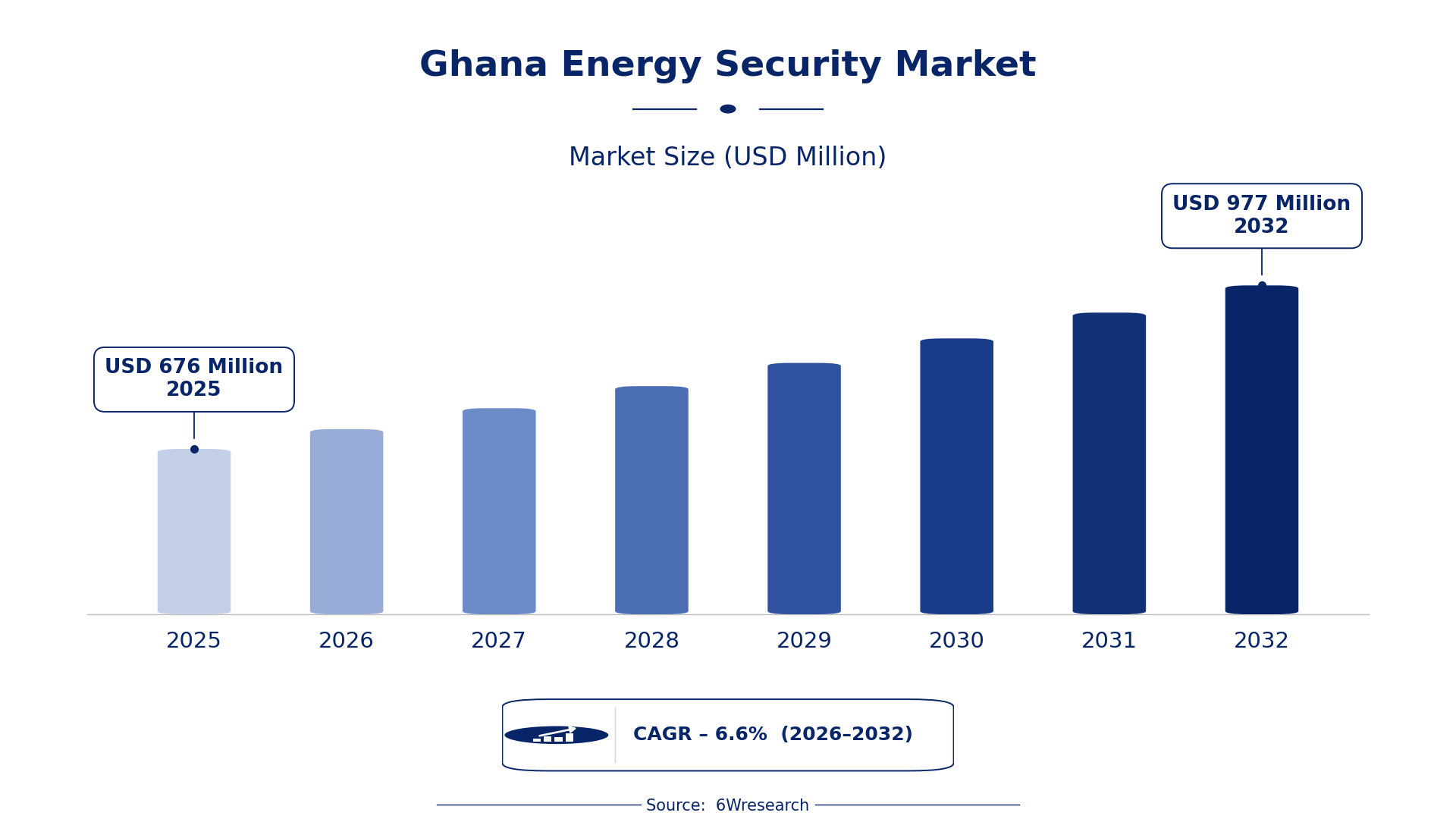
The Ghana Energy Security Market was estimated at USD 676 Million in 2025 and is projected to reach USD 977 Million by 2032, growing at a CAGR of 6.6% from 2026 to 2032.
Ghana Energy Security Market Synopsis
As Ghana seeks to diversify its energy portfolio, the shift towards renewable energy sources like solar and wind is gaining traction. The government's commitment to enhance energy infrastructure is key, drawing investment from both local and international players keen to capitalize on the growth potential.
Inadequate transmission and distribution networks pose a challenge, but the push for energy storage technologies offers hope for improved grid stability. Stakeholders see collaboration as essential to overcoming these hurdles and achieving a more resilient energy future for Ghana.
Ghana Energy Security Market Year-wise Growth Rate and Key Drivers
This graph illustrates the annual growth rates of the Ghana Energy Security Market from 2021 to 2032, highlighting a steady upward trajectory and projected expansion over the forecast period.
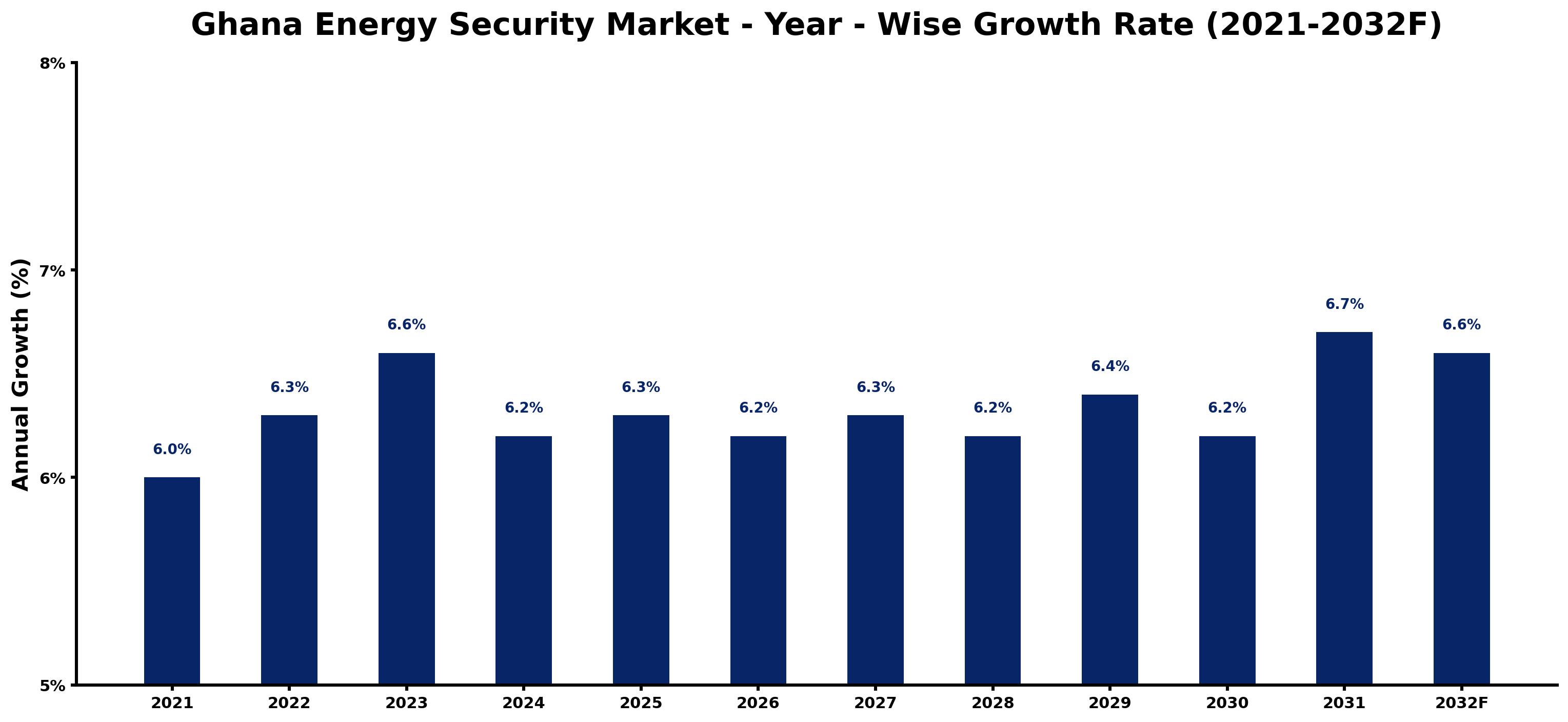
The table below presents the year‑wise growth rates along with the key drivers influencing the market
| Year | Growth Rate | Major Drivers |
| 2021 | 6.0% | Increased government focus on renewable energy investment. |
| 2022 | 6.3% | Adoption of local clean energy policies by Energy Commission. |
| 2023 | 6.6% | Accelerated funding from international development banks. |
| 2024 | 6.2% | Growing public-private partnerships in energy infrastructure projects. |
| 2025 | 6.3% | Increased access to solar technology for households. |
| 2026 | 6.2% | Rising urbanization boosting electricity demand in cities. |
| 2027 | 6.3% | Enhanced regulatory framework for energy efficiency improvements. |
| 2028 | 6.2% | Government incentives for off-grid solar solutions. |
| 2029 | 6.4% | Increased community engagement in energy projects nationwide. |
| 2030 | 6.2% | Support for innovative energy storage solutions in Ghana. |
| 2031 | 6.7% | Development of energy resilience programs post climate events. |
| 2032 | 6.6% | Boosted investment in local energy startups and innovators. |
Note: Market size estimations and growth projections presented in this report are based on 6Wresearch's proprietary forecasting methodology, utilizing the latest available industry data, government publications, and primary research inputs.
Ghana Energy Security Market Key Takeaways
Below are some of the specific key takeaways from the market, including:
- Renewable energy projects are increasingly prioritized, with solar and wind at the forefront of initiatives.
- Investment opportunities are growing in energy storage solutions to stabilize the grid.
- Government policies are designed to enhance energy efficiency across all sectors.
- Collaboration between public and private sectors is critical for infrastructure upgrades.
- Rural electrification programs are expanding to improve access to energy for underserved areas.
Evaluation of Restraints in Ghana Energy Security Market
The Ghana Energy Security Market faces real hurdles that limit its expansion. Inadequate infrastructure continues to plague both urban and rural areas, leading to frequent power outages that disrupt economic activities. Financial constraints also play a significant role, as the reliance on imported fuels compounds the challenges of securing investments in renewable energy initiatives. Coupled with political instability and regulatory uncertainties, these factors deter potential investors and stall progress toward a more secure energy future.
Ghana Energy Security Market Trends
The market is currently witnessing a strong trend toward increasing the share of renewables in the energy mix. Growing environmental awareness has catalyzed interest in sustainable energy solutions, resulting in substantial investments in solar and wind projects. Off-grid solutions are gaining popularity, especially for enhancing energy access in rural communities. The rise of energy efficiency technologies also reflects a shift in how energy is consumed and managed in Ghana.
Ghana Energy Security Market Opportunities
Investment opportunities abound, particularly in renewable energy generation, including solar and wind farms. There is also a burgeoning demand for energy storage systems that can provide backup during outages and enhance grid reliability. As the country works to improve energy efficiency, technologies that optimize consumption are gaining traction. Partnerships between public and private sectors in infrastructure development present further avenues for investment, potentially transforming Ghana’s energy security landscape.
Government Initiatives in the Ghana Energy Security Market
The Ghanaian government is proactive in its approach to improving energy security, implementing various initiatives designed to promote sustainability and efficiency. Recent policies underscore the urgency of diversifying the energy mix while enhancing reliability and access. Regulatory frameworks are being refined to attract both domestic and foreign investment into the sector.
- The Renewable Energy Act, implemented to encourage investment in solar, wind, and hydro projects, has established clearer guidelines for market participation.
- A national energy efficiency labeling program is currently underway to improve energy consumption awareness and standards.
- The Energy Commission has been tasked with overseeing compliance and supporting the energy sector's transition toward renewables.
- A rural electrification initiative, launched to improve access to electricity in underserved areas, is being rolled out with significant government backing.
- Plans for a national grid upgrade project aim to enhance transmission capacity, set to begin in the next few years.
Future Insights of the Ghana Energy Security Market
Looking ahead to 2026-2032, the Ghana Energy Security Market is positioned for growth as the government intensifies efforts to reduce dependency on imported fuels. The focus on expanding renewable energy sources will bolster the country's energy resilience and security. on top of that, innovations in energy storage and efficiency are expected to play a crucial role in shaping a more sustainable energy future, attracting further investment and facilitating economic development.
Ghana Energy Security Market Latest Developments
Over the past year, Ghana's energy sector has seen a surge in initiatives aimed at enhancing energy security and sustainability. The government has been focusing on regulatory improvements and fostering investment in renewable projects. This dynamic environment is conducive to new developments, creating a more favorable landscape for stakeholders.
- A new solar power project was successfully launched in early 2025, expected to provide significant energy to rural communities.
- An energy storage pilot program, currently underway, aims to test various technologies for grid stabilization.
- Plans for a major wind farm project have been announced, with a rollout expected to begin in late 2026.
- A partnership between local authorities and international investors was established to expand energy efficiency programs in urban centers, initiated in Q3 2025.
- Infrastructure upgrades for transmission lines are scheduled to commence by mid-2026 as part of the national grid improvement effort.
Ghana Energy Security Market - Key Attractiveness of the Report
- 10 Years of Market Numbers
- Historical Data Starting from 2022 to 2025
- Base Year: 2025
- Forecast Data until 2032
- Key Performance Indicators Impacting the Market
- Major Upcoming Developments and Projects
Key Highlights of the Report:
- Ghana Energy Security Market Outlook
- Market Size of Ghana Energy Security Market, 2025
- Forecast of Ghana Energy Security Market, 2032
- Historical Data and Forecast of Ghana Energy Security Revenues & Volume for the Period 2022-2032F
- Ghana Energy Security Market Trend Evolution
- Ghana Energy Security Market Drivers and Challenges
- Ghana Energy Security Price Trends
- Ghana Energy Security Porter's Five Forces
- Ghana Energy Security Industry Life Cycle
- Historical Data and Forecast of Ghana Energy Security Market Revenues & Volume By Power Plants for the Period 2022-2032F
- Historical Data and Forecast of Ghana Energy Security Market Revenues & Volume By Nuclear for the Period 2022-2032F
- Historical Data and Forecast of Ghana Energy Security Market Revenues & Volume By Thermal for the Period 2022-2032F
- Historical Data and Forecast of Ghana Energy Security Market Revenues & Volume By Hydro for the Period 2022-2032F
- Historical Data and Forecast of Ghana Energy Security Market Revenues & Volume By Oil for the Period 2022-2032F
- Historical Data and Forecast of Ghana Energy Security Market Revenues & Volume By Gas for the Period 2022-2032F
- Historical Data and Forecast of Ghana Energy Security Market Revenues & Volume By Renewable Energy for the Period 2022-2032F
- Historical Data and Forecast of Ghana Energy Security Market Revenues & Volume By Technologies for the Period 2022-2032F
- Historical Data and Forecast of Ghana Energy Security Market Revenues & Volume By Physical for the Period 2022-2032F
- Historical Data and Forecast of Ghana Energy Security Market Revenues & Volume By Network Security for the Period 2022-2032F
- Ghana Energy Security Import Export Trade Statistics
- Market Opportunity Assessment By Power Plants
- Market Opportunity Assessment By Technologies
- Ghana Energy Security Top Companies Market Share
- Ghana Energy Security Competitive Benchmarking By Technical and Operational Parameters
- Ghana Energy Security Company Profiles
- Ghana Energy Security Key Strategic Recommendations






































