Ghana Farm Equipment Market Size, Share & Growth Rate
The Ghana Farm Equipment Market was estimated at USD 245 Million in 2025 and is projected to reach USD 325 Million by 2032, growing at a CAGR of 4.1% from 2026 to 2032. This positive trajectory is driven by a growing population, which necessitates increased agricultural productivity, alongside a rising awareness of modern farming techniques. Government support in the form of subsidies and incentives further facilitates farmers' access to advanced technologies, while significant foreign investment bolsters the sector by providing the funds needed for essential machinery.
Ghana Farm Equipment Market Growth Rate Analysis (2021-2032)
The Ghana farm equipment market has demonstrated stable growth, with notable rates such as 4.9% in 2021 and 5.0% in 2023, indicating a resilient demand. This expansion can be attributed to rising agricultural productivity, fueled by investments in modern technology and increased consumer demand for mechanization. Notably, 2026 is expected to witness a growth spike to 5.1%, driven by government policies aimed at enhancing food security and boosting local agricultural infrastructure. Fluctuations in growth rates, including a slight decline to 4.6% in 2025 and again in 2032, may reflect short-term adjustment phases as the market adapts to emerging trends in energy transition and greater digitalization within the sector. Overall, these dynamics set a promising stage for future developments.
Ghana Farm Equipment Market Year-wise Growth Rate and Key Drivers
This graph highlights how the Ghana Farm Equipment Market has steadily grown over the past five years, supported by major growth factors.
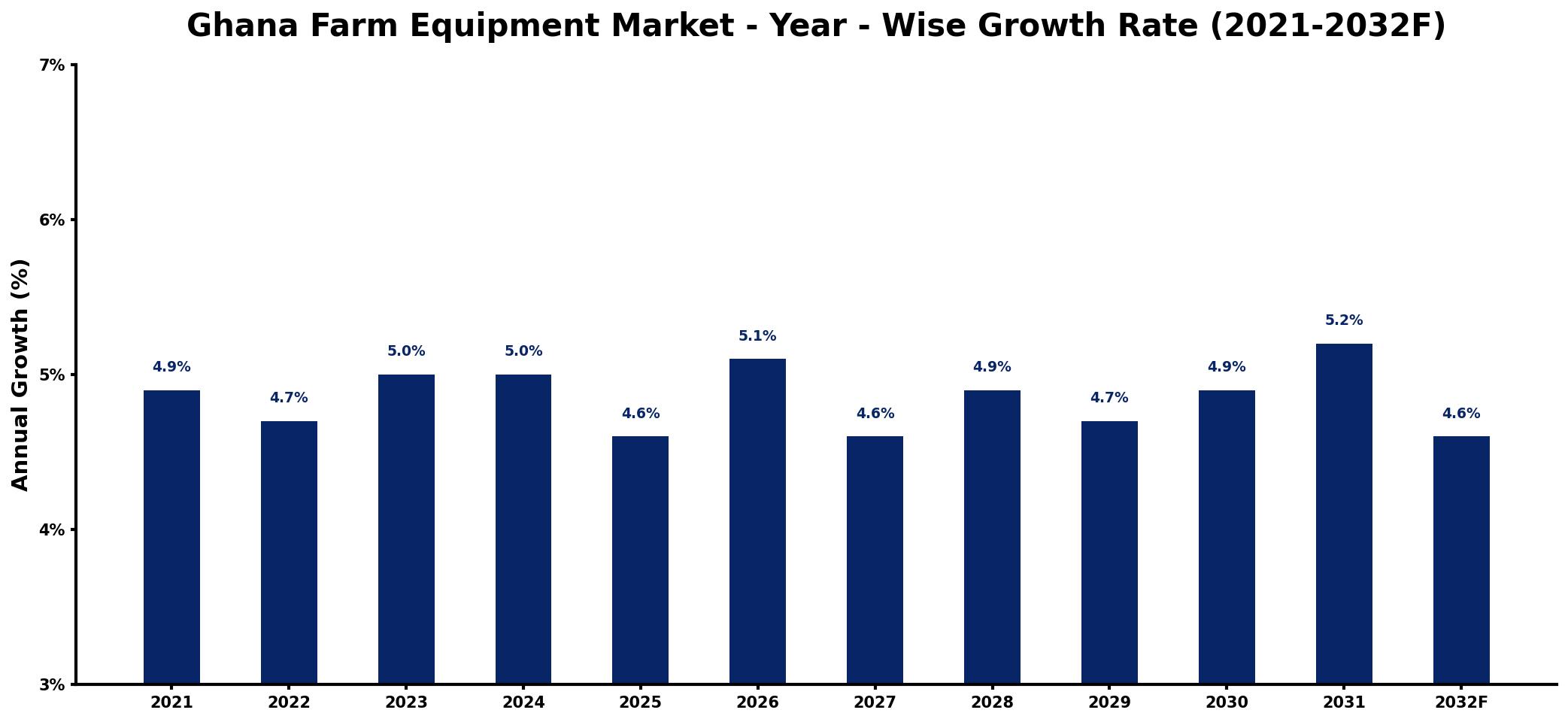
The table below presents the year‑wise growth rates along with the key drivers influencing the market
| Year | Growth Rate | Major Drivers |
| 2021 | 4.9% | Increased agricultural investment initiatives |
| 2022 | 4.7% | Rising demand for mechanized solutions |
| 2023 | 5.0% | Expansion of irrigation infrastructure projects |
| 2024 | 5.0% | Growth in export-oriented agriculture |
| 2025 | 4.6% | Surge in agritech startup funding |
| 2026 | 5.1% | Improved access to financing options |
| 2027 | 4.6% | Increase in rural electrification programs |
| 2028 | 4.9% | Enhanced government agricultural policies |
| 2029 | 4.7% | Boost in crop diversification strategies |
| 2030 | 4.9% | rising export shipment volumes |
| 2031 | 5.2% | Strengthened agricultural research partnerships |
| 2032 | 4.6% | rising infrastructure development spending |
Note: Market size estimations and growth projections presented in this report are based on 6Wresearch's proprietary forecasting methodology, utilizing the latest available industry data, government publications, and primary research inputs.
Ghana Farm Equipment Market Synopsis
The Ghana Farm Equipment Market is witnessing a robust transformation as modern agricultural practices gain traction among local farmers. This shift is propelled by a combination of demographic pressures and supportive government policies aimed at enhancing agricultural efficiency.
International investments are also on the rise, with foreign companies recognizing Ghana's potential for agricultural growth. This influx of capital not only helps to introduce cutting-edge machinery but also encourages competition, ultimately benefitting local manufacturers and driving prices down.
Ghana Farm Equipment Market Key Takeaways
- The Ghana Farm Equipment Market is expected to experience steady growth, reaching USD 325 Million by 2032.
- Government incentives are pivotal in facilitating farmer access to modern agricultural technologies.
- Increased foreign investment is reshaping the market dynamics, bringing new technologies and competition.
- Awareness of innovative farming practices is driving demand for improved machinery.
- The competitive landscape is likely to lower prices for essential farming equipment over time.
Evaluation of Restraints in Ghana Farm Equipment Market
Despite the positive outlook, several constraints affect the growth of the Ghana Farm Equipment Market. Limited access to financing options for smallholder farmers remains a significant barrier, often hindering their ability to invest in modern machinery. Additionally, infrastructural challenges, such as poor road networks and inadequate supply chains, can complicate the distribution of farm equipment. These issues may slow the adoption of advanced technologies that are crucial for maximizing agricultural efficiency.
Ghana Farm Equipment Market Trends
Emerging trends in the Ghana Farm Equipment Market include an increasing adoption of precision agriculture technologies, which are gaining traction among tech-savvy farmers. There is also a noticeable shift toward sustainable farming practices, pushing for equipment that supports eco-friendly operations. Furthermore, the integration of digital solutions, such as farm management software, is enhancing efficiency and productivity, allowing farmers to make data-driven decisions.
Ghana Farm Equipment Market Opportunities
The market presents a wealth of opportunities, particularly in the realm of affordable equipment targeted at small-scale farmers. Moreover, the development of localized manufacturing can help reduce import costs and increase equipment availability. Collaborations between local and international firms to improve technology transfer can further enhance the market's appeal. Investment in training programs for farmers on modern farming techniques will also foster a more informed customer base eager to invest in new equipment.
Government Initiatives in the Ghana Farm Equipment Market
The government of Ghana has initiated various programs aimed at bolstering the agricultural sector, including policies that provide subsidies for purchasing farm equipment. These initiatives are designed to improve access to modern technology for farmers and promote agricultural efficiency. Public spending in rural infrastructure is also being prioritized to enhance supply chains, thereby supporting the overall growth of the farm equipment market.
Future Insights of the Ghana Farm Equipment Market
Looking forward to the period between 2026 and 2032, the Ghana Farm Equipment Market is poised for expansion driven by ongoing demographic shifts and increased investment in agricultural technology. As farmers become more educated about modern agricultural practices, the demand for advanced machinery will rise. Continued government support and the emergence of innovative financing solutions will likely empower even smallholder farmers, ensuring widespread adoption of modern equipment across the sector.
Ghana Farm Equipment Market Latest Developments (2025 - 2026)
Recent developments indicate a growing interest among both local and international players in establishing partnerships to enhance the supply of farm machinery. Initiatives focused on providing training programs for farmers have gained momentum, enabling them to better utilize modern equipment. Additionally, advancements in technology have led to the introduction of more efficient, user-friendly machinery tailored for the local agricultural landscape, improving the overall productivity of the sector.
Ghana Farm Equipment Market - Key Attractiveness of the Report
- 10 Years of Market Numbers
- Historical Data Starting from 2022 to 2025
- Base Year: 2025
- Forecast Data until 2032
- Key Performance Indicators Impacting the Market
- Major Upcoming Developments and Projects
Key Highlights of the Report:
- Ghana Farm Equipment Market Outlook
- Market Size of Ghana Farm Equipment Market, 2025
- Forecast of Ghana Farm Equipment Market, 2032
- Historical Data and Forecast of Ghana Farm Equipment Revenues & Volume for the Period 2022-2032F
- Ghana Farm Equipment Market Trend Evolution
- Ghana Farm Equipment Market Drivers and Challenges
- Ghana Farm Equipment Price Trends
- Ghana Farm Equipment Porter's Five Forces
- Ghana Farm Equipment Industry Life Cycle
- Historical Data and Forecast of Ghana Farm Equipment Market Revenues & Volume By Power Output for the Period 2022-2032F
- Historical Data and Forecast of Ghana Farm Equipment Market Revenues & Volume By <30 HP for the Period 2022-2032F
- Historical Data and Forecast of Ghana Farm Equipment Market Revenues & Volume By 31�70 HP for the Period 2022-2032F
- Historical Data and Forecast of Ghana Farm Equipment Market Revenues & Volume By 71�130 HP for the Period 2022-2032F
- Historical Data and Forecast of Ghana Farm Equipment Market Revenues & Volume By 131�250 HP for the Period 2022-2032F
- Historical Data and Forecast of Ghana Farm Equipment Market Revenues & Volume By >250 HP for the Period 2022-2032F
- Historical Data and Forecast of Ghana Farm Equipment Market Revenues & Volume By Drive Type for the Period 2022-2032F
- Historical Data and Forecast of Ghana Farm Equipment Market Revenues & Volume By Two-wheel for the Period 2022-2032F
- Historical Data and Forecast of Ghana Farm Equipment Market Revenues & Volume By Four-wheel for the Period 2022-2032F
- Historical Data and Forecast of Ghana Farm Equipment Market Revenues & Volume By Function for the Period 2022-2032F
- Historical Data and Forecast of Ghana Farm Equipment Market Revenues & Volume By Plowing & Cultivating for the Period 2022-2032F
- Historical Data and Forecast of Ghana Farm Equipment Market Revenues & Volume By Sowing & Planting for the Period 2022-2032F
- Historical Data and Forecast of Ghana Farm Equipment Market Revenues & Volume By Plant Protection & Fertilizing for the Period 2022-2032F
- Historical Data and Forecast of Ghana Farm Equipment Market Revenues & Volume By Harvesting & Threshing for the Period 2022-2032F
- Historical Data and Forecast of Ghana Farm Equipment Market Revenues & Volume By Others for the Period 2022-2032F
- Historical Data and Forecast of Ghana Farm Equipment Market Revenues & Volume By Equipment Type for the Period 2022-2032F
- Historical Data and Forecast of Ghana Farm Equipment Market Revenues & Volume By Tractors for the Period 2022-2032F
- Historical Data and Forecast of Ghana Farm Equipment Market Revenues & Volume By Combines for the Period 2022-2032F
- Historical Data and Forecast of Ghana Farm Equipment Market Revenues & Volume By Sprayers for the Period 2022-2032F
- Historical Data and Forecast of Ghana Farm Equipment Market Revenues & Volume By Balers for the Period 2022-2032F
- Historical Data and Forecast of Ghana Farm Equipment Market Revenues & Volume By Others for the Period 2022-2032F
- Ghana Farm Equipment Import Export Trade Statistics
- Market Opportunity Assessment By Power Output
- Market Opportunity Assessment By Drive Type
- Market Opportunity Assessment By Function
- Market Opportunity Assessment By Equipment Type
- Ghana Farm Equipment Top Companies Market Share
- Ghana Farm Equipment Competitive Benchmarking By Technical and Operational Parameters
- Ghana Farm Equipment Company Profiles
- Ghana Farm Equipment Key Strategic Recommendations






































