Ghana Fish Farming Market Size, Share & Growth Rate
The Ghana Fish Farming Market was estimated at USD 184 Million in 2025 and is projected to reach USD 258 Million by 2032, growing at a CAGR of 4.9% from 2026 to 2032. This robust growth trajectory is primarily driven by increasing local demand for affordable and nutritious fish, particularly tilapia, amidst declining wild fish stocks. Furthermore, government initiatives aimed at promoting sustainable aquaculture practices are bolstering the market's prospects.
Ghana Fish Farming Market Year-wise Growth Rate and Key Drivers
This graph highlights how the Ghana Fish Farming Market has steadily grown over the years, supported by major growth factors.
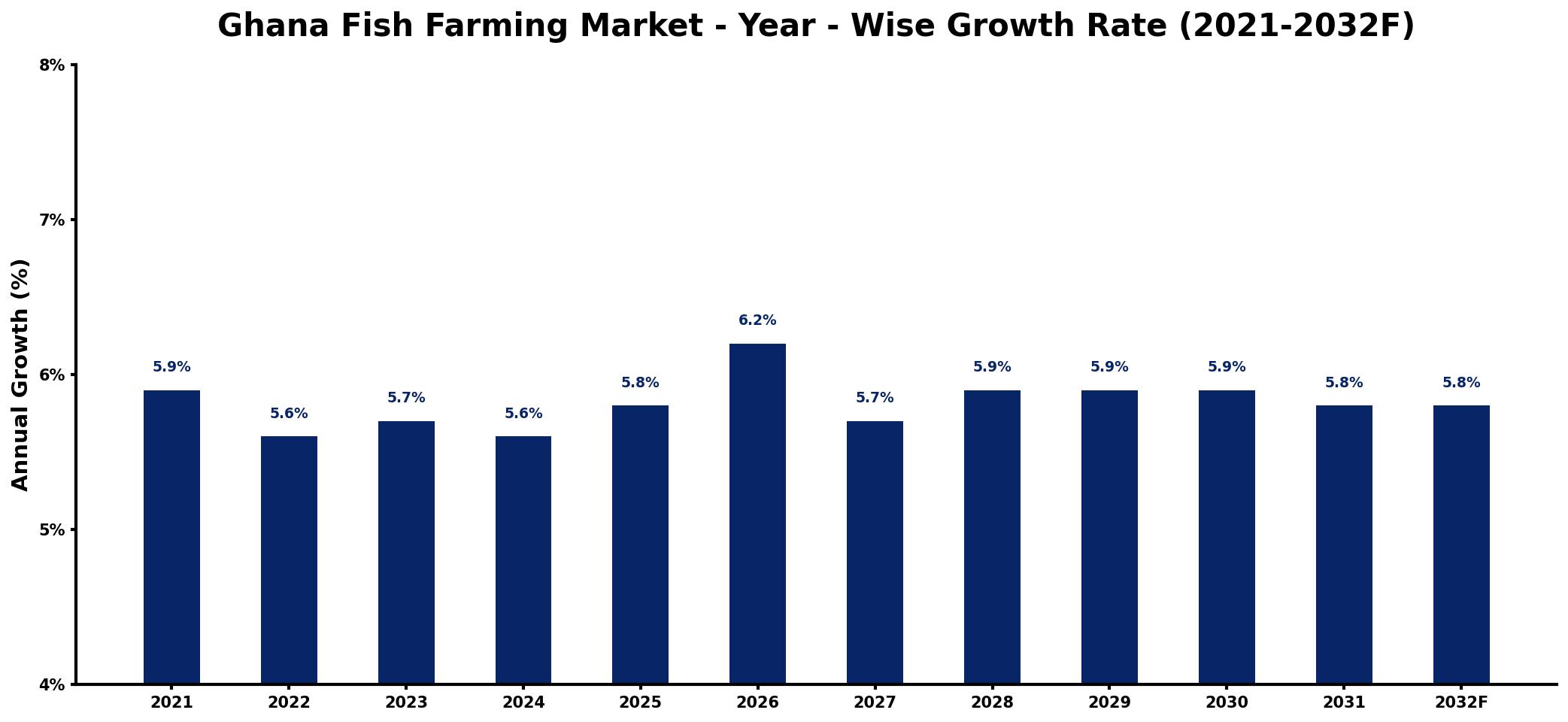
The table below presents the year‑wise growth rates along with the key drivers influencing the market
| Year | Growth Rate | Major Drivers |
| 2021 | 5.9% | increased local consumption rates |
| 2022 | 5.6% | rising investment in aquaculture |
| 2023 | 5.7% | growing export opportunities abroad |
| 2024 | 5.6% | enhanced technological advancements adoption |
| 2025 | 5.8% | expanding distribution networks efficiency |
| 2026 | 6.2% | increased government support initiatives |
| 2027 | 5.7% | higher consumer awareness programs |
| 2028 | 5.9% | strengthened partnerships with retailers |
| 2029 | 5.9% | developing sustainable practices integration |
| 2030 | 5.9% | increased research and innovation funding |
| 2031 | 5.8% | growing demand for protein sources |
| 2032 | 5.8% | strengthened agricultural policy frameworks |
Note: Market size estimations and growth projections presented in this report are based on 6Wresearch's proprietary forecasting methodology, utilizing the latest available industry data, government publications, and primary research inputs.
Ghana Fish Farming Market Synopsis
In Ghana, fish farming is increasingly recognized as a vital component of food security, with aquaculture contributing significantly to the national protein supply. The tilt towards aquaculture is largely attributed to a growing population that demands consistent and quality fish supply, especially as wild stocks dwindle.
The market is populated by a mix of small-scale farmers and larger commercial operations, with tilapia leading as the most cultivated species. However, the sector is not without its challenges; issues related to quality feed access, disease management, and resource allocation are pivotal in determining overall productivity and sustainability.
Ghana Fish Farming Market Key Takeaways
- Ghana's aquaculture sector is experiencing rapid growth, fueled by rising demand for fish protein.
- Government initiatives are fostering sustainable practices, enhancing fish farming's long-term viability.
- Key challenges such as feed quality, disease control, and infrastructure need addressing for optimal growth.
- There is increasing interest in integrated fish farming systems that combine aquaculture with crop and livestock production.
- Investment opportunities abound, especially in modern aquaculture technologies and value-added processing.
Evaluation of Restraints in Ghana Fish Farming Market
Despite its promising growth, the Ghana fish farming market is constrained by several critical factors. A pervasive issue is the inadequate access to high-quality feeds, which directly impacts fish growth rates and overall productivity. Additionally, farmers often struggle with limited technical expertise, hampering the adoption of modern aquaculture practices that could enhance yields. Poor infrastructure for transportation and storage further complicates the distribution process, leading to significant post-harvest losses. These constraints must be addressed if the industry is to reach its full potential.
Ghana Fish Farming Market Trends
The Ghana fish farming landscape is witnessing a number of transformative trends. The integration of technology, such as recirculating aquaculture systems and automated feeding, is revolutionizing production efficiency. Additionally, theres a growing emphasis on sustainable practices that balance productivity with environmental stewardship. Moreover, farmers are increasingly exploring value-added processing to cater to both local and export markets, enhancing market competitiveness.
Ghana Fish Farming Market Opportunities
Investment prospects in the Ghana fish farming market are abundant, particularly due to the consistent demand for fish as a primary protein source. Areas ripe for investment include the establishment of modern fish farms, development of sustainable feed production facilities, and the establishment of processing plants tailored to meet both local and international standards. Furthermore, collaborations with local farmers to improve production practices could significantly enhance overall market competitiveness.
Government Initiatives in the Ghana Fish Farming Market
The Ghanaian government is actively promoting the fish farming sector through various supportive policies. The Aquaculture Development Policy aims to boost domestic fish production by offering incentives such as tax breaks and subsidies. The Fisheries Act of 2002 sets clear regulatory frameworks for fish farming, including licensing requirements and standards for practice. Additionally, the government prioritizes research and development initiatives to enhance aquaculture productivity and sustainability, fostering a robust framework for industry growth.
Future Insights of the Ghana Fish Farming Market
Looking ahead to 2026-2032, the Ghana fish farming market is poised for consistent expansion. Population growth coupled with heightened awareness of fish's health benefits is expected to amplify demand. Moreover, continued government support, particularly in promoting sustainable practices and improving infrastructure, will serve as a catalyst for market growth. The integration of advanced technologies and innovative farming techniques further positions this sector for significant advancements in productivity and efficiency.
Ghana Fish Farming Market Latest Developments (2025 - 2026)
Recent developments within the Ghana fish farming industry indicate a shift towards adopting more sustainable aquaculture practices. There is an increasing push for integrated farming systems that optimize land use and resource management. Additionally, training programs aimed at enhancing farmers' technical skills are being launched to address gaps in expertise. These initiatives signify a concerted effort to modernize the sector, enhance productivity, and reduce environmental impacts.
Ghana Fish Farming Market - Key Attractiveness of the Report
- 10 Years of Market Numbers
- Historical Data Starting from 2022 to 2025
- Base Year: 2025
- Forecast Data until 2032
- Key Performance Indicators Impacting the Market
- Major Upcoming Developments and Projects
Key Highlights of the Report:
- Ghana Fish Farming Market Outlook
- Market Size of Ghana Fish Farming Market, 2025
- Forecast of Ghana Fish Farming Market, 2032
- Historical Data and Forecast of Ghana Fish Farming Revenues & Volume for the Period 2022-2032F
- Ghana Fish Farming Market Trend Evolution
- Ghana Fish Farming Market Drivers and Challenges
- Ghana Fish Farming Price Trends
- Ghana Fish Farming Porter's Five Forces
- Ghana Fish Farming Industry Life Cycle
- Historical Data and Forecast of Ghana Fish Farming Market Revenues & Volume By Environment for the Period 2022-2032F
- Historical Data and Forecast of Ghana Fish Farming Market Revenues & Volume By Marine Water for the Period 2022-2032F
- Historical Data and Forecast of Ghana Fish Farming Market Revenues & Volume By Fresh Water for the Period 2022-2032F
- Historical Data and Forecast of Ghana Fish Farming Market Revenues & Volume By Brackish Water for the Period 2022-2032F
- Historical Data and Forecast of Ghana Fish Farming Market Revenues & Volume By Fish Type for the Period 2022-2032F
- Historical Data and Forecast of Ghana Fish Farming Market Revenues & Volume By Pompano for the Period 2022-2032F
- Historical Data and Forecast of Ghana Fish Farming Market Revenues & Volume By Snappers for the Period 2022-2032F
- Historical Data and Forecast of Ghana Fish Farming Market Revenues & Volume By Groupers for the Period 2022-2032F
- Historical Data and Forecast of Ghana Fish Farming Market Revenues & Volume By Salmon for the Period 2022-2032F
- Historical Data and Forecast of Ghana Fish Farming Market Revenues & Volume By Milkfish for the Period 2022-2032F
- Historical Data and Forecast of Ghana Fish Farming Market Revenues & Volume By Tuna for the Period 2022-2032F
- Historical Data and Forecast of Ghana Fish Farming Market Revenues & Volume By Tilapia for the Period 2022-2032F
- Historical Data and Forecast of Ghana Fish Farming Market Revenues & Volume By Others for the Period 2022-2032F
- Ghana Fish Farming Import Export Trade Statistics
- Market Opportunity Assessment By Environment
- Market Opportunity Assessment By Fish Type
- Ghana Fish Farming Top Companies Market Share
- Ghana Fish Farming Competitive Benchmarking By Technical and Operational Parameters
- Ghana Fish Farming Company Profiles
- Ghana Fish Farming Key Strategic Recommendations






































