Ghana Food Dehydrators Market Size, Share & Growth Rate
The Ghana Food Dehydrators Market was estimated at USD 839 Million in 2025 and is projected to reach USD 1209 Million by 2032, growing at a CAGR of 5.4% from 2026 to 2032. This growth trajectory is primarily driven by an increasing awareness among consumers about food preservation benefits and the rising demand for healthy, convenient snack options. Coupled with government initiatives aimed at improving food security, the market is well-positioned to expand as both households and commercial enterprises embrace modern preservation methods.
Ghana Food Dehydrators Market Year-wise Growth Rate and Key Drivers
This graph highlights how the Ghana Food Dehydrators Market has steadily grown over the years, supported by major growth factors.
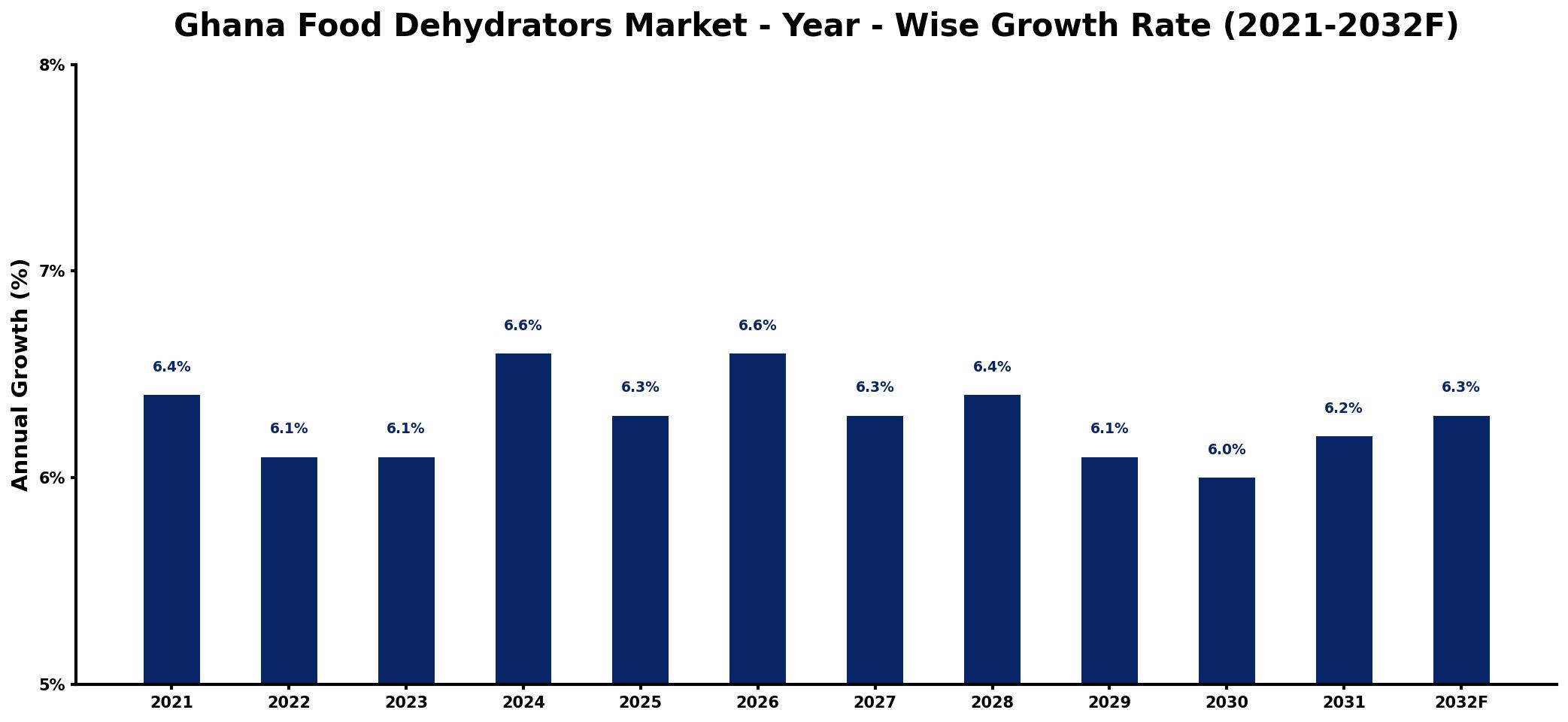
The table below presents the year‑wise growth rates along with the key drivers influencing the market
| Year | Growth Rate | Major Drivers |
| 2021 | 6.4% | increased health consciousness among consumers |
| 2022 | 6.1% | rising demand for organic snacks |
| 2023 | 6.1% | growing popularity of home preservation |
| 2024 | 6.6% | expansion of retail distribution channels |
| 2025 | 6.3% | increased investment in sustainable practices |
| 2026 | 6.6% | greater awareness of nutritional benefits |
| 2027 | 6.3% | surge in online shopping trends |
| 2028 | 6.4% | more affordable energy-efficient options |
| 2029 | 6.1% | emergence of innovative preservation techniques |
| 2030 | 6.0% | increased focus on waste reduction |
| 2031 | 6.2% | growing interest in culinary arts |
| 2032 | 6.3% | expanding manufacturing base activity |
Note: Market size estimations and growth projections presented in this report are based on 6Wresearch's proprietary forecasting methodology, utilizing the latest available industry data, government publications, and primary research inputs.
Ghana Food Dehydrators Market Synopsis
The Ghana Food Dehydrators Market is at a pivotal point, characterized by a blend of local innovation and international investment. The increasing trend of home food preservation is not just about convenience; it reflects a deeper understanding of sustainability and food waste reduction among consumers.
As the market evolves, both local and foreign players are enhancing their product offerings to cater to diverse consumer needs. This includes the introduction of energy-efficient dehydrators and compact models tailored for urban households, making food preservation accessible to a broader demographic.
Ghana Food Dehydrators Market Key Takeaways
- The market is benefiting from a growing agricultural sector and advancements in food processing technologies.
- Consumer preferences are shifting towards energy-efficient and nutrient-retaining dehydrators.
- Government policies supporting food security and agricultural resilience are facilitating market expansion.
- Local manufacturers are focused on producing affordable high-quality dehydrators for various consumer segments.
- The surge in demand for processed foods and healthy snacks is driving innovation in product development.
Evaluation of Restraints in Ghana Food Dehydrators Market
Despite the promising growth outlook, the Ghana Food Dehydrators Market faces notable restraints. A significant barrier is the limited awareness and understanding of food dehydration technology, particularly among small-scale farmers and food processors. This lack of knowledge often results in underutilization of available equipment and missed opportunities for improved food preservation. Furthermore, inconsistent power supply and high energy costs create operational challenges for businesses in this space, potentially impacting profitability and production capabilities. To address these issues, there is an urgent need for education and training initiatives aimed at empowering local stakeholders.
Ghana Food Dehydrators Market Trends
Current trends in the Ghana Food Dehydrators Market indicate a significant consumer shift towards health-conscious eating habits. As people become more aware of the nutritional benefits of dehydrated foods, they are increasingly inclined to purchase dehydrators that preserve the flavor and vitamins of fresh produce. Additionally, the demand for compact, user-friendly models is on the rise, especially among urban dwellers with limited kitchen space. Another trend is the growing interest in dehydrators equipped with advanced features, such as adjustable temperature settings and multi-tray options, that enhance convenience and efficiency in food preparation.
Ghana Food Dehydrators Market Opportunities
The Ghana Food Dehydrators Market offers substantial investment opportunities, particularly for manufacturers and distributors focused on innovative food preservation solutions. Given the country's strong agricultural sector, there is a unique chance to introduce affordable dehydrator models specifically designed for local consumer needs. Additionally, the rise in demand for processed foods presents avenues for partnerships with commercial producers and exporters, ensuring that more dried products reach both local and international markets. By tapping into the growing interest in sustainability and healthier eating habits, businesses can carve out significant market share in this burgeoning industry.
Government Initiatives in the Ghana Food Dehydrators Market
The Ghanaian government has rolled out several supportive policies aimed at bolstering the food dehydrators market. One prominent initiative is the National Food and Agriculture Resilience Management Plan, which advocates for the adoption of modern technologies, including food dehydrators, to enhance agricultural productivity and food security. Additionally, various agricultural financing schemes and subsidies have been established to facilitate access to affordable dehydrators for small-scale farmers, helping them reduce post-harvest losses and improve food preservation techniques.
Future Insights of the Ghana Food Dehydrators Market
Looking ahead to 2026-2032, the Ghana Food Dehydrators Market is poised for continued growth. Increasing awareness of food preservation methods, combined with the rising consumer demand for healthy and convenient food options, will drive market expansion. As technological advancements lead to more efficient and user-friendly dehydrator designs, it is likely that adoption rates will rise among both households and commercial enterprises. Furthermore, the ongoing emphasis on sustainability and reducing food waste is expected to further fuel interest in dehydrators as an essential tool for modern food preparation and storage.
Ghana Food Dehydrators Market Latest Developments (2025 - 2026)
Recent developments within the Ghana Food Dehydrators Market have seen a notable uptick in innovative product launches aimed at enhancing consumer experience. Manufacturers are increasingly focusing on energy-efficient models that appeal to environmentally conscious consumers. Additionally, trade exhibitions and workshops are being organized to raise awareness about the benefits of food dehydration, contributing to a greater understanding and adoption of this preservation method across various demographics in Ghana.
Ghana Food Dehydrators Market - Key Attractiveness of the Report
- 10 Years of Market Numbers
- Historical Data Starting from 2022 to 2025
- Base Year: 2025
- Forecast Data until 2032
- Key Performance Indicators Impacting the Market
- Major Upcoming Developments and Projects
Key Highlights of the Report:
- Ghana Food Dehydrators Market Outlook
- Market Size of Ghana Food Dehydrators Market, 2025
- Forecast of Ghana Food Dehydrators Market, 2032
- Historical Data and Forecast of Ghana Food Dehydrators Revenues & Volume for the Period 2022-2032F
- Ghana Food Dehydrators Market Trend Evolution
- Ghana Food Dehydrators Market Drivers and Challenges
- Ghana Food Dehydrators Price Trends
- Ghana Food Dehydrators Porter's Five Forces
- Ghana Food Dehydrators Industry Life Cycle
- Historical Data and Forecast of Ghana Food Dehydrators Market Revenues & Volume By Technology for the Period 2022-2032F
- Historical Data and Forecast of Ghana Food Dehydrators Market Revenues & Volume By Vertical Flow for the Period 2022-2032F
- Historical Data and Forecast of Ghana Food Dehydrators Market Revenues & Volume By Horizontal Flow for the Period 2022-2032F
- Historical Data and Forecast of Ghana Food Dehydrators Market Revenues & Volume By End-Use for the Period 2022-2032F
- Historical Data and Forecast of Ghana Food Dehydrators Market Revenues & Volume By Industrial for the Period 2022-2032F
- Historical Data and Forecast of Ghana Food Dehydrators Market Revenues & Volume By Commercial for the Period 2022-2032F
- Historical Data and Forecast of Ghana Food Dehydrators Market Revenues & Volume By Residential for the Period 2022-2032F
- Historical Data and Forecast of Ghana Food Dehydrators Market Revenues & Volume By Others for the Period 2022-2032F
- Historical Data and Forecast of Ghana Food Dehydrators Market Revenues & Volume By Energy Source for the Period 2022-2032F
- Historical Data and Forecast of Ghana Food Dehydrators Market Revenues & Volume By Electricity for the Period 2022-2032F
- Historical Data and Forecast of Ghana Food Dehydrators Market Revenues & Volume By Biofuel for the Period 2022-2032F
- Historical Data and Forecast of Ghana Food Dehydrators Market Revenues & Volume By Solar for the Period 2022-2032F
- Historical Data and Forecast of Ghana Food Dehydrators Market Revenues & Volume By Others for the Period 2022-2032F
- Ghana Food Dehydrators Import Export Trade Statistics
- Market Opportunity Assessment By Technology
- Market Opportunity Assessment By End-Use
- Market Opportunity Assessment By Energy Source
- Ghana Food Dehydrators Top Companies Market Share
- Ghana Food Dehydrators Competitive Benchmarking By Technical and Operational Parameters
- Ghana Food Dehydrators Company Profiles
- Ghana Food Dehydrators Key Strategic Recommendations






































