Ghana Food & Grocery Retail Market Size, Share & Growth Rate
The Ghana Food & Grocery Retail Market was estimated at USD 1155 Million in 2025 and is projected to reach USD 2102 Million by 2032, growing at a CAGR of 8.9% from 2026 to 2032. This growth trajectory is largely influenced by rapid urbanization, an expanding middle class, and evolving consumer preferences towards modern retail formats. With the increasing population and a rising demand for convenience, the retail landscape is shifting significantly, presenting numerous opportunities for investment.
Ghana Food & Grocery Retail Market Year-wise Growth Rate and Key Drivers
This graph highlights how the Ghana Food & Grocery Retail Market has steadily grown over the years, supported by major growth factors.
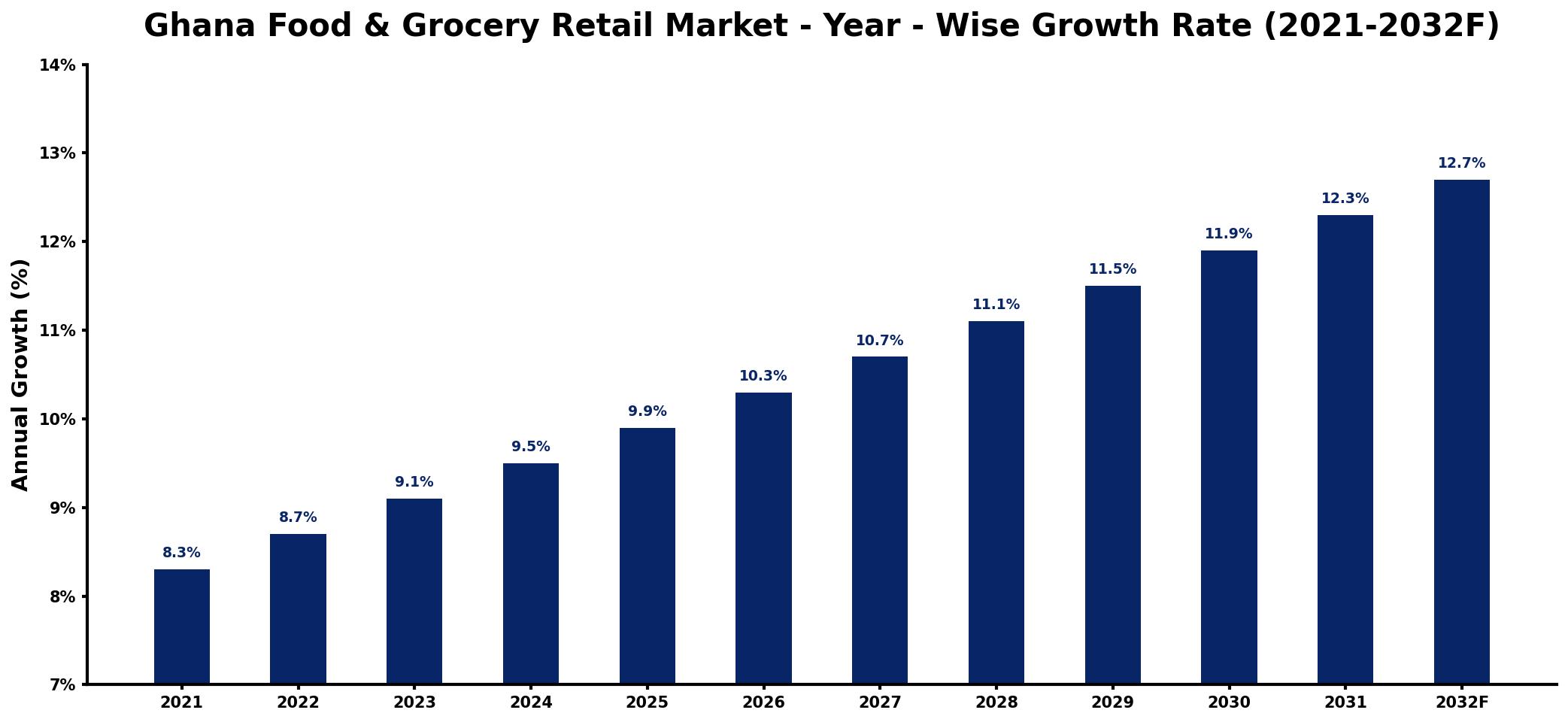
The table below presents the year‑wise growth rates along with the key drivers influencing the market
| Year | Growth Rate | Major Drivers |
| 2021 | 8.3% | Rising consumer spending power |
| 2022 | 8.7% | Expansion of distribution networks |
| 2023 | 9.1% | growing commercial sector adoption |
| 2024 | 9.5% | Growth in e-commerce platforms |
| 2025 | 9.9% | Investment in local agriculture |
| 2026 | 10.3% | Emergence of health-conscious consumers |
| 2027 | 10.7% | Advancements in supply chain technology |
| 2028 | 11.1% | Diversification of product offerings |
| 2029 | 11.5% | Strengthening of local partnerships |
| 2030 | 11.9% | Increased foreign investment inflows |
| 2031 | 12.3% | Growing demand for convenience |
| 2032 | 12.7% | Rise of sustainable practices |
Note: Market size estimations and growth projections presented in this report are based on 6Wresearch's proprietary forecasting methodology, utilizing the latest available industry data, government publications, and primary research inputs.
Ghana Food & Grocery Retail Market Synopsis
The Ghana Food & Grocery Retail Market is witnessing a transformative phase, characterized by a gradual transition from traditional markets to modern retail formats such as supermarkets and convenience stores. While informal vendors continue to dominate, consumers are increasingly drawn to retailers that offer a diverse range of products and improved shopping experiences.
Additionally, e-commerce is starting to reshape consumer habits, particularly in urban areas, as more people turn to online platforms for their grocery needs. The market dynamics are complex and evolving, reflecting a blend of traditional practices with modern conveniences that cater to a rapidly changing consumer base.
- The market is projected to grow from USD 1155 Million in 2025 to USD 2102 Million by 2032.
- Urbanization and a growing middle class are significant drivers of market expansion.
- Consumers are increasingly favoring modern retail formats over traditional markets.
- E-commerce and digital payment solutions are becoming crucial for the grocery retail landscape.
- Investment in infrastructure and supply chains is vital for sustaining growth in this sector.
Despite its growth prospects, the Ghana Food & Grocery Retail Market faces several restraints. Inadequate infrastructure poses logistical challenges, making transportation and storage of goods inefficient. High operating costs further complicate the landscape, squeezing profit margins for retailers. Additionally, small retailers often grapple with limited access to financing, hindering their ability to innovate or expand. These factors create significant barriers to sustainable growth, requiring focused solutions to enhance market performance.
Several key trends are shaping the Ghana Food & Grocery Retail Market. A prominent shift is the demand for convenience, with an increasing number of consumers opting for online shopping and home delivery services. This trend is coupled with a growing preference for healthier and organic products, prompting retailers to expand their offerings in these categories. Moreover, technology is playing a vital role, as retailers embrace mobile payment systems and e-commerce platforms to enhance customer engagement and improve shopping experiences.
The landscape for investment opportunities in the Ghana Food & Grocery Retail Market is vibrant and varied. There is significant potential for establishing or expanding supermarkets and convenience stores that cater to the diverse preferences of urban consumers. The rise of online grocery platforms is another area ripe for investment, as e-commerce continues to gain traction. Furthermore, enhancing cold chain infrastructure can lead to better food storage and distribution, while collaborations with local producers can create stable supply chains and promote locally sourced goods.
The Ghanaian government has implemented various initiatives aimed at fostering growth in the food and grocery retail sector. Policies such as the National Food and Agriculture Policy are designed to support sustainable agricultural production and food security. Foreign investment is encouraged under the Ghana Investment Promotion Center Act, which provides a regulatory framework to protect local businesses while allowing for international participation. Additionally, the government supports local businesses through programs aimed at enhancing manufacturing and job creation in the food industry.
Looking ahead, the Ghana Food & Grocery Retail Market is poised for robust growth between 2026 and 2032. Factors such as urbanization, increasing disposable income, and shifting consumer behavior will drive the demand for modern retail formats and online shopping. The ongoing government initiatives to improve infrastructure and create a favorable investment climate will further bolster market expansion. Consequently, both local and international retailers stand to gain significantly by aligning their strategies with evolving consumer preferences.
Recent developments in the Ghana Food & Grocery Retail Market indicate a strong focus on enhancing customer experience through technological advancements. Retailers are increasingly integrating digital platforms to facilitate online sales and streamline operations. Additionally, there is a notable increase in promotional campaigns aimed at educating consumers about healthier food choices, reflecting a broader trend towards wellness in grocery shopping. Collaborations among industry stakeholders are also emerging as key strategies to improve supply chain efficiencies.
- 10 Years of Market Numbers
- Historical Data Starting from 2022 to 2025
- Base Year: 2025
- Forecast Data until 2032
- Key Performance Indicators Impacting the Market
- Major Upcoming Developments and Projects
Key Highlights of the Report:
- Ghana Food & Grocery Retail Market Outlook
- Market Size of Ghana Food & Grocery Retail Market, 2025
- Forecast of Ghana Food & Grocery Retail Market, 2032
- Historical Data and Forecast of Ghana Food & Grocery Retail Revenues & Volume for the Period 2022-2032F
- Ghana Food & Grocery Retail Market Trend Evolution
- Ghana Food & Grocery Retail Market Drivers and Challenges
- Ghana Food & Grocery Retail Price Trends
- Ghana Food & Grocery Retail Porter's Five Forces
- Ghana Food & Grocery Retail Industry Life Cycle
- Historical Data and Forecast of Ghana Food & Grocery Retail Market Revenues & Volume By Product for the Period 2022-2032F
- Historical Data and Forecast of Ghana Food & Grocery Retail Market Revenues & Volume By Fresh Food for the Period 2022-2032F
- Historical Data and Forecast of Ghana Food & Grocery Retail Market Revenues & Volume By Frozen Food for the Period 2022-2032F
- Historical Data and Forecast of Ghana Food & Grocery Retail Market Revenues & Volume By Food Cupboard for the Period 2022-2032F
- Historical Data and Forecast of Ghana Food & Grocery Retail Market Revenues & Volume By Beverages for the Period 2022-2032F
- Historical Data and Forecast of Ghana Food & Grocery Retail Market Revenues & Volume By Cleaning & Household for the Period 2022-2032F
- Historical Data and Forecast of Ghana Food & Grocery Retail Market Revenues & Volume By Others for the Period 2022-2032F
- Historical Data and Forecast of Ghana Food & Grocery Retail Market Revenues & Volume By Distribution Channel for the Period 2022-2032F
- Historical Data and Forecast of Ghana Food & Grocery Retail Market Revenues & Volume By Supermarkets & Hypermarkets for the Period 2022-2032F
- Historical Data and Forecast of Ghana Food & Grocery Retail Market Revenues & Volume By Convenience Stores for the Period 2022-2032F
- Historical Data and Forecast of Ghana Food & Grocery Retail Market Revenues & Volume By Departmental Stores & Clubs for the Period 2022-2032F
- Historical Data and Forecast of Ghana Food & Grocery Retail Market Revenues & Volume By Online for the Period 2022-2032F
- Ghana Food & Grocery Retail Import Export Trade Statistics
- Market Opportunity Assessment By Product
- Market Opportunity Assessment By Distribution Channel
- Ghana Food & Grocery Retail Top Companies Market Share
- Ghana Food & Grocery Retail Competitive Benchmarking By Technical and Operational Parameters
- Ghana Food & Grocery Retail Company Profiles
- Ghana Food & Grocery Retail Key Strategic Recommendations






































