Ghana Fruit Pulp Market Size, Share & Growth Rate
The Ghana Fruit Pulp Market was estimated at USD 925 Million in 2025 and is projected to reach USD 1327 Million by 2032, growing at a CAGR of 5.3% from 2026 to 2032. This growth trajectory is largely driven by a surging consumer preference for natural and healthy ingredients in food and beverages. As Ghanaians increasingly favor fruit-based products, the demand for a diverse range of fruit pulps, including mango, guava, and passion fruit, is expanding rapidly, indicating a robust market potential.
Ghana Fruit Pulp Market Year-wise Growth Rate and Key Drivers
This graph highlights how the Ghana Fruit Pulp Market has steadily grown over the years, supported by major growth factors.
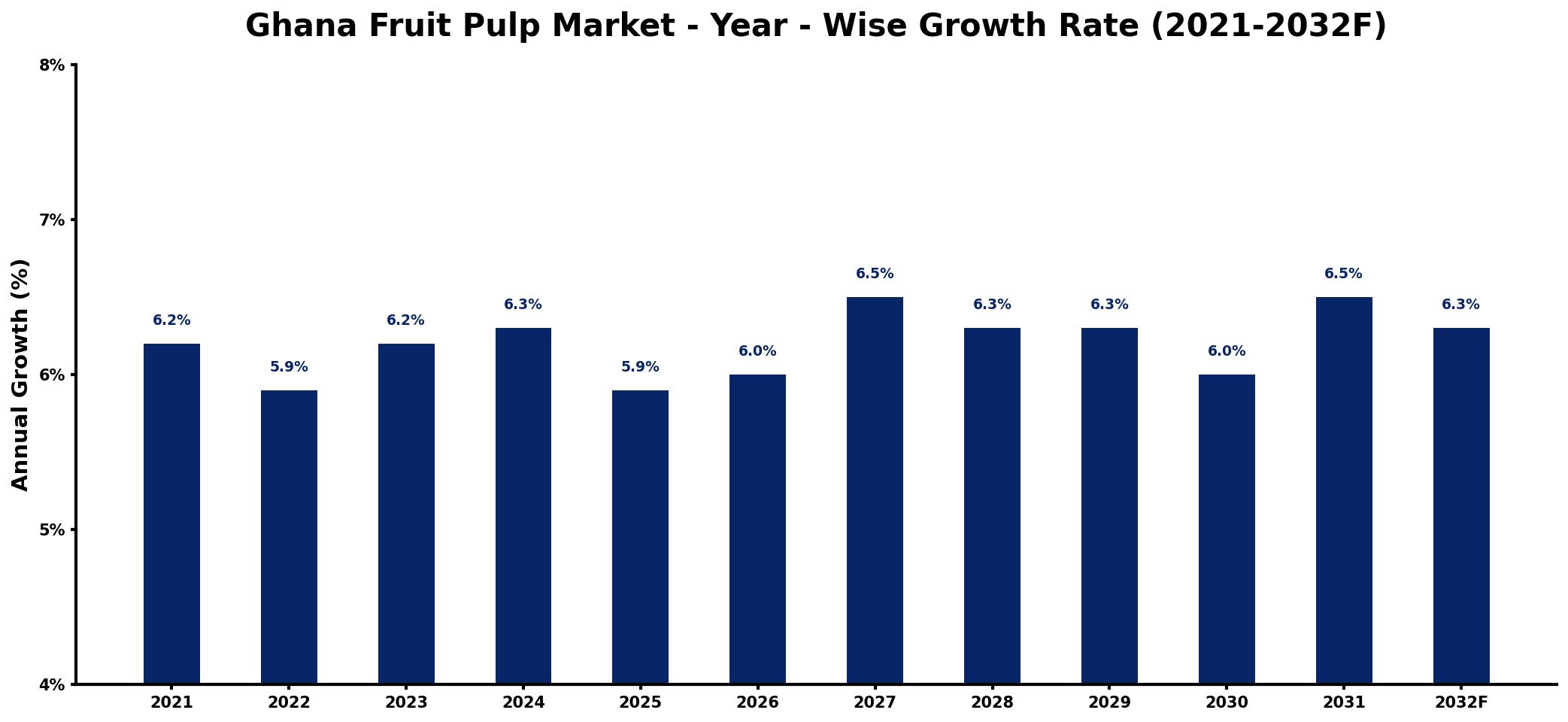
The table below presents the year‑wise growth rates along with the key drivers influencing the market
| Year | Growth Rate | Major Drivers |
| 2021 | 6.2% | Rising health consciousness among consumers |
| 2022 | 5.9% | Increased investment in processing technology |
| 2023 | 6.2% | Growing popularity of natural ingredients |
| 2024 | 6.3% | Expansion of distribution networks globally |
| 2025 | 5.9% | Higher demand for organic alternatives |
| 2026 | 6.0% | Emerging markets adopting healthy trends |
| 2027 | 6.5% | Surge in plant-based diet adoption |
| 2028 | 6.3% | Innovative product offerings attracting consumers |
| 2029 | 6.3% | Strengthened partnerships with retailers |
| 2030 | 6.0% | Advancements in sustainable sourcing practices |
| 2031 | 6.5% | Increased consumer awareness on nutrition |
| 2032 | 6.3% | Rising demand for convenient solutions |
Note: Market size estimations and growth projections presented in this report are based on 6Wresearch's proprietary forecasting methodology, utilizing the latest available industry data, government publications, and primary research inputs.
Ghana Fruit Pulp Market Synopsis
The Ghana fruit pulp market is a vibrant segment that reflects the country's agricultural richness and evolving consumer habits. As consumers become more health-conscious, they are gravitating toward products that offer natural flavors and nutritional benefits, positioning fruit pulp as a key ingredient in various food applications.
Furthermore, advancements in processing technology and distribution channels are fostering greater accessibility to fruit pulp, thereby enhancing its presence in both local and international markets. The interplay between local production initiatives and growing culinary applications is likely to further invigorate this market.
Ghana Fruit Pulp Market Key Takeaways
- The increasing shift towards healthy eating habits is driving demand for fruit pulp in Ghana.
- Major fruit varieties like mango and guava are gaining traction in the processed food segment.
- Technological advancements in fruit processing are enabling better quality and longer shelf-life.
- Government policies are encouraging local production and enhancing processing capabilities.
- Post-harvest losses and supply chain inefficiencies pose challenges for market players.
Evaluation of Restraints in Ghana Fruit Pulp Market
While the Ghana fruit pulp market holds significant promise, it is not without its challenges. Supply chain inefficiencies remain a critical issue, often leading to increased costs and reduced profitability. Additionally, post-harvest losses substantially affect the availability of fresh fruit, creating barriers to consistent pulp production. Manufacturers also face obstacles related to maintaining quality control and adhering to stringent storage requirements, which are essential for preserving the freshness and extending the shelf-life of fruit pulp products. These limitations must be addressed to unlock the market's full potential.
Ghana Fruit Pulp Market Trends
The Ghana fruit pulp market is currently witnessing several noteworthy trends that are shaping its dynamics. A prominent trend is the increasing incorporation of fruit pulp in health-oriented products, catering to a health-conscious consumer base. Additionally, the rise of e-commerce platforms is facilitating the direct distribution of fruit pulp products, enabling consumers to access diverse options conveniently. There is also a growing interest in sustainable production practices, pushing manufacturers to adopt environmentally friendly processes.
Ghana Fruit Pulp Market Opportunities
Opportunities in the Ghana fruit pulp market are burgeoning, particularly with the increasing investment in agricultural infrastructure. Enhanced logistics and processing capabilities can significantly reduce post-harvest losses, thus elevating production levels. Furthermore, as global demand for organic and natural ingredients rises, Ghana's unique fruit varieties can be marketed effectively in international markets. The potential for product innovation, such as introducing new flavors and blends, also presents a fruitful avenue for growth.
Government Initiatives in the Ghana Fruit Pulp Market
The Ghanaian government has recognized the strategic importance of the fruit pulp market and is actively implementing supportive policies. These include incentives for local fruit production and processing, aimed at bolstering the agricultural sector. Investment in infrastructure is also a priority, enhancing facilities for cultivation and processing. Moreover, the government is promoting standards and regulations to ensure quality and safety in fruit pulp manufacturing, creating a conducive environment for market growth.
Future Insights of the Ghana Fruit Pulp Market
Looking ahead to 2026-2032, the Ghana fruit pulp market is poised for significant expansion. The combination of rising consumer awareness around health and nutrition, coupled with government support, is expected to create a favorable landscape for growth. Technological advancements will likely continue to improve processing efficiency and product quality, enabling Ghana to enhance its presence in both domestic and international fruit pulp markets. As manufacturers innovate and diversify their offerings, the market will undoubtedly evolve to meet changing consumer preferences.
Ghana Fruit Pulp Market Latest Developments (2025 - 2026)
In recent months, the Ghana fruit pulp market has seen a heightened focus on sustainability and quality improvement initiatives. Several processing facilities are upgrading their technology to optimize output and minimize waste, reflecting a growing trend towards environmentally conscious practices. Additionally, new distribution partnerships are forming, enabling wider access to fruit pulp products in both domestic and international markets, thereby enhancing overall market competitiveness.
Ghana Fruit Pulp Market - Key Attractiveness of the Report
- 10 Years of Market Numbers
- Historical Data Starting from 2022 to 2025
- Base Year: 2025
- Forecast Data until 2032
- Key Performance Indicators Impacting the Market
- Major Upcoming Developments and Projects
Key Highlights of the Report:
- Ghana Fruit Pulp Market Outlook
- Market Size of Ghana Fruit Pulp Market, 2025
- Forecast of Ghana Fruit Pulp Market, 2032
- Historical Data and Forecast of Ghana Fruit Pulp Revenues & Volume for the Period 2022-2032F
- Ghana Fruit Pulp Market Trend Evolution
- Ghana Fruit Pulp Market Drivers and Challenges
- Ghana Fruit Pulp Price Trends
- Ghana Fruit Pulp Porter's Five Forces
- Ghana Fruit Pulp Industry Life Cycle
- Historical Data and Forecast of Ghana Fruit Pulp Market Revenues & Volume By Fruit Type for the Period 2022-2032F
- Historical Data and Forecast of Ghana Fruit Pulp Market Revenues & Volume By Mango for the Period 2022-2032F
- Historical Data and Forecast of Ghana Fruit Pulp Market Revenues & Volume By Strawberry for the Period 2022-2032F
- Historical Data and Forecast of Ghana Fruit Pulp Market Revenues & Volume By Apple for the Period 2022-2032F
- Historical Data and Forecast of Ghana Fruit Pulp Market Revenues & Volume By Guava for the Period 2022-2032F
- Historical Data and Forecast of Ghana Fruit Pulp Market Revenues & Volume By Berries for the Period 2022-2032F
- Historical Data and Forecast of Ghana Fruit Pulp Market Revenues & Volume By Citrus Fruits for the Period 2022-2032F
- Historical Data and Forecast of Ghana Fruit Pulp Market Revenues & Volume By Others for the Period 2022-2032F
- Historical Data and Forecast of Ghana Fruit Pulp Market Revenues & Volume By Form for the Period 2022-2032F
- Historical Data and Forecast of Ghana Fruit Pulp Market Revenues & Volume By Liquid for the Period 2022-2032F
- Historical Data and Forecast of Ghana Fruit Pulp Market Revenues & Volume By Powder for the Period 2022-2032F
- Historical Data and Forecast of Ghana Fruit Pulp Market Revenues & Volume By Application for the Period 2022-2032F
- Historical Data and Forecast of Ghana Fruit Pulp Market Revenues & Volume By Food and Beverages for the Period 2022-2032F
- Historical Data and Forecast of Ghana Fruit Pulp Market Revenues & Volume By Distribution for the Period 2022-2032F
- Historical Data and Forecast of Ghana Fruit Pulp Market Revenues & Volume By E-Commerce for the Period 2022-2032F
- Historical Data and Forecast of Ghana Fruit Pulp Market Revenues & Volume By Convenience Stores for the Period 2022-2032F
- Historical Data and Forecast of Ghana Fruit Pulp Market Revenues & Volume By Supermarkets/Hypermarkets for the Period 2022-2032F
- Historical Data and Forecast of Ghana Fruit Pulp Market Revenues & Volume By Specialty Stores for the Period 2022-2032F
- Historical Data and Forecast of Ghana Fruit Pulp Market Revenues & Volume By Others for the Period 2022-2032F
- Ghana Fruit Pulp Import Export Trade Statistics
- Market Opportunity Assessment By Fruit Type
- Market Opportunity Assessment By Form
- Market Opportunity Assessment By Application
- Market Opportunity Assessment By Distribution
- Ghana Fruit Pulp Top Companies Market Share
- Ghana Fruit Pulp Competitive Benchmarking By Technical and Operational Parameters
- Ghana Fruit Pulp Company Profiles
- Ghana Fruit Pulp Key Strategic Recommendations






































