Ghana Gas Chromatography Systems Market Size, Share & Growth Rate
The Ghana Gas Chromatography Systems Market was estimated at USD 402 Million in 2025 and is projected to reach USD 534 Million by 2032, growing at a CAGR of 4.1% from 2026 to 2032. This steady growth trajectory is primarily fueled by rising demand across critical sectors such as petrochemicals, pharmaceuticals, and environmental monitoring, where accurate analytical tools are vital. Additionally, the trend toward regulatory compliance and enhanced quality control measures is driving the adoption of advanced gas chromatography systems.
Ghana Gas Chromatography Systems Market Year-wise Growth Rate and Key Drivers
This graph highlights how the Ghana Gas Chromatography Systems Market has steadily grown over the years, supported by major growth factors.
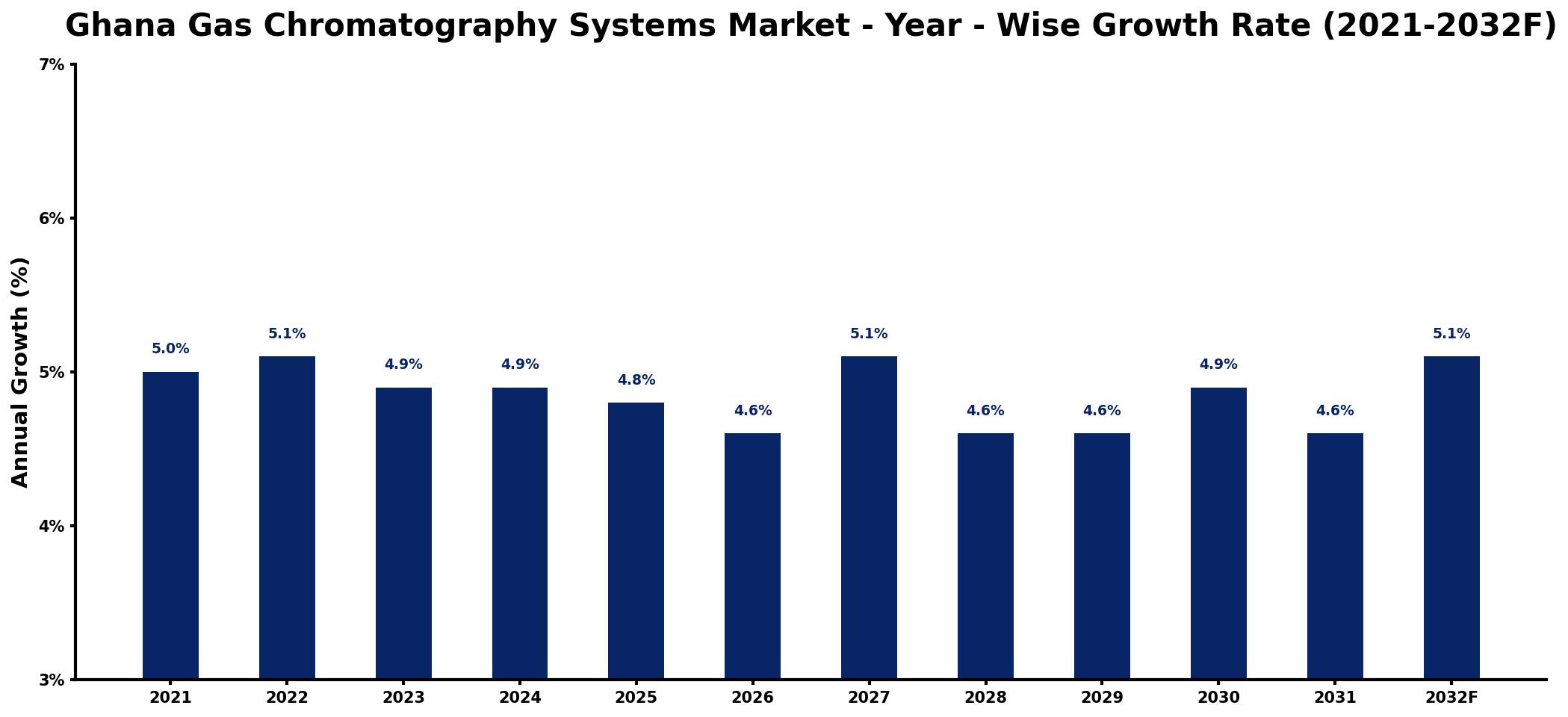
The table below presents the year‑wise growth rates along with the key drivers influencing the market
| Year | Growth Rate | Major Drivers |
| 2021 | 5.0% | Rising industrial demand for analysis |
| 2022 | 5.1% | Increased investment in research facilities |
| 2023 | 4.9% | Growing focus on environmental regulations |
| 2024 | 4.9% | Expansion of pharmaceutical manufacturing capabilities |
| 2025 | 4.8% | Emerging markets adopting advanced technologies |
| 2026 | 4.6% | Boost in academic research funding |
| 2027 | 5.1% | Increased collaborations with international partners |
| 2028 | 4.6% | expanding industrial usage applications |
| 2029 | 4.6% | rising demand from electronics |
| 2030 | 4.9% | Technological advancements driving market growth |
| 2031 | 4.6% | Higher standards for laboratory testing |
| 2032 | 5.1% | increased capital investment inflows |
Note: Market size estimations and growth projections presented in this report are based on 6Wresearch's proprietary forecasting methodology, utilizing the latest available industry data, government publications, and primary research inputs.
Ghana Gas Chromatography Systems Market Synopsis
Currently, the Ghana Gas Chromatography Systems market is on a robust growth path, influenced by the increasing need for precise analytical instruments. Industries are recognizing the significance of gas chromatography in ensuring product safety and compliance with stringent regulatory standards.
Moreover, innovative technological advancements, particularly in the development of portable and user-friendly systems, are significantly enhancing market dynamics. Such developments not only cater to diverse applications but also improve accessibility for on-site testing, thus broadening the user base across various industries.
Ghana Gas Chromatography Systems Market Key Takeaways
- Strong growth driven by demand from petrochemical, pharmaceutical, and environmental sectors.
- Technological advancements are enhancing system capabilities and user-friendliness.
- The market is increasingly shifting towards sustainable and energy-efficient solutions.
- Investment opportunities arise from the growing need for quality control and regulatory compliance.
- Government initiatives are fostering innovation and improving the regulatory environment.
Evaluation of Restraints in Ghana Gas Chromatography Systems Market
Despite the positive growth outlook, several constraints may inhibit the market's full potential. A key barrier is the high initial investment required for gas chromatography systems, which can deter smaller businesses and startups from entering the market. Furthermore, the ongoing need for skilled professionals capable of operating and maintaining these sophisticated systems presents another challenge. Limited awareness and understanding of gas chromatography among potential users also restricts market penetration. Regulatory compliance issues and infrastructural limitations in certain regions add additional layers of complexity that stakeholders must navigate.
Ghana Gas Chromatography Systems Market Trends
The Ghana Gas Chromatography Systems market is experiencing transformative trends that are redefining its landscape. A noticeable shift is the adoption of advanced gas chromatography systems characterized by improved sensitivity and accuracy. These systems are becoming essential tools in environmental analysis and food safety applications, where precise measurements are critical.
Moreover, the demand for portable gas chromatography systems is on the rise, enabling on-the-go testing and enhancing operational efficiency. The focus on environmentally sustainable practices is also evident, as manufacturers develop energy-efficient systems. The integration of digital technologies, such as remote monitoring and software solutions for data analysis, is further augmenting market productivity and convenience.
Ghana Gas Chromatography Systems Market Opportunities
The Ghana Gas Chromatography Systems market presents abundant investment opportunities, especially as various sectors recognize the importance of analytical tools. The oil and gas industry, along with environmental monitoring and pharmaceuticals, represent significant avenues for growth. As businesses prioritize quality control and regulatory compliance, there will be an increased necessity for reliable gas chromatography systems capable of analyzing complex chemical mixtures. Partnering with local distributors or manufacturers can provide strategic advantages in capitalizing on this burgeoning demand.
Government Initiatives in the Ghana Gas Chromatography Systems Market
Ghana's government policies play a crucial role in shaping the Gas Chromatography Systems market. Regulatory frameworks established by the Ghana Standards Authority ensure product quality and reliability, while the Environmental Protection Agency regulates the safe disposal of waste products. Furthermore, government initiatives aimed at fostering research and development are encouraging innovation within the sector, often through tax incentives and grants. Collectively, these policies create a supportive environment that not only ensures compliance but also promotes sustainable growth in the gas chromatography domain.
Future Insights of the Ghana Gas Chromatography Systems Market
Looking ahead, the Ghana gas chromatography systems market is set for steady expansion through 2032. Factors such as increased investment in R&D, stringent regulatory standards, and the pressing need for accurate chemical analysis will drive growth. The trend towards developing user-friendly, portable systems will likely continue, enhancing access to analytical capabilities across diverse environments. As industries modernize and expand in Ghana, the demand for advanced gas chromatography solutions is expected to escalate, offering significant prospects for market players.
Ghana Gas Chromatography Systems Market Latest Developments (2025 - 2026)
Recent months have seen a shift towards the integration of advanced analytics and software solutions within gas chromatography systems, enhancing data interpretation and operational efficiency. Companies are increasingly focusing on the development of environmentally friendly technologies, as sustainability becomes a core consideration. Additionally, investment in local manufacturing capabilities is gaining momentum, which could streamline supply chains and improve market responsiveness.
Ghana Gas Chromatography Systems Market - Key Attractiveness of the Report
- 10 Years of Market Numbers
- Historical Data Starting from 2022 to 2025
- Base Year: 2025
- Forecast Data until 2032
- Key Performance Indicators Impacting the Market
- Major Upcoming Developments and Projects
Key Highlights of the Report:
- Ghana Gas Chromatography Systems Market Outlook
- Market Size of Ghana Gas Chromatography Systems Market, 2025
- Forecast of Ghana Gas Chromatography Systems Market, 2032
- Historical Data and Forecast of Ghana Gas Chromatography Systems Revenues & Volume for the Period 2022-2032F
- Ghana Gas Chromatography Systems Market Trend Evolution
- Ghana Gas Chromatography Systems Market Drivers and Challenges
- Ghana Gas Chromatography Systems Price Trends
- Ghana Gas Chromatography Systems Porter's Five Forces
- Ghana Gas Chromatography Systems Industry Life Cycle
- Historical Data and Forecast of Ghana Gas Chromatography Systems Market Revenues & Volume By Product for the Period 2022-2032F
- Historical Data and Forecast of Ghana Gas Chromatography Systems Market Revenues & Volume By Systems for the Period 2022-2032F
- Historical Data and Forecast of Ghana Gas Chromatography Systems Market Revenues & Volume By Detectors for the Period 2022-2032F
- Historical Data and Forecast of Ghana Gas Chromatography Systems Market Revenues & Volume By Auto-samplers for the Period 2022-2032F
- Historical Data and Forecast of Ghana Gas Chromatography Systems Market Revenues & Volume By Fraction Collectors for the Period 2022-2032F
- Historical Data and Forecast of Ghana Gas Chromatography Systems Market Revenues & Volume By Other Products for the Period 2022-2032F
- Historical Data and Forecast of Ghana Gas Chromatography Systems Market Revenues & Volume By End User for the Period 2022-2032F
- Historical Data and Forecast of Ghana Gas Chromatography Systems Market Revenues & Volume By Pharmaceutical and Bioindustries for the Period 2022-2032F
- Historical Data and Forecast of Ghana Gas Chromatography Systems Market Revenues & Volume By Academic Research Institutes for the Period 2022-2032F
- Historical Data and Forecast of Ghana Gas Chromatography Systems Market Revenues & Volume By Other End Users for the Period 2022-2032F
- Ghana Gas Chromatography Systems Import Export Trade Statistics
- Market Opportunity Assessment By Product
- Market Opportunity Assessment By End User
- Ghana Gas Chromatography Systems Top Companies Market Share
- Ghana Gas Chromatography Systems Competitive Benchmarking By Technical and Operational Parameters
- Ghana Gas Chromatography Systems Company Profiles
- Ghana Gas Chromatography Systems Key Strategic Recommendations






































