Ghana Golf Clubs Market Size, Share & Growth Rate
The Ghana Golf Clubs Market was estimated at USD 227 Million in 2025 and is projected to reach USD 298 Million by 2032, growing at a CAGR of 4.0% from 2026 to 2032. This growth trajectory is fueled by increasing local participation in the sport and a growing middle class with disposable income. As both domestic and expatriate communities seek recreational outlets, golf is establishing itself as an attractive option, further enhanced by government initiatives aimed at promoting sports tourism.
Ghana Golf Clubs Market Year-wise Growth Rate and Key Drivers
This graph highlights how the Ghana Golf Clubs Market has steadily grown over the years, supported by major growth factors.
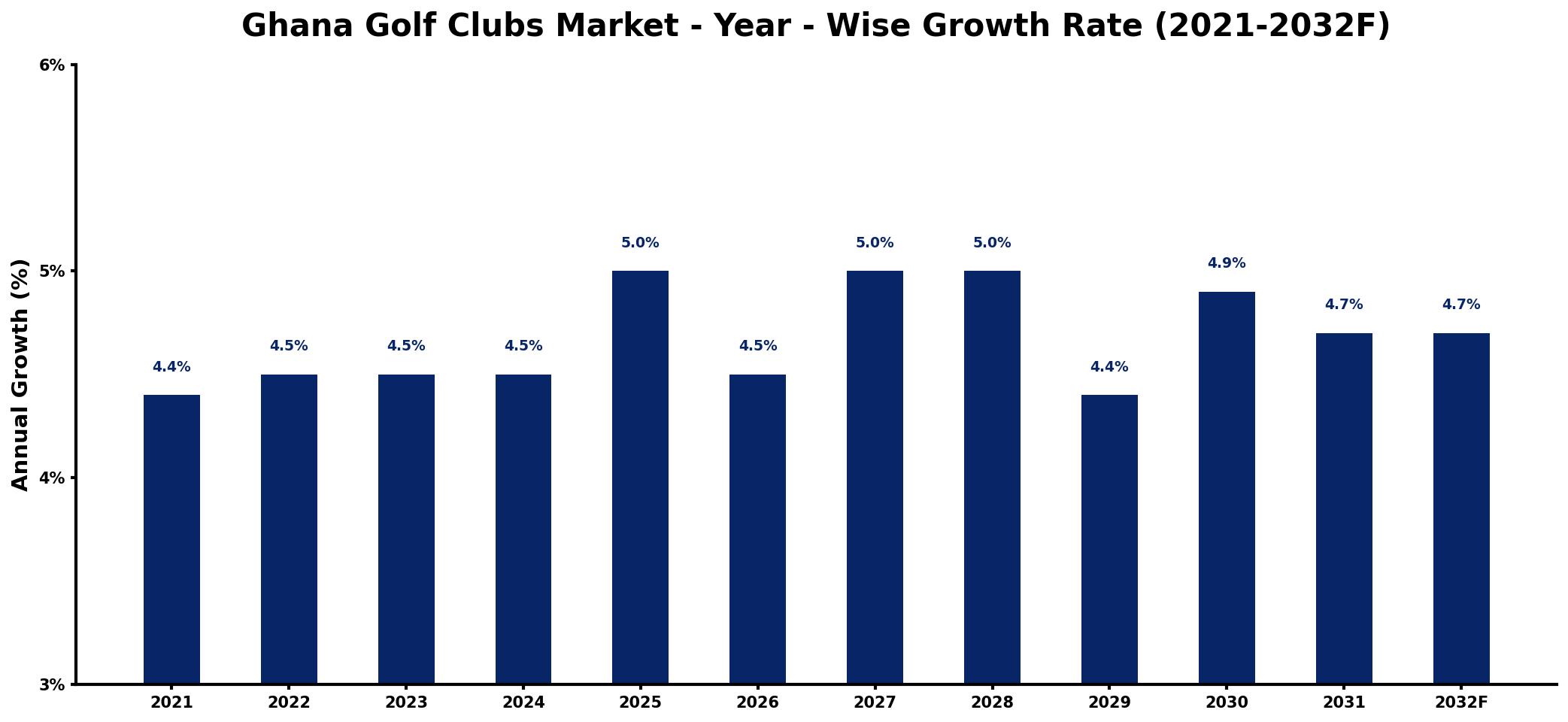
The table below presents the year‑wise growth rates along with the key drivers influencing the market
| Year | Growth Rate | Major Drivers |
| 2021 | 4.4% | Increased interest in leisure activities |
| 2022 | 4.5% | Growth in tourism and hospitality |
| 2023 | 4.5% | Investment in sports facilities expansion |
| 2024 | 4.5% | Rise in corporate sponsorship deals |
| 2025 | 5.0% | Emergence of youth sports programs |
| 2026 | 4.5% | Boost in recreational community events |
| 2027 | 5.0% | Expansion of local sports associations |
| 2028 | 5.0% | Increased participation in fitness trends |
| 2029 | 4.4% | rising export shipment volumes |
| 2030 | 4.9% | Development of new sports initiatives |
| 2031 | 4.7% | Enhanced media coverage of events |
| 2032 | 4.7% | Strengthened partnerships with schools |
Note: Market size estimations and growth projections presented in this report are based on 6Wresearch's proprietary forecasting methodology, utilizing the latest available industry data, government publications, and primary research inputs.
Ghana Golf Clubs Market Synopsis
The Ghana Golf Clubs Market is witnessing an exciting transformation driven by a newfound appreciation for golf among diverse demographics. Both local enthusiasts and expatriates are increasingly participating, utilizing an expanding range of clubs, equipment, and services tailored to various skill levels.
This niche market benefits significantly from a growing infrastructure of golf courses and clubs across the nation. As more facilities become accessible, opportunities for tournaments and social gatherings arise, fostering a vibrant golfing culture that appeals to enthusiasts and newcomers alike.
Ghana Golf Clubs Market Key Takeaways
- Significant growth projected due to increased local participation and expatriate interest.
- Shifting trends towards eco-friendly products and tech-enhanced golfing equipment.
- Growing customization options tailored to individual golfer needs are emerging.
- Government initiatives are strengthening the infrastructure and popularity of golf.
- Investment opportunities are expanding in club ownership, sponsorship, and event management.
Evaluation of Restraints in Ghana Golf Clubs Market
While the Ghana Golf Clubs Market shows promise, it faces several restraints that could limit its full potential. Accessibility remains a pressing issue; many areas lack quality golfing facilities or equipment. Additionally, funding for maintenance and upgrades of existing clubs is often insufficient, leading to subpar playing conditions. The sport's reputation as an elitist pastime further hampers participation from broader segments of the population, creating a perception barrier that impacts overall growth.
Ghana Golf Clubs Market Trends
A notable trend within the Ghana Golf Clubs Market is the increasing demand for eco-friendly and sustainable products. Golfers are becoming more environmentally conscious, driving interest in equipment made from recycled materials. Concurrently, the market is experiencing a rise in technology-driven innovations, such as adjustable weight clubs and enhanced distance control features, catering to golfers' desires for personalized performance.
Ghana Golf Clubs Market Opportunities
The Ghana Golf Clubs Market is ripe for investment and expansion. As more golf courses are developed, there are ample opportunities for new entrants to participate in club ownership and equipment sales. International partnerships present further avenues to introduce premium golf products into the market, meeting the growing expectations of consumers eager for high-quality offerings.
Government Initiatives in the Ghana Golf Clubs Market
The Ghanaian government is actively promoting sports tourism and facilitating local engagement in golf. Key initiatives aim to improve golf course infrastructure and attract international tournaments, positioning the country as a golfing destination in West Africa. Policies also include providing training for local golfers and supporting facility development with potential tax incentives, further enhancing the market's attractiveness.
Future Insights of the Ghana Golf Clubs Market
Looking ahead to 2026-2032, the Ghana Golf Clubs Market is expected to flourish, fueled by an increasing number of golf courses and rising disposable incomes. The government's ongoing efforts to promote sports tourism, combined with the regions natural beauty and favorable golfing conditions, are set to draw both domestic and international golf enthusiasts. This trend presents exciting new avenues for manufacturers, retailers, and stakeholders keen to capitalize on the expanding market landscape.
Ghana Golf Clubs Market Latest Developments (2025 - 2026)
Recent developments in the Ghana Golf Clubs Market have focused on enhancing playing facilities and amenities. Efforts include renovations of existing golf courses and the introduction of new technology for training and performance assessment. Additionally, there has been a noticeable increase in promotional events aimed at raising awareness and participation in golf, which have resonated positively with various community groups.
Ghana Golf Clubs Market - Key Attractiveness of the Report
- 10 Years of Market Numbers
- Historical Data Starting from 2022 to 2025
- Base Year: 2025
- Forecast Data until 2032
- Key Performance Indicators Impacting the Market
- Major Upcoming Developments and Projects
Key Highlights of the Report:
- Ghana Golf Clubs Market Outlook
- Market Size of Ghana Golf Clubs Market, 2025
- Forecast of Ghana Golf Clubs Market, 2032
- Historical Data and Forecast of Ghana Golf Clubs Revenues & Volume for the Period 2022-2032F
- Ghana Golf Clubs Market Trend Evolution
- Ghana Golf Clubs Market Drivers and Challenges
- Ghana Golf Clubs Price Trends
- Ghana Golf Clubs Porter's Five Forces
- Ghana Golf Clubs Industry Life Cycle
- Historical Data and Forecast of Ghana Golf Clubs Market Revenues & Volume By Product Type for the Period 2022-2032F
- Historical Data and Forecast of Ghana Golf Clubs Market Revenues & Volume By Woods for the Period 2022-2032F
- Historical Data and Forecast of Ghana Golf Clubs Market Revenues & Volume By Iron for the Period 2022-2032F
- Historical Data and Forecast of Ghana Golf Clubs Market Revenues & Volume By Wedges for the Period 2022-2032F
- Historical Data and Forecast of Ghana Golf Clubs Market Revenues & Volume By Putters for the Period 2022-2032F
- Ghana Golf Clubs Import Export Trade Statistics
- Market Opportunity Assessment By Product Type
- Ghana Golf Clubs Top Companies Market Share
- Ghana Golf Clubs Competitive Benchmarking By Technical and Operational Parameters
- Ghana Golf Clubs Company Profiles
- Ghana Golf Clubs Key Strategic Recommendations






































