Ghana Helicopter Market Size, Share & Growth Rate
The Ghana Helicopter Market was estimated at USD 220 Million in 2025 and is projected to reach USD 292 Million by 2032, growing at a CAGR of 4.1% from 2026 to 2032. This growth trajectory is largely fueled by the booming oil and gas sector, with increasing offshore exploration driving demand for efficient transport solutions. Additionally, rising tourism activities and the critical need for medical evacuation services in remote areas further contribute to this upward trend in the market.
Ghana Helicopter Market Year-wise Growth Rate and Key Drivers
This graph highlights how the Ghana Helicopter Market has steadily grown over the years, supported by major growth factors.
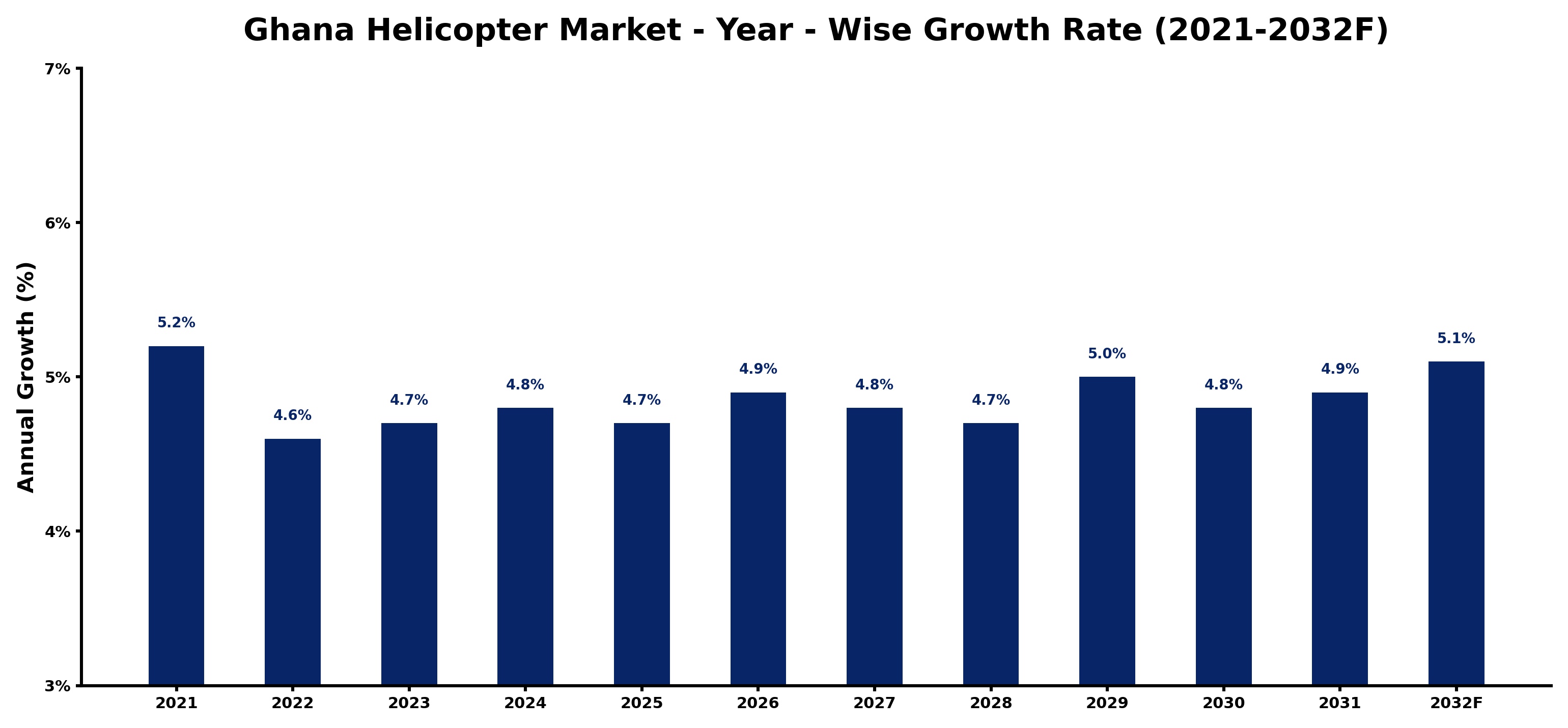
The table below presents the year‑wise growth rates along with the key drivers influencing the market
| Year | Growth Rate | Major Drivers |
| 2021 | 5.2% | Local assembly plants boost helicopter component manufacturing investment viability |
| 2022 | 4.6% | Local tech adoption boosts helicopter maintenance service efficiency |
| 2023 | 4.7% | Export driven helicopter component manufacturing boosts local supply chain development |
| 2024 | 4.8% | Increased oil exploration drives demand for helicopter support services |
| 2025 | 4.7% | Emergency response contracts boost helicopter maintenance service demand |
| 2026 | 4.9% | Infrastructure development projects boost helicopter demand in Ghana |
| 2027 | 4.8% | Strengthened logistics infrastructure enhanced helicopter component manufacturing efficiency |
| 2028 | 4.7% | Manufacturing investments in composite materials boost helicopter component production |
| 2029 | 5.0% | New manufacturing facility enhances helicopter component supply chain efficiency |
| 2030 | 4.8% | Domestic helicopter manufacturing investments enhance aviation maintenance capabilities |
| 2031 | 4.9% | Regional helicopter maintenance contracts boost parts manufacturing investments |
| 2032 | 5.1% | Oil and gas sector growth drives helicopter fleet maintenance contracts |
Note - Market size estimations and growth projections presented in this report are based on 6Wresearch's advanced forecasting approach, validated with industry datasets as of June 2026.
Ghana Helicopter Market Synopsis
The most significant force shaping the Ghana Helicopter Market is the growing demand from the oil and gas industry, which relies heavily on helicopter services for personnel and logistics transportation. This demand is complemented by a burgeoning tourism sector that is embracing helicopter tours as a means to explore Ghana's diverse landscapes and attractions.
Furthermore, the urgent need for timely medical evacuations in rural regions amplifies the market's significance. The combination of these sectors is not only enhancing operational efficiency but is also establishing helicopters as an indispensable asset for various industries across Ghana.
Ghana Helicopter Market Key Takeaways
- The market is projected to grow from USD 220 Million in 2025 to USD 292 Million by 2032.
- Increasing oil and gas exploration activities are the primary growth driver.
- Tourism is rapidly integrating helicopter services for enhanced travel experiences.
- Medical evacuation needs in remote areas are creating substantial demand.
- Advancements in technology are leading to a shift towards modern helicopter models.
Evaluation of Restraints in Ghana Helicopter Market
Despite its growth potential, the Ghana Helicopter Market faces several restraints that may hinder its progress. Limited infrastructure poses significant challenges to operational efficiency, while high operational costs, particularly related to fuel and maintenance, create barriers for profitability. Regulatory hurdles, including bureaucratic red tape, can delay service deployment and complicate compliance efforts. Additionally, an inadequate local skill set for helicopter operations and maintenance further exacerbates the operational challenges. Security concerns in certain regions also contribute to risk aversion among potential investors.
Ghana Helicopter Market Trends
The Ghana Helicopter Market is witnessing several pivotal trends that are reshaping its landscape. The increasing reliance on helicopters in the oil and gas sector emphasizes the importance of quick and efficient transportation to offshore rigs. Concurrently, the rise in luxury tourism is fostering a demand for helicopter tours that provide unique aerial views of the country's natural beauty. The medical sector is also evolving, with helicopters becoming critical for emergency evacuations, ensuring timely healthcare delivery to remote locations. Furthermore, a transition towards more advanced helicopter technology is occurring, with operators seeking models that enhance safety and operational efficiency.
Ghana Helicopter Market Opportunities
The Ghana helicopter market is ripe with investment opportunities, particularly in the tourism sector, where helicopter tours can elevate visitor experiences and showcase the country's attractions. Additionally, the oil and gas industry presents substantial opportunities for investment in transportation and logistical support for offshore operations. Medical evacuation services represent another lucrative area, as there is an ongoing need for reliable transport to facilitate emergency healthcare in remote areas. Investing in infrastructure, such as helipads and maintenance facilities, will further tap into these burgeoning sectors.
Government Initiatives in the Ghana Helicopter Market
The Ghanaian government has taken strides to support and regulate the helicopter market through the Ghana Civil Aviation Authority (GCAA). This body ensures that helicopter operations comply with international safety standards and maintains oversight on certification. The government is also keen on attracting investment by introducing tax incentives and promoting partnerships between local and international companies. Additionally, regulations encouraging local content in the helicopter industry are in place to foster workforce development and enhance the skills needed for sustainable growth.
Future Insights of the Ghana Helicopter Market
Looking ahead to the period between 2026 and 2032, the Ghana Helicopter Market is poised for robust growth. With new oil reserves being discovered offshore, the demand for helicopter services will likely increase significantly. Government initiatives aimed at improving infrastructure and enhancing tourism appeal will further stimulate market demand. The ongoing technological advancements, coupled with a growing focus on safety, suggest that the market will attract both domestic and international players, fostering a competitive yet collaborative environment.
Ghana Helicopter Market Latest Developments (May 2025 - June 2026)
In the latest industry developments, there has been a marked focus on enhancing helicopter operational capabilities, with several operators exploring partnerships to expand service offerings. Discussions around regulatory reforms to streamline operational processes have gained momentum, aimed at reducing bureaucratic delays. The tourism sector has also seen initiatives to promote helicopter tours, highlighting scenic areas and cultural heritage sites. Efforts to improve local training programs for helicopter maintenance and operations are underway, addressing the skills gap within the industry.
Ghana Helicopter Market - Key Attractiveness of the Report
- 10 Years of Market Numbers
- Historical Data Starting from 2022 to 2025
- Base Year: 2025
- Forecast Data until 2032
- Key Performance Indicators Impacting the Market
- Major Upcoming Developments and Projects
Key Highlights of the Report:
- Ghana Helicopter Market Outlook
- Market Size of Ghana Helicopter Market, 2025
- Forecast of Ghana Helicopter Market, 2032
- Historical Data and Forecast of Ghana Helicopter Revenues & Volume for the Period 2022-2032F
- Ghana Helicopter Market Trend Evolution
- Ghana Helicopter Market Drivers and Challenges
- Ghana Helicopter Price Trends
- Ghana Helicopter Porter's Five Forces
- Ghana Helicopter Industry Life Cycle
- Historical Data and Forecast of Ghana Helicopter Market Revenues & Volume By End-users for the Period 2022-2032F
- Historical Data and Forecast of Ghana Helicopter Market Revenues & Volume By Commercial for the Period 2022-2032F
- Historical Data and Forecast of Ghana Helicopter Market Revenues & Volume By Military for the Period 2022-2032F
- Historical Data and Forecast of Ghana Helicopter Market Revenues & Volume By Component for the Period 2022-2032F
- Historical Data and Forecast of Ghana Helicopter Market Revenues & Volume By Aerostructures/Airframes for the Period 2022-2032F
- Historical Data and Forecast of Ghana Helicopter Market Revenues & Volume By Rotary System for the Period 2022-2032F
- Historical Data and Forecast of Ghana Helicopter Market Revenues & Volume By Engine for the Period 2022-2032F
- Historical Data and Forecast of Ghana Helicopter Market Revenues & Volume By Undercarriage for the Period 2022-2032F
- Historical Data and Forecast of Ghana Helicopter Market Revenues & Volume By Avionics for the Period 2022-2032F
- Historical Data and Forecast of Ghana Helicopter Market Revenues & Volume By Cabin Interiors for the Period 2022-2032F
- Historical Data and Forecast of Ghana Helicopter Market Revenues & Volume By Environmental Control System for the Period 2022-2032F
- Historical Data and Forecast of Ghana Helicopter Market Revenues & Volume By Sales Channels for the Period 2022-2032F
- Historical Data and Forecast of Ghana Helicopter Market Revenues & Volume By OEM for the Period 2022-2032F
- Historical Data and Forecast of Ghana Helicopter Market Revenues & Volume By Maintenance for the Period 2022-2032F
- Historical Data and Forecast of Ghana Helicopter Market Revenues & Volume By Repair for the Period 2022-2032F
- Historical Data and Forecast of Ghana Helicopter Market Revenues & Volume By Overhaul for the Period 2022-2032F
- Ghana Helicopter Import Export Trade Statistics
- Market Opportunity Assessment By End-users
- Market Opportunity Assessment By Component
- Market Opportunity Assessment By Sales Channels
- Ghana Helicopter Top Companies Market Share
- Ghana Helicopter Competitive Benchmarking By Technical and Operational Parameters
- Ghana Helicopter Company Profiles
- Ghana Helicopter Key Strategic Recommendations






































