Ghana Home Appliances Market Summary
The ghana home appliances market was estimated at USD 416 Million in 2025 and is projected to reach USD 568 Million by 2032, growing at a CAGR of 5.5% from 2026 to 2032.
Ghana Home Appliances Market Year-wise Growth Rate and Key Drivers
This graph highlights how the Ghana Home Appliances Market has steadily grown over the past five years, supported by major growth factors.
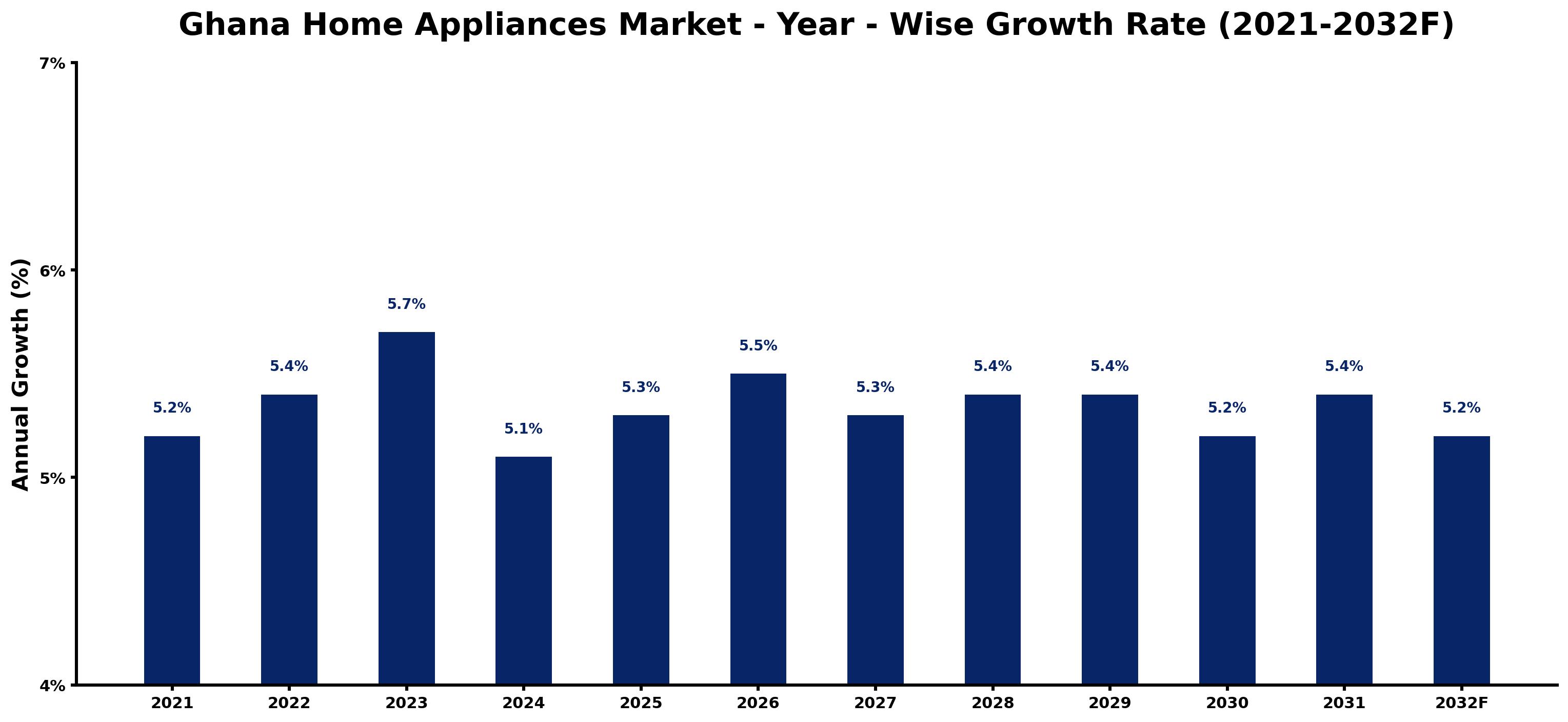
The table below presents the year wise growth rates along with the key drivers influencing the market
| Year | Growth Rate | Major Drivers |
| 2021 | 5.2% | Consumer spending patterns showed a noticeable shift towards home appliance efficiency. |
| 2022 | 5.4% | Urbanization trends encouraged increased investments in modern kitchen and household devices. |
| 2023 | 5.7% | Digital marketing strategies effectively targeted younger demographics eager for smart appliances. |
| 2024 | 5.1% | Brand collaborations focused on sustainability attracted environmentally conscious consumers. |
| 2025 | 5.3% | Local manufacturers improved product quality, enhancing competition with international brands. |
| 2026 | 5.5% | Rising disposable incomes allowed families to opt for premium home appliance options. |
| 2027 | 5.3% | Technological integration in household management created demand for smart home devices. |
| 2028 | 5.4% | Increased awareness about energy efficiency fostered interest in eco-friendly appliance solutions. |
| 2029 | 5.4% | Availability of financing options made high-end appliances more accessible to consumers. |
| 2030 | 5.2% | Emerging trends in remote work prompted investments in home conveniences and appliances. |
| 2031 | 5.4% | E-commerce platforms expanded, transforming how consumers purchase home appliances online. |
| 2032 | 5.2% | Cultural shifts towards home entertainment spurred purchases of advanced kitchen gadgets. |
Note - Market size estimations and growth projections presented in this report are based on 6Wresearch's advanced forecasting approach, validated with industry datasets as of June 2026.
Ghana Home Appliances Market Synopsis
The Ghana Home Appliances Market is projected to reach 5.5% and witness significant growth during the forecast period (2026-2032). This market is primarily driven by several factors, including rising disposable income among consumers and an increasing trend towards urbanization. With urban living comes a demand for modern conveniences, which has positioned home appliances as essential components of contemporary households in Ghana.
Ghana Home Appliances Market Growth Drivers
The growth trajectory of the Ghana Home Appliances Market can be attributed to various interlinked drivers that shape consumer behavior and purchasing patterns. One of the foremost contributors is the increase in disposable income, allowing individuals and families to invest in modern appliances that enhance their quality of life.
- The urbanization trend in Ghana is facilitating a shift in lifestyle, where traditional methods of cooking, refrigeration, and cleaning are being replaced with more efficient appliances.
- Technological advancements are playing a critical role, with manufacturers developing energy-efficient products. Solar-powered air conditioners and refrigerators are becoming increasingly popular due to their ability to reduce electricity consumption.
- Government initiatives aimed at promoting renewable energy sources are fostering an environment conducive to the growth of eco-friendly appliances like solar water heaters, enhancing consumer awareness about sustainable options.
- The ongoing development of infrastructure and improvement in supply chains allow for better distribution of home appliances, making them more accessible to consumers across both urban and rural areas.
- Finally, the growing consumer awareness regarding health and safety standards in household appliances has driven the demand for high-quality products that ensure reliability and efficiency in daily chores.
Ghana Home Appliances Market Trends and Opportunities
The Ghana Home Appliances Market is witnessing notable trends that present significant opportunities for growth. A critical trend is the increasing consumer preference for smart appliances that offer connectivity and automation. As internet penetration grows, many households are gravitating towards smart devices that can be controlled via mobile applications, providing enhanced convenience and energy management.
- The demand for energy-efficient appliances is on the rise, driven by both responsible consumer behavior and regulatory pressures to minimize environmental impact.
- Local manufacturers are stepping up efforts to produce appliances tailored to the unique needs of Ghanaian consumers, creating opportunities for innovation and market differentiation.
- The embrace of e-commerce channels is reshaping how consumers purchase home appliances, with online platforms offering convenience and often competitive pricing.
- Collaboration between manufacturers and technology providers to enhance product features and performance opens avenues for advanced home appliances that meet modern demands.
- Finally, as the government emphasizes sustainability, there is an expanding market for eco-friendly appliances, aligning with global environmental commitments and local initiatives.
Ghana Home Appliances Market Challenges and Restraints
Despite the positive outlook, the Ghana Home Appliances Market faces several challenges that could impede growth. One major concern is the economic volatility, which can affect consumer spending on non-essential goods.
- Importing foreign appliances can lead to high costs and tariffs, making it difficult for local companies to compete with established brands that may be perceived as superior.
- Limited access to reliable electricity supply poses a challenge for the adoption of certain appliances, especially in rural areas where energy resources are inconsistent.
- Consumer skepticism regarding the quality of locally manufactured products may result in a continued preference for imported goods, delaying market growth.
- There is a lack of skilled technicians for appliance installation and maintenance, which can affect customer satisfaction and deter potential buyers.
- Regulatory compliance concerning environmental standards and safety measures can be challenging for both new entrants and established firms, leading to potential operational hurdles.
Ghana Home Appliances Market Government Investment and Initiatives
The Ghanaian government has recognized the importance of the home appliances sector in enhancing the lives of its citizens and stimulating economic growth. Various initiatives are currently being undertaken to boost the sector, focusing on renewable energy and local production. Policies aimed at promoting the use of solar energy are particularly relevant, as they encourage the adoption of solar-powered home appliances, which not only reduce electricity costs but also align with global sustainability goals.
- Government investment in renewable energy infrastructure is setting the groundwork for broader availability of solar energy solutions, which is critical for the expansion of eco-friendly appliances.
- Public spending on technology education and training programs will help develop a skilled workforce capable of supporting both the manufacturing and maintenance of advanced appliances.
- Development plans focused on urbanization are improving living conditions across cities, which may drive demand for modern appliances as urban lifestyles evolve.
- The government's commitment to enhancing local production capabilities through incentives for manufacturers contributes to a more competitive market landscape.
- Regulatory frameworks are being established to ensure quality and safety standards for home appliances, providing consumers with assurance and fostering trust in the market.
Ghana Home Appliances Market Latest Developments (May 2025 - June 2026)
The period from May 2025 to June 2026 has seen notable developments within the Ghana Home Appliances Market. The industry has experienced a surge in consumer interest in energy-efficient appliances, spurred by ongoing public awareness campaigns promoting sustainable living. In addition, there has been an uptick in partnerships formed between local manufacturers and technology firms to develop innovative products that cater to the unique needs of the Ghanaian market.
- Advancements in manufacturing techniques have led to improved product quality and reduced prices, making modern appliances more accessible to a wider range of consumers.
- Online retail platforms have seen an increase in usage, facilitating easier purchasing options for consumers and contributing to market growth.
- Research and development efforts are being bolstered, with companies investing in new technologies to enhance product functionality and energy efficiency.
- Consumer education initiatives introduced by organizations are helping to improve understanding of the benefits associated with energy-efficient and eco-friendly appliances.
- The government's promotion of renewable energy initiatives continues to pave the way for increased acceptance and integration of solar-powered appliances in homes across Ghana.
Ghana Home Appliances Market - Key Attractiveness of the Report
- 10 Years of Market Numbers
- Historical Data Starting from 2022 to 2025
- Base Year: 2025
- Forecast Data until 2032
- Key Performance Indicators Impacting the Market
- Major Upcoming Developments and Projects
Key Highlights of the Report:
- Ghana Home Appliances Market Outlook
- Market Size of Ghana Home Appliances Market, 2025
- Forecast of Ghana Home Appliances Market, 2032
- Historical Data and Forecast of Ghana Home Appliances Revenues & Volume for the Period 2022-2032
- Ghana Home Appliances Market Trend Evolution
- Ghana Home Appliances Market Drivers and Challenges
- Ghana Home Appliances Price Trends
- Ghana Home Appliances Porter's Five Forces
- Ghana Home Appliances Industry Life Cycle
- Historical Data and Forecast of Ghana Home Appliances Market Revenues & Volume By Product Types for the Period 2022-2032
- Historical Data and Forecast of Ghana Home Appliances Market Revenues & Volume By Kitchen Appliances for the Period 2022-2032
- Historical Data and Forecast of Ghana Home Appliances Market Revenues & Volume By Washing Appliances for the Period 2022-2032
- Historical Data and Forecast of Ghana Home Appliances Market Revenues & Volume By Entertainment Appliances for the Period 2022-2032
- Historical Data and Forecast of Ghana Home Appliances Market Revenues & Volume By Air Conditioner for the Period 2022-2032
- Historical Data and Forecast of Ghana Home Appliances Market Revenues & Volume By Others for the Period 2022-2032
- Historical Data and Forecast of Ghana Home Appliances Market Revenues & Volume By Technology for the Period 2022-2032
- Historical Data and Forecast of Ghana Home Appliances Market Revenues & Volume By Wi-Fi for the Period 2022-2032
- Historical Data and Forecast of Ghana Home Appliances Market Revenues & Volume By Bluetooth for the Period 2022-2032
- Historical Data and Forecast of Ghana Home Appliances Market Revenues & Volume By ZigBee for the Period 2022-2032
- Historical Data and Forecast of Ghana Home Appliances Market Revenues & Volume By Radio Frequency Identification for the Period 2022-2032
- Historical Data and Forecast of Ghana Home Appliances Market Revenues & Volume By Cellular Technology for the Period 2022-2032
- Historical Data and Forecast of Ghana Home Appliances Market Revenues & Volume By IoT for the Period 2022-2032
- Historical Data and Forecast of Ghana Home Appliances Market Revenues & Volume By Distribution Channel for the Period 2022-2032
- Historical Data and Forecast of Ghana Home Appliances Market Revenues & Volume By Retail for the Period 2022-2032
- Historical Data and Forecast of Ghana Home Appliances Market Revenues & Volume By E-commerce for the Period 2022-2032
- Historical Data and Forecast of Ghana Home Appliances Market Revenues & Volume By Others for the Period 2022-2032
- Ghana Home Appliances Import Export Trade Statistics
- Market Opportunity Assessment By Product Types
- Market Opportunity Assessment By Technology
- Market Opportunity Assessment By Distribution Channel
- Ghana Home Appliances Top Companies Market Share
- Ghana Home Appliances Competitive Benchmarking By Technical and Operational Parameters
- Ghana Home Appliances Company Profiles
- Ghana Home Appliances Key Strategic Recommendations






































