Ghana Household Cleaning Products Market Size Growth Rate
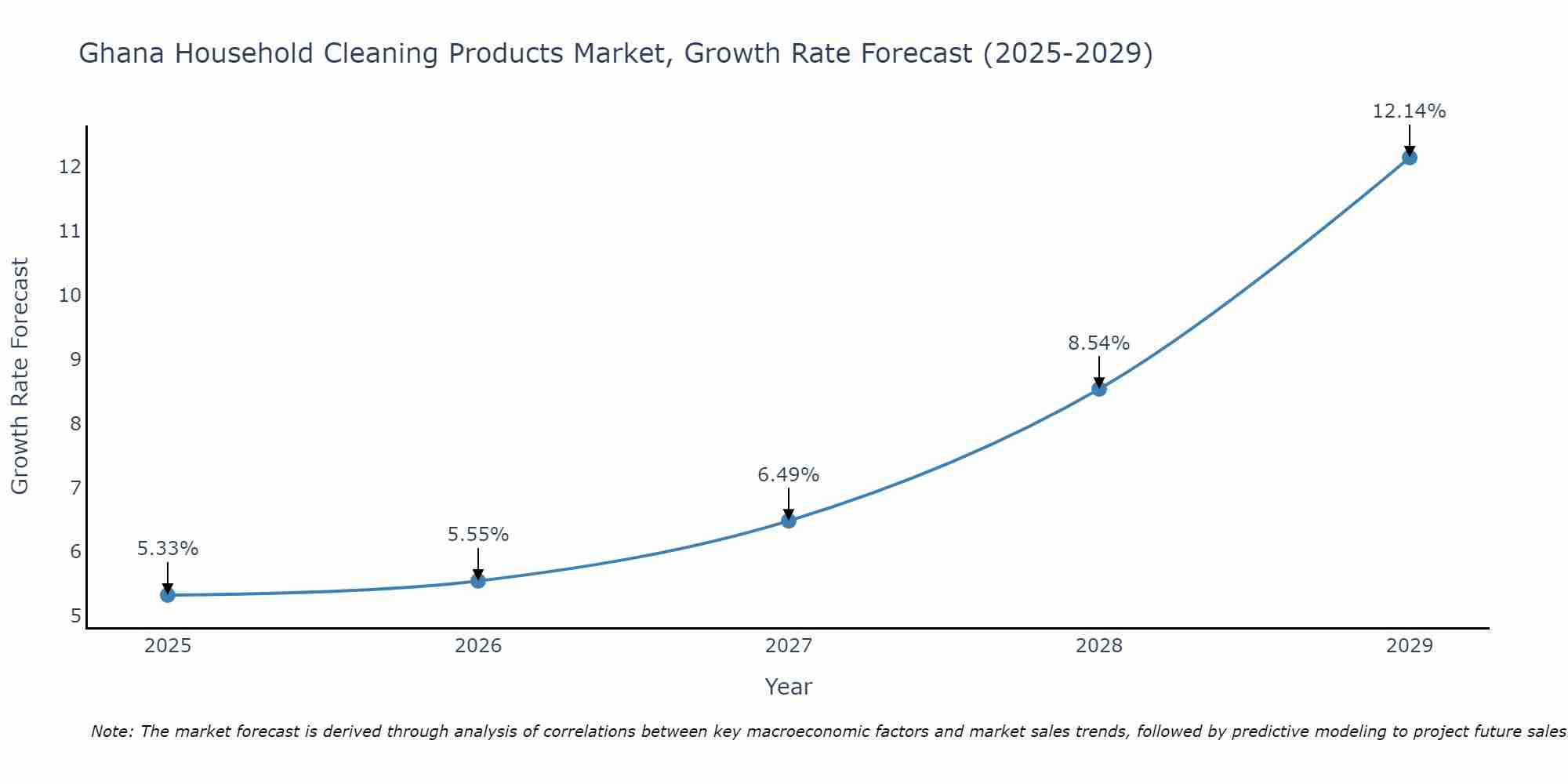
The Ghana Household Cleaning Products Market is likely to experience consistent growth rate gains over the period 2025 to 2029. The growth rate starts at 5.33% in 2025 and reaches 12.14% by 2029.
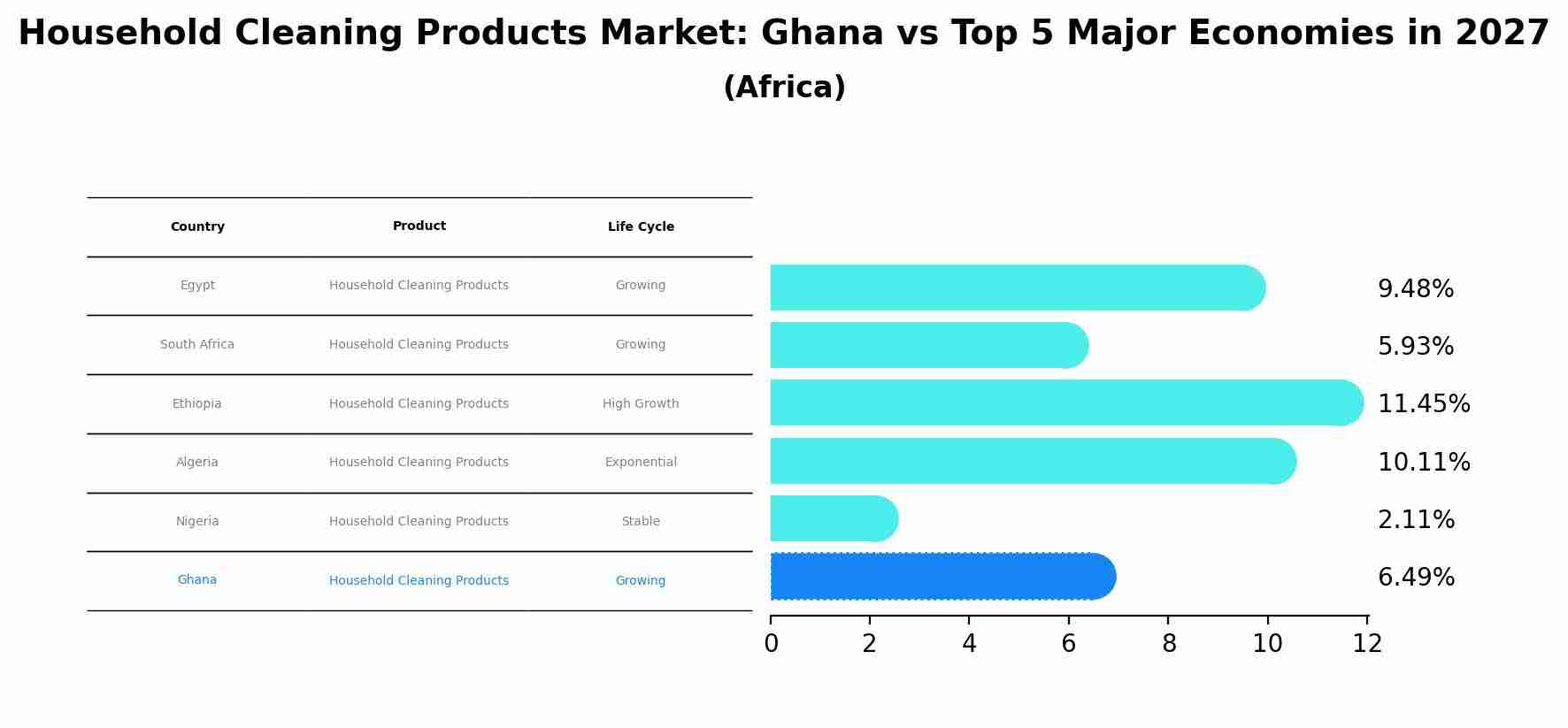
Household Cleaning Products Market: Ghana vs Top 5 Major Economies in 2027 (Africa)
Ghana's Household Cleaning Products market is anticipated to experience a growing growth rate of 6.49% by 2027, reflecting trends observed in the largest economy Egypt, followed by South Africa, Ethiopia, Algeria and Nigeria.
Ghana Household Cleaning Products Market Overview
The Ghana household cleaning products market involves the production, distribution, and sale of cleaning agents, detergents, and disinfectants for household and commercial cleaning purposes. In Ghana, household cleaning products include surface cleaners, laundry detergents, dishwashing liquids, and disinfectant sprays used for maintaining cleanliness, hygiene, and sanitation in homes, offices, and public spaces, driving demand for effective and environmentally friendly cleaning solutions.
Drivers of the market
The Ghana household cleaning products market is witnessing growth driven by the increasing awareness of hygiene, sanitation, and cleanliness among consumers, particularly in urban areas, where lifestyles are becoming more hectic, and disposable incomes are rising. Household cleaning products, including surface cleaners, disinfectants, laundry detergents, and air fresheners, play a crucial role in maintaining cleanliness, preventing infections, and creating pleasant living environments. Factors such as urbanization, consumer preferences, and health consciousness are driving the demand for household cleaning products in Ghana. Moreover, product innovation, eco-friendly formulations, and marketing campaigns are further fueling market growth in the country.
Challenges of the market
In Ghana, the household cleaning products market encounters challenges related to consumer awareness and preferences for environmentally friendly and biodegradable cleaning solutions. Additionally, addressing affordability and accessibility issues for low-income households poses challenges for manufacturers and distributors. Moreover, ensuring product safety and compliance with regulatory standards may hinder market expansion in Ghana household cleaning products industry.
Government Policy of the market
Given their widespread use and potential environmental and health impacts, household cleaning products are subject to regulations and standards to ensure their safety, efficacy, and sustainability. The government of Ghana has implemented policies to regulate the production, labeling, and marketing of household cleaning products, including ingredient disclosure requirements, product testing and certification procedures, and public awareness campaigns on safe and responsible use of cleaning chemicals.
Key Highlights of the Report:
- Ghana Household Cleaning Products Market Outlook
- Market Size of Ghana Household Cleaning Products Market, 2024
- Forecast of Ghana Household Cleaning Products Market, 2031
- Historical Data and Forecast of Ghana Household Cleaning Products Revenues & Volume for the Period 2021-2031
- Ghana Household Cleaning Products Market Trend Evolution
- Ghana Household Cleaning Products Market Drivers and Challenges
- Ghana Household Cleaning Products Price Trends
- Ghana Household Cleaning Products Porter's Five Forces
- Ghana Household Cleaning Products Industry Life Cycle
- Historical Data and Forecast of Ghana Household Cleaning Products Market Revenues & Volume By Product Type for the Period 2021-2031
- Historical Data and Forecast of Ghana Household Cleaning Products Market Revenues & Volume By Laundry Detergents for the Period 2021-2031
- Historical Data and Forecast of Ghana Household Cleaning Products Market Revenues & Volume By Surface Cleaners for the Period 2021-2031
- Historical Data and Forecast of Ghana Household Cleaning Products Market Revenues & Volume By Dishwashing Products for the Period 2021-2031
- Historical Data and Forecast of Ghana Household Cleaning Products Market Revenues & Volume By Toilet Cleaners for the Period 2021-2031
- Historical Data and Forecast of Ghana Household Cleaning Products Market Revenues & Volume By Others for the Period 2021-2031
- Ghana Household Cleaning Products Import Export Trade Statistics
- Market Opportunity Assessment By Product Type
- Ghana Household Cleaning Products Top Companies Market Share
- Ghana Household Cleaning Products Competitive Benchmarking By Technical and Operational Parameters
- Ghana Household Cleaning Products Company Profiles
- Ghana Household Cleaning Products Key Strategic Recommendations






































