Ghana Household furniture Market Summary
The ghana household furniture market was estimated at USD 173 Million in 2025 and is projected to reach USD 189 Million by 2032, growing at a CAGR of 1.1% from 2026 to 2032.
Ghana Household furniture Market Year-wise Growth Rate and Key Drivers
This graph highlights how the Ghana Household furniture Market has steadily grown over the past five years, supported by major growth factors.
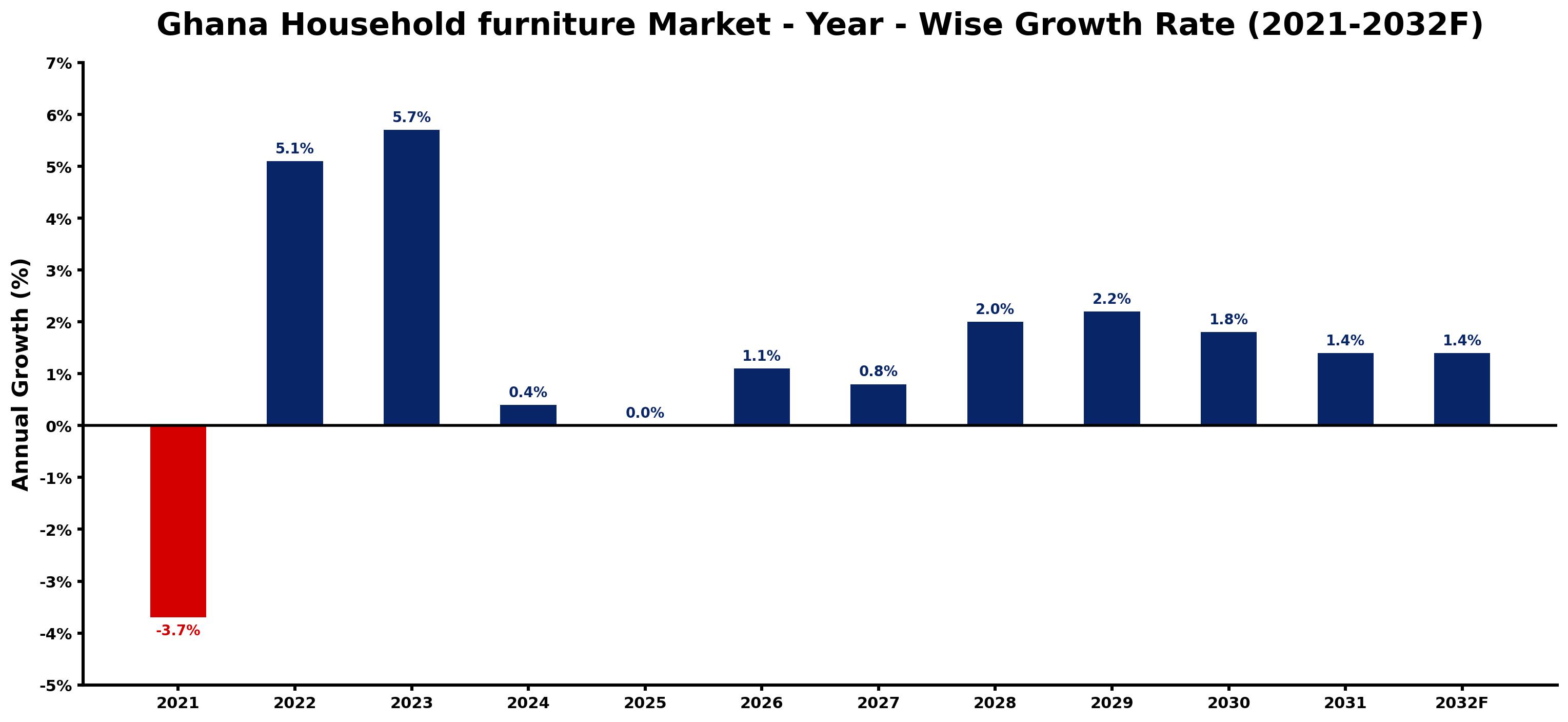
The table below presents the year wise growth rates along with the key drivers influencing the market
| Year | Growth Rate | Major Drivers |
| 2021 | -3.7% | Supply chain disruptions caused by the pandemic severely limited inventory levels, hindering sales in the furniture sector. |
| 2022 | 5.1% | Local production capabilities expanded, reducing dependency on imported furniture and enhancing affordability. |
| 2023 | 5.7% | Urbanization trends transformed traditional homes into modern spaces, increasing demand for stylish furnishings. |
| 2024 | 0.4% | E-commerce platforms gained traction, facilitating easier access to a variety of furniture options. |
| 2025 | 0.0% | Sustainable materials became essential as consumer awareness of environmental impacts grew significantly. |
| 2026 | 1.1% | Inflation pressures prompted households to seek value-driven furniture alternatives without compromising quality. |
| 2027 | 0.8% | Interior design services flourished, with more Ghanaians investing in professional consultations for home aesthetics. |
| 2028 | 2.0% | Tourism recovery spurred demand for higher-quality furniture in hospitality and rental properties. |
| 2029 | 2.2% | Investment in housing developments surged, driving up demand for both residential and commercial furniture. |
| 2030 | 1.8% | Technological innovations in manufacturing enhanced customization options for consumers, attracting tech-savvy buyers. |
| 2031 | 1.4% | Collaborations between local artisans and designers enriched the market with culturally inspired, unique pieces. |
| 2032 | 1.4% | Focus on healthy living spaces propelled the market for ergonomic and multifunctional furniture solutions. |
Note - Market size estimations and growth projections presented in this report are based on 6Wresearch's advanced forecasting approach, validated with industry datasets as of June 2026.
Ghana Household furniture Market Synopsis
The Ghana Household furniture Market is projected to reach 1.1% and witness significant growth during the forecast period (2026-2032). This growth trajectory is primarily attributed to factors such as urbanization, increasing disposable incomes, and shifting consumer preferences towards quality and modern designs. The market is characterized by a blend of local manufacturers and international brands, each catering to diverse consumer segments with a wide variety of furniture products.
Ghana Household furniture Market Growth Drivers
Several key drivers are propelling the expansion of the Ghana Household furniture Market. The ongoing urbanization trend has led to an increase in demand for stylish and functional furniture as urban dwellers seek to enhance their living environments. Additionally, the rising disposable income among Ghanaians allows consumers to invest more in quality furniture, aligning their purchases with personal style and preferences. The growing popularity of e-commerce platforms provides consumers with greater access to a wider range of products, enabling them to make informed purchasing decisions from the comfort of their homes.
- The convergence of urbanization and rising incomes is fostering demand for contemporary furniture solutions.
- Increased interest in sustainable living drives demand for eco-friendly and ethically sourced furniture.
- Younger buyers are gravitating towards unique designs, boosting the popularity of bespoke furniture options.
- The shift towards digital shopping has expanded market reach, making furniture purchasing more convenient.
- Local craftsmanship and traditional styles are gaining traction, balancing modern aesthetics and cultural heritage.
Ghana Household furniture Market Trends and Opportunities
In response to evolving consumer preferences, the Ghana Household furniture Market is witnessing a surge in trends centered around sustainability, customization, and multifunctionality. As environmental awareness grows, consumers increasingly prioritize furniture that is both stylish and sustainable. This focus on eco-friendly production methods and materials presents opportunities for brands to differentiate themselves in a competitive landscape.
- Growing demand for locally crafted furniture is fostering regional craftsmanship and entrepreneurship.
- Customization is emerging as a key selling point, allowing consumers to reflect their individuality through unique designs.
- Multifunctional furniture is becoming essential for urban dwellers facing space constraints, addressing both style and utility.
- The rise of social media influences consumer choices, making aesthetic appeal a vital component in design considerations.
- Collaboration with local artisans can enhance brand authenticity and appeal, leveraging community talent for unique offerings.
Ghana Household furniture Market Challenges and Restraints
Despite the promising growth potential, the Ghana Household furniture Market faces several challenges that may hinder its expansion. Limited access to quality raw materials domestically necessitates reliance on imports, resulting in increased production costs. Additionally, inconsistent electricity supply can disrupt manufacturing operations, further exacerbating operational expenses. Local manufacturers also face stiff competition from cheaper imported furniture, which can erode market share and impact profitability.
- High production costs linked to imported raw materials are a significant barrier for local manufacturers.
- Inconsistent power supply challenges manufacturing efficiency and increases overhead costs.
- Intense competition from low-cost imports pressures local brands to innovate and reduce prices.
- Economic fluctuations may limit consumer purchasing power, affecting overall market demand.
- The scarcity of skilled labor in specialized furniture design can stifle innovation and product development.
Ghana Household furniture Market Government Investment and Initiatives
The Ghanaian government has enacted strategic policies aimed at bolstering the household furniture market and encouraging local production. Initiatives such as import duty waivers on raw materials essential for furniture manufacturing are designed to lower production costs and improve competitiveness. To stimulate the local furniture industry, procurement policies have been introduced, prioritizing the purchase of Ghanaian-made furniture for government institutions.
Furthermore, the government supports capacity-building programs that provide training and resources for furniture manufacturers, ultimately fostering skill development and innovation within the sector. These investments serve to strengthen the domestic market, enhance employment opportunities, and promote sustainable economic growth within Ghana.
Ghana Household furniture Market Latest Developments (May 2025 - June 2026)
Recent developments in the Ghana Household furniture Market indicate a continued shift towards modern furniture solutions, with an increasing number of consumers seeking products that merge functionality with aesthetic appeal. During this period, the trend of online shopping has accelerated, resulting in greater competitiveness among e-commerce platforms as they enhance user experience and diversify product offerings.
Additionally, sustainability remains a key focus, prompting manufacturers to explore innovative materials and production methods that align with eco-conscious consumer preferences. Collaborations between local artisans and furniture brands are also on the rise, fostering a greater appreciation for craftsmanship while meeting the demand for unique and locally made products.
Ghana Household furniture Market - Key Attractiveness of the Report
- 10 Years of Market Numbers
- Historical Data Starting from 2022 to 2025
- Base Year: 2025
- Forecast Data until 2032
- Key Performance Indicators Impacting the Market
- Major Upcoming Developments and Projects
Key Highlights of the Report:
- Ghana Household furniture Market Outlook
- Market Size of Ghana Household furniture Market, 2025
- Forecast of Ghana Household furniture Market, 2032F
- Historical Data and Forecast of Ghana Household furniture Revenues & Volume for the Period 2022-2032F
- Ghana Household furniture Market Trend Evolution
- Ghana Household furniture Market Drivers and Challenges
- Ghana Household furniture Price Trends
- Ghana Household furniture Porter's Five Forces
- Ghana Household furniture Industry Life Cycle
- Historical Data and Forecast of Ghana Household furniture Market Revenues & Volume By Types for the Period 2022-2032F
- Historical Data and Forecast of Ghana Household furniture Market Revenues & Volume By Wood Furniture for the Period 2022-2032F
- Historical Data and Forecast of Ghana Household furniture Market Revenues & Volume By Metal Furniture for the Period 2022-2032F
- Historical Data and Forecast of Ghana Household furniture Market Revenues & Volume By Plastic Furniture for the Period 2022-2032F
- Historical Data and Forecast of Ghana Household furniture Market Revenues & Volume By Others for the Period 2022-2032F
- Historical Data and Forecast of Ghana Household furniture Market Revenues & Volume By Area of Use for the Period 2022-2032F
- Historical Data and Forecast of Ghana Household furniture Market Revenues & Volume By ?Bedroom Furniture for the Period 2022-2032F
- Historical Data and Forecast of Ghana Household furniture Market Revenues & Volume By Living Room Furniture for the Period 2022-2032F
- Historical Data and Forecast of Ghana Household furniture Market Revenues & Volume By Dining Room Furniture for the Period 2022-2032F
- Historical Data and Forecast of Ghana Household furniture Market Revenues & Volume By Household Furniture for the Period 2022-2032F
- Historical Data and Forecast of Ghana Household furniture Market Revenues & Volume By Others for the Period 2022-2032F
- Ghana Household furniture Import Export Trade Statistics
- Market Opportunity Assessment By Types
- Market Opportunity Assessment By Area of Use
- Ghana Household furniture Top Companies Market Share
- Ghana Household furniture Competitive Benchmarking By Technical and Operational Parameters
- Ghana Household furniture Company Profiles
- Ghana Household furniture Key Strategic Recommendations






































