Ghana Industrial Burner Market Size, Share & Growth Rate
The Ghana Industrial Burner Market was estimated at USD 172 Million in 2025 and is projected to reach USD 188 Million by 2032, growing at a CAGR of 1.3% from 2026 to 2032. This steady growth trajectory is fueled by the rising industrial activities across sectors that demand reliable and efficient heating solutions. With increasing emphasis on energy efficiency and compliance with environmental regulations, industries are increasingly adopting advanced burner technologies that not only enhance combustion efficiency but also reduce harmful emissions.
Ghana Industrial Burner Market Year-wise Growth Rate and Key Drivers
This graph highlights how the Ghana Industrial Burner Market has steadily grown over the years, supported by major growth factors.
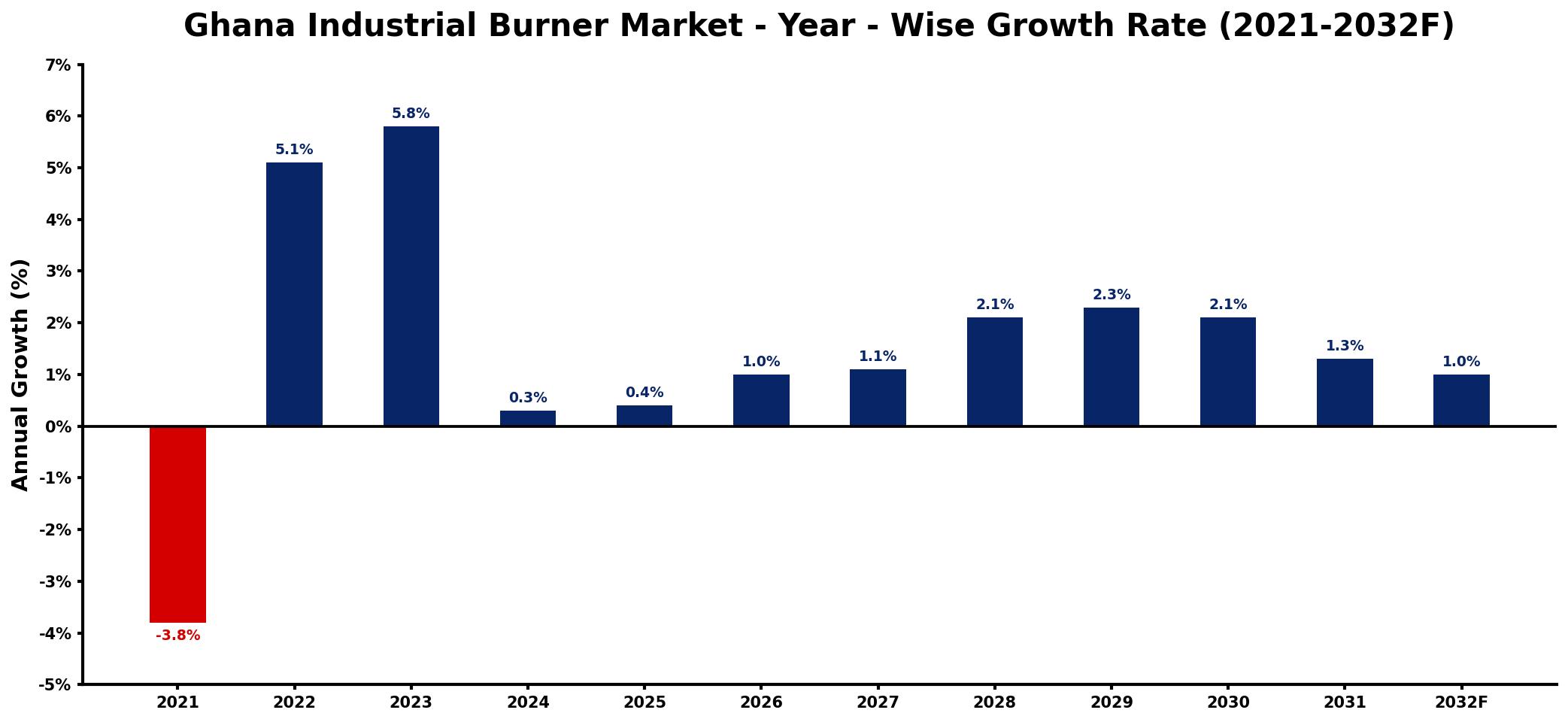
The table below presents the year‑wise growth rates along with the key drivers influencing the market
| Year | Growth Rate | Major Drivers |
| 2021 | -3.8% | decrease in manufacturing output |
| 2022 | 5.1% | increased energy efficiency initiatives |
| 2023 | 5.8% | growth in food processing sector |
| 2024 | 0.3% | rising demand for sustainable solutions |
| 2025 | 0.4% | expansion of construction projects |
| 2026 | 1.0% | increased investment in infrastructure |
| 2027 | 1.1% | strengthening underlying market demand |
| 2028 | 2.1% | rising exports of processed goods |
| 2029 | 2.3% | increased adoption of automation |
| 2030 | 2.1% | expanding manufacturing base activity |
| 2031 | 1.3% | increased production capacity utilization |
| 2032 | 1.0% | increased governmental support programs |
Note: Market size estimations and growth projections presented in this report are based on 6Wresearch's proprietary forecasting methodology, utilizing the latest available industry data, government publications, and primary research inputs.
Ghana Industrial Burner Market Synopsis
The driving force behind the Ghana Industrial Burner Market is the accelerating demand for energy-efficient combustion solutions across various industrial processes. Industries engaged in heating, drying, and thermal processing are particularly leveraging modern burner technologies to optimize their operations and ensure regulatory compliance.
Furthermore, the shift towards sustainable practices and cleaner fuels is prompting significant innovation in burner technologies. This market evolution is being supported by local manufacturers focusing on developing advanced combustion systems that align with international standards for emissions and efficiency.
Ghana Industrial Burner Market Key Takeaways
- Robust demand for energy-efficient heating solutions is driving market growth.
- Manufacturers are focusing on advanced technologies to enhance burner performance and sustainability.
- Government regulations are influencing the adoption of low-emission burner technologies.
- Challenges related to fuel quality and combustion control remain significant for operators.
- The market is poised for steady growth with opportunities for investment in innovative burner solutions.
Evaluation of Restraints in Ghana Industrial Burner Market
Despite the promising growth prospects, the Ghana Industrial Burner Market faces significant restraints. One of the primary challenges is optimizing burner designs to meet stringent emissions and energy efficiency standards. Many operators, especially in remote areas, grapple with issues regarding fuel quality and availability, which can affect overall performance. Additionally, maintaining proper combustion control and monitoring systems to minimize emissions while maximizing fuel efficiency presents an ongoing challenge for both manufacturers and users in the industry.
Ghana Industrial Burner Market Trends
Current trends in the Ghana Industrial Burner Market highlight a strong inclination towards integrating smart technologies. The incorporation of IoT and advanced combustion control systems is enabling real-time monitoring and optimization of burner operations, enhancing efficiency. Additionally, the trend towards using alternative and biomass fuels reflects a growing commitment to sustainability and lower carbon footprints. As businesses seek to improve their environmental impact, innovative burner solutions are at the forefront of this transition.
Ghana Industrial Burner Market Opportunities
The Ghana Industrial Burner Market presents considerable opportunities for growth and investment. As industries transition towards cleaner technologies, there is a high demand for modern burner systems that comply with environmental standards. Innovations in burner design, including the utilization of alternative fuels and advanced combustion controls, offer significant potential for manufacturers. Furthermore, partnerships with government initiatives aimed at promoting energy efficiency can unlock new avenues for market expansion.
Government Initiatives in the Ghana Industrial Burner Market
The government of Ghana recognizes the importance of efficient burner technologies for industrial applications and has put forth various policies to encourage their adoption. These initiatives include establishing emissions standards for industrial burner operations, offering incentives for investments in clean combustion technologies, and providing technical assistance programs for both manufacturers and end-users. Such measures are instrumental in fostering an environment conducive to innovation and compliance with international environmental standards.
Future Insights of the Ghana Industrial Burner Market
Looking ahead to the period between 2026 and 2032, the Ghana Industrial Burner Market is likely to experience continued growth driven by increasing industrial activities and a strong push towards sustainability. As more industries recognize the importance of energy efficiency and reduced emissions, the demand for advanced burner technologies will rise. Additionally, government support for clean technologies will play a crucial role in shaping the future landscape, paving the way for innovations that will redefine combustion solutions in the country.
Ghana Industrial Burner Market Latest Developments (2025 - 2026)
The Ghana Industrial Burner Market has seen significant momentum recently, with numerous initiatives focusing on technology upgrades to improve energy efficiency. Manufacturers are investing in R&D to develop state-of-the-art burner systems designed to meet evolving regulations. Additionally, partnerships between public and private sectors are being formed to explore alternative fuels, enhancing sustainability efforts. These trends signal a proactive approach to addressing both market needs and environmental challenges.
Ghana Industrial Burner Market - Key Attractiveness of the Report
- 10 Years of Market Numbers
- Historical Data Starting from 2022 to 2025
- Base Year: 2025
- Forecast Data until 2032
- Key Performance Indicators Impacting the Market
- Major Upcoming Developments and Projects
Key Highlights of the Report:
- Ghana Industrial Burner Market Outlook
- Market Size of Ghana Industrial Burner Market, 2025
- Forecast of Ghana Industrial Burner Market, 2032
- Historical Data and Forecast of Ghana Industrial Burner Revenues & Volume for the Period 2022-2032F
- Ghana Industrial Burner Market Trend Evolution
- Ghana Industrial Burner Market Drivers and Challenges
- Ghana Industrial Burner Price Trends
- Ghana Industrial Burner Porter's Five Forces
- Ghana Industrial Burner Industry Life Cycle
- Historical Data and Forecast of Ghana Industrial Burner Market Revenues & Volume By Type for the Period 2022-2032F
- Historical Data and Forecast of Ghana Industrial Burner Market Revenues & Volume By Cold Chamber Die Casting Machine for the Period 2022-2032F
- Historical Data and Forecast of Ghana Industrial Burner Market Revenues & Volume By Hot Chamber Die Casting Machine for the Period 2022-2032F
- Historical Data and Forecast of Ghana Industrial Burner Market Revenues & Volume By Gravity Die Casting Machine for the Period 2022-2032F
- Historical Data and Forecast of Ghana Industrial Burner Market Revenues & Volume By Material for the Period 2022-2032F
- Historical Data and Forecast of Ghana Industrial Burner Market Revenues & Volume By Aluminum for the Period 2022-2032F
- Historical Data and Forecast of Ghana Industrial Burner Market Revenues & Volume By Zinc for the Period 2022-2032F
- Historical Data and Forecast of Ghana Industrial Burner Market Revenues & Volume By Magnesium for the Period 2022-2032F
- Historical Data and Forecast of Ghana Industrial Burner Market Revenues & Volume By End User for the Period 2022-2032F
- Historical Data and Forecast of Ghana Industrial Burner Market Revenues & Volume By Transportation for the Period 2022-2032F
- Historical Data and Forecast of Ghana Industrial Burner Market Revenues & Volume By Mechanical & Manufacturing Equipment for the Period 2022-2032F
- Historical Data and Forecast of Ghana Industrial Burner Market Revenues & Volume By Building & Construction for the Period 2022-2032F
- Ghana Industrial Burner Import Export Trade Statistics
- Market Opportunity Assessment By Type
- Market Opportunity Assessment By Material
- Market Opportunity Assessment By End User
- Ghana Industrial Burner Top Companies Market Share
- Ghana Industrial Burner Competitive Benchmarking By Technical and Operational Parameters
- Ghana Industrial Burner Company Profiles
- Ghana Industrial Burner Key Strategic Recommendations






































