Ghana Industrial Sugar Market Size, Share & Growth Rate
The Ghana Industrial Sugar Market was estimated at USD 127 Million in 2025 and is projected to reach USD 139 Million by 2032, growing at a CAGR of 1.3% from 2026 to 2032. This growth trajectory is primarily driven by the rapid expansion of the food and beverage sector, alongside a rising demand for sweeteners and food additives. As consumers increasingly favor processed foods, the versatility and cost-effectiveness of industrial sugar have become essential for manufacturers aiming to enhance product quality and shelf life.
Ghana Industrial Sugar Market Year-wise Growth Rate and Key Drivers
This graph highlights how the Ghana Industrial Sugar Market has steadily grown over the years, supported by major growth factors.
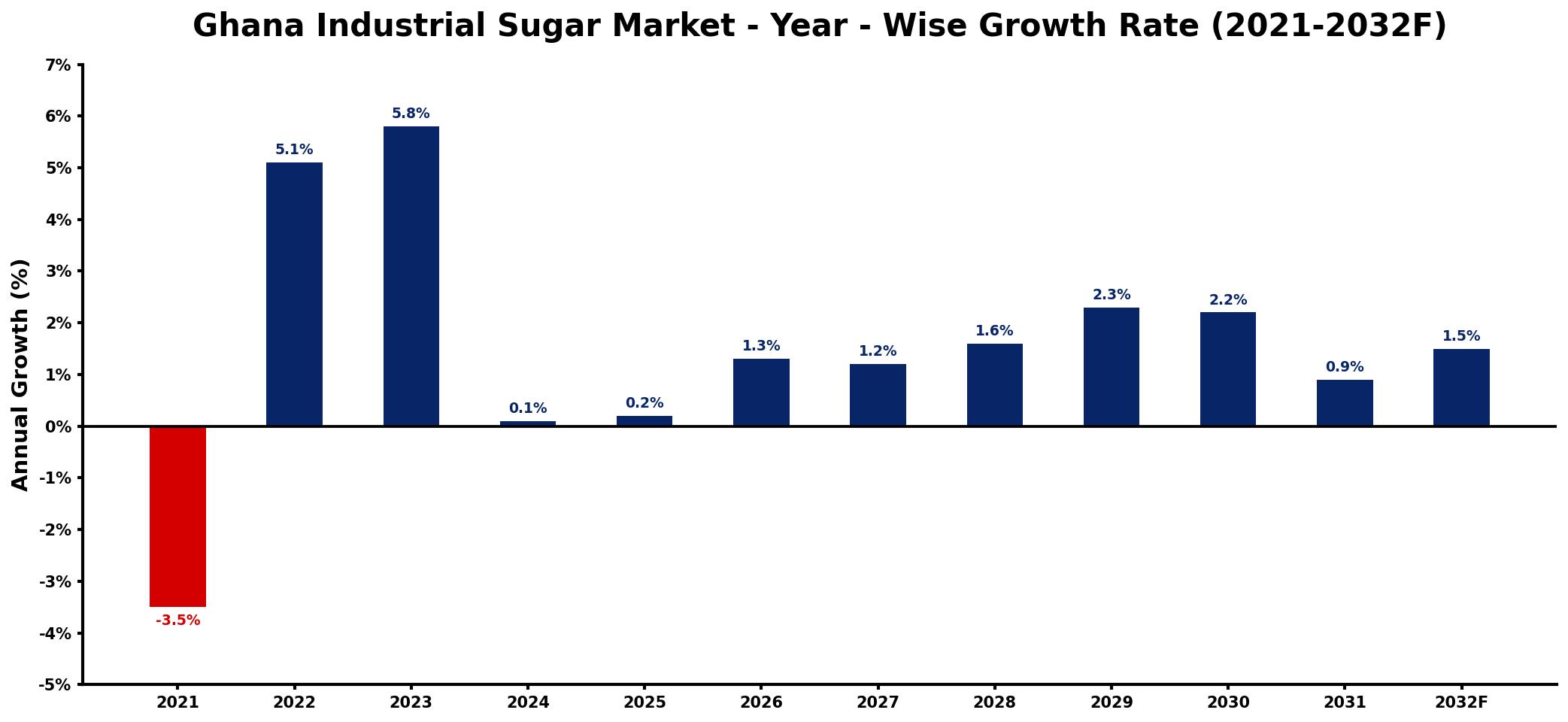
The table below presents the year‑wise growth rates along with the key drivers influencing the market
| Year | Growth Rate | Major Drivers |
| 2021 | -3.5% | decrease in consumer purchasing power |
| 2022 | 5.1% | increased demand from beverage sector |
| 2023 | 5.8% | expansion of food processing facilities |
| 2024 | 0.1% | growing export opportunities for products |
| 2025 | 0.2% | rise in domestic production capacity |
| 2026 | 1.3% | investment in renewable energy sources |
| 2027 | 1.2% | increased government support for agriculture |
| 2028 | 1.6% | enhanced logistics and distribution networks |
| 2029 | 2.3% | growing popularity of health products |
| 2030 | 2.2% | growing emerging market penetration |
| 2031 | 0.9% | increase in urban population consumption |
| 2032 | 1.5% | rising demand for confectionery items |
Note: Market size estimations and growth projections presented in this report are based on 6Wresearch's proprietary forecasting methodology, utilizing the latest available industry data, government publications, and primary research inputs.
Ghana Industrial Sugar Market Synopsis
The Ghana Industrial Sugar Market is currently experiencing a dynamic transformation, largely fueled by the food and beverage industry's robust growth. With industrial sugar playing a critical role as a sweetener and preservative, its applications across various sectors continue to expand.
Furthermore, urbanization trends and changing consumer preferences are propelling demand for processed foods, thus making industrial sugar a vital ingredient in food processing and confectionery production. This evolving landscape reflects the broader shifts in dietary habits and market needs within Ghana.
Ghana Industrial Sugar Market Key Takeaways
- The market is poised for steady growth, backed by increasing demand from food processing and beverage sectors.
- Urbanization and changing consumer preferences are critical factors driving the adoption of industrial sugar.
- Technological advancements in sugar processing are enhancing product formulations and sustainability.
- Government regulations ensure quality and safety standards for industrial sugar, reinforcing market credibility.
- Price volatility remains a significant challenge for local producers, influencing market stability.
Evaluation of Restraints in Ghana Industrial Sugar Market
Despite the promising growth, the Ghana Industrial Sugar Market faces several restraints that could limit its potential. Price volatility remains a pressing issue, as fluctuations in global sugar prices and currency exchange rates significantly affect local producers. This unpredictability can hamper profitability and deter investments, ultimately influencing market dynamics. Additionally, competition from imported sugars poses challenges for domestic manufacturers, pressuring them to remain competitive in pricing and quality without sacrificing their margins.
Ghana Industrial Sugar Market Trends
A notable trend within the Ghana Industrial Sugar Market is the increasing focus on sustainability. Manufacturers are exploring sustainable sourcing and production practices to appeal to environmentally-conscious consumers. Furthermore, innovations in sugar processing technology are leading to more efficient production methods, enhancing product consistency and quality.
Additionally, the rise of health-conscious consumers is prompting a shift toward the development of functional ingredients. This trend is pushing companies to consider alternative sweetening solutions that complement industrial sugar while catering to evolving dietary preferences.
Ghana Industrial Sugar Market Opportunities
The Ghana Industrial Sugar Market presents several growth opportunities for stakeholders. As urbanization continues to drive demand for processed foods, there is a significant potential for expansion in the food and beverage sectors. Manufacturers can leverage advancements in technology to optimize their production processes and reduce costs. Moreover, exploring export opportunities could also benefit local producers as they seek to diversify their market presence.
Government Initiatives in the Ghana Industrial Sugar Market
The Ghanaian government has actively implemented policies to regulate the industrial sugar sector, emphasizing quality and safety standards. These regulations not only ensure consumer protection but also support local producers by establishing clear quality specifications. Additionally, technical assistance programs have been put in place to aid sugar producers and end-users in areas such as processing, handling, and storage, contributing to overall market stability and growth.
Future Insights of the Ghana Industrial Sugar Market
Looking ahead to 2026-2032, the Ghana Industrial Sugar Market is expected to continue its steady growth trajectory. As the food and beverage industry evolves, the demand for versatile ingredients, including industrial sugar, will likely rise. Innovations in processing technology and sustainability efforts will further shape the market, presenting opportunities for producers to enhance their offerings and operational efficiencies. Consequently, strategic investments in these areas are anticipated to be pivotal for long-term success.
Ghana Industrial Sugar Market Latest Developments (2025 - 2026)
Recent developments within the Ghana Industrial Sugar Market reflect a growing awareness of sustainability and quality. Industry stakeholders are increasingly adopting practices that align with environmental goals while ensuring product integrity. Simultaneously, collaborations between government agencies and sugar producers have strengthened efforts to improve processing standards and product quality across the sector. These initiatives are integral as Ghana seeks to enhance its market competitiveness on both domestic and international fronts.
Ghana Industrial Sugar Market - Key Attractiveness of the Report
- 10 Years of Market Numbers
- Historical Data Starting from 2022 to 2025
- Base Year: 2025
- Forecast Data until 2032
- Key Performance Indicators Impacting the Market
- Major Upcoming Developments and Projects
Key Highlights of the Report:
- Ghana Industrial Sugar Market Outlook
- Market Size of Ghana Industrial Sugar Market, 2025
- Forecast of Ghana Industrial Sugar Market, 2032
- Historical Data and Forecast of Ghana Industrial Sugar Revenues & Volume for the Period 2022-2032F
- Ghana Industrial Sugar Market Trend Evolution
- Ghana Industrial Sugar Market Drivers and Challenges
- Ghana Industrial Sugar Price Trends
- Ghana Industrial Sugar Porter's Five Forces
- Ghana Industrial Sugar Industry Life Cycle
- Historical Data and Forecast of Ghana Industrial Sugar Market Revenues & Volume By Type for the Period 2022-2032F
- Historical Data and Forecast of Ghana Industrial Sugar Market Revenues & Volume By White sugar for the Period 2022-2032F
- Historical Data and Forecast of Ghana Industrial Sugar Market Revenues & Volume By Brown sugar for the Period 2022-2032F
- Historical Data and Forecast of Ghana Industrial Sugar Market Revenues & Volume By Liquid sugar for the Period 2022-2032F
- Historical Data and Forecast of Ghana Industrial Sugar Market Revenues & Volume By Form for the Period 2022-2032F
- Historical Data and Forecast of Ghana Industrial Sugar Market Revenues & Volume By Granulated for the Period 2022-2032F
- Historical Data and Forecast of Ghana Industrial Sugar Market Revenues & Volume By Powdered for the Period 2022-2032F
- Historical Data and Forecast of Ghana Industrial Sugar Market Revenues & Volume By Syrup for the Period 2022-2032F
- Historical Data and Forecast of Ghana Industrial Sugar Market Revenues & Volume By Application for the Period 2022-2032F
- Historical Data and Forecast of Ghana Industrial Sugar Market Revenues & Volume By Dairy for the Period 2022-2032F
- Historical Data and Forecast of Ghana Industrial Sugar Market Revenues & Volume By Bakery for the Period 2022-2032F
- Historical Data and Forecast of Ghana Industrial Sugar Market Revenues & Volume By Confectionery for the Period 2022-2032F
- Historical Data and Forecast of Ghana Industrial Sugar Market Revenues & Volume By Beverage for the Period 2022-2032F
- Historical Data and Forecast of Ghana Industrial Sugar Market Revenues & Volume By Canned & frozen foods for the Period 2022-2032F
- Historical Data and Forecast of Ghana Industrial Sugar Market Revenues & Volume By Pharmaceuticals for the Period 2022-2032F
- Historical Data and Forecast of Ghana Industrial Sugar Market Revenues & Volume By Other food items for the Period 2022-2032F
- Historical Data and Forecast of Ghana Industrial Sugar Market Revenues & Volume By Source for the Period 2022-2032F
- Historical Data and Forecast of Ghana Industrial Sugar Market Revenues & Volume By Cane sugar for the Period 2022-2032F
- Historical Data and Forecast of Ghana Industrial Sugar Market Revenues & Volume By Beet sugar for the Period 2022-2032F
- Ghana Industrial Sugar Import Export Trade Statistics
- Market Opportunity Assessment By Type
- Market Opportunity Assessment By Form
- Market Opportunity Assessment By Application
- Market Opportunity Assessment By Source
- Ghana Industrial Sugar Top Companies Market Share
- Ghana Industrial Sugar Competitive Benchmarking By Technical and Operational Parameters
- Ghana Industrial Sugar Company Profiles
- Ghana Industrial Sugar Key Strategic Recommendations






































