Ghana Industrial Vacuum Cleaner Market Size, Share & Growth Rate
The Ghana Industrial Vacuum Cleaner Market was estimated at USD 128 Million in 2025 and is projected to reach USD 140 Million by 2032, growing at a CAGR of 1.3% from 2026 to 2032. This growth trajectory is primarily driven by the increasing demand from sectors such as manufacturing, construction, and hospitality, where maintaining a clean and safe working environment is paramount. As businesses recognize the importance of hygiene and regulatory compliance, the demand for advanced industrial vacuum cleaners featuring HEPA filtration and wet/dry capabilities is on the rise.
Ghana Industrial Vacuum Cleaner Market Year-wise Growth Rate and Key Drivers
This graph highlights how the Ghana Industrial Vacuum Cleaner Market has steadily grown over the years, supported by major growth factors.
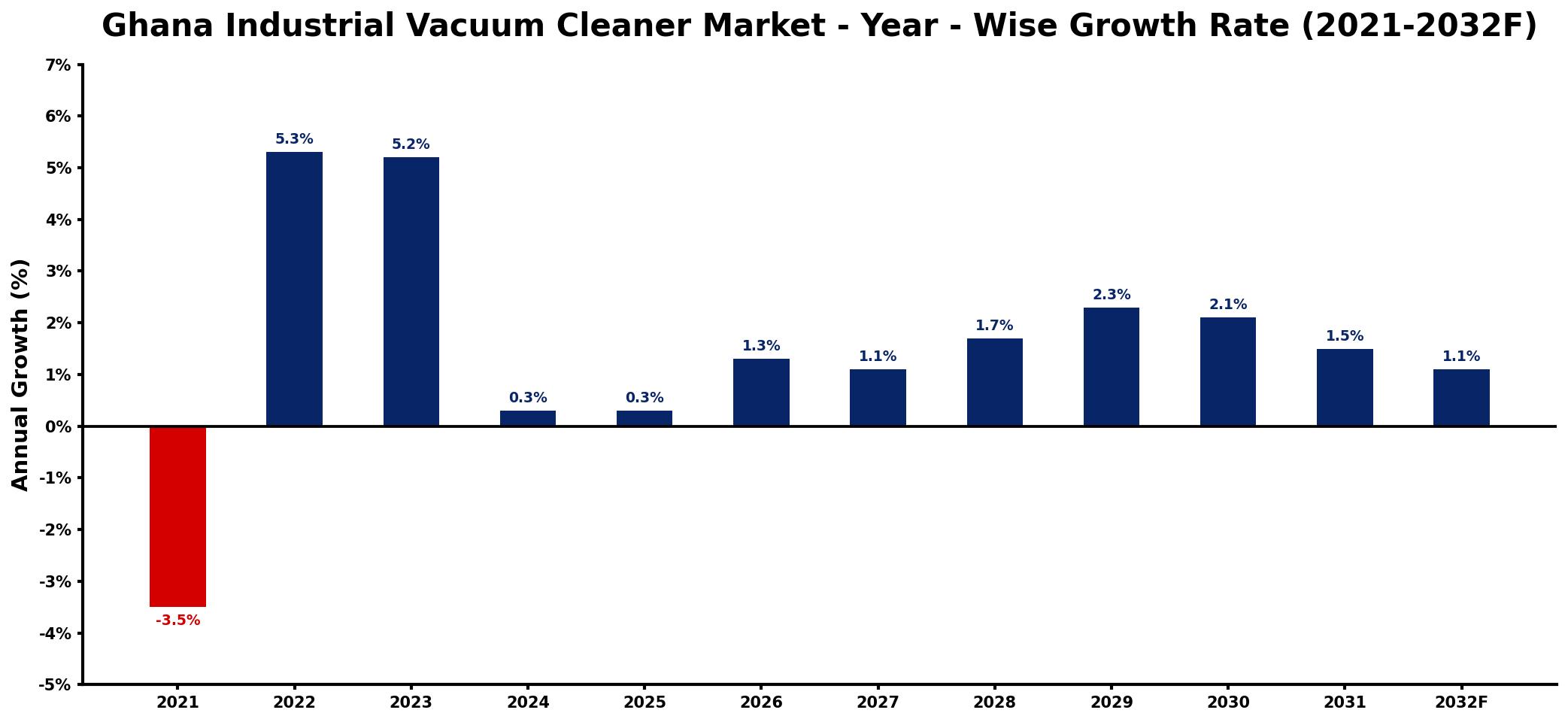
The table below presents the year‑wise growth rates along with the key drivers influencing the market
| Year | Growth Rate | Major Drivers |
| 2021 | -3.5% | decreased manufacturing facility investments |
| 2022 | 5.3% | increased demand from healthcare sector |
| 2023 | 5.2% | expansion in hospitality industry services |
| 2024 | 0.3% | growing construction projects nationwide |
| 2025 | 0.3% | rising emphasis on sanitation standards |
| 2026 | 1.3% | emerging e-commerce logistics enhancements |
| 2027 | 1.1% | increased adoption of automation technologies |
| 2028 | 1.7% | greater focus on environmental sustainability |
| 2029 | 2.3% | expansion of food processing facilities |
| 2030 | 2.1% | growing urban infrastructure developments |
| 2031 | 1.5% | increased foreign direct investments |
| 2032 | 1.1% | rising demand for energy efficiency |
Note: Market size estimations and growth projections presented in this report are based on 6Wresearch's proprietary forecasting methodology, utilizing the latest available industry data, government publications, and primary research inputs.
Ghana Industrial Vacuum Cleaner Market Synopsis
In recent years, the Ghana Industrial Vacuum Cleaner Market has gained momentum, fueled by a heightened awareness of cleanliness standards across various industries. However, as the market evolves, it faces unique challenges that may influence its growth trajectory, such as the need for skilled technicians and access to spare parts. The interplay of these dynamics will shape the future landscape of industrial cleaning solutions in Ghana.
While industrial vacuum cleaners are becoming indispensable in maintaining air quality and workplace safety, the market is still on a path of transformation. Innovations in technology, such as energy-efficient designs and ergonomic features, are increasingly meeting the diverse needs of users, setting the stage for substantial growth in the coming years.
Ghana Industrial Vacuum Cleaner Market Key Takeaways
- The market is projected to reach USD 140 Million by 2032, reflecting a steady growth driven by industrial demand.
- There is a significant emphasis on workplace hygiene, propelled by regulatory standards in various sectors.
- Technological advancements are fostering product innovation, with a focus on energy efficiency and user-friendly designs.
- Challenges related to maintenance and repair availability could impact operational productivity in the sector.
- Government regulations are increasingly influencing the design and manufacturing of industrial vacuum cleaners to meet performance standards.
Evaluation of Restraints in Ghana Industrial Vacuum Cleaner Market
Despite the encouraging growth outlook, the Ghana Industrial Vacuum Cleaner Market faces significant restraints. One of the primary challenges is the scarcity of skilled technicians who can perform maintenance and repairs on these advanced systems. This limitation often results in extended downtime, negatively affecting productivity and operational efficiency. Additionally, access to spare parts remains a concern, as logistical and supply chain issues can delay repairs and lead to increased operational costs for businesses reliant on these essential tools.
Ghana Industrial Vacuum Cleaner Market Trends
Several trends are shaping the Ghana Industrial Vacuum Cleaner Market, notably the increasing integration of advanced filtration systems such as HEPA filters, which enhance indoor air quality. Furthermore, there is a growing inclination towards multifunctional vacuum cleaners with wet/dry capabilities, allowing industries to address a broader range of cleaning needs. Ergonomic designs are also becoming more prevalent, as companies prioritize user comfort and efficiency in their cleaning processes.
Ghana Industrial Vacuum Cleaner Market Opportunities
The Ghana Industrial Vacuum Cleaner Market is ripe with opportunities for growth and investment. As industries expand, the need for effective cleaning solutions continues to rise. New entrants with innovative technologies and sustainable practices could capture market share by meeting the evolving demands of customers seeking energy-efficient and eco-friendly options. Furthermore, strategic partnerships with local manufacturers can facilitate better service delivery and increase access to maintenance support, enhancing customer satisfaction.
Government Initiatives in the Ghana Industrial Vacuum Cleaner Market
The government of Ghana is taking significant steps to promote the effective use of industrial vacuum cleaners across various sectors. Policies have been introduced to regulate the design, manufacturing, and operational standards of these devices, ensuring that they meet performance criteria related to suction power and filtration efficiency. Additionally, technical assistance programs are being implemented to educate users and maintenance personnel, helping improve operational standards and safety in industrial environments.
Future Insights of the Ghana Industrial Vacuum Cleaner Market
Looking ahead to 2026-2032, the Ghana Industrial Vacuum Cleaner Market is expected to continue its growth trajectory, driven by ongoing industrialization and the rising importance of workplace safety and cleanliness. The integration of smart technologies and automation in vacuum cleaning systems may redefine operational efficiencies, as industries seek to optimize resource allocation and reduce labor costs. As businesses increasingly adopt sustainable practices, the demand for energy-efficient and environmentally friendly vacuum solutions will likely intensify, positioning the market for exciting developments in the near future.
Ghana Industrial Vacuum Cleaner Market Latest Developments (2025 - 2026)
In the period from & to June 2026, the Ghana Industrial Vacuum Cleaner Market has witnessed notable shifts as companies adapt to new regulations and technological advancements. Emphasis has been placed on product innovation, with manufacturers releasing models that incorporate cutting-edge filtration technologies and enhanced usability features. Concurrently, businesses have ramped up efforts to educate their personnel on the efficient use and maintenance of industrial vacuum cleaners to ensure compliance with safety standards.
Ghana Industrial Vacuum Cleaner Market - Key Attractiveness of the Report
- 10 Years of Market Numbers
- Historical Data Starting from 2022 to 2025
- Base Year: 2025
- Forecast Data until 2032
- Key Performance Indicators Impacting the Market
- Major Upcoming Developments and Projects
Key Highlights of the Report:
- Ghana Industrial Vacuum Cleaner Market Outlook
- Market Size of Ghana Industrial Vacuum Cleaner Market, 2025
- Forecast of Ghana Industrial Vacuum Cleaner Market, 2032
- Historical Data and Forecast of Ghana Industrial Vacuum Cleaner Revenues & Volume for the Period 2022-2032F
- Ghana Industrial Vacuum Cleaner Market Trend Evolution
- Ghana Industrial Vacuum Cleaner Market Drivers and Challenges
- Ghana Industrial Vacuum Cleaner Price Trends
- Ghana Industrial Vacuum Cleaner Porter's Five Forces
- Ghana Industrial Vacuum Cleaner Industry Life Cycle
- Historical Data and Forecast of Ghana Industrial Vacuum Cleaner Market Revenues & Volume By Type for the Period 2022-2032F
- Historical Data and Forecast of Ghana Industrial Vacuum Cleaner Market Revenues & Volume By Dry for the Period 2022-2032F
- Historical Data and Forecast of Ghana Industrial Vacuum Cleaner Market Revenues & Volume By Wet & Dry for the Period 2022-2032F
- Historical Data and Forecast of Ghana Industrial Vacuum Cleaner Market Revenues & Volume By Power Source for the Period 2022-2032F
- Historical Data and Forecast of Ghana Industrial Vacuum Cleaner Market Revenues & Volume By Electric for the Period 2022-2032F
- Historical Data and Forecast of Ghana Industrial Vacuum Cleaner Market Revenues & Volume By Pneumatic for the Period 2022-2032F
- Historical Data and Forecast of Ghana Industrial Vacuum Cleaner Market Revenues & Volume By Industry for the Period 2022-2032F
- Historical Data and Forecast of Ghana Industrial Vacuum Cleaner Market Revenues & Volume By Food & Beverages for the Period 2022-2032F
- Historical Data and Forecast of Ghana Industrial Vacuum Cleaner Market Revenues & Volume By Metalworking for the Period 2022-2032F
- Historical Data and Forecast of Ghana Industrial Vacuum Cleaner Market Revenues & Volume By Pharmaceuticals for the Period 2022-2032F
- Historical Data and Forecast of Ghana Industrial Vacuum Cleaner Market Revenues & Volume By Manufacturing for the Period 2022-2032F
- Historical Data and Forecast of Ghana Industrial Vacuum Cleaner Market Revenues & Volume By Building & Construction for the Period 2022-2032F
- Historical Data and Forecast of Ghana Industrial Vacuum Cleaner Market Revenues & Volume By Others for the Period 2022-2032F
- Ghana Industrial Vacuum Cleaner Import Export Trade Statistics
- Market Opportunity Assessment By Type
- Market Opportunity Assessment By Power Source
- Market Opportunity Assessment By Industry
- Ghana Industrial Vacuum Cleaner Top Companies Market Share
- Ghana Industrial Vacuum Cleaner Competitive Benchmarking By Technical and Operational Parameters
- Ghana Industrial Vacuum Cleaner Company Profiles
- Ghana Industrial Vacuum Cleaner Key Strategic Recommendations






































