Ghana Iron Castings Market Summary
The ghana iron castings market was estimated at USD 424 Million in 2025 and is projected to reach USD 577 Million by 2032, growing at a CAGR of 5.4% from 2026 to 2032.
Ghana Iron Castings Market Year-wise Growth Rate and Key Drivers
This graph highlights how the Ghana Iron Castings Market has steadily grown over the past five years, supported by major growth factors.
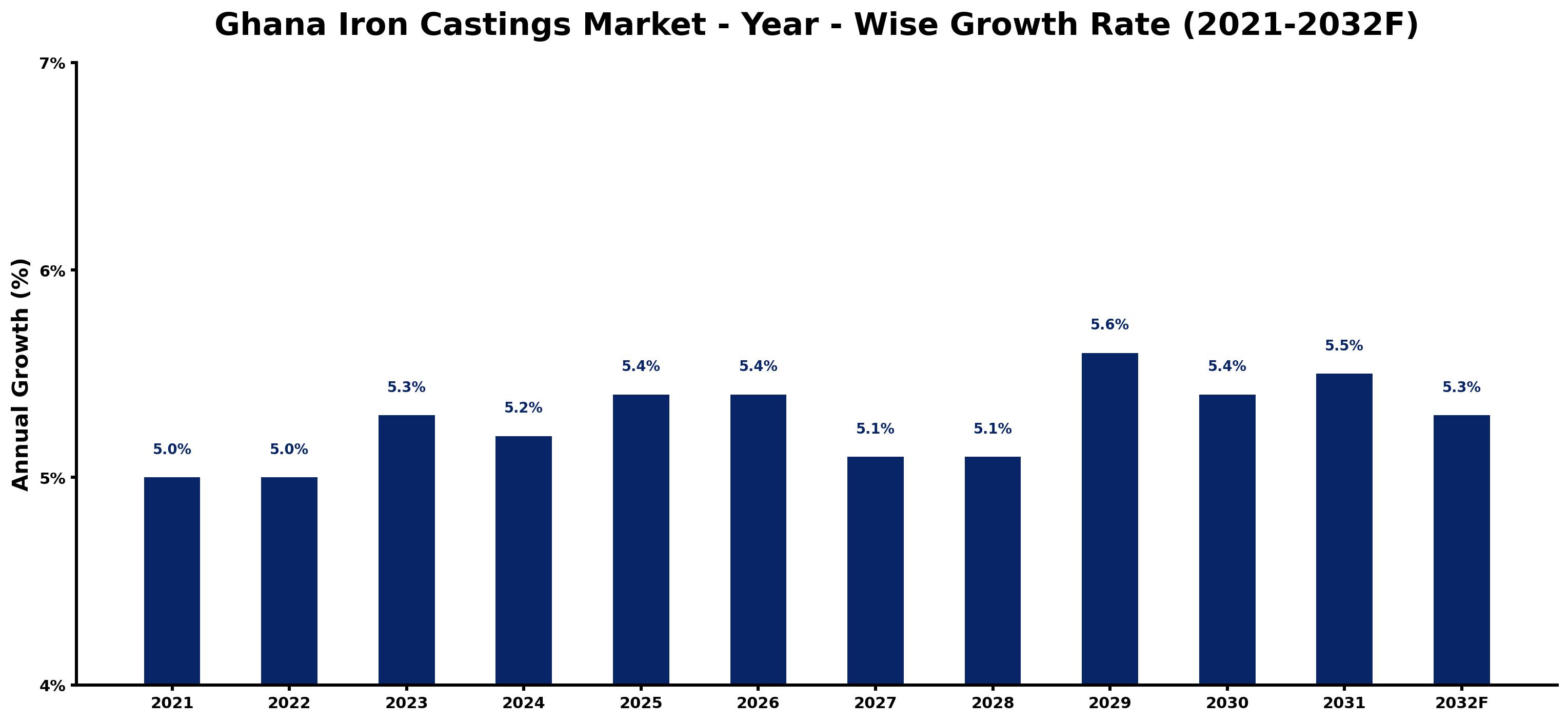
The table below presents the year wise growth rates along with the key drivers influencing the market
| Year | Growth Rate | Major Drivers |
| 2021 | 5.0% | Manufacturers focused on enhancing production capacity to meet local infrastructure needs. |
| 2022 | 5.0% | Emerging construction projects in urban areas increased demand for iron castings significantly. |
| 2023 | 5.3% | Local industries sought partnerships to improve supply chain resilience and efficiency. |
| 2024 | 5.2% | Technological upgrades in casting processes aimed to enhance product quality and reduce waste. |
| 2025 | 5.4% | Shifts towards sustainable construction materials drove a niche market for eco-friendly castings. |
| 2026 | 5.4% | Rising investment in renewable energy infrastructure created opportunities for specialized castings. |
| 2027 | 5.1% | Ghana's expanding automotive industry required tailored iron components for vehicle manufacturing. |
| 2028 | 5.1% | Regional trade agreements improved market access for Ghanaian iron casting exporters. |
| 2029 | 5.6% | Increased urbanization led to higher demand for iron castings in consumer goods manufacturing. |
| 2030 | 5.4% | Technological advancements in 3D printing opened new avenues for customized iron casting. |
| 2031 | 5.5% | Demand from machinery manufacturers surged as agricultural mechanization gained momentum. |
| 2032 | 5.3% | A favorable economic climate supported expansions in existing foundries and new entrants. |
Note - Market size estimations and growth projections presented in this report are based on 6Wresearch's advanced forecasting approach, validated with industry datasets as of June 2026.
Ghana Iron Castings Market Synopsis
The Ghana Iron Castings Market is projected to reach 5.4% and witness significant growth during the forecast period (2026-2032). The growth trajectory of this market is attributed to the increasing demand for iron castings across various sectors, particularly in construction, automotive, and manufacturing. As Ghana continues to invest in infrastructure development and industrialization, the iron castings market is well-positioned to capitalize on these trends.
Ghana Iron Castings Market Growth Drivers
Several key drivers are stimulating growth in the Ghana Iron Castings Market. First, the ongoing infrastructure projects, including road construction and housing developments, are generating a higher demand for iron castings. Second, the automotive sector is expanding, further increasing the need for durable and high-quality castings. Third, local foundries are gaining traction, supported by government initiatives aimed at fostering domestic production. Fourth, rising investments in the manufacturing sector enhance the overall market demand for cast iron products. Finally, a growing emphasis on sustainability is pushing companies towards adopting recyclable materials and eco-friendly manufacturing processes.
Ghana Iron Castings Market Trends and Opportunities
The Ghana Iron Castings Market is witnessing noteworthy trends that present new opportunities for growth. There is an undeniable shift towards sustainable production models, with an increasing number of foundries implementing environmentally friendly techniques and utilizing recycled raw materials. Technology also plays a critical role in this evolving landscape, with manufacturers increasingly adopting automation and digital technologies to optimize production efficiency and improve quality. Furthermore, as government policies continue to prioritize local sourcing, this trend is expected to boost the market prospects for domestic foundries.
Ghana Iron Castings Market Challenges and Restraints
Despite its promising outlook, the Ghana Iron Castings Market faces several challenges that could impede growth. Limited access to modern technology hampers productivity and quality enhancements. Additionally, the industry is plagued by an inconsistent power supply, which can disrupt manufacturing processes, leading to increased costs. High production expenses, largely driven by reliance on imported raw materials, further complicate the economic landscape for local foundries. The market is also contending with significant competition from lower-cost imported iron castings, which can affect the viability of domestic products. Finally, inadequate infrastructure, such as insufficient transportation networks, restricts the export potential and market reach of Ghanaian iron castings.
Ghana Iron Castings Market Investment Opportunities
The investment landscape in the Ghana Iron Castings Market is rich with potential, attracting both local and international stakeholders. The steady economic growth and industrial advancements within the country create fertile ground for iron casting investors. As the demand for castings in construction, automotive, and machinery sectors continues to swell, there are profitable avenues for establishing foundries or production facilities. Moreover, the government's pro-manufacturing stance, including initiatives to boost local industry, augments the attractiveness of this market for investors. Engaging with this sector offers the potential for long-term growth and the opportunity to contribute significantly to Ghana's industrial evolution.
Ghana Iron Castings Market Government Investment and Initiatives
The Ghanaian government has taken considerable steps to enhance the prospects of the iron castings market through various policies and initiatives. Import tariffs and trade regulations have been established to protect domestic manufacturers from foreign competition while encouraging local production. Several incentives, including tax breaks, subsidies, and grants, are available to firms that invest in the sector. Furthermore, local content policies have been enacted to ensure that Ghanaian companies obtain a substantial share of contracts, thus fostering employment. Environmental regulations are also in place to ensure sustainable practices in production, which aligns with global standards and increases competitiveness in the marketplace. These initiatives are integral to fostering innovation and driving growth within the Ghana Iron Castings Market.
Ghana Iron Castings Market Latest Developments (May 2025 - June 2026)
Recent developments in the Ghana Iron Castings Market from May 2025 to June 2026 have been predominantly characterized by increasing adaptation of advanced manufacturing technologies. Foundries are progressively incorporating automation tools to enhance production efficiency, while investments in green technologies are on the rise to meet sustainable manufacturing standards. Additionally, ongoing infrastructure projects across the nation have spurred demand for iron castings, creating a robust environment for growth. The government is also pushing for greater localization in manufacturing processes, stimulating interest among multinational corporations considering entry into the market. Overall, the industry appears to be aligning well with global trends toward modernization and sustainability.
Ghana Iron Castings Market - Key Attractiveness of the Report
- 10 Years of Market Numbers
- Historical Data Starting from 2022 to 2025
- Base Year: 2025
- Forecast Data until 2032
- Key Performance Indicators Impacting the Market
- Major Upcoming Developments and Projects
Key Highlights of the Report:
- Ghana Iron Castings Market Outlook
- Market Size of Ghana Iron Castings Market, 2025
- Forecast of Ghana Iron Castings Market, 2032F
- Historical Data and Forecast of Ghana Iron Castings Revenues & Volume for the Period 2022-2032F
- Ghana Iron Castings Market Trend Evolution
- Ghana Iron Castings Market Drivers and Challenges
- Ghana Iron Castings Price Trends
- Ghana Iron Castings Porter's Five Forces
- Ghana Iron Castings Industry Life Cycle
- Historical Data and Forecast of Ghana Iron Castings Market Revenues & Volume By Product for the Period 2022-2032F
- Historical Data and Forecast of Ghana Iron Castings Market Revenues & Volume By Gray Iron for the Period 2022-2032F
- Historical Data and Forecast of Ghana Iron Castings Market Revenues & Volume By Ductile Iron for the Period 2022-2032F
- Historical Data and Forecast of Ghana Iron Castings Market Revenues & Volume By Malleable Iron for the Period 2022-2032F
- Historical Data and Forecast of Ghana Iron Castings Market Revenues & Volume By End-User for the Period 2022-2032F
- Historical Data and Forecast of Ghana Iron Castings Market Revenues & Volume By Automobile for the Period 2022-2032F
- Historical Data and Forecast of Ghana Iron Castings Market Revenues & Volume By Industrial Machinery for the Period 2022-2032F
- Historical Data and Forecast of Ghana Iron Castings Market Revenues & Volume By Infrastructure and Construction Machines for the Period 2022-2032F
- Historical Data and Forecast of Ghana Iron Castings Market Revenues & Volume By Power for the Period 2022-2032F
- Historical Data and Forecast of Ghana Iron Castings Market Revenues & Volume By Others for the Period 2022-2032F
- Ghana Iron Castings Import Export Trade Statistics
- Market Opportunity Assessment By Product
- Market Opportunity Assessment By End-User
- Ghana Iron Castings Top Companies Market Share
- Ghana Iron Castings Competitive Benchmarking By Technical and Operational Parameters
- Ghana Iron Castings Company Profiles
- Ghana Iron Castings Key Strategic Recommendations






































