Ghana Kosher Food Market Size, Share & Growth Rate
The Ghana Kosher Food Market was estimated at USD 244 Million in 2025 and is projected to reach USD 338 Million by 2032, growing at a CAGR of 4.8% from 2026 to 2032. This robust growth trajectory is primarily fueled by rising awareness and acceptance of kosher dietary laws, not only within the Jewish community but also among health-conscious consumers seeking perceived quality and safety in their food choices. Furthermore, the increasing multicultural fabric of Ghanaian society supports the expanding consumer base for kosher-certified products.
Ghana Kosher Food Market Year-wise Growth Rate and Key Drivers
This graph highlights how the Ghana Kosher Food Market has steadily grown over the years, supported by major growth factors.
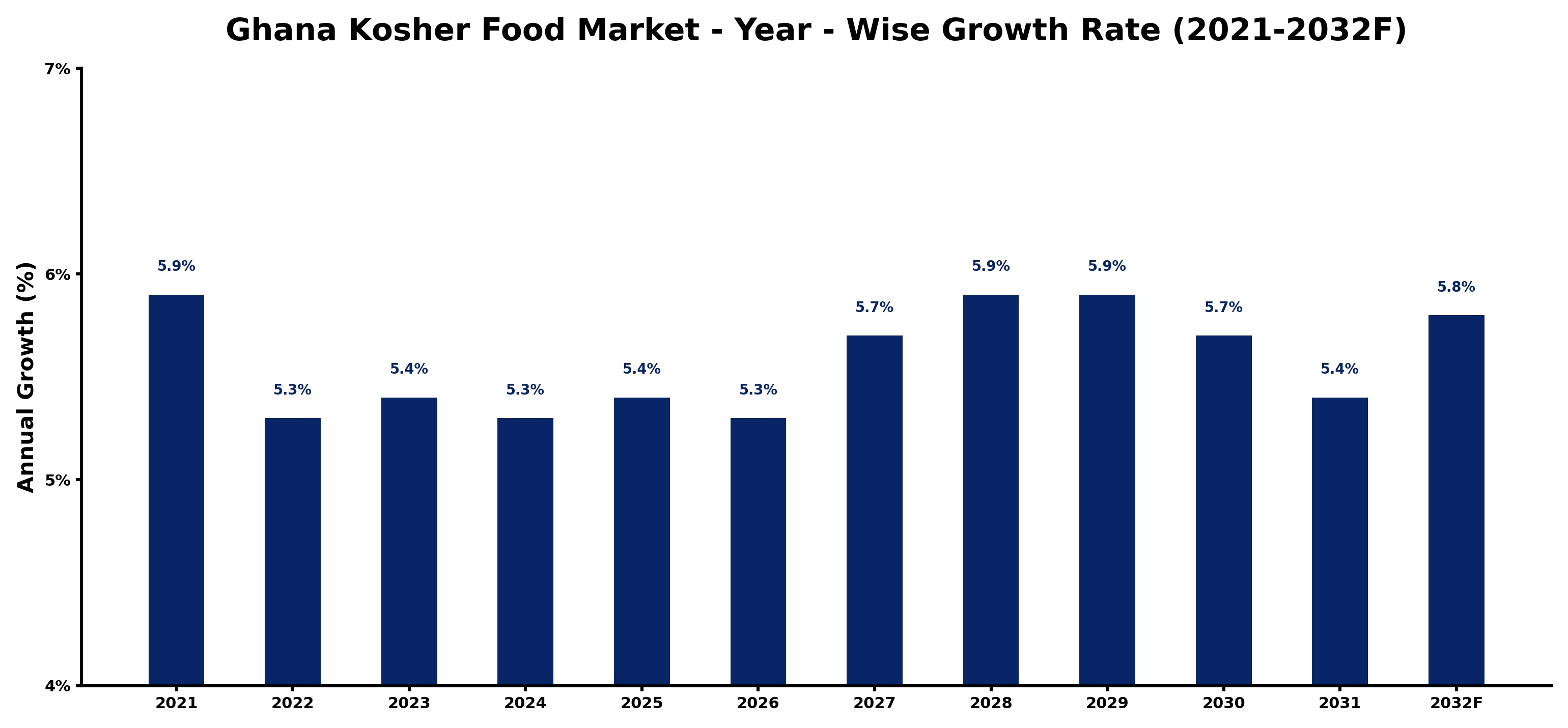
The table below presents the year‑wise growth rates along with the key drivers influencing the market
| Year | Growth Rate | Major Drivers |
| 2021 | 5.9% | Domestic manufacturers boost capacity to meet rising kosher food demand |
| 2022 | 5.3% | Manufacturing investments boost local kosher food processing capabilities |
| 2023 | 5.4% | Export driven kosher food certifications boosted local production capacity |
| 2024 | 5.3% | Improved supply chain logistics boosted kosher food export capacity |
| 2025 | 5.4% | Local packaging firms upgraded machinery for kosher food processing |
| 2026 | 5.3% | Digital tracking systems enhanced compliance in kosher food processing |
| 2027 | 5.7% | Export driven local ingredient sourcing boosted kosher food manufacturing output |
| 2028 | 5.9% | Automated kosher food packaging lines boost production efficiency significantly |
| 2029 | 5.9% | Local packaging advancements boosted Ghana's kosher food production efficiency |
| 2030 | 5.7% | Accelerated capacity utilization boosted local kosher food production efficiency |
| 2031 | 5.4% | Demand for locally sourced ingredients boosts kosher food manufacturing output |
| 2032 | 5.8% | New kosher certification processes boost local food production capabilities |
Note - Market size estimations and growth projections presented in this report are based on 6Wresearch's advanced forecasting approach, validated with industry datasets as of June 2026.
Ghana Kosher Food Market Synopsis
In recent years, the Ghana kosher food market has witnessed notable momentum, with demand surging among both Jewish populations and a wider demographic of non-Jewish consumers. This growing interest is expected to propel the market forward, paving the way for innovative product offerings and a more competitive landscape.
Looking ahead, the market is anticipated to evolve significantly, driven by ongoing cultural shifts and increased government support. As consumer preferences shift towards healthier food options, the kosher food segment stands to benefit from its reputation for quality and compliance with rigorous dietary standards, effectively positioning it for sustained growth.
Ghana Kosher Food Market Key Takeaways
- The market is expanding due to rising demand for kosher-certified products among diverse consumer groups.
- Perceptions of kosher food as healthier and higher quality are influencing purchasing decisions.
- Government initiatives may bolster the kosher food sector by enhancing accessibility and consumer awareness.
- Quality control and certification costs present challenges to maintaining affordability in the market.
- The multicultural landscape of Ghana supports a robust foundation for market growth.
Evaluation of Restraints in Ghana Kosher Food Market
The Ghana kosher food market faces certain constraints that may limit its growth potential. Certification costs remain a significant hurdle, as achieving compliance with strict kosher dietary laws requires substantial investment in quality control processes. Furthermore, the challenge of keeping kosher products affordable while maintaining the integrity of certification can deter some price-sensitive consumers. The balance of affordability and quality is critical as producers seek to capture a wider audience in this diverse market.
Ghana Kosher Food Market Trends
Emerging trends within the Ghana kosher food market indicate a growing demand for innovative product formulations, such as ready-to-eat kosher meals and organic offerings that cater to health-conscious consumers. Additionally, the rise of online retail platforms presents new distribution avenues, making kosher products more accessible to a broader audience. Social media campaigns and influencer marketing are also becoming increasingly effective in educating consumers about the benefits of kosher foods.
Ghana Kosher Food Market Opportunities
Significant growth opportunities lie in expanding product lines to include convenient, ready-to-eat meals that appeal to busy urban populations. Additionally, partnerships with local retailers and food service providers can enhance distribution channels and promote greater consumer awareness. There's also potential for developing new kosher-certified products that align with dietary trends such as gluten-free, vegan, or organic options, which could attract a wider customer base.
Government Initiatives in the Ghana Kosher Food Market
The Ghanaian government acknowledges the cultural significance of kosher food, particularly for the Jewish community. Policymakers are increasingly focused on ensuring the availability and accessibility of kosher food products. Initiatives may include collaborating with religious organizations to standardize certification processes and support kosher food producers through favorable regulations. Additionally, government programs aimed at promoting public awareness around kosher dietary laws could enhance consumer engagement and foster market growth.
Future Insights of the Ghana Kosher Food Market
From 2026 to 2032, the Ghana kosher food market is expected to continue its upward trajectory, driven by sustained consumer interest and government support. As more individuals become aware of kosher dietary benefits, including health and safety considerations, the demand for certified kosher products will likely increase. Furthermore, the collaboration between producers, retailers, and community organizations is anticipated to facilitate more efficient distribution, enhancing the market's overall growth potential.
Ghana Kosher Food Market Latest Developments (May 2025 - June 2026)
Recent developments in the Ghana kosher food market reflect a proactive response to rising consumer demand. There have been notable efforts to streamline certification processes, enabling quicker access to kosher products for consumers. Initiatives to enhance marketing strategies have gained traction, with producers focusing on expanding their online presence and utilizing social media to reach target audiences. Furthermore, collaborations with local suppliers have emerged, fostering innovation and quality in kosher offerings.
Ghana Kosher Food Market - Key Attractiveness of the Report
- 10 Years of Market Numbers
- Historical Data Starting from 2022 to 2025
- Base Year: 2025
- Forecast Data until 2032
- Key Performance Indicators Impacting the Market
- Major Upcoming Developments and Projects
Key Highlights of the Report:
- Ghana Kosher Food Market Outlook
- Market Size of Ghana Kosher Food Market, 2025
- Forecast of Ghana Kosher Food Market, 2032
- Historical Data and Forecast of Ghana Kosher Food Revenues & Volume for the Period 2022-2032F
- Ghana Kosher Food Market Trend Evolution
- Ghana Kosher Food Market Drivers and Challenges
- Ghana Kosher Food Price Trends
- Ghana Kosher Food Porter's Five Forces
- Ghana Kosher Food Industry Life Cycle
- Historical Data and Forecast of Ghana Kosher Food Market Revenues & Volume By Type for the Period 2022-2032F
- Historical Data and Forecast of Ghana Kosher Food Market Revenues & Volume By Meat for the Period 2022-2032F
- Historical Data and Forecast of Ghana Kosher Food Market Revenues & Volume By Dairy for the Period 2022-2032F
- Historical Data and Forecast of Ghana Kosher Food Market Revenues & Volume By Pareve for the Period 2022-2032F
- Historical Data and Forecast of Ghana Kosher Food Market Revenues & Volume By Application for the Period 2022-2032F
- Historical Data and Forecast of Ghana Kosher Food Market Revenues & Volume By Seafood for the Period 2022-2032F
- Historical Data and Forecast of Ghana Kosher Food Market Revenues & Volume By Processed Meat and Poultry for the Period 2022-2032F
- Historical Data and Forecast of Ghana Kosher Food Market Revenues & Volume By Beverages for the Period 2022-2032F
- Historical Data and Forecast of Ghana Kosher Food Market Revenues & Volume By Staples for the Period 2022-2032F
- Historical Data and Forecast of Ghana Kosher Food Market Revenues & Volume By Snacks & Savoury for the Period 2022-2032F
- Historical Data and Forecast of Ghana Kosher Food Market Revenues & Volume By Bakery and Confectionery for the Period 2022-2032F
- Historical Data and Forecast of Ghana Kosher Food Market Revenues & Volume By Others for the Period 2022-2032F
- Historical Data and Forecast of Ghana Kosher Food Market Revenues & Volume By Distribution Channel for the Period 2022-2032F
- Historical Data and Forecast of Ghana Kosher Food Market Revenues & Volume By Supermarkets and Hypermarkets for the Period 2022-2032F
- Historical Data and Forecast of Ghana Kosher Food Market Revenues & Volume By Grocery Stores for the Period 2022-2032F
- Historical Data and Forecast of Ghana Kosher Food Market Revenues & Volume By Online Stores for the Period 2022-2032F
- Ghana Kosher Food Import Export Trade Statistics
- Market Opportunity Assessment By Type
- Market Opportunity Assessment By Application
- Market Opportunity Assessment By Distribution Channel
- Ghana Kosher Food Top Companies Market Share
- Ghana Kosher Food Competitive Benchmarking By Technical and Operational Parameters
- Ghana Kosher Food Company Profiles
- Ghana Kosher Food Key Strategic Recommendations






































