Ghana lawn & garden equipment Market Size, Share & Growth Rate
The Ghana lawn & garden equipment Market was estimated at USD 216 Million in 2025 and is projected to reach USD 287 Million by 2032, growing at a CAGR of 4.1% from 2026 to 2032. This steady trajectory is largely driven by the increasing urbanization across the country, where more homeowners are investing in outdoor spaces. Additionally, rising disposable incomes enable a growing segment of the population to prioritize landscaping and gardening, further contributing to market growth.
Ghana lawn & garden equipment Market Year-wise Growth Rate and Key Drivers
This graph highlights how the Ghana lawn & garden equipment Market has steadily grown over the years, supported by major growth factors.
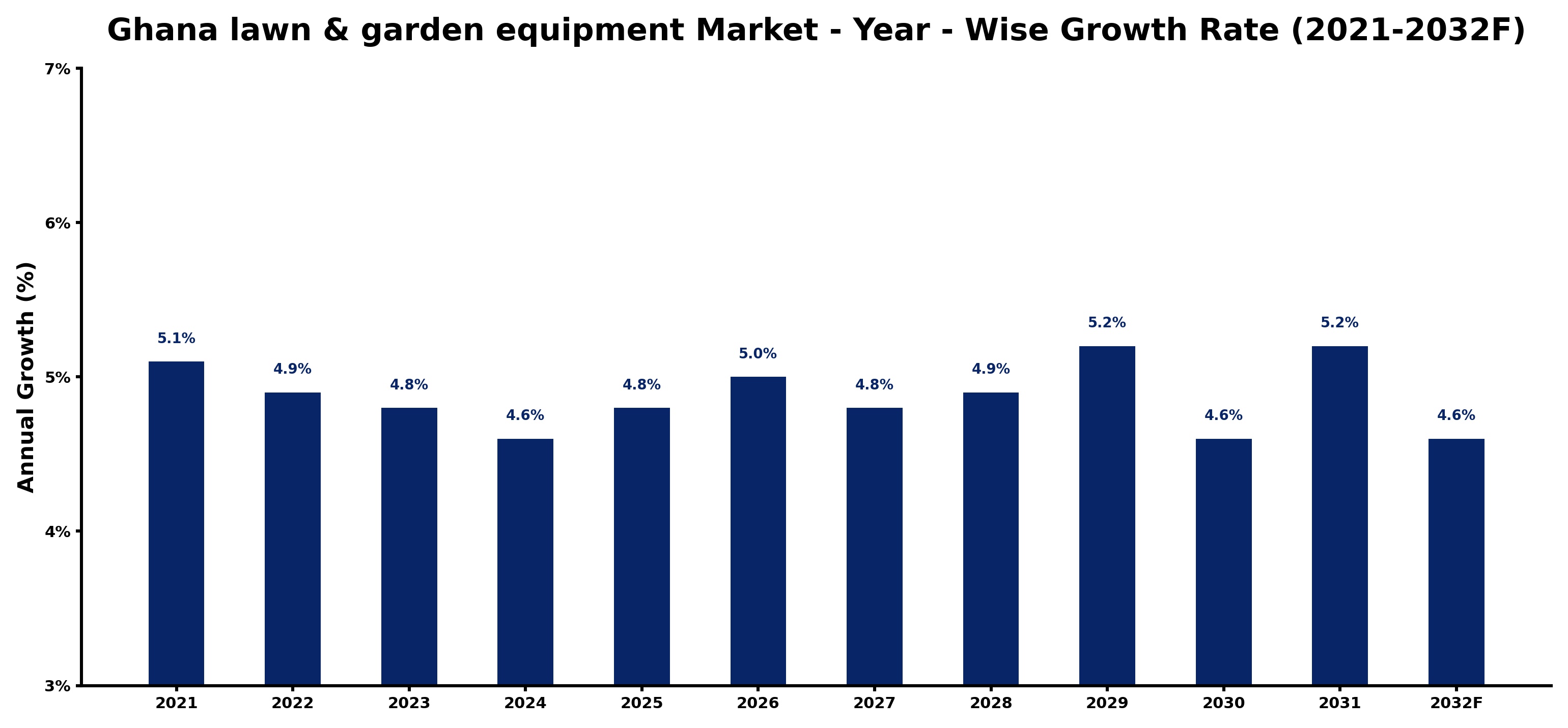
The table below presents the year‑wise growth rates along with the key drivers influencing the market
| Year | Growth Rate | Major Drivers |
| 2021 | 5.1% | Increased urban gardening popularity |
| 2022 | 4.9% | Rising disposable income levels |
| 2023 | 4.8% | Growing interest in landscaping services |
| 2024 | 4.6% | Sustainable gardening practices gaining traction |
| 2025 | 4.8% | Technological advancements in equipment |
| 2026 | 5.0% | Home improvement trends driving sales |
| 2027 | 4.8% | Increased awareness of lawn care |
| 2028 | 4.9% | Expansion of gardening retail outlets |
| 2029 | 5.2% | Diverse product offerings enhancing appeal |
| 2030 | 4.6% | Government initiatives supporting agriculture |
| 2031 | 5.2% | Rising demand for eco-friendly products |
| 2032 | 4.6% | Community gardening projects gaining momentum |
Note - Market size estimations and growth projections presented in this report are based on 6Wresearch’s advanced forecasting approach, validated with industry datasets as of June 2026.
Ghana lawn & garden equipment Market Synopsis
In Ghana, the demand for lawn and garden equipment has been significantly bolstered by an increasing number of residential customers looking to enhance their outdoor environments. This trend is complemented by a parallel rise in landscaping activities among commercial establishments seeking to improve their curb appeal.
Local manufacturers are beginning to emerge, which is vital for catering to the diverse consumer segments in the market. However, the presence of established international brands also ensures a broad spectrum of product availability, creating a competitive environment that benefits consumers.
Ghana lawn & garden equipment Market Key Takeaways
- The market is driven by urbanization and a growing interest in outdoor living spaces.
- Increasing disposable incomes are allowing consumers to invest in quality lawn and garden products.
- Local manufacturing is gaining traction, providing tailored solutions for the Ghanaian consumer base.
- Adoption of eco-friendly, battery-operated equipment is on the rise due to environmental concerns.
- Smart technology integration is transforming the way consumers maintain their gardens and lawns.
Evaluation of Restraints in Ghana lawn & garden equipment Market
Despite its growth potential, the Ghana lawn & garden equipment market faces significant challenges. High import costs lead to inflated prices, making quality equipment less accessible to the average consumer. Moreover, limited awareness about specialized gardening techniques means many potential buyers are unaware of the benefits offered by advanced equipment. This lack of awareness, paired with insufficient financing options for smaller-scale farmers and homeowners, creates a barrier to market penetration and growth. Additionally, the deficit in after-sales support and maintenance services can deter customers from making purchases, ultimately impacting brand loyalty.
Ghana lawn & garden equipment Market Trends
The Ghana lawn & garden equipment market is witnessing a noticeable shift towards eco-friendly and sustainable products, as consumers increasingly opt for electric or battery-powered tools. This trend is driven by growing environmental concerns and rising fuel costs associated with gas-powered equipment. Furthermore, ergonomic designs and multifunctional tools are becoming more popular, enhancing convenience and efficiency for users. Technology is also playing a critical role, with innovations like robotic lawn mowers and smart irrigation systems gaining traction among tech-savvy consumers.
Ghana lawn & garden equipment Market Opportunities
As the market evolves, several investment opportunities are emerging, particularly within the distribution and retail sectors. With urbanization fueling interest in home gardening and landscaping, establishing robust distribution channels through both physical retail outlets and online platforms can yield substantial returns. Collaborations with local landscapers and gardening services to supply quality equipment are also promising. Tailoring product offerings to meet various consumer preferences and budget constraints will further enhance engagement within this expanding market.
Government Initiatives in the Ghana lawn & garden equipment Market
The Ghanaian government is actively promoting the use of environmentally friendly and energy-efficient products within the lawn & garden equipment sector. Policies aimed at encouraging sustainable landscaping practices are being implemented to mitigate environmental impact. Regulatory measures, such as import tariffs, ensure that only quality equipment enters the market, safeguarding consumer interests. Moreover, there are incentives in place for individuals and businesses that invest in modern, efficient lawn and garden tools, aimed at enhancing productivity across the sector.
Future Insights of the Ghana lawn & garden equipment Market
Looking ahead to 2026-2032, the Ghana lawn & garden equipment market is poised for continued growth. The combination of a rising middle class, increasing interest in gardening and outdoor spaces, and ongoing government support for green initiatives will likely fuel demand. Consumers will continue to seek high-quality tools that blend efficiency with eco-friendliness, prompting manufacturers to innovate. Overall, as Ghanaian households increasingly prioritize outdoor aesthetics and functionality, there will be ample opportunities for both local and international players to thrive.
Ghana lawn & garden equipment Market Latest Developments (May 2025 - June 2026)
Recent developments in the Ghana lawn & garden equipment sector indicate a robust movement towards smart technology integration and sustainable practices. Companies are investing in research and development to introduce innovative products that appeal to the environmentally conscious consumer. Additionally, several initiatives aimed at increasing local production capacities are emerging, which could enhance product accessibility and affordability in the near future.
Ghana lawn & garden equipment Market - Key Attractiveness of the Report
- 10 Years of Market Numbers
- Historical Data Starting from 2022 to 2025
- Base Year: 2025
- Forecast Data until 2032
- Key Performance Indicators Impacting the Market
- Major Upcoming Developments and Projects
Key Highlights of the Report:
- Ghana lawn & garden equipment Market Outlook
- Market Size of Ghana lawn & garden equipment Market, 2025
- Forecast of Ghana lawn & garden equipment Market, 2032
- Historical Data and Forecast of Ghana lawn & garden equipment Revenues & Volume for the Period 2022-2032F
- Ghana lawn & garden equipment Market Trend Evolution
- Ghana lawn & garden equipment Market Drivers and Challenges
- Ghana lawn & garden equipment Price Trends
- Ghana lawn & garden equipment Porter's Five Forces
- Ghana lawn & garden equipment Industry Life Cycle
- Historical Data and Forecast of Ghana lawn & garden equipment Market Revenues & Volume By Power for the Period 2022-2032F
- Historical Data and Forecast of Ghana lawn & garden equipment Market Revenues & Volume By Manual for the Period 2022-2032F
- Historical Data and Forecast of Ghana lawn & garden equipment Market Revenues & Volume By Electric-powered for the Period 2022-2032F
- Historical Data and Forecast of Ghana lawn & garden equipment Market Revenues & Volume By Gas-powered for the Period 2022-2032F
- Historical Data and Forecast of Ghana lawn & garden equipment Market Revenues & Volume By Others for the Period 2022-2032F
- Historical Data and Forecast of Ghana lawn & garden equipment Market Revenues & Volume By End-use for the Period 2022-2032F
- Historical Data and Forecast of Ghana lawn & garden equipment Market Revenues & Volume By Residential for the Period 2022-2032F
- Historical Data and Forecast of Ghana lawn & garden equipment Market Revenues & Volume By Golf Courses for the Period 2022-2032F
- Historical Data and Forecast of Ghana lawn & garden equipment Market Revenues & Volume By Playgrounds for the Period 2022-2032F
- Historical Data and Forecast of Ghana lawn & garden equipment Market Revenues & Volume By Operation for the Period 2022-2032F
- Historical Data and Forecast of Ghana lawn & garden equipment Market Revenues & Volume By Walk-behind for the Period 2022-2032F
- Historical Data and Forecast of Ghana lawn & garden equipment Market Revenues & Volume By Riders for the Period 2022-2032F
- Historical Data and Forecast of Ghana lawn & garden equipment Market Revenues & Volume By Others for the Period 2022-2032F
- Historical Data and Forecast of Ghana lawn & garden equipment Market Revenues & Volume By Product for the Period 2022-2032F
- Historical Data and Forecast of Ghana lawn & garden equipment Market Revenues & Volume By Blowers for the Period 2022-2032F
- Historical Data and Forecast of Ghana lawn & garden equipment Market Revenues & Volume By Chain Saws for the Period 2022-2032F
- Historical Data and Forecast of Ghana lawn & garden equipment Market Revenues & Volume By Cutters & Shredders for the Period 2022-2032F
- Historical Data and Forecast of Ghana lawn & garden equipment Market Revenues & Volume By Tractors for the Period 2022-2032F
- Historical Data and Forecast of Ghana lawn & garden equipment Market Revenues & Volume By Lawn Mowers for the Period 2022-2032F
- Historical Data and Forecast of Ghana lawn & garden equipment Market Revenues & Volume By Sprinkler & Hoses for the Period 2022-2032F
- Historical Data and Forecast of Ghana lawn & garden equipment Market Revenues & Volume By Others for the Period 2022-2032F
- Ghana lawn & garden equipment Import Export Trade Statistics
- Market Opportunity Assessment By Power
- Market Opportunity Assessment By End-use
- Market Opportunity Assessment By Operation
- Market Opportunity Assessment By Product
- Ghana lawn & garden equipment Top Companies Market Share
- Ghana lawn & garden equipment Competitive Benchmarking By Technical and Operational Parameters
- Ghana lawn & garden equipment Company Profiles
- Ghana lawn & garden equipment Key Strategic Recommendations






































