Ghana Letterpress Printing Machinery Market Size, Share & Growth Rate
The Ghana Letterpress Printing Machinery Market was estimated at USD 327 Million in 2025 and is projected to reach USD 428 Million by 2032, growing at a CAGR of 3.9% from 2026 to 2032. This growth trajectory is fueled by an increasing demand for high-quality printed materials across various sectors, especially in advertising and packaging. As small to medium-sized printing businesses invest in modernizing their equipment, the market stands to benefit significantly from technological advancements that enhance operational efficiency and product quality.
Ghana Letterpress Printing Machinery Market Year-wise Growth Rate and Key Drivers
This graph highlights how the Ghana Letterpress Printing Machinery Market has steadily grown over the years, supported by major growth factors.
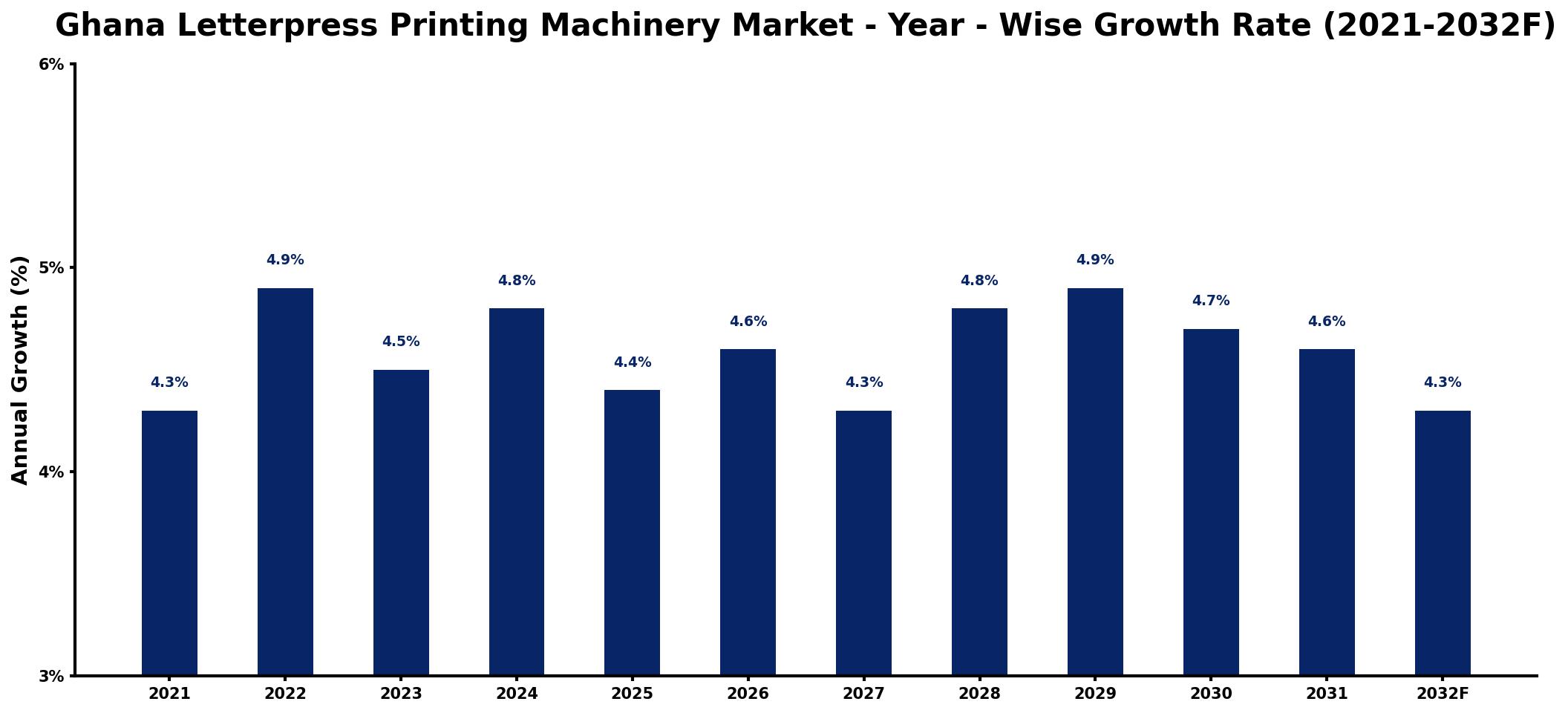
The table below presents the year‑wise growth rates along with the key drivers influencing the market
| Year | Growth Rate | Major Drivers |
| 2021 | 4.3% | Increased demand for local production |
| 2022 | 4.9% | Emergence of small businesses growth |
| 2023 | 4.5% | Rising consumer preference for customization |
| 2024 | 4.8% | Expansion in packaging sector investments |
| 2025 | 4.4% | Growth in advertising industry requirements |
| 2026 | 4.6% | Surge in educational materials production |
| 2027 | 4.3% | rising procurement volume requirements |
| 2028 | 4.8% | Strengthening of local supply chains |
| 2029 | 4.9% | Increased e-commerce fulfillment needs |
| 2030 | 4.7% | Development of sustainable material usage |
| 2031 | 4.6% | Rising interest in heritage arts |
| 2032 | 4.3% | Expansion of regional trade networks |
Note: Market size estimations and growth projections presented in this report are based on 6Wresearch's proprietary forecasting methodology, utilizing the latest available industry data, government publications, and primary research inputs.
Ghana Letterpress Printing Machinery Market Synopsis
The strongest force shaping the Ghana Letterpress Printing Machinery Market is the gradual shift towards modernized printing solutions. This transformation is largely driven by the need for enhanced printing capabilities that can meet the rising expectations for quality and customization from clients in diverse industries.
As businesses embrace innovative printing techniques, there is a growing interest in sustainable and eco-friendly practices within the sector. This trend is influencing both machinery selection and operational methods, positioning companies that prioritize sustainability for future growth and competitive advantage.
Ghana Letterpress Printing Machinery Market Key Takeaways
- The market is witnessing a shift towards digital printing technology, improving efficiency and customization.
- Investment in modern machinery is crucial for maintaining competitiveness in a rapidly evolving landscape.
- Government initiatives supporting SMEs are expected to bolster the market's growth.
- Environmental sustainability is becoming a significant focus, driving investments in eco-friendly printing solutions.
- Limited access to modern technology remains a barrier for many small printing businesses.
Evaluation of Restraints in Ghana Letterpress Printing Machinery Market
Despite the positive market outlook, several restraints hinder growth in the Ghana Letterpress Printing Machinery Market. A significant challenge is the limited access to modern technologies, as many businesses continue to rely on outdated equipment. This reliance can result in inefficiencies, higher production costs, and subpar quality compared to emerging digital technologies. Additionally, the high import costs of modern printing machinery, compounded by tariffs and taxes, act as significant barriers for companies aiming to upgrade their operations. Finally, the scarcity of skilled labor proficient in operating and maintaining advanced letterpress machinery further complicates market progress.
Ghana Letterpress Printing Machinery Market Trends
Key trends in the Ghana Letterpress Printing Machinery Market include a noticeable pivot towards digital printing technologies. The efficiency, speed, and versatility of digital printers cater to the growing demand for short-run, customized print jobs. In parallel, traditional letterpress methods remain vital for specialty jobs that require exceptional quality finishes, highlighting a dual demand for both conventional and modern printing solutions.
Moreover, there is a rising emphasis on sustainable printing practices, prompting a shift towards machinery that minimizes environmental impact. As public awareness of eco-friendly initiatives increases, printing businesses are adapting their strategies to incorporate greener alternatives in their operations.
Ghana Letterpress Printing Machinery Market Opportunities
The Ghana Letterpress Printing Machinery Market is ripe with opportunities for growth and investment. With the consistent demand for high-quality printed materials across various sectors, businesses can capitalize on modern letterpress technologies that offer enhanced efficiency and customization options. Additionally, the trend towards sustainability presents avenues for investment in environmentally friendly printing practices. Moreover, government initiatives aimed at boosting local industries provide favorable conditions for establishing and expanding printing businesses within Ghana.
Government Initiatives in the Ghana Letterpress Printing Machinery Market
The Ghanaian government is actively fostering the growth of the Letterpress Printing Machinery Market through various policies and initiatives. Import restrictions and tariffs have been implemented to encourage local manufacturing, enhancing the competitiveness of domestic printing businesses. Furthermore, programs designed to provide access to financing and technical training are available to support small and medium-sized enterprises (SMEs) in the printing sector. Regulatory frameworks promoting environmental sustainability ensure that operations align with waste management and recycling requirements, further enhancing industry viability.
Future Insights of the Ghana Letterpress Printing Machinery Market
Looking ahead, the future of the Ghana Letterpress Printing Machinery Market appears promising. As technological advancements continue to shape the industry, businesses will increasingly invest in modern equipment to meet the demands for high-quality printing services. Rising disposable incomes and a growing preference for eco-friendly solutions are likely to drive further market expansion. Government initiatives supporting local printing enterprises will also play a pivotal role in reinforcing industry resilience and promoting sustainable practices over the next few years.
Ghana Letterpress Printing Machinery Market Latest Developments (2025 - 2026)
In recent months, the Ghana Letterpress Printing Machinery Market has witnessed a noticeable uptick in companies exploring partnerships focused on modernization and technology exchange. Many local printing firms are evaluating their operational capacities, with an increasing number considering investments in digital printing systems. Additionally, there is a growing interest in sustainable production methods, leading to discussions around adopting eco-friendly machinery solutions. This momentum indicates a sector adapting swiftly to both consumer preferences and technological innovations.
Ghana Letterpress Printing Machinery Market - Key Attractiveness of the Report
- 10 Years of Market Numbers
- Historical Data Starting from 2022 to 2025
- Base Year: 2025
- Forecast Data until 2032
- Key Performance Indicators Impacting the Market
- Major Upcoming Developments and Projects
Key Highlights of the Report:
- Ghana Letterpress Printing Machinery Market Outlook
- Market Size of Ghana Letterpress Printing Machinery Market, 2025
- Forecast of Ghana Letterpress Printing Machinery Market, 2032
- Historical Data and Forecast of Ghana Letterpress Printing Machinery Revenues & Volume for the Period 2022-2032F
- Ghana Letterpress Printing Machinery Market Trend Evolution
- Ghana Letterpress Printing Machinery Market Drivers and Challenges
- Ghana Letterpress Printing Machinery Price Trends
- Ghana Letterpress Printing Machinery Porter's Five Forces
- Ghana Letterpress Printing Machinery Industry Life Cycle
- Historical Data and Forecast of Ghana Letterpress Printing Machinery Market Revenues & Volume By Type for the Period 2022-2032F
- Historical Data and Forecast of Ghana Letterpress Printing Machinery Market Revenues & Volume By Rotary Letterpress Machine for the Period 2022-2032F
- Historical Data and Forecast of Ghana Letterpress Printing Machinery Market Revenues & Volume By Other for the Period 2022-2032F
- Historical Data and Forecast of Ghana Letterpress Printing Machinery Market Revenues & Volume By Application for the Period 2022-2032F
- Historical Data and Forecast of Ghana Letterpress Printing Machinery Market Revenues & Volume By Securities for the Period 2022-2032F
- Historical Data and Forecast of Ghana Letterpress Printing Machinery Market Revenues & Volume By Invitation Card for the Period 2022-2032F
- Historical Data and Forecast of Ghana Letterpress Printing Machinery Market Revenues & Volume By Other for the Period 2022-2032F
- Ghana Letterpress Printing Machinery Import Export Trade Statistics
- Market Opportunity Assessment By Type
- Market Opportunity Assessment By Application
- Ghana Letterpress Printing Machinery Top Companies Market Share
- Ghana Letterpress Printing Machinery Competitive Benchmarking By Technical and Operational Parameters
- Ghana Letterpress Printing Machinery Company Profiles
- Ghana Letterpress Printing Machinery Key Strategic Recommendations






































