Ghana Licensed Merchandise Market Size, Share & Growth Rate
The Ghana Licensed Merchandise Market was estimated at USD 1190 Million in 2025 and is projected to reach USD 1731 Million by 2032, growing at a CAGR of 5.5% from 2026 to 2032. This robust growth trajectory is supported by a burgeoning middle class and an increasing appetite for branded products across sectors like entertainment, sports, and fashion. As more consumers seek quality and authenticity in their purchases, the expansion of licensing partnerships between local retailers and international brands further underscores the markets potential.
Ghana Licensed Merchandise Market Year-wise Growth Rate and Key Drivers
This graph highlights how the Ghana Licensed Merchandise Market has steadily grown over the years, supported by major growth factors.
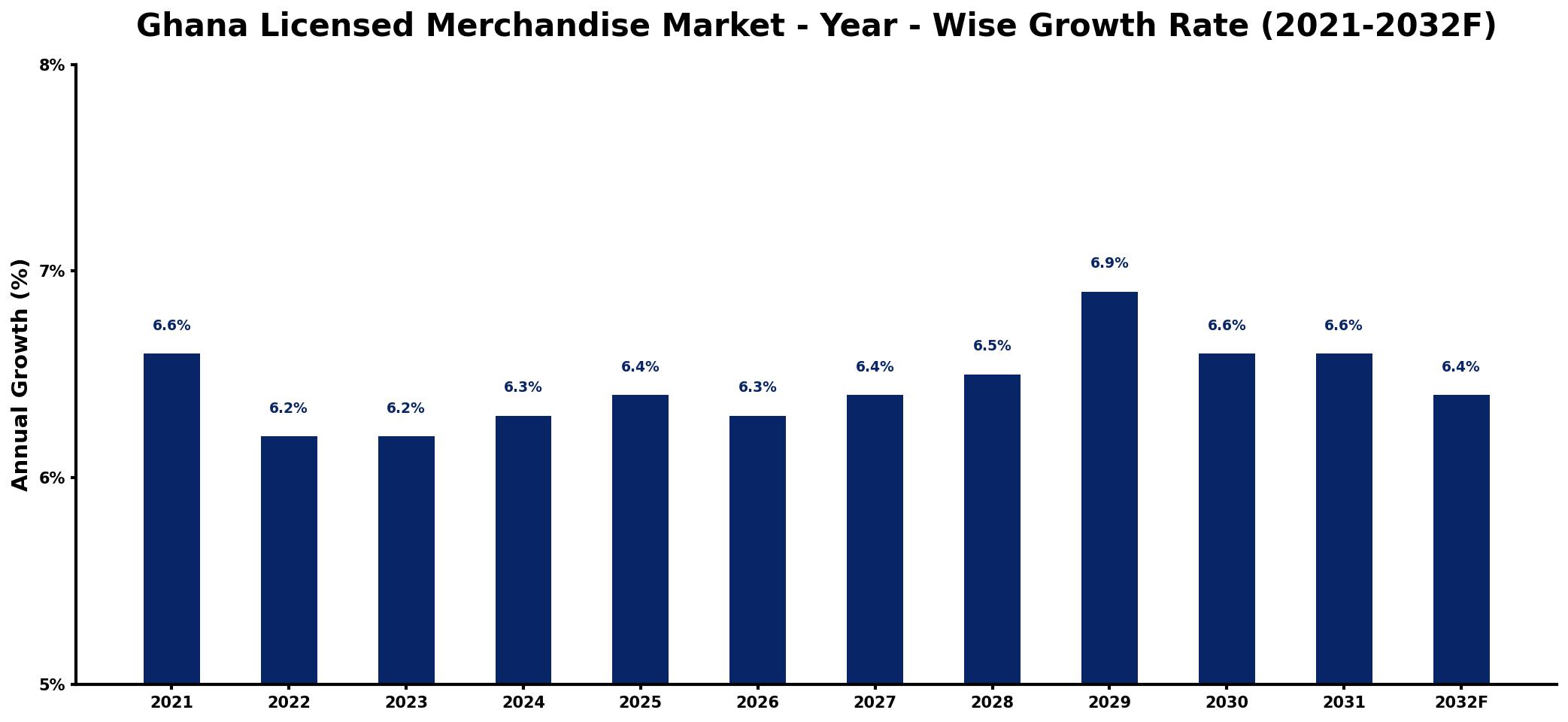
The table below presents the year‑wise growth rates along with the key drivers influencing the market
| Year | Growth Rate | Major Drivers |
| 2021 | 6.6% | increased consumer spending on apparel |
| 2022 | 6.2% | growing popularity of local brands |
| 2023 | 6.2% | expansion of online retail platforms |
| 2024 | 6.3% | rising interest in sports events |
| 2025 | 6.4% | increased investment in marketing strategies |
| 2026 | 6.3% | enhanced distribution network efficiency |
| 2027 | 6.4% | growing youth engagement in fashion |
| 2028 | 6.5% | increased collaboration with influencers |
| 2029 | 6.9% | rising demand for unique designs |
| 2030 | 6.6% | expanding manufacturing base activity |
| 2031 | 6.6% | increased brand loyalty initiatives |
| 2032 | 6.4% | growing emphasis on sustainable practices |
Note: Market size estimations and growth projections presented in this report are based on 6Wresearch's proprietary forecasting methodology, utilizing the latest available industry data, government publications, and primary research inputs.
Ghana Licensed Merchandise Market Synopsis
The Ghana Licensed Merchandise Market is currently witnessing a dynamic transformation, fueled by diverse consumer interests and rising disposable incomes. Licensed products, particularly in apparel, accessories, and electronics, are gaining popularity as consumers increasingly associate these items with authenticity and quality.
In Ghana's vibrant landscape, the entertainment industry plays a significant role, with merchandise linked to music, movies, and sports resonating with a wide audience. This market is also experiencing an influx of local creativity, as Ghanaian artists and designers collaborate with international brands, offering unique products that reflect the countrys rich cultural heritage.
Ghana Licensed Merchandise Market Key Takeaways
- The market is expected to see significant growth, with a projected CAGR of 5.5% from 2026 to 2032.
- Partnerships between local and international brands are expanding, enhancing product diversity.
- Counterfeit goods remain a major issue, affecting brand trust and market dynamics.
- Social media and e-commerce platforms are pivotal in promoting licensed merchandise to consumers.
- Investment opportunities are emerging in sectors such as entertainment and sports branding.
Evaluation of Restraints in Ghana Licensed Merchandise Market
While the market is poised for growth, several restraints impact its potential. The prevalence of counterfeit products continues to undermine the integrity of genuine merchandise, creating skepticism among consumers. Additionally, the lack of robust intellectual property enforcement makes it easier for counterfeiters to operate, threatening legitimate businesses. Consumer awareness regarding the benefits of licensed products is still developing, which could hinder demand. Lastly, the market's relatively small size and competition from unlicensed products pose challenges for brands aiming for deeper penetration and sustained revenue growth.
Ghana Licensed Merchandise Market Trends
The Ghana Licensed Merchandise Market is currently shaped by several key trends. A notable shift towards collaborative product offerings between local brands and international licensors has emerged, allowing for the creation of unique, culturally relevant merchandise. The influence of popular global entertainment franchises and sports teams drives consumer purchasing decisions as individuals look to showcase their interests through branded products. Additionally, the rise of e-commerce and social media influencers is revolutionizing how licensed merchandise reaches consumers, broadening the market's reach and engagement.
Ghana Licensed Merchandise Market Opportunities
There are abundant investment opportunities in the Ghana Licensed Merchandise Market, particularly for brands looking to establish or expand their presence. With consumers increasingly drawn to licensed products, partnerships with international brands can unlock new revenue streams. Additionally, the flourishing local creative scene presents a unique avenue for developing merchandise that reflects Ghana's cultural richness. Investors can explore avenues such as exclusive licensing agreements, collaborations with local artists, and initiatives aimed at enhancing consumer education around the value of licensed merchandise.
Government Initiatives in the Ghana Licensed Merchandise Market
The Ghanaian government is actively promoting the growth of the licensed merchandise sector through various initiatives. Policies centered around intellectual property rights, including the Copyright Act and the Trademarks Act, provide a framework for the protection of creative works and branding. Such regulations ensure transparency and foster a conducive environment for businesses to thrive. Ongoing public awareness campaigns about the importance of supporting licensed products help cultivate a consumer base that values authenticity and quality.
Future Insights of the Ghana Licensed Merchandise Market
Looking ahead to 2026-2032, the Ghana Licensed Merchandise Market is set to expand significantly. As consumer awareness continues to grow, the demand for high-quality licensed products is expected to increase, driven by rising disposable incomes and a desire for branded goods. The diversification of product offerings, alongside the increasing influence of global culture, suggests that both local and international players will continue to find opportunities in this evolving landscape. The increasing sophistication of the market will likely foster innovation and collaboration, making it an exciting space for businesses and investors alike.
Ghana Licensed Merchandise Market Latest Developments (2025 - 2026)
Recent developments in the Ghana Licensed Merchandise Market indicate a positive trend towards partnerships between local creatives and international brands. This has resulted in a variety of new product launches that resonate with the local culture. Moreover, social media campaigns are gaining traction, increasing visibility for licensed products and attracting a broader customer base. The rise in e-commerce activity has further facilitated access to licensed merchandise, making it easier for consumers to engage with and purchase these products.
Ghana Licensed Merchandise Market - Key Attractiveness of the Report
- 10 Years of Market Numbers
- Historical Data Starting from 2022 to 2025
- Base Year: 2025
- Forecast Data until 2032
- Key Performance Indicators Impacting the Market
- Major Upcoming Developments and Projects
Key Highlights of the Report:
- Ghana Licensed Merchandise Market Outlook
- Market Size of Ghana Licensed Merchandise Market, 2025
- Forecast of Ghana Licensed Merchandise Market, 2032
- Historical Data and Forecast of Ghana Licensed Merchandise Revenues & Volume for the Period 2022-2032F
- Ghana Licensed Merchandise Market Trend Evolution
- Ghana Licensed Merchandise Market Drivers and Challenges
- Ghana Licensed Merchandise Price Trends
- Ghana Licensed Merchandise Porter's Five Forces
- Ghana Licensed Merchandise Industry Life Cycle
- Historical Data and Forecast of Ghana Licensed Merchandise Market Revenues & Volume By Product Type for the Period 2022-2032F
- Historical Data and Forecast of Ghana Licensed Merchandise Market Revenues & Volume By Apparel and Footwear for the Period 2022-2032F
- Historical Data and Forecast of Ghana Licensed Merchandise Market Revenues & Volume By Accessories and Gifts for the Period 2022-2032F
- Historical Data and Forecast of Ghana Licensed Merchandise Market Revenues & Volume By Toys and Games for the Period 2022-2032F
- Historical Data and Forecast of Ghana Licensed Merchandise Market Revenues & Volume By Others for the Period 2022-2032F
- Historical Data and Forecast of Ghana Licensed Merchandise Market Revenues & Volume By for the Period 2022-2032F
- Historical Data and Forecast of Ghana Licensed Merchandise Market Revenues & Volume By Distribution Channel for the Period 2022-2032F
- Historical Data and Forecast of Ghana Licensed Merchandise Market Revenues & Volume By Online Stores for the Period 2022-2032F
- Historical Data and Forecast of Ghana Licensed Merchandise Market Revenues & Volume By Supermarkets and Hypermarkets for the Period 2022-2032F
- Historical Data and Forecast of Ghana Licensed Merchandise Market Revenues & Volume By Departmental Stores for the Period 2022-2032F
- Historical Data and Forecast of Ghana Licensed Merchandise Market Revenues & Volume By Specialty Stores for the Period 2022-2032F
- Historical Data and Forecast of Ghana Licensed Merchandise Market Revenues & Volume By Others for the Period 2022-2032F
- Historical Data and Forecast of Ghana Licensed Merchandise Market Revenues & Volume By for the Period 2022-2032F
- Historical Data and Forecast of Ghana Licensed Merchandise Market Revenues & Volume By Price Range for the Period 2022-2032F
- Historical Data and Forecast of Ghana Licensed Merchandise Market Revenues & Volume By Premium for the Period 2022-2032F
- Historical Data and Forecast of Ghana Licensed Merchandise Market Revenues & Volume By Economic for the Period 2022-2032F
- Historical Data and Forecast of Ghana Licensed Merchandise Market Revenues & Volume By for the Period 2022-2032F
- Historical Data and Forecast of Ghana Licensed Merchandise Market Revenues & Volume By End-User for the Period 2022-2032F
- Historical Data and Forecast of Ghana Licensed Merchandise Market Revenues & Volume By Men for the Period 2022-2032F
- Historical Data and Forecast of Ghana Licensed Merchandise Market Revenues & Volume By Women for the Period 2022-2032F
- Historical Data and Forecast of Ghana Licensed Merchandise Market Revenues & Volume By Children for the Period 2022-2032F
- Ghana Licensed Merchandise Import Export Trade Statistics
- Market Opportunity Assessment By Product Type
- Market Opportunity Assessment By Distribution Channel
- Market Opportunity Assessment By Price Range
- Market Opportunity Assessment By End-User
- Ghana Licensed Merchandise Top Companies Market Share
- Ghana Licensed Merchandise Competitive Benchmarking By Technical and Operational Parameters
- Ghana Licensed Merchandise Company Profiles
- Ghana Licensed Merchandise Key Strategic Recommendations






































