Ghana Livestock Market Size, Share & Growth Rate
The Ghana Livestock Market was estimated at USD 229 Million in 2025 and is projected to reach USD 313 Million by 2032, growing at a CAGR of 4.6% from 2026 to 2032. This growth trajectory is primarily driven by increasing domestic consumption of meat products fueled by a rising population and evolving dietary preferences. Additionally, government initiatives aimed at enhancing livestock productivity and addressing challenges faced by smallholder farmers are contributing to a favorable market environment.
Ghana Livestock Market Year-wise Growth Rate and Key Drivers
This graph highlights how the Ghana Livestock Market has steadily grown over the years, supported by major growth factors.
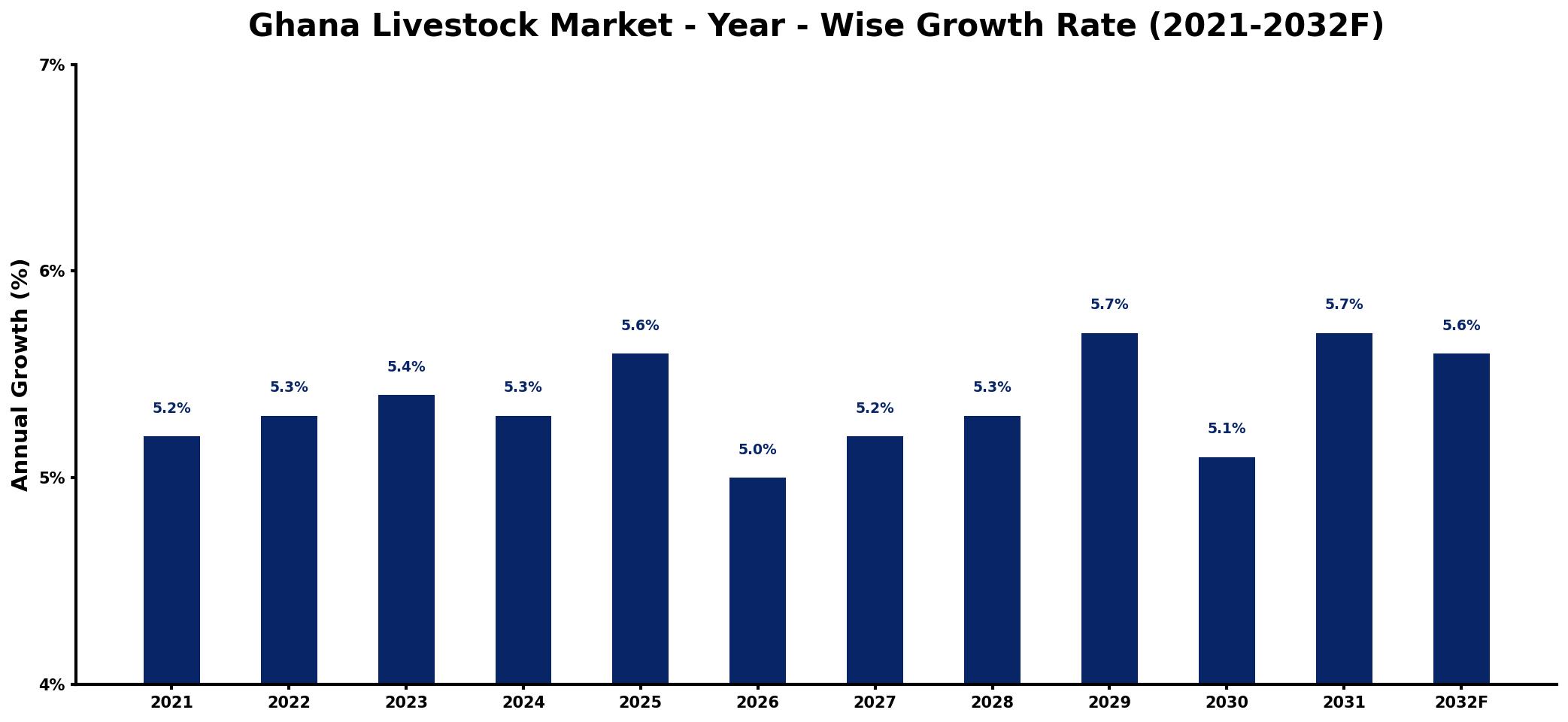
The table below presents the year‑wise growth rates along with the key drivers influencing the market
| Year | Growth Rate | Major Drivers |
| 2021 | 5.2% | rising consumer demand for protein |
| 2022 | 5.3% | increased investment in agriculture |
| 2023 | 5.4% | expansion of veterinary services market |
| 2024 | 5.3% | growing interest in sustainable practices |
| 2025 | 5.6% | enhanced supply chain efficiency initiatives |
| 2026 | 5.0% | development of export markets potential |
| 2027 | 5.2% | improved breeding technology adoption |
| 2028 | 5.3% | increased availability of financing options |
| 2029 | 5.7% | growing urban population consumption trends |
| 2030 | 5.1% | advancements in feed production technology |
| 2031 | 5.7% | strengthened local market infrastructure |
| 2032 | 5.6% | rising awareness of health benefits |
Note: Market size estimations and growth projections presented in this report are based on 6Wresearch's proprietary forecasting methodology, utilizing the latest available industry data, government publications, and primary research inputs.
Ghana Livestock Market Synopsis
The strongest force shaping the Ghana Livestock Market is the burgeoning domestic demand for meat products, largely driven by population growth and changes in consumer preferences. As the middle class expands, there is a significant shift towards higher quality and sustainably sourced livestock products, encouraging both production and innovation in the sector.
This market is characterized by a diverse range of livestock, including cattle, goats, sheep, and poultry, predominantly produced by smallholder farmers. While traditional farming practices are still prevalent, there is a gradual adoption of modern techniques aimed at improving efficiency and productivity, laying the groundwork for future advancements in the industry.
Ghana Livestock Market Key Takeaways
- The market is experiencing significant growth, with projections indicating an increase in value from USD 229 Million in 2025 to USD 313 Million by 2032.
- Smallholder farmers dominate production, yet modernization and technology adoption are on the rise.
- Consumer preferences are shifting towards organic and sustainably sourced livestock products.
- Government initiatives are actively supporting productivity and addressing infrastructure challenges.
- Investment opportunities are robust in sectors such as poultry, cattle, and goat farming.
Evaluation of Restraints in Ghana Livestock Market
Despite the promising outlook for the Ghana Livestock Market, significant restraints persist. Access to quality veterinary services remains inadequate, leading to health challenges within livestock populations. Furthermore, poor infrastructure for transportation and storage of livestock products hampers market efficiency. Limited financial resources prevent many farmers from adopting modern practices that could enhance productivity and profitability. These factors contribute to a fragmented supply chain, posing challenges for market players and affecting overall industry growth.
Ghana Livestock Market Trends
Current trends in the Ghana Livestock Market reflect a growing inclination towards sustainable farming practices. Consumer awareness surrounding health and environmental concerns is driving demand for grass-fed and free-range products, as well as indigenous livestock breeds. Additionally, there is an increasing interest in value-added livestock products, which are gaining traction as farmers explore diversification strategies. The integration of technology in farming operations is also paving the way for enhanced productivity, optimizing feeding practices, and improving health management.
Ghana Livestock Market Opportunities
Opportunities for growth in the Ghana Livestock Market are plentiful. Poultry farming stands out as a lucrative investment due to the surging demand for eggs and meat. Cattle rearing is becoming increasingly viable as dietary preferences shift towards beef and dairy consumption. Goat farming, too, offers promising prospects, particularly as the demand for goat meat and milk rises. Moreover, the potential for technological advancements in livestock farming presents an attractive avenue for investors looking to capitalize on this dynamic sector.
Government Initiatives in the Ghana Livestock Market
The Ghanaian government plays a pivotal role in fostering growth within the livestock sector through a variety of initiatives. Policies such as the Livestock Act aim to promote sustainable practices while ensuring animal welfare. The National Livestock Development Project (NLDP) has been established to boost productivity via improved health services and better market access. Additional programs, like the Livestock Development Project for Northern Ghana (LDG), specifically target challenges faced by farmers in underdeveloped regions, ultimately enhancing the overall competitiveness of the market.
Future Insights of the Ghana Livestock Market
Looking ahead to 2026-2032, the Ghana Livestock Market is set to experience steady growth underpinned by rising population levels and increasing income, driving demand for quality livestock products. Government interventions aimed at modernizing farming methods and enhancing animal health are anticipated to strengthen market foundations. Additionally, consumer trends favoring organic and ethically produced goods present avenues for premium market segments. Addressing infrastructural limitations and ensuring financial access for farmers will be crucial in unlocking the full potential of this vibrant market.
Ghana Livestock Market Latest Developments (2025 - 2026)
Recent developments in the Ghana Livestock Market reflect an increased focus on sustainable practices and technology adoption. Efforts are underway to enhance veterinary services and infrastructure, creating a more resilient supply chain. Furthermore, local initiatives aimed at promoting traditional livestock breeds have gained traction, catering to the growing consumer demand for unique and ethically sourced products. These shifts indicate a robust direction for the market as it adapts to emerging consumer preferences.
Ghana Livestock Market - Key Attractiveness of the Report
- 10 Years of Market Numbers
- Historical Data Starting from 2022 to 2025
- Base Year: 2025
- Forecast Data until 2032
- Key Performance Indicators Impacting the Market
- Major Upcoming Developments and Projects
Key Highlights of the Report:
- Ghana Livestock Market Outlook
- Market Size of Ghana Livestock Market, 2025
- Forecast of Ghana Livestock Market, 2032
- Historical Data and Forecast of Ghana Livestock Revenues & Volume for the Period 2022-2032F
- Ghana Livestock Market Trend Evolution
- Ghana Livestock Market Drivers and Challenges
- Ghana Livestock Price Trends
- Ghana Livestock Porter's Five Forces
- Ghana Livestock Industry Life Cycle
- Historical Data and Forecast of Ghana Livestock Market Revenues & Volume By Animal Type for the Period 2022-2032F
- Historical Data and Forecast of Ghana Livestock Market Revenues & Volume By Ruminants for the Period 2022-2032F
- Historical Data and Forecast of Ghana Livestock Market Revenues & Volume By Poultry for the Period 2022-2032F
- Historical Data and Forecast of Ghana Livestock Market Revenues & Volume By Swine for the Period 2022-2032F
- Historical Data and Forecast of Ghana Livestock Market Revenues & Volume By Aquaculture for the Period 2022-2032F
- Ghana Livestock Import Export Trade Statistics
- Market Opportunity Assessment By Animal Type
- Ghana Livestock Top Companies Market Share
- Ghana Livestock Competitive Benchmarking By Technical and Operational Parameters
- Ghana Livestock Company Profiles
- Ghana Livestock Key Strategic Recommendations






































