Ghana Magnesium Metal Market Size, Share & Growth Rate
The Ghana Magnesium Metal Market was estimated at USD 1411 Million in 2025 and is projected to reach USD 2034 Million by 2032, growing at a CAGR of 5.4% from 2026 to 2032. This growth trajectory is primarily driven by the rising demand for lightweight and high-strength materials across key industries such as automotive, aerospace, and electronics. Furthermore, Ghana's strategic location in West Africa and its significant magnesite ore reserves position it well to meet the growing regional and global demand for magnesium metal.
Ghana Magnesium Metal Market Year-wise Growth Rate and Key Drivers
This graph highlights how the Ghana Magnesium Metal Market has steadily grown over the years, supported by major growth factors.
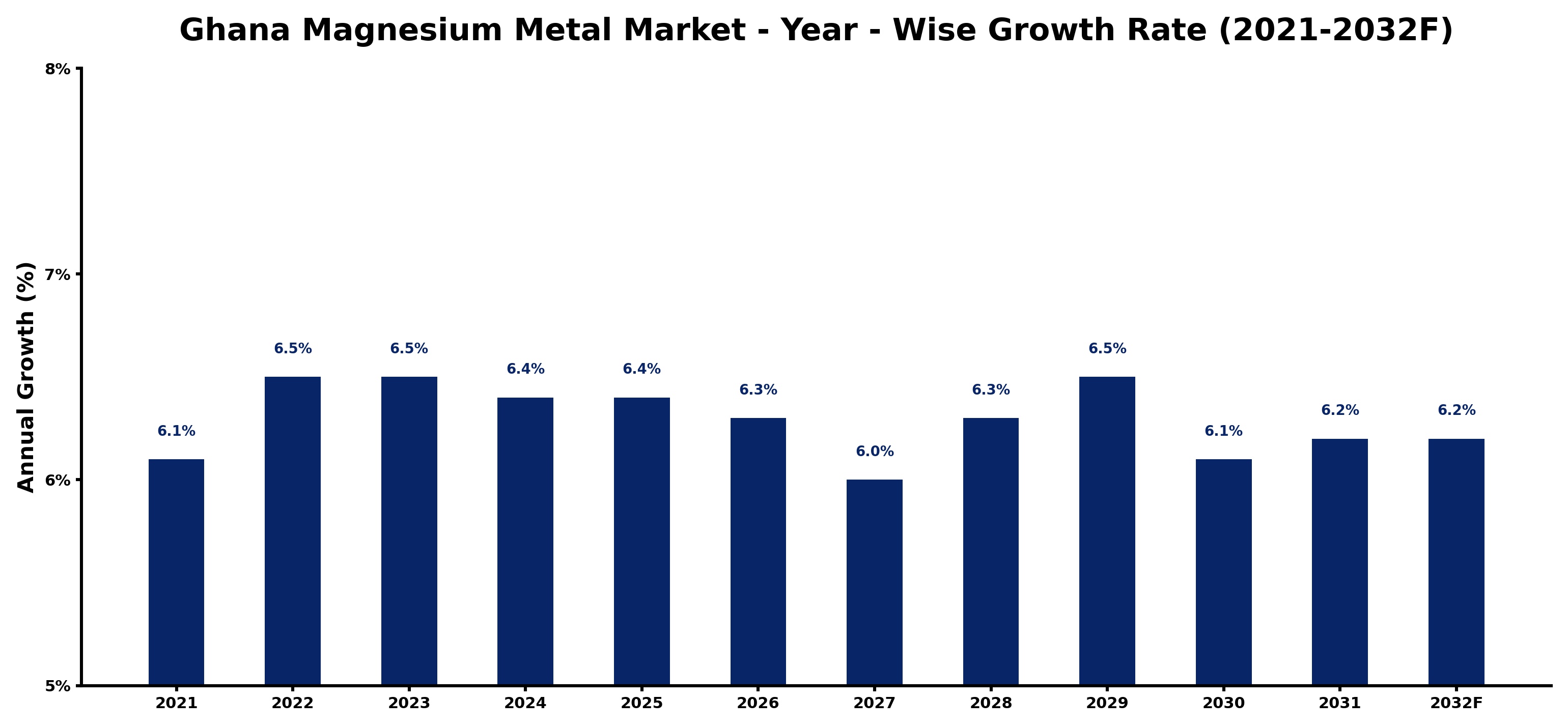
The table below presents the year‑wise growth rates along with the key drivers influencing the market
| Year | Growth Rate | Major Drivers |
| 2021 | 6.1% | Increased construction activities drove demand |
| 2022 | 6.5% | Automotive industry growth spurred usage |
| 2023 | 6.5% | Electronics manufacturing expanded significantly |
| 2024 | 6.4% | Aerospace sector demand increased notably |
| 2025 | 6.4% | Renewable energy projects boosted consumption |
| 2026 | 6.3% | Infrastructure development enhanced market potential |
| 2027 | 6.0% | Consumer goods production expanded rapidly |
| 2028 | 6.3% | Technological advancements improved efficiency |
| 2029 | 6.5% | Export opportunities increased market reach |
| 2030 | 6.1% | Research and development investments grew |
| 2031 | 6.2% | Sustainability initiatives drove innovation |
| 2032 | 6.2% | Strategic partnerships enhanced market presence |
Note - Market size estimations and growth projections presented in this report are based on 6Wresearch's advanced forecasting approach, validated with industry datasets as of June 2026.
Ghana Magnesium Metal Market Synopsis
The Ghana Magnesium Metal Market is on a steady upward trajectory, spurred by the increasing utilization of magnesium in various sectors due to its unique properties. Industries are recognizing the benefits of magnesium as a material that enhances performance while reducing weight, crucial for automotive and aerospace applications.
Despite facing challenges such as fluctuating raw material prices and a limited domestic production capacity, the market is poised for expansion. With ongoing investments in infrastructure and advancements in production technologies, Ghana is well-positioned to become a key player in the global magnesium supply chain.
Ghana Magnesium Metal Market Key Takeaways
- Significant growth driven by high demand across automotive, aerospace, and electronics sectors.
- Ghana's magnesium reserves and competitive production costs are attractive to investors.
- Sustainable practices and recycling are becoming integral to market strategies.
- Investments in R&D can enhance production capabilities and product applications.
- Government initiatives support the development of the magnesium production industry.
Evaluation of Restraints in Ghana Magnesium Metal Market
The Ghana Magnesium Metal Market is hampered by a few critical constraints. Limited production capacity and an over-reliance on imports hinder local industry development, while fluctuating global prices create instability in the market. Additionally, there is a noticeable shortage of skilled labor, which complicates the advancement of production processes. The industry's growth is also stifled by inadequate infrastructure, making it essential to address these challenges through strategic investments and development initiatives.
Ghana Magnesium Metal Market Trends
Emerging trends within the Ghana Magnesium Metal Market highlight a shift towards sustainability and environmental responsibility. Companies are increasingly focusing on eco-friendly production methods and recycling practices to align with global sustainability goals. Additionally, heightened awareness of magnesium's benefits, such as improved performance and weight reduction, is leading to broader adoption in diverse applications.
Ghana Magnesium Metal Market Opportunities
The market presents several investment opportunities, particularly for stakeholders interested in establishing magnesium extraction and processing facilities. With the increasing demand for lightweight materials, investors can explore innovative applications of magnesium, enhancing its market presence. Furthermore, the ongoing emphasis on sustainability creates avenues for developing eco-friendly magnesium products that cater to growing consumer demand.
Government Initiatives in the Ghana Magnesium Metal Market
Government policies are pivotal in shaping the Ghana Magnesium Metal Market. The Minerals and Mining Act of 2006 governs mining operations, including licensing for magnesium extraction. The Minerals Development Fund Act promotes community development through mineral royalties, while the Ghana Investment Promotion Centre Act encourages foreign investments in the mining sector. Additionally, environmental standards enforced by the Environmental Protection Agency ensure sustainable practices within the industry.
Future Insights of the Ghana Magnesium Metal Market
The future of the Ghana Magnesium Metal Market appears bright, driven by increasing demand from pivotal industries such as automotive and aerospace. The ongoing investments from both domestic and international stakeholders in production capacity and technology are set to facilitate market growth. Moreover, as industries continue to prioritize lightweight and sustainable materials, Ghana is well-positioned to capture a significant share of the global magnesium market over the coming years.
Ghana Magnesium Metal Market Latest Developments (May 2025 - June 2026)
Recent developments in the Ghana Magnesium Metal Market indicate an upward trend in investments aimed at improving production capabilities. Industry stakeholders are exploring partnerships to enhance technology transfer and increase the skill level of the local workforce. Moreover, initiatives focusing on environmental sustainability are gaining traction, with more companies adopting recycling practices and efficient production methods to align with global market demands.
Ghana Magnesium Metal Market - Key Attractiveness of the Report
- 10 Years of Market Numbers
- Historical Data Starting from 2022 to 2025
- Base Year: 2025
- Forecast Data until 2032
- Key Performance Indicators Impacting the Market
- Major Upcoming Developments and Projects
Key Highlights of the Report:
- Ghana Magnesium Metal Market Outlook
- Market Size of Ghana Magnesium Metal Market, 2025
- Forecast of Ghana Magnesium Metal Market, 2032
- Historical Data and Forecast of Ghana Magnesium Metal Revenues & Volume for the Period 2022-2032F
- Ghana Magnesium Metal Market Trend Evolution
- Ghana Magnesium Metal Market Drivers and Challenges
- Ghana Magnesium Metal Price Trends
- Ghana Magnesium Metal Porter's Five Forces
- Ghana Magnesium Metal Industry Life Cycle
- Historical Data and Forecast of Ghana Magnesium Metal Market Revenues & Volume By Application for the Period 2022-2032F
- Historical Data and Forecast of Ghana Magnesium Metal Market Revenues & Volume By Die Casting for the Period 2022-2032F
- Historical Data and Forecast of Ghana Magnesium Metal Market Revenues & Volume By Aluminum Alloys for the Period 2022-2032F
- Historical Data and Forecast of Ghana Magnesium Metal Market Revenues & Volume By Titanium Reduction for the Period 2022-2032F
- Historical Data and Forecast of Ghana Magnesium Metal Market Revenues & Volume By Iron & Steel Making for the Period 2022-2032F
- Historical Data and Forecast of Ghana Magnesium Metal Market Revenues & Volume By Others for the Period 2022-2032F
- Historical Data and Forecast of Ghana Magnesium Metal Market Revenues & Volume By End-user Industry for the Period 2022-2032F
- Historical Data and Forecast of Ghana Magnesium Metal Market Revenues & Volume By Automotive for the Period 2022-2032F
- Historical Data and Forecast of Ghana Magnesium Metal Market Revenues & Volume By Aerospace for the Period 2022-2032F
- Historical Data and Forecast of Ghana Magnesium Metal Market Revenues & Volume By Electronics for the Period 2022-2032F
- Historical Data and Forecast of Ghana Magnesium Metal Market Revenues & Volume By Sports for the Period 2022-2032F
- Historical Data and Forecast of Ghana Magnesium Metal Market Revenues & Volume By Medical for the Period 2022-2032F
- Historical Data and Forecast of Ghana Magnesium Metal Market Revenues & Volume By Others for the Period 2022-2032F
- Ghana Magnesium Metal Import Export Trade Statistics
- Market Opportunity Assessment By Application
- Market Opportunity Assessment By End-user Industry
- Ghana Magnesium Metal Top Companies Market Share
- Ghana Magnesium Metal Competitive Benchmarking By Technical and Operational Parameters
- Ghana Magnesium Metal Company Profiles
- Ghana Magnesium Metal Key Strategic Recommendations






































