Ghana Manual Pruning Shears Market Size, Share & Growth Rate
The Ghana Manual Pruning Shears Market was estimated at USD 387 Million in 2025 and is projected to reach USD 509 Million by 2032, growing at a CAGR of 4.0% from 2026 to 2032. This upward trajectory is largely fueled by increasing agricultural productivity needs, a burgeoning interest in gardening and landscaping among urban populations, and the growing adoption of sustainable farming practices. Furthermore, the resilience of the product design tailored to withstand Ghana's unique climatic challenges enhances its market appeal.
Ghana Manual Pruning Shears Market Growth Rate Analysis (2021-2032)
The Ghana manual pruning shears market has shown steady growth over recent years, with rates fluctuating between 4.5% and 4.9%. Notably, the market grew by 4.7% in 2021, followed by a slightly higher increase of 4.8% in 2022, reflecting a robust consumer demand driven by rising agricultural activities and investments in modern farming techniques. In 2023, growth stabilized at 4.7%, as market players adopted innovative designs and efficient manufacturing processes. Looking ahead, the trend suggests an increase to 4.9% in 2024. Factors such as government policies to support agricultural productivity and an ongoing shift towards sustainable farming practices are expected to sustain this growth momentum through 2032.
Ghana Manual Pruning Shears Market Year-wise Growth Rate and Key Drivers
This graph highlights how the Ghana Manual Pruning Shears Market has steadily grown over the past five years, supported by major growth factors.
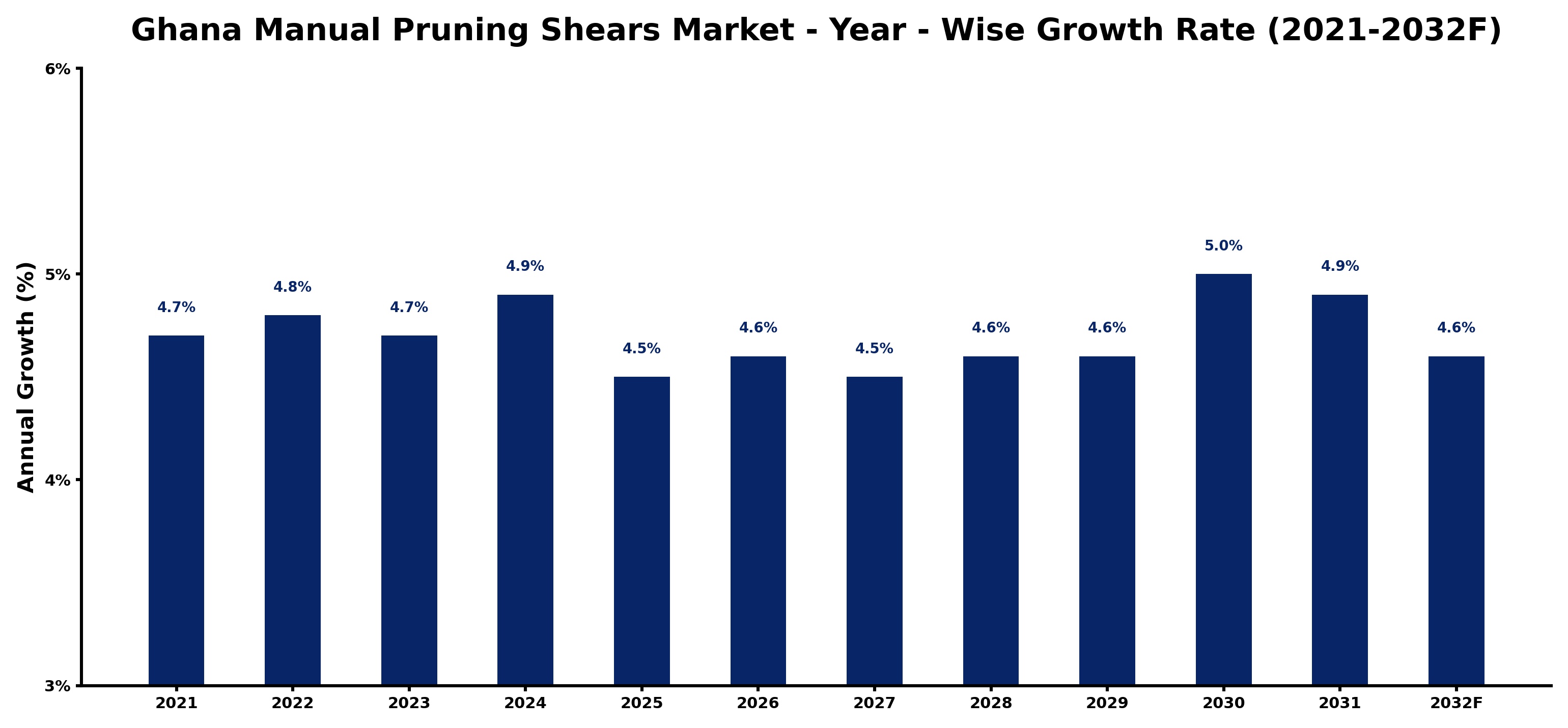
The table below presents the year‑wise growth rates along with the key drivers influencing the market
| Year | Growth Rate | Major Drivers |
| 2021 | 4.7% | Expansion of transportation and logistics networks |
| 2022 | 4.8% | Increasing industrial automation investments |
| 2023 | 4.7% | Government infrastructure modernization initiatives |
| 2024 | 4.9% | Increasing adoption of advanced technologies |
| 2025 | 4.5% | Government infrastructure modernization initiatives |
| 2026 | 4.6% | Increasing smart city development projects |
| 2027 | 4.5% | Increasing industrial infrastructure investments |
| 2028 | 4.6% | Growing renewable energy integration projects |
| 2029 | 4.6% | Expansion of transportation and logistics networks |
| 2030 | 5.0% | Rapid growth in telecom and data center sectors |
| 2031 | 4.9% | Government infrastructure modernization initiatives |
| 2032 | 4.6% | Government infrastructure modernization initiatives |
Note - Market size estimations and growth projections presented in this report are based on 6Wresearch’s advanced forecasting approach, validated with industry datasets as of June 2026.
Ghana Manual Pruning Shears Market Synopsis
The Ghana Manual Pruning Shears Market is witnessing a transformative phase, propelled by the launch of tools that embody both durability and ergonomic efficiency. Notably, the shears crafted from high-quality steel are resistant to rust and corrosion, making them especially suited for the country's humid conditions.
These pruning shears are engineered for extended use, ensuring comfort for both professional gardeners and hobbyists. With the rising focus on home gardening and small-scale farming, the market is primed for growth, responding dynamically to the needs of its user base while promoting sustainable practices.
Ghana Manual Pruning Shears Market Key Takeaways
- The market is projected to grow significantly, driven by increasing agricultural and gardening activities.
- High-quality, ergonomic designs are a primary focus, enhancing user experience and reducing fatigue.
- Durability against Ghana's harsh climate positions these tools as essential for both professionals and amateurs.
- Consumer preference is shifting towards sustainable and efficient gardening solutions, fostering innovation.
- The growth of urban gardening and landscaping trends is substantially impacting market demand.
Evaluation of Restraints in Ghana Manual Pruning Shears Market
Despite its growth potential, the Ghana Manual Pruning Shears Market faces several constraints. Limited access to distribution networks in rural areas restricts availability, affecting consumer adoption. Furthermore, price sensitivity among local farmers can inhibit investment in higher-end tools, steering preferences towards lower-cost alternatives. Additionally, competition from imported tools presents challenges, as foreign products may offer established reputations or perceived quality advantages, potentially overshadowing local offerings.
Ghana Manual Pruning Shears Market Trends
Current trends highlight a rising demand for manual tools that combine functionality with sustainable practices. Eco-friendly materials and designs are becoming increasingly popular as consumers express a preference for products that align with environmentally conscious values. Moreover, urban gardening initiatives are on the rise, propelled by a shift towards local food production and self-sufficiency, creating a favorable environment for the manual pruning shears market.
Ghana Manual Pruning Shears Market Opportunities
There are significant opportunities for growth within the Ghana Manual Pruning Shears Market. The increasing interest in horticulture and home gardening presents avenues for innovation and product diversification. Moreover, investment in agricultural training programs can spur demand for quality tools, leading to potential partnerships between manufacturers and agricultural organizations. The expansion of e-commerce platforms also opens new distribution channels, enabling wider access to consumers across the country.
Government Initiatives in the Ghana Manual Pruning Shears Market
The Ghanaian government has initiated several programs aimed at bolstering the agricultural sector, which indirectly supports the manual pruning shears market. Policies encouraging local farming and self-sufficiency promote the use of quality gardening tools. Additionally, public spending on agricultural development creates a conducive environment for manufacturers to flourish, as farmers are incentivized to invest in better equipment. These initiatives reflect a commitment to enhancing productivity and sustainability within the sector.
Future Insights of the Ghana Manual Pruning Shears Market
Looking ahead to 2026-2032, the Ghana Manual Pruning Shears Market is poised for significant evolution. As awareness around the importance of sustainable agricultural practices grows, the demand for quality tools that enhance efficiency and productivity will follow suit. Innovations that integrate smart technologies, such as ergonomics tailored to individual user preferences and environmentally friendly materials, will likely dominate market offerings. Moreover, the expanding urban population in Ghana will continue to drive demand for home gardening solutions, reinforcing the market's growth narrative.
Ghana Manual Pruning Shears Market Latest Developments (May 2025 - June 2026)
In recent months, the Ghana Manual Pruning Shears Market has seen innovative product launches that emphasize durability and ergonomic designs tailored for local conditions. Retailers are increasingly leveraging digital platforms for marketing and distribution, enhancing accessibility for both urban and rural consumers. Collaborations between local manufacturers and agricultural organizations are also gaining traction, aiming to promote quality and sustainability within the sector.
Ghana Manual Pruning Shears Market - Key Attractiveness of the Report
- 10 Years of Market Numbers
- Historical Data Starting from 2022 to 2025
- Base Year: 2025
- Forecast Data until 2032
- Key Performance Indicators Impacting the Market
- Major Upcoming Developments and Projects
Key Highlights of the Report:
- Ghana Manual Pruning Shears Market Outlook
- Market Size of Ghana Manual Pruning Shears Market, 2025
- Forecast of Ghana Manual Pruning Shears Market, 2032F
- Historical Data and Forecast of Ghana Manual Pruning Shears Revenues & Volume for the Period 2022-2032F
- Ghana Manual Pruning Shears Market Trend Evolution
- Ghana Manual Pruning Shears Market Drivers and Challenges
- Ghana Manual Pruning Shears Price Trends
- Ghana Manual Pruning Shears Porter's Five Forces
- Ghana Manual Pruning Shears Industry Life Cycle
- Historical Data and Forecast of Ghana Manual Pruning Shears Market Revenues & Volume By Type for the Period 2022-2032F
- Historical Data and Forecast of Ghana Manual Pruning Shears Market Revenues & Volume By Pruning Shears for the Period 2022-2032F
- Historical Data and Forecast of Ghana Manual Pruning Shears Market Revenues & Volume By Hedge Shears for the Period 2022-2032F
- Historical Data and Forecast of Ghana Manual Pruning Shears Market Revenues & Volume By Lopping Shears for the Period 2022-2032F
- Historical Data and Forecast of Ghana Manual Pruning Shears Market Revenues & Volume By Long Reach Pruners for the Period 2022-2032F
- Historical Data and Forecast of Ghana Manual Pruning Shears Market Revenues & Volume By Application for the Period 2022-2032F
- Historical Data and Forecast of Ghana Manual Pruning Shears Market Revenues & Volume By Household for the Period 2022-2032F
- Historical Data and Forecast of Ghana Manual Pruning Shears Market Revenues & Volume By Commercial Use for the Period 2022-2032F
- Ghana Manual Pruning Shears Import Export Trade Statistics
- Market Opportunity Assessment By Type
- Market Opportunity Assessment By Application
- Ghana Manual Pruning Shears Top Companies Market Share
- Ghana Manual Pruning Shears Competitive Benchmarking By Technical and Operational Parameters
- Ghana Manual Pruning Shears Company Profiles
- Ghana Manual Pruning Shears Key Strategic Recommendations






































