Ghana Military Laser Rangefinder Market Size, Share & Growth Rate
The Ghana Military Laser Rangefinder Market was estimated at USD 467 Million in 2025 and is projected to reach USD 619 Million by 2032, growing at a CAGR of 4.1% from 2026 to 2032. This growth trajectory is primarily fueled by the increasing demand for precise targeting systems within the Ghanaian military, which are essential for enhancing artillery accuracy and reconnaissance capabilities. Furthermore, advancements in laser technology and the rising emphasis on modern warfare techniques are playing a pivotal role in driving market expansion.
Ghana Military Laser Rangefinder Market Year-wise Growth Rate and Key Drivers
This graph highlights how the Ghana Military Laser Rangefinder Market has steadily grown over the years, supported by major growth factors.
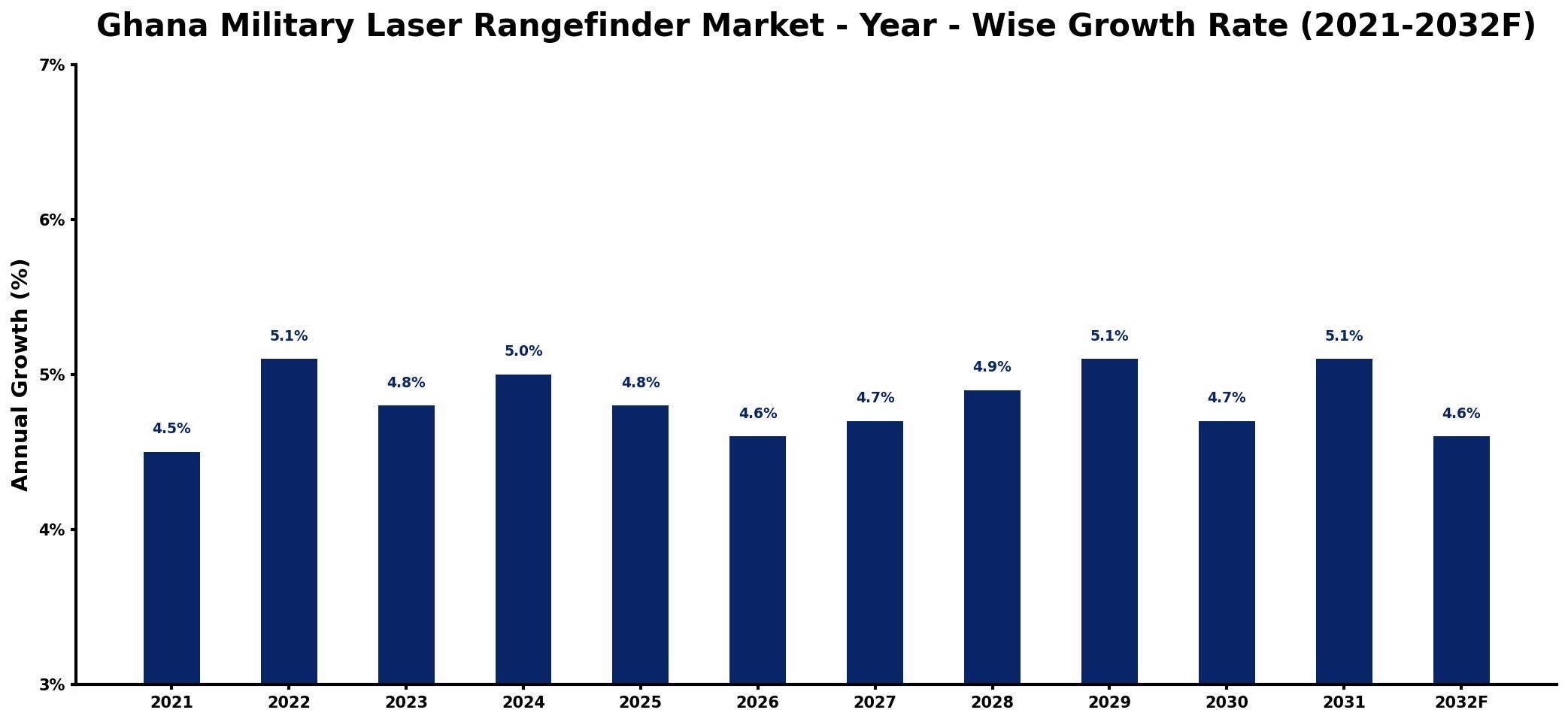
The table below presents the year‑wise growth rates along with the key drivers influencing the market
| Year | Growth Rate | Major Drivers |
| 2021 | 4.5% | increased capital investment inflows |
| 2022 | 5.1% | Growing regional security initiatives |
| 2023 | 4.8% | Rising demand for precision technology |
| 2024 | 5.0% | Expansion of defense partnerships |
| 2025 | 4.8% | Enhanced training programs adoption |
| 2026 | 4.6% | Investment in advanced technologies |
| 2027 | 4.7% | Focus on modernization efforts |
| 2028 | 4.9% | growing emerging market penetration |
| 2029 | 5.1% | Emerging threats driving innovation |
| 2030 | 4.7% | Boost in local manufacturing capabilities |
| 2031 | 5.1% | Growing emphasis on tactical efficiency |
| 2032 | 4.6% | Advancement in surveillance systems |
Note: Market size estimations and growth projections presented in this report are based on 6Wresearch's proprietary forecasting methodology, utilizing the latest available industry data, government publications, and primary research inputs.
Ghana Military Laser Rangefinder Market Synopsis
The most significant factor influencing the Ghana Military Laser Rangefinder Market is the military's urgent need for advanced target acquisition systems. As Ghana continues to enhance its defense capabilities, precision-guided munitions and laser-based targeting solutions are becoming increasingly vital. This shift toward precision warfare is reshaping operational strategies, leading to higher investments in laser rangefinder technologies.
In addition, the government's proactive policies aimed at integrating modern technologies into military operations are creating a favorable environment for market growth. The focus on lightweight and compact rangefinders, which facilitate faster and more accurate deployments, is reshaping the competitive landscape, paving the way for innovations in the sector.
Ghana Military Laser Rangefinder Market Key Takeaways
- The market is on a steady growth path driven by the military's focus on precision warfare.
- Government initiatives are fostering an environment conducive to technological advancements in laser systems.
- There is a noticeable trend towards the development of lightweight and portable rangefinder technologies.
- Strategic investments in defense capabilities are influencing the demand for high-performance rangefinders.
- Despite challenges, the market presents significant opportunities for manufacturers and technology developers.
Evaluation of Restraints in Ghana Military Laser Rangefinder Market
While the market for military laser rangefinders in Ghana is positioned for growth, several factors are constraining its potential. A critical issue is the limited awareness regarding the technological advantages of laser rangefinders among key stakeholders, which impedes wider adoption. Additionally, stringent military specifications often restrict the speed of innovation and integration of new systems, leading to challenges in meeting interoperability requirements. These constraints necessitate focused efforts to educate military personnel and streamline procurement processes to enhance market penetration.
Ghana Military Laser Rangefinder Market Trends
Emerging trends in the Ghana Military Laser Rangefinder Market include a push toward the miniaturization of equipment. Compact rangefinders with advanced optics are gaining traction as military units seek portable solutions that do not compromise performance. Additionally, the integration of digital interfaces and data analytics capabilities into laser rangefinders is becoming more prevalent, enabling real-time data sharing and improved operational decision-making. The emphasis on sustainability is also emerging, with eco-friendly materials and energy-efficient technologies becoming integral components of new product developments.
Ghana Military Laser Rangefinder Market Opportunities
Significant growth opportunities lie in the collaboration between government entities and private manufacturers focused on laser rangefinder technology. As Ghana strengthens its defense posture, investments in research and development can lead to innovative solutions tailored for local operational needs. Moreover, the export potential of domestically produced rangefinders to neighboring countries presents an avenue for expanding market reach. Customization of products to meet specific military requirements is an additional opportunity that manufacturers can exploit.
Government Initiatives in the Ghana Military Laser Rangefinder Market
The Ghanaian government has embarked on several initiatives to bolster the military's capabilities, including policies aimed at enhancing target acquisition technologies. These initiatives focus on promoting investments in laser rangefinder manufacturing and ensuring compliance with stringent military specifications. Additionally, partnerships between defense contractors and regulatory bodies are being encouraged to improve the interoperability and reliability of laser rangefinder systems, ultimately leading to better performance in military operations.
Future Insights of the Ghana Military Laser Rangefinder Market
Looking ahead to 2026-2032, the Ghana Military Laser Rangefinder Market is expected to continue its upward trajectory, driven by an ongoing commitment to modernize defense strategies. As precision warfare becomes increasingly critical, demand for sophisticated targeting technologies will intensify. The anticipated advancements in laser technology and optics will provide military units with enhanced capabilities, thereby solidifying Ghana's position in regional defense initiatives. Investment in domestic manufacturing will likely create a more sustainable and self-reliant defense ecosystem.
Ghana Military Laser Rangefinder Market Latest Developments (2025 - 2026)
Recent developments in the Ghana Military Laser Rangefinder Market indicate a growing focus on integrating advanced technologies with existing military systems. Initiatives aimed at improving the accuracy and efficiency of current equipment are underway, along with collaborations to enhance the overall capabilities of laser rangefinders. Ongoing training programs for military personnel are also being implemented to ensure optimal utilization of these advanced tools, reflecting a strategic emphasis on operational effectiveness.
Ghana Military Laser Rangefinder Market - Key Attractiveness of the Report
- 10 Years of Market Numbers
- Historical Data Starting from 2022 to 2025
- Base Year: 2025
- Forecast Data until 2032
- Key Performance Indicators Impacting the Market
- Major Upcoming Developments and Projects
Key Highlights of the Report:
- Ghana Military Laser Rangefinder Market Outlook
- Market Size of Ghana Military Laser Rangefinder Market, 2025
- Forecast of Ghana Military Laser Rangefinder Market, 2032
- Historical Data and Forecast of Ghana Military Laser Rangefinder Revenues & Volume for the Period 2022-2032F
- Ghana Military Laser Rangefinder Market Trend Evolution
- Ghana Military Laser Rangefinder Market Drivers and Challenges
- Ghana Military Laser Rangefinder Price Trends
- Ghana Military Laser Rangefinder Porter's Five Forces
- Ghana Military Laser Rangefinder Industry Life Cycle
- Historical Data and Forecast of Ghana Military Laser Rangefinder Market Revenues & Volume By Type for the Period 2022-2032F
- Historical Data and Forecast of Ghana Military Laser Rangefinder Market Revenues & Volume By Man-Portable for the Period 2022-2032F
- Historical Data and Forecast of Ghana Military Laser Rangefinder Market Revenues & Volume By Vehicle-Mounted for the Period 2022-2032F
- Historical Data and Forecast of Ghana Military Laser Rangefinder Market Revenues & Volume By Application for the Period 2022-2032F
- Historical Data and Forecast of Ghana Military Laser Rangefinder Market Revenues & Volume By Weapon Guidance for the Period 2022-2032F
- Historical Data and Forecast of Ghana Military Laser Rangefinder Market Revenues & Volume By Detection for the Period 2022-2032F
- Ghana Military Laser Rangefinder Import Export Trade Statistics
- Market Opportunity Assessment By Type
- Market Opportunity Assessment By Application
- Ghana Military Laser Rangefinder Top Companies Market Share
- Ghana Military Laser Rangefinder Competitive Benchmarking By Technical and Operational Parameters
- Ghana Military Laser Rangefinder Company Profiles
- Ghana Military Laser Rangefinder Key Strategic Recommendations






































