Ghana Multifunctional Composite Materials Market Summary
The ghana multifunctional composite materials market was estimated at USD 371 Million in 2025 and is projected to reach USD 517 Million by 2032, growing at a CAGR of 5.4% from 2026 to 2032.
Ghana Multifunctional Composite Materials Market Year-wise Growth Rate and Key Drivers
This graph highlights how the Ghana Multifunctional Composite Materials Market has steadily grown over the past five years, supported by major growth factors.
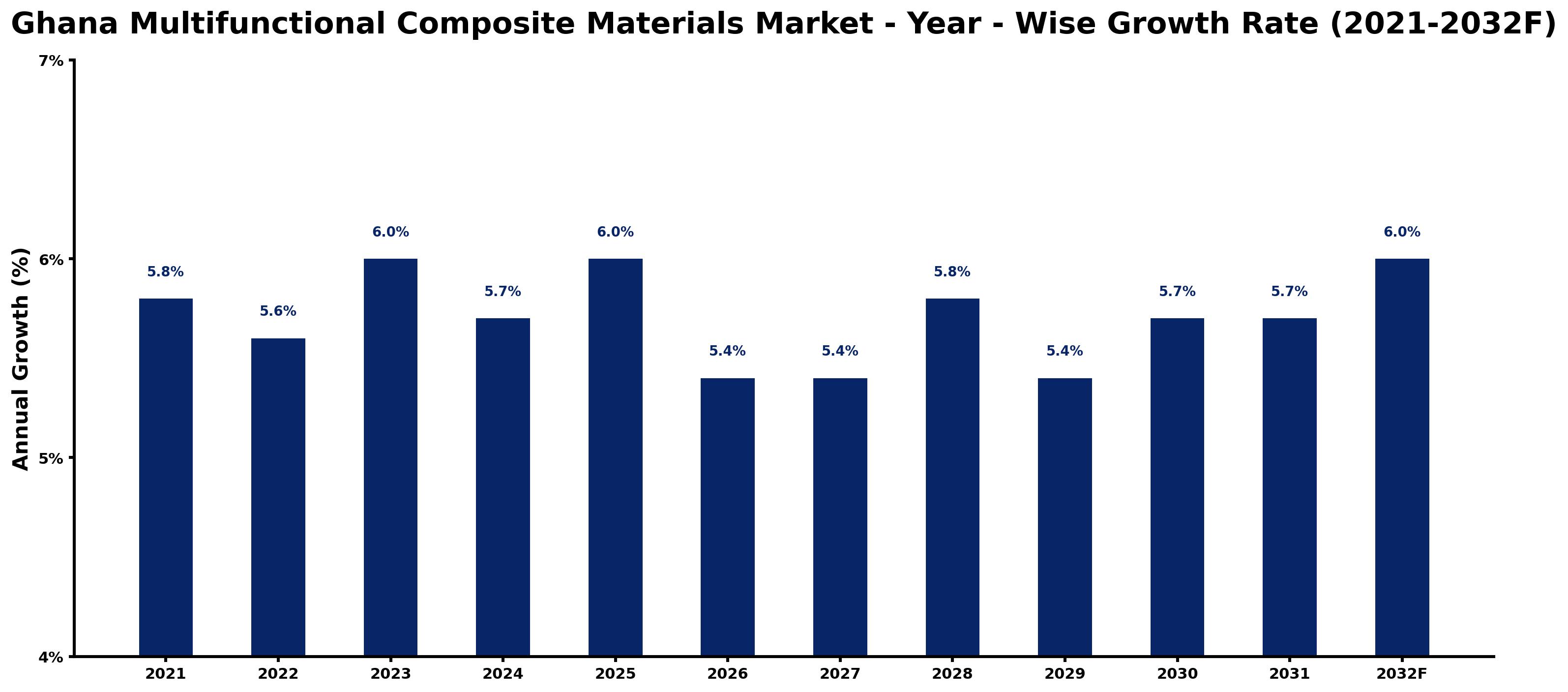
The table below presents the year wise growth rates along with the key drivers influencing the market
| Year | Growth Rate | Major Drivers |
| 2021 | 5.8% | Economic recovery post-COVID spurred investments in infrastructure and construction sectors. |
| 2022 | 5.6% | Manufacturers sought sustainable materials, boosting the popularity of composite alternatives. |
| 2023 | 6.0% | Local companies began collaborating with universities to innovate composite material applications. |
| 2024 | 5.7% | Infrastructure projects expanded, increasing the demand for durable construction materials significantly. |
| 2025 | 6.0% | Growing awareness of environmental benefits drove demand for multifunctional materials in various industries. |
| 2026 | 5.4% | Investment in renewable energy projects created opportunities for innovative composite material solutions. |
| 2027 | 5.4% | Regional trade agreements facilitated easier access to advanced composite manufacturing technologies. |
| 2028 | 5.8% | Emerging industries like automotive and aerospace showed increased interest in local composite sourcing. |
| 2029 | 5.4% | Technological advancements in manufacturing processes improved efficiency and lowered production costs. |
| 2030 | 5.7% | Consumer preferences shifted towards eco-friendly products, influencing market trends in composites. |
| 2031 | 5.7% | Collaboration between local firms and global players enhanced product quality and market reach. |
| 2032 | 6.0% | Integration of composites in everyday products underscored their versatility and market potential. |
Note - Market size estimations and growth projections presented in this report are based on 6Wresearch's advanced forecasting approach, validated with industry datasets as of June 2026.
Ghana Multifunctional Composite Materials Market Synopsis
The Ghana Multifunctional Composite Materials Market is projected to reach 5.4% and witness significant growth during the forecast period (2026-2032). The rising demand for lightweight, high-performance materials in sectors such as aerospace, automotive, and construction is a primary driver of this market. Multifunctional composite materials are increasingly adopted due to their versatility, combining various fibers and polymer resins to offer enhanced mechanical, thermal, and electrical properties tailored for specific applications.
Ghana Multifunctional Composite Materials Market Growth Drivers
Several factors contribute to the robust growth of the Ghana multifunctional composite materials market. Key growth drivers include:
- The increasing emphasis on lightweight materials to improve efficiency in transportation and energy consumption, especially in the automotive and aerospace sectors.
- The construction industry's shift towards sustainable practices has increased the adoption of composite materials in infrastructure projects, particularly where weight reduction is crucial.
- Advancements in manufacturing technologies, such as additive manufacturing and automated layup processes, have facilitated the production of complex composite structures at scale.
- Rising investments in renewable energy projects, where multifunctional composites play a vital role in wind turbine blades and solar panel structures, are spurring market growth.
- The increasing awareness of the environmental impact of traditional materials like steel and concrete has led to a gradual shift towards composites that offer lower environmental footprints.
Ghana Multifunctional Composite Materials Market Challenges and Restraints
Despite its growth potential, the Ghana multifunctional composite materials market faces several challenges that could impede its progression. The primary challenges include:
- The high initial costs associated with advanced composite materials can deter their widespread adoption, especially among small and medium enterprises.
- The need for specialized manufacturing processes requires skilled labor and technology, which may not be readily available in all regions of Ghana.
- Competition from traditional materials such as metals and concrete, which are cheaper and have established supply chains, continues to challenge market penetration.
- Environmental concerns related to the disposal and recycling of composite materials present regulatory and logistical hurdles within the market.
- Market dynamics may also be affected by fluctuating raw material prices, impacting the overall cost structure of composites.
Ghana Multifunctional Composite Materials Market Government Investment and Initiatives
The Ghanaian government has recognized the potential of multifunctional composite materials in driving innovation and sustainable economic growth. In response, several initiatives and investment strategies have been initiated to bolster this market:
- Government policies are prioritizing investment in research and development to advance composite material technologies and applications.
- Public spending plans are being directed towards infrastructure projects that utilize composite materials, promoting their adoption across various sectors.
- Skills training programs have been established to prepare a workforce capable of operating and innovating within the advanced composite manufacturing landscape.
- Technology transfer initiatives aim to enhance local capabilities in composite manufacturing, fostering partnerships between research institutions and industry.
- The government is actively promoting collaborations among suppliers, manufacturers, and regulatory bodies to ensure a streamlined approach to composite material development and use.
Ghana Multifunctional Composite Materials Market Latest Developments (May 2025 - June 2026)
During the period from May 2025 to June 2026, the Ghana multifunctional composite materials market has exhibited noteworthy trends that highlight its evolving landscape. Innovation in manufacturing technologies has continued to gain momentum, with companies exploring new applications for composites that enhance performance in diverse sectors. The construction industry has shown increased interest in utilizing lightweight composites for both residential and commercial projects, aiming to improve energy efficiency and reduce overall costs. Furthermore, the renewable energy sector has expanded its use of composite materials in wind and solar applications, aligning with national goals for sustainability. Investment in local manufacturing capabilities and R&D has also escalated, fostering a more competitive environment within the market. Initiatives to enhance workforce skills tailored towards composite production and application have been introduced, ensuring that Ghana can effectively support and grow its multifunctional composite materials market.
Ghana Multifunctional Composite Materials Market - Key Attractiveness of the Report
- 10 Years of Market Numbers
- Historical Data Starting from 2022 to 2025
- Base Year: 2025
- Forecast Data until 2032
- Key Performance Indicators Impacting the Market
- Major Upcoming Developments and Projects
Key Highlights of the Report:
- Ghana Multifunctional Composite Materials Market Outlook
- Market Size of Ghana Multifunctional Composite Materials Market, 2025
- Forecast of Ghana Multifunctional Composite Materials Market, 2032
- Historical Data and Forecast of Ghana Multifunctional Composite Materials Revenues & Volume for the Period 2022-2032F
- Ghana Multifunctional Composite Materials Market Trend Evolution
- Ghana Multifunctional Composite Materials Market Drivers and Challenges
- Ghana Multifunctional Composite Materials Price Trends
- Ghana Multifunctional Composite Materials Porter's Five Forces
- Ghana Multifunctional Composite Materials Industry Life Cycle
- Historical Data and Forecast of Ghana Multifunctional Composite Materials Market Revenues & Volume By Product Type for the Period 2022-2032F
- Historical Data and Forecast of Ghana Multifunctional Composite Materials Market Revenues & Volume By Carbon Fiber for the Period 2022-2032F
- Historical Data and Forecast of Ghana Multifunctional Composite Materials Market Revenues & Volume By Fabrics/Reinforcements for the Period 2022-2032F
- Historical Data and Forecast of Ghana Multifunctional Composite Materials Market Revenues & Volume By Prepregs/Resins for the Period 2022-2032F
- Historical Data and Forecast of Ghana Multifunctional Composite Materials Market Revenues & Volume By Adhesives for the Period 2022-2032F
- Historical Data and Forecast of Ghana Multifunctional Composite Materials Market Revenues & Volume By Honeycomb for the Period 2022-2032F
- Historical Data and Forecast of Ghana Multifunctional Composite Materials Market Revenues & Volume By Other for the Period 2022-2032F
- Historical Data and Forecast of Ghana Multifunctional Composite Materials Market Revenues & Volume By Applications for the Period 2022-2032F
- Historical Data and Forecast of Ghana Multifunctional Composite Materials Market Revenues & Volume By Aerospace Industry for the Period 2022-2032F
- Historical Data and Forecast of Ghana Multifunctional Composite Materials Market Revenues & Volume By Medical Industry for the Period 2022-2032F
- Historical Data and Forecast of Ghana Multifunctional Composite Materials Market Revenues & Volume By Machinery Industry for the Period 2022-2032F
- Historical Data and Forecast of Ghana Multifunctional Composite Materials Market Revenues & Volume By Achitechture Industry for the Period 2022-2032F
- Historical Data and Forecast of Ghana Multifunctional Composite Materials Market Revenues & Volume By Other for the Period 2022-2032F
- Ghana Multifunctional Composite Materials Import Export Trade Statistics
- Market Opportunity Assessment By Product Type
- Market Opportunity Assessment By Applications
- Ghana Multifunctional Composite Materials Top Companies Market Share
- Ghana Multifunctional Composite Materials Competitive Benchmarking By Technical and Operational Parameters
- Ghana Multifunctional Composite Materials Company Profiles
- Ghana Multifunctional Composite Materials Key Strategic Recommendations






































