Ghana Natural Fragrance Market Size, Share & Growth Rate
The Ghana Natural Fragrance Market was estimated at USD 234 Million in 2025 and is projected to reach USD 312 Million by 2032, growing at a CAGR of 4.2% from 2026 to 2032. This growth trajectory is primarily fueled by a marked shift among consumers toward eco-friendly and sustainable products, as well as increasing awareness regarding the adverse effects of synthetic fragrances. The countrys diverse botanical resources further enhance its capability to produce high-quality natural fragrances, positioning Ghana favorably in the global market.
Ghana Natural Fragrance Market Year-wise Growth Rate and Key Drivers
This graph highlights how the Ghana Natural Fragrance Market has steadily grown over the years, supported by major growth factors.
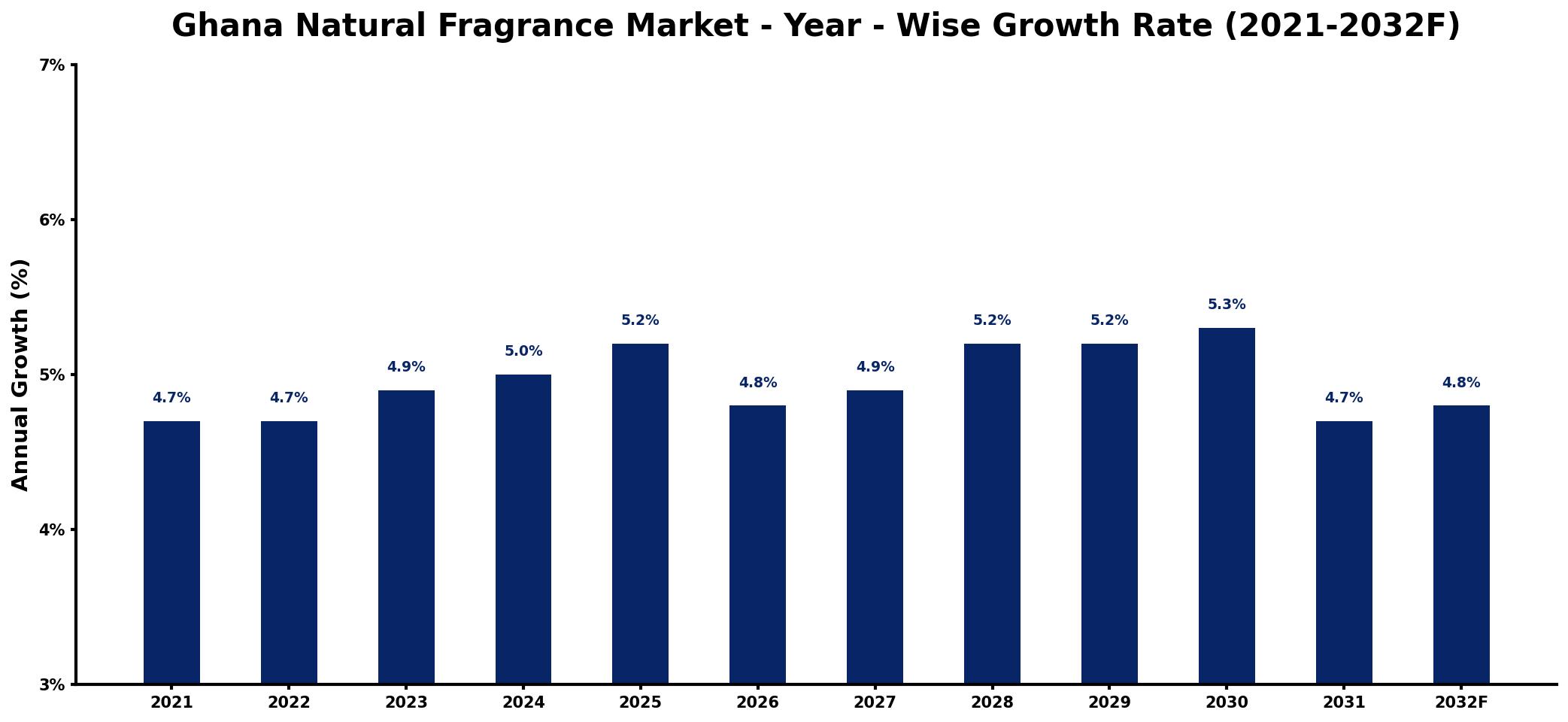
The table below presents the year‑wise growth rates along with the key drivers influencing the market
| Year | Growth Rate | Major Drivers |
| 2021 | 4.7% | Rising consumer health awareness |
| 2022 | 4.7% | Increased disposable income levels |
| 2023 | 4.9% | Growing trend of sustainability |
| 2024 | 5.0% | Expansion of retail distribution channels |
| 2025 | 5.2% | Emergence of eco-friendly brands |
| 2026 | 4.8% | Surge in online shopping platforms |
| 2027 | 4.9% | Heightened interest in wellness products |
| 2028 | 5.2% | Growing influence of social media |
| 2029 | 5.2% | Increase in premium product offerings |
| 2030 | 5.3% | growing regional consumption patterns |
| 2031 | 4.7% | Rising popularity of artisanal goods |
| 2032 | 4.8% | Growth in personalized consumer experiences |
Note: Market size estimations and growth projections presented in this report are based on 6Wresearch's proprietary forecasting methodology, utilizing the latest available industry data, government publications, and primary research inputs.
Ghana Natural Fragrance Market Synopsis
In recent years, the Ghana Natural Fragrance Market has experienced significant momentum, driven by changing consumer preferences and a burgeoning interest in organic personal care products. However, as the market looks ahead, it faces critical challenges regarding the supply of natural ingredients and a prevailing preference for synthetic options among some segments of the population.
While the current trajectory points towards substantial growth, the markets success will depend on overcoming these challenges through innovative product development and increased consumer education. The focus on sustainability and eco-consciousness will play a pivotal role in shaping the future of the Ghana Natural Fragrance Market.
Ghana Natural Fragrance Market Key Takeaways
- The market is projected to grow from USD 234 Million in 2025 to USD 312 Million by 2032, with a CAGR of 4.2%.
- Consumer shift toward natural and organic products significantly drives market expansion.
- Ghana's rich biodiversity offers a competitive advantage in sourcing natural fragrance ingredients.
- Government policies are increasingly supportive of sustainable practices within the fragrance industry.
- Challenges related to ingredient supply and consumer habits need to be addressed for sustained growth.
Evaluation of Restraints in Ghana Natural Fragrance Market
Despite the positive growth indicators, the Ghana Natural Fragrance Market is constrained by several key factors. The limited availability of natural fragrance ingredients presents a significant hurdle, particularly as demand for these products increases. Additionally, the extraction processes associated with natural fragrances can be costly, which may deter potential producers. Furthermore, entrenched consumer preferences for synthetic fragrances challenge the market's ability to gain wider acceptance among all demographic groups. These issues necessitate concerted efforts from industry stakeholders to innovate and promote the benefits of natural fragrances.
Ghana Natural Fragrance Market Trends
Several trends are currently shaping the Ghana Natural Fragrance Market. A notable shift towards clean beauty and wellness is encouraging consumers to seek out eco-friendly products free from harmful chemicals. This has catalyzed an increase in demand for organic and natural fragrances. Additionally, the incorporation of traditional and indigenous ingredients into fragrance formulations is emerging, resonating well with consumers who value authenticity and cultural relevance. The trend towards personalized fragrances is also gaining traction, with customers looking for unique scent profiles that reflect their individual identities.
Ghana Natural Fragrance Market Opportunities
The Ghana Natural Fragrance Market presents several compelling opportunities for growth and investment. The increasing global demand for sustainable and ethical beauty products opens avenues for local producers to expand their reach. Moreover, enhancing product innovation through the development of unique scent profiles that incorporate local botanicals can attract both local and international consumers. Partnerships with international brands seeking authentic natural ingredients offer additional pathways for market expansion. Investing in educational campaigns about the benefits of natural fragrances can further stimulate consumer interest and broaden market penetration.
Government Initiatives in the Ghana Natural Fragrance Market
The Ghanaian government is actively working to bolster the natural fragrance market through various initiatives aimed at promoting sustainable practices. Policies have been established to support the safe sourcing and manufacturing of fragrance ingredients while ensuring compliance with international safety and labeling standards. By fostering partnerships among producers, extractors, and regulatory bodies, the government aims to enhance the industry's competitiveness and market access. These efforts are pivotal in creating an environment conducive to growth while prioritizing environmental sustainability and fair trade.
Future Insights of the Ghana Natural Fragrance Market
Looking towards the future, the Ghana Natural Fragrance Market is poised for substantial growth, driven by the increasing consumer preference for natural and sustainably sourced products. Between 2026 and 2032, it is anticipated that more local companies will emerge, focusing on innovation and product diversification. As awareness of the harmful effects of synthetic fragrances continues to rise, market players who effectively communicate the benefits of natural alternatives will likely capture significant market share. Additionally, government support will play a crucial role in navigating challenges and ensuring a robust market landscape.
Ghana Natural Fragrance Market Latest Developments (2025 - 2026)
The Ghana Natural Fragrance Market has seen a flurry of activity in recent months, with local producers exploring innovative extraction techniques that enhance the quality and yield of natural fragrances. Meanwhile, consumer awareness campaigns are increasingly emphasizing the benefits of choosing natural over synthetic fragrances, which has resulted in a slow but steady shift in purchasing behavior. Additionally, collaborations between local fragrance artisans and international brands have begun to emerge, enabling the sharing of knowledge and resources, ultimately leading to greater market competitiveness.
Ghana Natural Fragrance Market - Key Attractiveness of the Report
- 10 Years of Market Numbers
- Historical Data Starting from 2022 to 2025
- Base Year: 2025
- Forecast Data until 2032
- Key Performance Indicators Impacting the Market
- Major Upcoming Developments and Projects
Key Highlights of the Report:
- Ghana Natural Fragrance Market Outlook
- Market Size of Ghana Natural Fragrance Market, 2025
- Forecast of Ghana Natural Fragrance Market, 2032
- Historical Data and Forecast of Ghana Natural Fragrance Revenues & Volume for the Period 2022-2032F
- Ghana Natural Fragrance Market Trend Evolution
- Ghana Natural Fragrance Market Drivers and Challenges
- Ghana Natural Fragrance Price Trends
- Ghana Natural Fragrance Porter's Five Forces
- Ghana Natural Fragrance Industry Life Cycle
- Historical Data and Forecast of Ghana Natural Fragrance Market Revenues & Volume By Ingredient for the Period 2022-2032F
- Historical Data and Forecast of Ghana Natural Fragrance Market Revenues & Volume By Essential Oils for the Period 2022-2032F
- Historical Data and Forecast of Ghana Natural Fragrance Market Revenues & Volume By Natural Extracts for the Period 2022-2032F
- Historical Data and Forecast of Ghana Natural Fragrance Market Revenues & Volume By Type for the Period 2022-2032F
- Historical Data and Forecast of Ghana Natural Fragrance Market Revenues & Volume By Top note for the Period 2022-2032F
- Historical Data and Forecast of Ghana Natural Fragrance Market Revenues & Volume By Middle Note for the Period 2022-2032F
- Historical Data and Forecast of Ghana Natural Fragrance Market Revenues & Volume By Base Note for the Period 2022-2032F
- Historical Data and Forecast of Ghana Natural Fragrance Market Revenues & Volume By Application for the Period 2022-2032F
- Historical Data and Forecast of Ghana Natural Fragrance Market Revenues & Volume By Fine Fragrances for the Period 2022-2032F
- Historical Data and Forecast of Ghana Natural Fragrance Market Revenues & Volume By Personal Care & Cosmetics for the Period 2022-2032F
- Historical Data and Forecast of Ghana Natural Fragrance Market Revenues & Volume By Household Care for the Period 2022-2032F
- Ghana Natural Fragrance Import Export Trade Statistics
- Market Opportunity Assessment By Ingredient
- Market Opportunity Assessment By Type
- Market Opportunity Assessment By Application
- Ghana Natural Fragrance Top Companies Market Share
- Ghana Natural Fragrance Competitive Benchmarking By Technical and Operational Parameters
- Ghana Natural Fragrance Company Profiles
- Ghana Natural Fragrance Key Strategic Recommendations






































