Ghana Network Slicing Market Size, Share & Growth Rate
The Ghana Network Slicing Market was estimated at USD 469 Million in 2025 and is projected to reach USD 677 Million by 2032, growing at a CAGR of 5.4% from 2026 to 2032. This growth is driven by the increasing demand for high-performance, customized network solutions that can adapt to various industry needs, particularly as 5G adoption accelerates. The need to support diverse applications—from enhanced mobile broadband to critical IoT services—further fuels market expansion.
Ghana Network Slicing Market Year-wise Growth Rate and Key Drivers
This graph highlights how the Ghana Network Slicing Market has steadily grown over the years, supported by major growth factors.
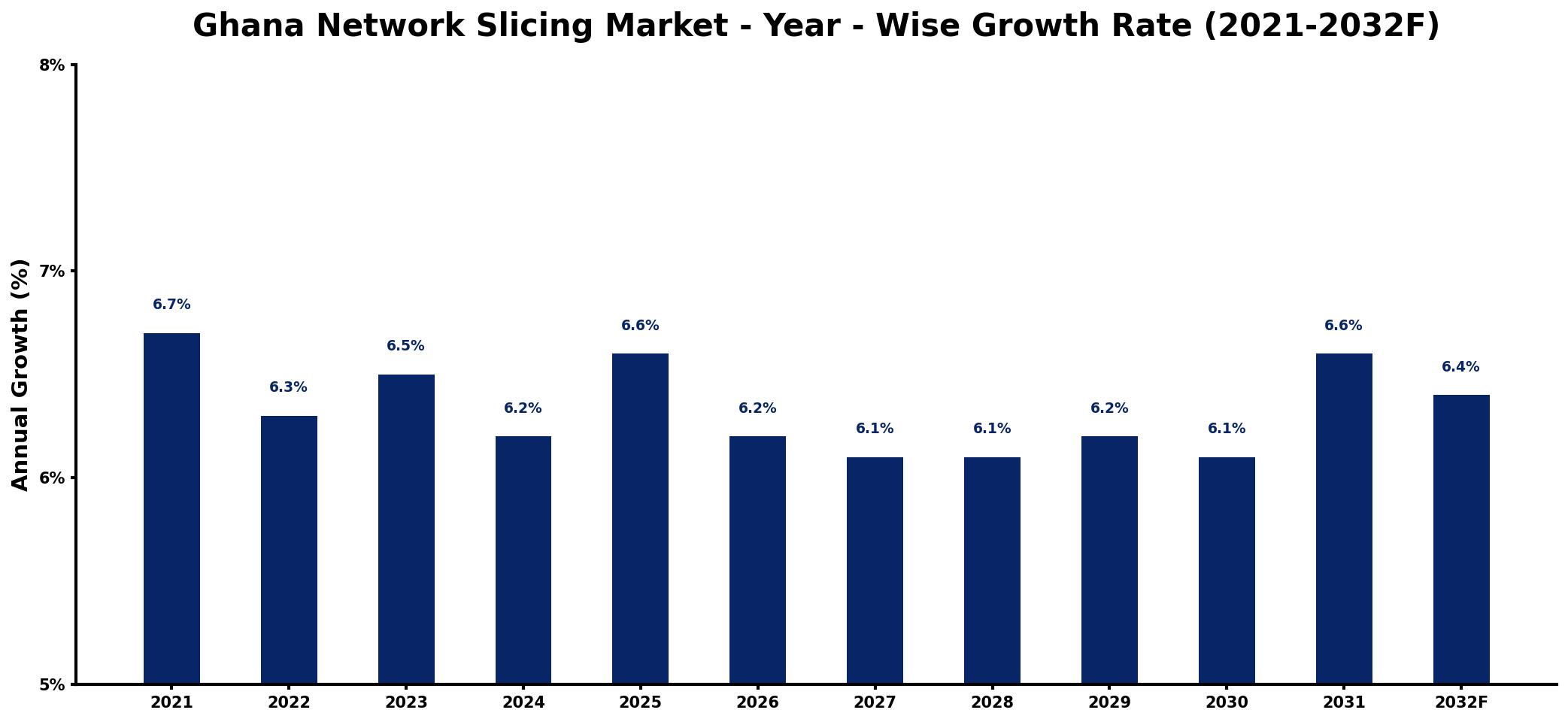
The table below presents the year‑wise growth rates along with the key drivers influencing the market
| Year | Growth Rate | Major Drivers |
| 2021 | 6.7% | Rising demand for connectivity solutions |
| 2022 | 6.3% | Expansion of 5G infrastructure initiatives |
| 2023 | 6.5% | Increased investments in telecommunications |
| 2024 | 6.2% | Growth in IoT device adoption |
| 2025 | 6.6% | Emergence of smart city projects |
| 2026 | 6.2% | Surge in data traffic requirements |
| 2027 | 6.1% | Development of edge computing applications |
| 2028 | 6.1% | Enhancement of digital transformation strategies |
| 2029 | 6.2% | strengthening international trade flows |
| 2030 | 6.1% | Adoption of advanced cloud services |
| 2031 | 6.6% | Investments in next-gen technologies |
| 2032 | 6.4% | growing regional consumption patterns |
Note: Market size estimations and growth projections presented in this report are based on 6Wresearch's proprietary forecasting methodology, utilizing the latest available industry data, government publications, and primary research inputs.
Ghana Network Slicing Market Synopsis
In Ghana, the demand for tailored network solutions is escalating as businesses and consumers alike seek enhanced connectivity. Network slicing allows telecom operators to allocate resources dynamically, thereby offering differentiated services tailored to specific user demands and application requirements.
The Ghanaian telecommunications landscape is becoming increasingly competitive, pushing providers to adopt innovative approaches. Network slicing serves as a pivotal strategy for delivering quality services, ensuring that operators can efficiently manage their network resources while meeting the diverse needs of their customer base.
Ghana Network Slicing Market Key Takeaways
- The market is underpinned by the widespread rollout of 5G infrastructure, enabling tailored services.
- Dynamic resource allocation through network slicing is becoming essential for IoT and Industry 4.0 initiatives.
- Government policies are increasingly supportive of regulatory frameworks that enhance network flexibility.
- Challenges such as limited interoperability and regulatory constraints require strategic solutions.
- Partnerships among stakeholders will play a crucial role in market development and scalability.
Evaluation of Restraints in Ghana Network Slicing Market
Despite its promising outlook, the Ghana Network Slicing Market faces notable constraints. Limited interoperability among various network slicing solutions poses a significant hurdle, making it difficult for operators to implement seamless integrations. Furthermore, dynamic resource allocation remains a challenge, requiring sophisticated management systems to optimize network performance. Regulatory frameworks also continue to evolve, potentially stifling innovation as operators navigate compliance and service level agreements.
Ghana Network Slicing Market Trends
Emerging trends in the Ghana Network Slicing Market indicate a robust push towards edge computing. This technology reduces latency and enhances performance for real-time applications, proving essential for sectors like manufacturing and smart cities. Additionally, the shift towards virtualized network functions is gaining traction, allowing for greater flexibility and efficiency in service delivery.
The integration of AI and machine learning in network management is another key trend, offering operators advanced analytics capabilities. This can optimize resource allocation and enhance decision-making processes, further driving demand for innovative network slicing solutions.
Ghana Network Slicing Market Opportunities
Genuine growth opportunities in the Ghana Network Slicing Market lie in the burgeoning IoT sector and the expanding requirements of Industry 4.0 applications. As businesses increasingly leverage smart devices and automation, the demand for tailored network experiences will surge. This scenario offers telecom operators a prime opportunity to innovate and develop bespoke solutions that cater to specific industry needs.
Furthermore, as urbanization accelerates in Ghana, cities are likely to invest in smart infrastructure, creating demand for robust network slicing capabilities to manage the diverse and growing connectivity needs of urban environments.
Government Initiatives in the Ghana Network Slicing Market
The Ghanaian government is actively promoting policies designed to foster the growth of the network slicing market, particularly in light of the impending rollout of 5G technology. Initiatives include establishing regulatory frameworks that set standards for network slicing architecture, performance benchmarks, and compliance with telecommunications quality standards. By encouraging partnerships between network operators, vendors, and regulatory authorities, the government aims to enhance the agility and scalability of network services across the nation.
Future Insights of the Ghana Network Slicing Market
Looking ahead, the Ghana Network Slicing Market is poised for significant evolution through 2026-2032. As 5G becomes more widely available, telecom providers will increasingly leverage network slicing to deliver versatile services that cater to a range of user applications—from entertainment to critical industrial operations. The collaborative environment fostered by government initiatives will likely yield innovative solutions, fostering a more connected and efficient digital ecosystem across Ghana.
Ghana Network Slicing Market Latest Developments (2025 - 2026)
Recent developments in the Ghana Network Slicing Market highlight a growing focus on strategic partnerships among telecommunications providers and technology vendors. These collaborations aim to enhance the deployment of network slicing technologies, ensuring interoperability and improved service delivery. Additionally, initiatives to standardize network slicing protocols are gaining momentum, with stakeholders working closely to establish benchmarks that align with international best practices.
Ghana Network Slicing Market - Key Attractiveness of the Report
- 10 Years of Market Numbers
- Historical Data Starting from 2022 to 2025
- Base Year: 2025
- Forecast Data until 2032
- Key Performance Indicators Impacting the Market
- Major Upcoming Developments and Projects
Key Highlights of the Report:
- Ghana Network Slicing Market Outlook
- Market Size of Ghana Network Slicing Market, 2025
- Forecast of Ghana Network Slicing Market, 2032
- Historical Data and Forecast of Ghana Network Slicing Revenues & Volume for the Period 2022-2032F
- Ghana Network Slicing Market Trend Evolution
- Ghana Network Slicing Market Drivers and Challenges
- Ghana Network Slicing Price Trends
- Ghana Network Slicing Porter's Five Forces
- Ghana Network Slicing Industry Life Cycle
- Historical Data and Forecast of Ghana Network Slicing Market Revenues & Volume By Component for the Period 2022-2032F
- Historical Data and Forecast of Ghana Network Slicing Market Revenues & Volume By Solution for the Period 2022-2032F
- Historical Data and Forecast of Ghana Network Slicing Market Revenues & Volume By Services (Professional & Managed) for the Period 2022-2032F
- Historical Data and Forecast of Ghana Network Slicing Market Revenues & Volume By End User for the Period 2022-2032F
- Historical Data and Forecast of Ghana Network Slicing Market Revenues & Volume By Telecom Operators for the Period 2022-2032F
- Historical Data and Forecast of Ghana Network Slicing Market Revenues & Volume By Enterprises for the Period 2022-2032F
- Historical Data and Forecast of Ghana Network Slicing Market Revenues & Volume By Application for the Period 2022-2032F
- Historical Data and Forecast of Ghana Network Slicing Market Revenues & Volume By Manufacturing for the Period 2022-2032F
- Historical Data and Forecast of Ghana Network Slicing Market Revenues & Volume By Government for the Period 2022-2032F
- Historical Data and Forecast of Ghana Network Slicing Market Revenues & Volume By Automotive for the Period 2022-2032F
- Historical Data and Forecast of Ghana Network Slicing Market Revenues & Volume By Media and Entertainment for the Period 2022-2032F
- Ghana Network Slicing Import Export Trade Statistics
- Market Opportunity Assessment By Component
- Market Opportunity Assessment By End User
- Market Opportunity Assessment By Application
- Ghana Network Slicing Top Companies Market Share
- Ghana Network Slicing Competitive Benchmarking By Technical and Operational Parameters
- Ghana Network Slicing Company Profiles
- Ghana Network Slicing Key Strategic Recommendations






































