Ghana Nylon Filament Yarn Market Size, Share & Growth Rate
The Ghana Nylon Filament Yarn Market was estimated at USD 1162 Million in 2025 and is projected to reach USD 1661 Million by 2032, growing at a CAGR of 5.2% from 2026 to 2032. This upward trajectory is primarily driven by a burgeoning textile and apparel industry in Ghana, which increasingly seeks durable and versatile materials. As local manufacturers enhance production capabilities and embrace innovative technologies, they are positioned to meet rising consumer demands effectively.
Ghana Nylon Filament Yarn Market Year-wise Growth Rate and Key Drivers
This graph highlights how the Ghana Nylon Filament Yarn Market has steadily grown over the years, supported by major growth factors.
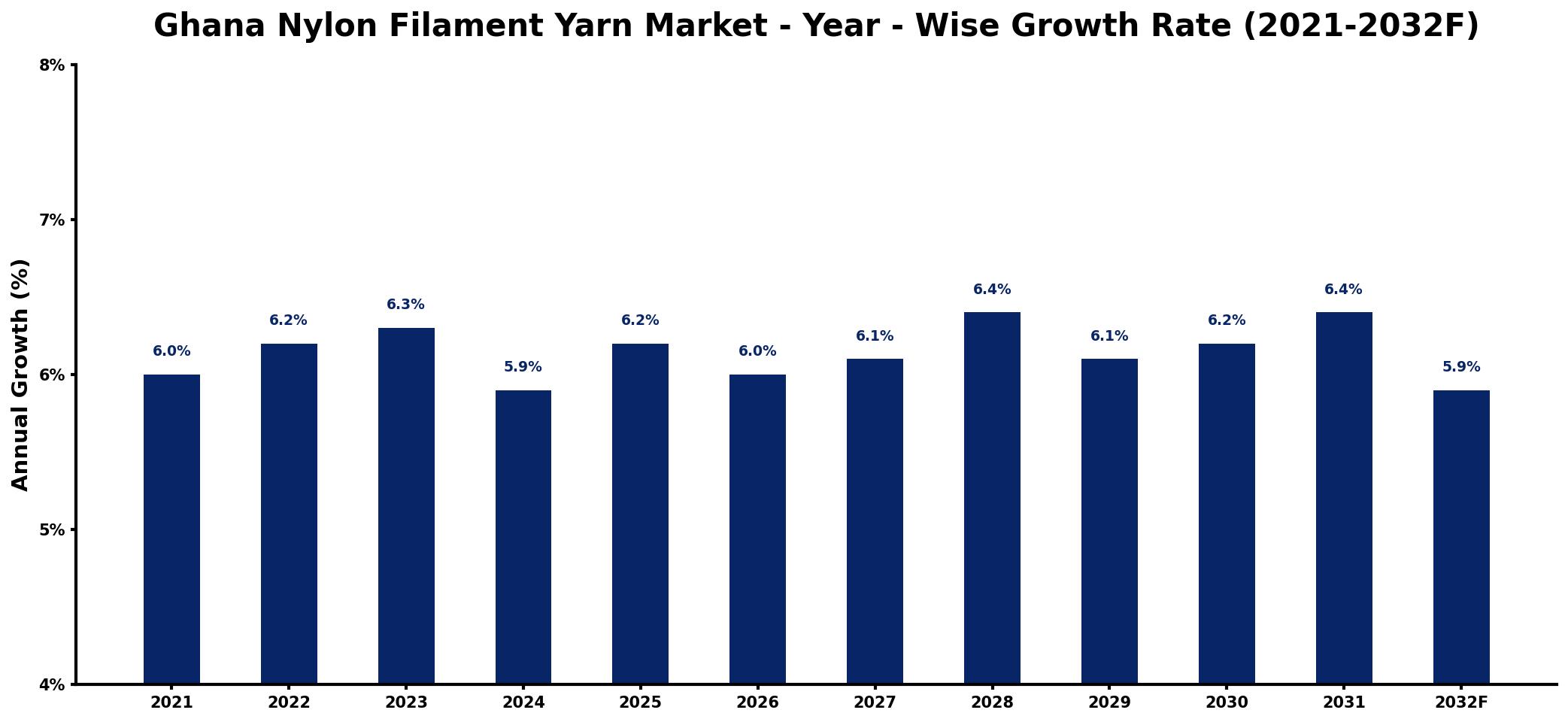
The table below presents the year‑wise growth rates along with the key drivers influencing the market
| Year | Growth Rate | Major Drivers |
| 2021 | 6.0% | Rising textile manufacturing capacity |
| 2022 | 6.2% | Increased consumer fashion demand |
| 2023 | 6.3% | Growing production efficiency investments |
| 2024 | 5.9% | Emerging sustainable material trends |
| 2025 | 6.2% | Expansion of retail distribution networks |
| 2026 | 6.0% | Technological advancements in production |
| 2027 | 6.1% | Increased exports to neighboring markets |
| 2028 | 6.4% | Growing demand for sportswear applications |
| 2029 | 6.1% | Rising popularity of home textiles |
| 2030 | 6.2% | Boost in local production initiatives |
| 2031 | 6.4% | Strengthened supply chain partnerships |
| 2032 | 5.9% | Focus on eco-friendly product lines |
Note: Market size estimations and growth projections presented in this report are based on 6Wresearch's proprietary forecasting methodology, utilizing the latest available industry data, government publications, and primary research inputs.
Ghana Nylon Filament Yarn Market Synopsis
In recent years, the Ghana Nylon Filament Yarn market has experienced notable growth, primarily attributed to its widespread application in textiles, ropes, and industrial materials. The unique properties of nylon filament yarn, such as its strength and resilience, make it a preferred choice across various sectors.
The competitive landscape is vibrant, featuring both local producers and international suppliers. This dynamic environment underscores the importance of innovation and quality in meeting the evolving needs of Ghana's rapidly expanding market.
Ghana Nylon Filament Yarn Market Key Takeaways
- Strong growth driven by increasing demand from the textile and apparel industries.
- Innovation in production techniques is enhancing product quality and performance.
- Government policies are fostering local manufacturing and reducing import reliance.
- Sustainable practices are gaining traction, resulting in recycled nylon filament yarn options.
- Infrastructure improvements are essential for unlocking further market potential.
Evaluation of Restraints in Ghana Nylon Filament Yarn Market
Despite the promising outlook, the Ghana Nylon Filament Yarn market faces significant constraints. Stiff competition from imported yarns, which benefit from larger-scale production and lower prices, challenges local manufacturers. Additionally, the volatility of raw material prices, especially those derived from petroleum, can erode profit margins. Infrastructure issues, such as inadequate power supply and transportation inefficiencies, further hinder production capabilities. These factors collectively pose a challenge to the local industrys competitiveness and growth.
Ghana Nylon Filament Yarn Market Trends
Key trends shaping the Ghana Nylon Filament Yarn market include a growing demand for high-quality, durable textiles and a shift towards sustainable manufacturing practices. As eco-consciousness rises among consumers, manufacturers are increasingly focusing on producing recycled nylon options. Technological advancements in yarn production are also notable, enhancing quality and making nylon filament yarn suitable for applications in sportswear, automotive textiles, and industrial fabrics.
Ghana Nylon Filament Yarn Market Opportunities
Investment opportunities abound in the Ghana Nylon Filament Yarn market. The demand for versatile synthetic fibers across industries such as textiles, automotive, and packaging is on the rise. Local manufacturers can capitalize on this growth by innovating and diversifying their product lines. Furthermore, government initiatives aimed at bolstering the manufacturing sector and enhancing infrastructure create a conducive environment for investment, paving the way for long-term profitability.
Government Initiatives in the Ghana Nylon Filament Yarn Market
The Ghanaian government is actively promoting local production of nylon filament yarn through various policies. These include tariffs on imports to protect domestic manufacturers and incentives such as tax breaks to encourage investments. Additionally, there is a strong focus on improving infrastructure and capacity building within the sector, which will ultimately support sustainable growth and enhance competitiveness in the market.
Future Insights of the Ghana Nylon Filament Yarn Market
Looking ahead to the period from 2026 to 2032, the Ghana Nylon Filament Yarn market is positioned for sustained growth. The increasing disposable income among consumers is likely to drive spending on quality textiles, while the expanding automotive sector will further stimulate demand for nylon filament products. As sustainability becomes a pivotal consideration, manufacturers who adapt to these trends are poised to thrive. However, navigating challenges such as raw material price fluctuations will be crucial for maintaining growth momentum.
Ghana Nylon Filament Yarn Market Latest Developments (2025 - 2026)
Recent developments in the Ghana Nylon Filament Yarn market highlight a shift towards greater innovation and quality production. Industry players are investing in advanced manufacturing technologies and exploring sustainable materials to capture the environmentally-conscious consumer segment. Additionally, local businesses are collaborating with government bodies to enhance production capacities and address infrastructure shortcomings, setting the stage for a more robust market presence.
Ghana Nylon Filament Yarn Market - Key Attractiveness of the Report
- 10 Years of Market Numbers
- Historical Data Starting from 2022 to 2025
- Base Year: 2025
- Forecast Data until 2032
- Key Performance Indicators Impacting the Market
- Major Upcoming Developments and Projects
Key Highlights of the Report:
- Ghana Nylon Filament Yarn Market Outlook
- Market Size of Ghana Nylon Filament Yarn Market, 2025
- Forecast of Ghana Nylon Filament Yarn Market, 2032
- Historical Data and Forecast of Ghana Nylon Filament Yarn Revenues & Volume for the Period 2022-2032F
- Ghana Nylon Filament Yarn Market Trend Evolution
- Ghana Nylon Filament Yarn Market Drivers and Challenges
- Ghana Nylon Filament Yarn Price Trends
- Ghana Nylon Filament Yarn Porter's Five Forces
- Ghana Nylon Filament Yarn Industry Life Cycle
- Historical Data and Forecast of Ghana Nylon Filament Yarn Market Revenues & Volume By Grade for the Period 2022-2032F
- Historical Data and Forecast of Ghana Nylon Filament Yarn Market Revenues & Volume By Flat Yarn for the Period 2022-2032F
- Historical Data and Forecast of Ghana Nylon Filament Yarn Market Revenues & Volume By Textured Yarn for the Period 2022-2032F
- Historical Data and Forecast of Ghana Nylon Filament Yarn Market Revenues & Volume By Partially Oriented Yarn for the Period 2022-2032F
- Historical Data and Forecast of Ghana Nylon Filament Yarn Market Revenues & Volume By Fully Drawn Yarn for the Period 2022-2032F
- Historical Data and Forecast of Ghana Nylon Filament Yarn Market Revenues & Volume By Dyed Yarns for the Period 2022-2032F
- Historical Data and Forecast of Ghana Nylon Filament Yarn Market Revenues & Volume By Application for the Period 2022-2032F
- Historical Data and Forecast of Ghana Nylon Filament Yarn Market Revenues & Volume By Textiles for the Period 2022-2032F
- Historical Data and Forecast of Ghana Nylon Filament Yarn Market Revenues & Volume By Sports Apparels for the Period 2022-2032F
- Historical Data and Forecast of Ghana Nylon Filament Yarn Market Revenues & Volume By Sports and Adventure Equipment for the Period 2022-2032F
- Historical Data and Forecast of Ghana Nylon Filament Yarn Market Revenues & Volume By Travel Accessories for the Period 2022-2032F
- Historical Data and Forecast of Ghana Nylon Filament Yarn Market Revenues & Volume By Fishing Nets for the Period 2022-2032F
- Historical Data and Forecast of Ghana Nylon Filament Yarn Market Revenues & Volume By Fabric for the Period 2022-2032F
- Historical Data and Forecast of Ghana Nylon Filament Yarn Market Revenues & Volume By Sales Channel for the Period 2022-2032F
- Historical Data and Forecast of Ghana Nylon Filament Yarn Market Revenues & Volume By Direct Company Sale for the Period 2022-2032F
- Historical Data and Forecast of Ghana Nylon Filament Yarn Market Revenues & Volume By Direct Import for the Period 2022-2032F
- Historical Data and Forecast of Ghana Nylon Filament Yarn Market Revenues & Volume By Distributors & Traders for the Period 2022-2032F
- Historical Data and Forecast of Ghana Nylon Filament Yarn Market Revenues & Volume By Retailers for the Period 2022-2032F
- Ghana Nylon Filament Yarn Import Export Trade Statistics
- Market Opportunity Assessment By Grade
- Market Opportunity Assessment By Application
- Market Opportunity Assessment By Sales Channel
- Ghana Nylon Filament Yarn Top Companies Market Share
- Ghana Nylon Filament Yarn Competitive Benchmarking By Technical and Operational Parameters
- Ghana Nylon Filament Yarn Company Profiles
- Ghana Nylon Filament Yarn Key Strategic Recommendations






































