Ghana Oil Country Tubular Goods Market Size, Share & Growth Rate
The Ghana Oil Country Tubular Goods Market was estimated at USD 802 Million in 2025 and is projected to reach USD 1166 Million by 2032, growing at a CAGR of 5.5% from 2026 to 2032. This positive growth trajectory is primarily fueled by escalating oil and gas exploration activities, supported by significant offshore reserves. The combination of local content regulations and an increasing focus on sustainability further propels the demand for high-quality OCTG products across the region.
Ghana Oil Country Tubular Goods Market Year-wise Growth Rate and Key Drivers
This graph highlights how the Ghana Oil Country Tubular Goods Market has steadily grown over the years, supported by major growth factors.
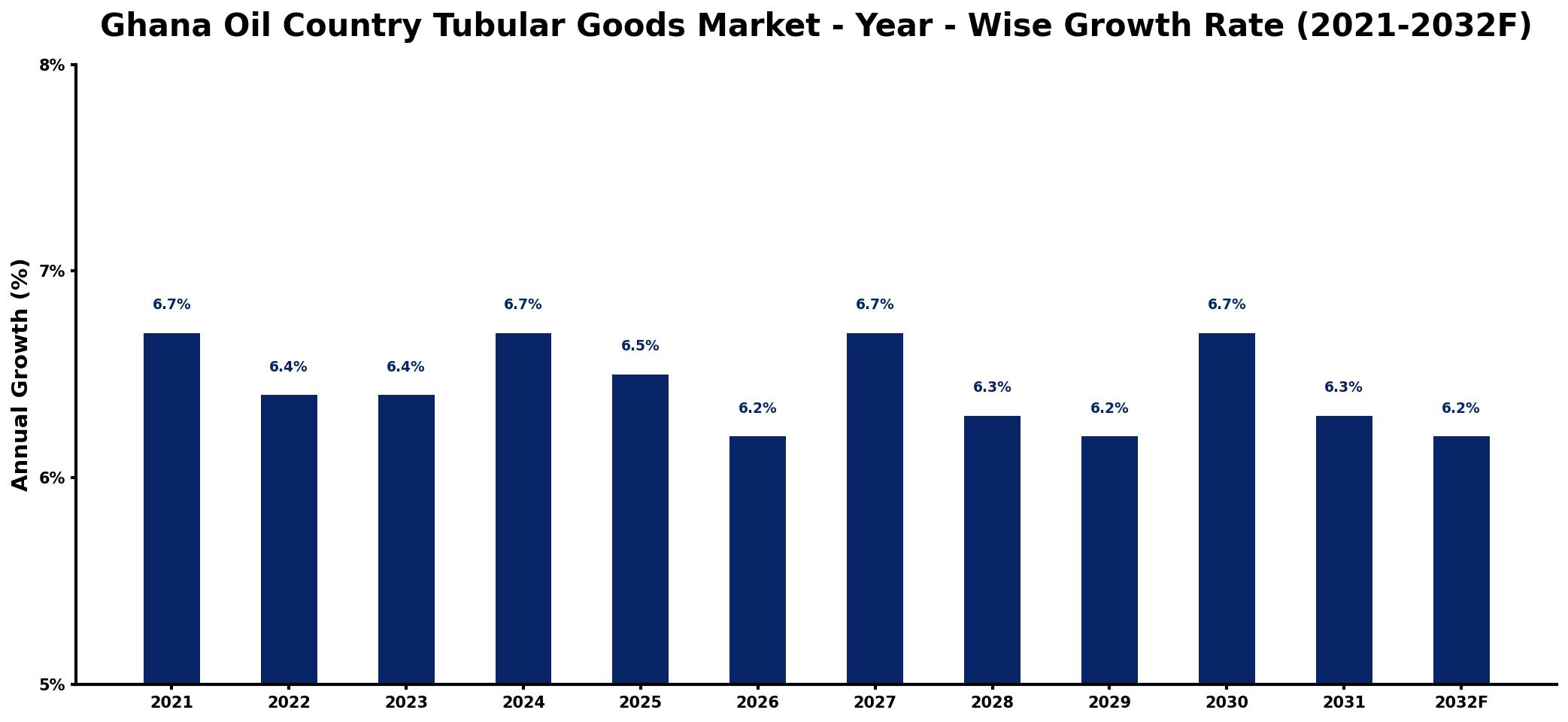
The table below presents the year‑wise growth rates along with the key drivers influencing the market
| Year | Growth Rate | Major Drivers |
| 2021 | 6.7% | Increased energy sector investments |
| 2022 | 6.4% | Rising industrial infrastructure projects |
| 2023 | 6.4% | Growing demand for energy solutions |
| 2024 | 6.7% | Expansion in construction activities |
| 2025 | 6.5% | Investment in renewable energy sources |
| 2026 | 6.2% | Emerging market exploration initiatives |
| 2027 | 6.7% | Strengthened local manufacturing capabilities |
| 2028 | 6.3% | Increased foreign direct investments |
| 2029 | 6.2% | Development of transportation infrastructure |
| 2030 | 6.7% | Enhanced regulatory support frameworks |
| 2031 | 6.3% | Growing technology adoption trends |
| 2032 | 6.2% | Rising energy efficiency initiatives |
Note: Market size estimations and growth projections presented in this report are based on 6Wresearch's proprietary forecasting methodology, utilizing the latest available industry data, government publications, and primary research inputs.
Ghana Oil Country Tubular Goods Market Synopsis
The demand for Oil Country Tubular Goods (OCTG) in Ghana is underpinned by the ongoing exploration of untapped oil and gas reserves. As both international and local companies ramp up their activities, the requirement for reliable OCTG products such as casing and tubing is becoming increasingly vital in meeting operational standards and enhancing efficiency.
Local content regulations have become a key driver, pushing companies to source materials from domestic suppliers. This not only stimulates local manufacturing capabilities but also encourages a competitive marketplace where both local and international players vie for a share of the growing demand.
Ghana Oil Country Tubular Goods Market Key Takeaways
- The market is witnessing strong growth due to ongoing oil and gas exploration efforts.
- Local content regulations are fostering domestic sourcing and manufacturing of OCTG products.
- Technological advancements in product offerings are enhancing operational efficiencies.
- Environmental sustainability is becoming a central focus for manufacturers in the region.
- Investment opportunities abound, with government support aimed at boosting local participation.
Evaluation of Restraints in Ghana Oil Country Tubular Goods Market
Despite its growth potential, the Ghana Oil Country Tubular Goods market faces several restraints. Intense competition from established international suppliers may challenge local companies striving for market share. Additionally, fluctuations in global oil prices introduce uncertainty, impacting demand and investment decisions. Infrastructure limitations also pose logistical challenges that can delay product delivery, further complicating operational efficiency for oil and gas firms.
Ghana Oil Country Tubular Goods Market Trends
Current trends in the Ghana OCTG market indicate a marked shift towards technological innovation, as manufacturers invest in developing high-quality products capable of withstanding extreme drilling conditions. This trend is mirrored by a rising commitment to sustainability, with firms increasingly adopting eco-friendly materials and production processes. The expansion of product portfolios is also evident, as suppliers seek to address diverse client needs across various applications within the oil and gas sector.
Ghana Oil Country Tubular Goods Market Opportunities
The Ghana OCTG market is rich with investment opportunities, particularly as exploration and production activities continue to intensify. The growing demand for essential OCTG components provides an avenue for investors to engage with local manufacturers who are aligning with government mandates on local content. Furthermore, with the Ghanaian government actively promoting investment in the oil and gas sector, the stage is set for robust growth in this domain.
Government Initiatives in the Ghana Oil Country Tubular Goods Market
The Ghanaian government has established several initiatives designed to boost local content within the oil and gas sector, significantly impacting the OCTG market. Policies such as the Local Content and Local Participation Regulations mandate that a portion of goods and services, including OCTG products, must be sourced locally. These regulations aim to strengthen domestic capabilities, create jobs, and enhance skills development, thereby maximizing the socio-economic benefits of the country's burgeoning energy sector.
Future Insights of the Ghana Oil Country Tubular Goods Market
The outlook for the Ghana Oil Country Tubular Goods market through 2026-2032 appears robust, buoyed by fresh offshore discoveries and continued exploration activities. The government's focus on attracting foreign investment and enhancing local production capabilities is expected to stimulate further growth. However, companies will need to navigate challenges like fluctuating oil prices and potential regulatory uncertainties while focusing on innovation and sustainability to maintain a competitive edge.
Ghana Oil Country Tubular Goods Market Latest Developments (2025 - 2026)
Recent developments in the Ghana Oil Country Tubular Goods market indicate a heightened focus on innovation and local manufacturing. Efforts to improve supply chain efficiency are underway, with many companies investing in advanced technologies. Moreover, government policies promoting local participation continue to shape the competitive landscape, enhancing opportunities for local suppliers and manufacturers to expand their market presence.
Ghana Oil Country Tubular Goods Market - Key Attractiveness of the Report
- 10 Years of Market Numbers
- Historical Data Starting from 2022 to 2025
- Base Year: 2025
- Forecast Data until 2032
- Key Performance Indicators Impacting the Market
- Major Upcoming Developments and Projects
Key Highlights of the Report:
- Ghana Oil Country Tubular Goods Market Outlook
- Market Size of Ghana Oil Country Tubular Goods Market, 2025
- Forecast of Ghana Oil Country Tubular Goods Market, 2032
- Historical Data and Forecast of Ghana Oil Country Tubular Goods Revenues & Volume for the Period 2022-2032F
- Ghana Oil Country Tubular Goods Market Trend Evolution
- Ghana Oil Country Tubular Goods Market Drivers and Challenges
- Ghana Oil Country Tubular Goods Price Trends
- Ghana Oil Country Tubular Goods Porter's Five Forces
- Ghana Oil Country Tubular Goods Industry Life Cycle
- Historical Data and Forecast of Ghana Oil Country Tubular Goods Market Revenues & Volume By Manufacturing Process for the Period 2022-2032F
- Historical Data and Forecast of Ghana Oil Country Tubular Goods Market Revenues & Volume By Seamless for the Period 2022-2032F
- Historical Data and Forecast of Ghana Oil Country Tubular Goods Market Revenues & Volume By Electric Resistance Welded for the Period 2022-2032F
- Historical Data and Forecast of Ghana Oil Country Tubular Goods Market Revenues & Volume By Grade for the Period 2022-2032F
- Historical Data and Forecast of Ghana Oil Country Tubular Goods Market Revenues & Volume By Premium Grade for the Period 2022-2032F
- Historical Data and Forecast of Ghana Oil Country Tubular Goods Market Revenues & Volume By API Grade for the Period 2022-2032F
- Ghana Oil Country Tubular Goods Import Export Trade Statistics
- Market Opportunity Assessment By Manufacturing Process
- Market Opportunity Assessment By Grade
- Ghana Oil Country Tubular Goods Top Companies Market Share
- Ghana Oil Country Tubular Goods Competitive Benchmarking By Technical and Operational Parameters
- Ghana Oil Country Tubular Goods Company Profiles
- Ghana Oil Country Tubular Goods Key Strategic Recommendations






































