Ghana Oil & Gas Pumps Market Size, Share & Growth Rate
The Ghana Oil & Gas Pumps Market was estimated at USD 188 Million in 2025 and is projected to reach USD 261 Million by 2032, growing at a CAGR of 4.8% from 2026 to 2032. This growth is primarily fueled by an increase in oil and gas exploration activities within Ghana's rich offshore fields, coupled with the government's commitment to boosting local production. As the industry matures, demand for high-quality, technologically advanced pump solutions continues to rise, driving robust market expansion.
Ghana Oil & Gas Pumps Market Year-wise Growth Rate and Key Drivers
This graph highlights how the Ghana Oil & Gas Pumps Market has steadily grown over the years, supported by major growth factors.
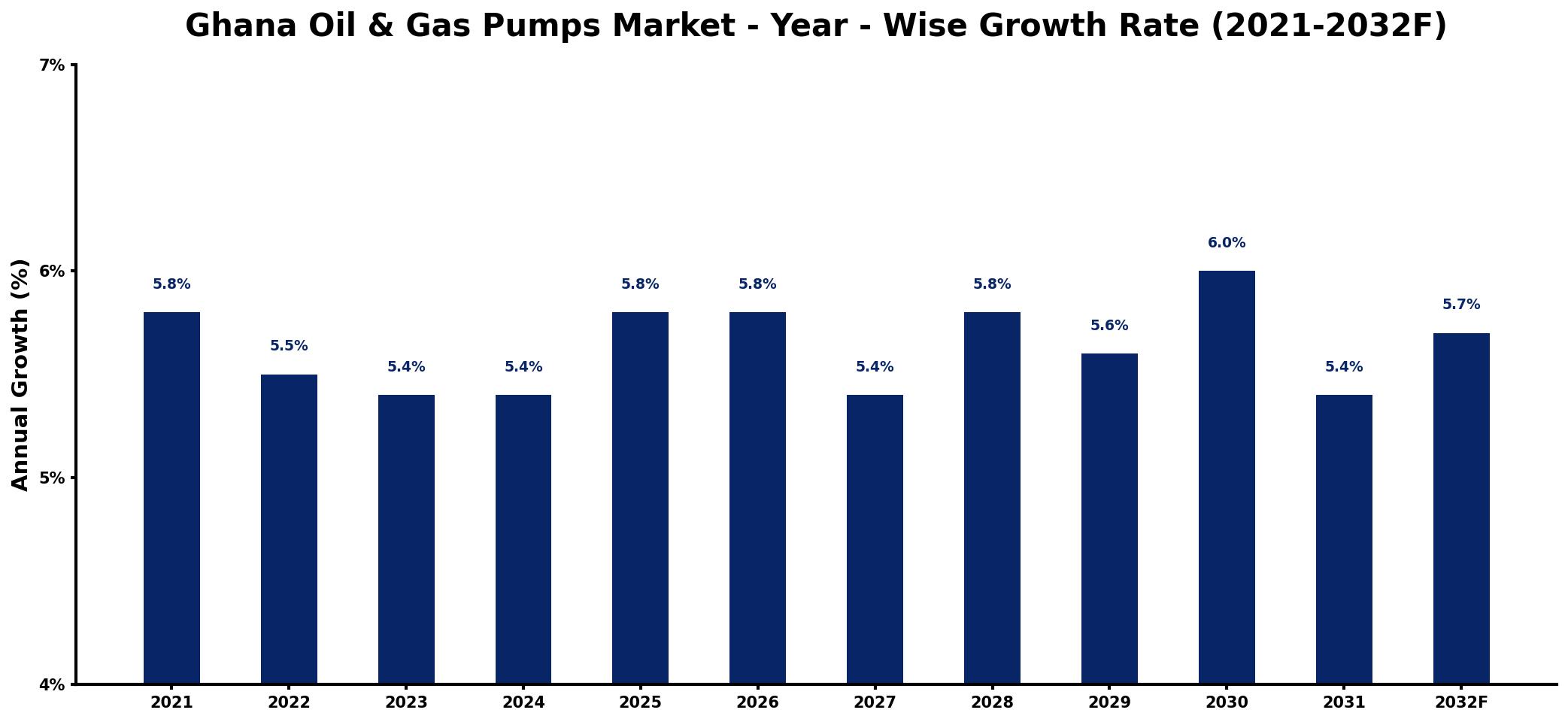
The table below presents the year‑wise growth rates along with the key drivers influencing the market
| Year | Growth Rate | Major Drivers |
| 2021 | 5.8% | Increased infrastructure development projects |
| 2022 | 5.5% | Rising energy sector investments |
| 2023 | 5.4% | Growing industrial manufacturing activities |
| 2024 | 5.4% | Expansion of transportation networks |
| 2025 | 5.8% | Surge in urbanization trends |
| 2026 | 5.8% | Boost in renewable energy initiatives |
| 2027 | 5.4% | Heightened demand from agriculture sector |
| 2028 | 5.8% | Emergence of new construction projects |
| 2029 | 5.6% | Increased foreign direct investments |
| 2030 | 6.0% | expanding manufacturing base activity |
| 2031 | 5.4% | Growth in residential construction sector |
| 2032 | 5.7% | Rising demand for energy efficiency |
Note: Market size estimations and growth projections presented in this report are based on 6Wresearch's proprietary forecasting methodology, utilizing the latest available industry data, government publications, and primary research inputs.
Ghana Oil & Gas Pumps Market Synopsis
The strongest force currently shaping the Ghana Oil & Gas Pumps Market is the surge in exploration and production initiatives spurred by both domestic and foreign investment. With oil and gas companies under pressure to enhance operational efficiency, there is a growing emphasis on pumps that offer reliability under challenging conditions.
Moreover, rising awareness around energy efficiency and sustainability is compelling stakeholders to adopt energy-efficient pump solutions. This evolving focus not only aligns with global trends but also meets local regulatory requirements aimed at reducing environmental impacts associated with the oil and gas sector.
- Technological advancements are driving demand for innovative pump solutions.
- Government initiatives are promoting local content and industry participation.
- The market is expected to benefit from infrastructural investments.
- Environmental sustainability is increasingly influencing pump selection.
- There is strong competition from international pump manufacturers, impacting local players.
Despite its growth prospects, the Ghana Oil & Gas Pumps Market faces several restraints that could limit its potential. Infrastructure challenges are notable, with inadequate pipeline networks and storage facilities complicating the transportation and storage of oil and gas products. Additionally, the fluctuating global oil prices can adversely affect investment decisions and impact project profitability. Regulatory uncertainties further complicate the landscape, making it imperative for companies to navigate changes effectively. Lastly, competition from established international manufacturers poses a significant challenge to local businesses striving to gain a foothold in the market.
The Ghana Oil & Gas Pumps Market is witnessing significant trends that align with global technological advancements. A marked shift toward the adoption of centrifugal and submersible pumps highlights a preference for solutions that enhance operational efficiency. Moreover, with the rising importance of sustainability, pump systems designed to minimize energy consumption and emissions are becoming increasingly popular. As the industry evolves, we can expect more innovations that focus on integrating smart technologies into pump systems, further boosting performance and reliability.
The prospects for investment in the Ghana Oil & Gas Pumps Market are robust, driven by heightened exploration and production activities. Opportunities abound in supplying high-quality pumps that meet strict industry standards, offering maintenance services that ensure optimal performance, and innovating new pump technologies aimed at increasing efficiency. The Ghanaian government's focus on attracting foreign investment and promoting local content development enhances the appeal for investors seeking to capitalize on the market's growth potential.
The Ghanaian government has enacted several policies aimed at enhancing the Oil & Gas Pumps Market. These include the Local Content and Local Participation Regulations, which require companies in the sector to prioritize local goods and services, thereby supporting the domestic economy. Furthermore, regulations mandate that oil and gas companies offer training and development opportunities for Ghanaian professionals, ensuring that the workforce is skilled and capable. Such initiatives are designed to promote sustainable growth while benefiting local businesses and communities.
The future outlook for the Ghana Oil & Gas Pumps Market appears promising, driven by ongoing investments and increasing demand for energy resources. Continued exploration and production activities in offshore fields are likely to sustain this growth trajectory. Moreover, advancements in pump technologies, including the integration of digital solutions, are expected to enhance operational efficiency. With a clear government commitment to local content and sustainability, the market is positioned for long-term expansion, promising a wealth of opportunities for stakeholders.
Recent developments in the Ghana Oil & Gas Pumps Market have focused on innovative pump technologies aimed at improving efficiency. There has been an increase in collaboration between local firms and international technology providers, highlighting a trend towards knowledge transfer and capacity building. Furthermore, ongoing government initiatives to streamline the regulatory landscape have created a more favorable environment for investments in the sector, signaling positive changes for market participants.
- 10 Years of Market Numbers
- Historical Data Starting from 2022 to 2025
- Base Year: 2025
- Forecast Data until 2032
- Key Performance Indicators Impacting the Market
- Major Upcoming Developments and Projects
Key Highlights of the Report:
- Ghana Oil & Gas Pumps Market Outlook
- Market Size of Ghana Oil & Gas Pumps Market, 2025
- Forecast of Ghana Oil & Gas Pumps Market, 2032
- Historical Data and Forecast of Ghana Oil & Gas Pumps Revenues & Volume for the Period 2022-2032F
- Ghana Oil & Gas Pumps Market Trend Evolution
- Ghana Oil & Gas Pumps Market Drivers and Challenges
- Ghana Oil & Gas Pumps Price Trends
- Ghana Oil & Gas Pumps Porter's Five Forces
- Ghana Oil & Gas Pumps Industry Life Cycle
- Historical Data and Forecast of Ghana Oil & Gas Pumps Market Revenues & Volume By Type for the Period 2022-2032F
- Historical Data and Forecast of Ghana Oil & Gas Pumps Market Revenues & Volume By Submersible Pumps for the Period 2022-2032F
- Historical Data and Forecast of Ghana Oil & Gas Pumps Market Revenues & Volume By Non-submersible Pumps for the Period 2022-2032F
- Historical Data and Forecast of Ghana Oil & Gas Pumps Market Revenues & Volume By Pump Type for the Period 2022-2032F
- Historical Data and Forecast of Ghana Oil & Gas Pumps Market Revenues & Volume By Centrifugal Pump for the Period 2022-2032F
- Historical Data and Forecast of Ghana Oil & Gas Pumps Market Revenues & Volume By Positive Displacement Pump for the Period 2022-2032F
- Historical Data and Forecast of Ghana Oil & Gas Pumps Market Revenues & Volume By Cryogenic Pump for the Period 2022-2032F
- Historical Data and Forecast of Ghana Oil & Gas Pumps Market Revenues & Volume By Application for the Period 2022-2032F
- Historical Data and Forecast of Ghana Oil & Gas Pumps Market Revenues & Volume By Upstream for the Period 2022-2032F
- Historical Data and Forecast of Ghana Oil & Gas Pumps Market Revenues & Volume By Midstream for the Period 2022-2032F
- Historical Data and Forecast of Ghana Oil & Gas Pumps Market Revenues & Volume By Downstream for the Period 2022-2032F
- Ghana Oil & Gas Pumps Import Export Trade Statistics
- Market Opportunity Assessment By Type
- Market Opportunity Assessment By Pump Type
- Market Opportunity Assessment By Application
- Ghana Oil & Gas Pumps Top Companies Market Share
- Ghana Oil & Gas Pumps Competitive Benchmarking By Technical and Operational Parameters
- Ghana Oil & Gas Pumps Company Profiles
- Ghana Oil & Gas Pumps Key Strategic Recommendations






































