Ghana Ornamental Fish Market Size, Share & Growth Rate
The Ghana Ornamental Fish Market was estimated at USD 414 Million in 2025 and is projected to reach USD 551 Million by 2032, growing at a CAGR of 4.2% from 2026 to 2032. This growth is primarily fueled by the increasing number of fishkeeping enthusiasts and the rising demand for unique and vibrant fish species among consumers. Additionally, urbanization and a burgeoning middle class are propelling interest in aquarium aesthetics, further driving market expansion.
Ghana Ornamental Fish Market Year-wise Growth Rate and Key Drivers
This graph highlights how the Ghana Ornamental Fish Market has steadily grown over the years, supported by major growth factors.
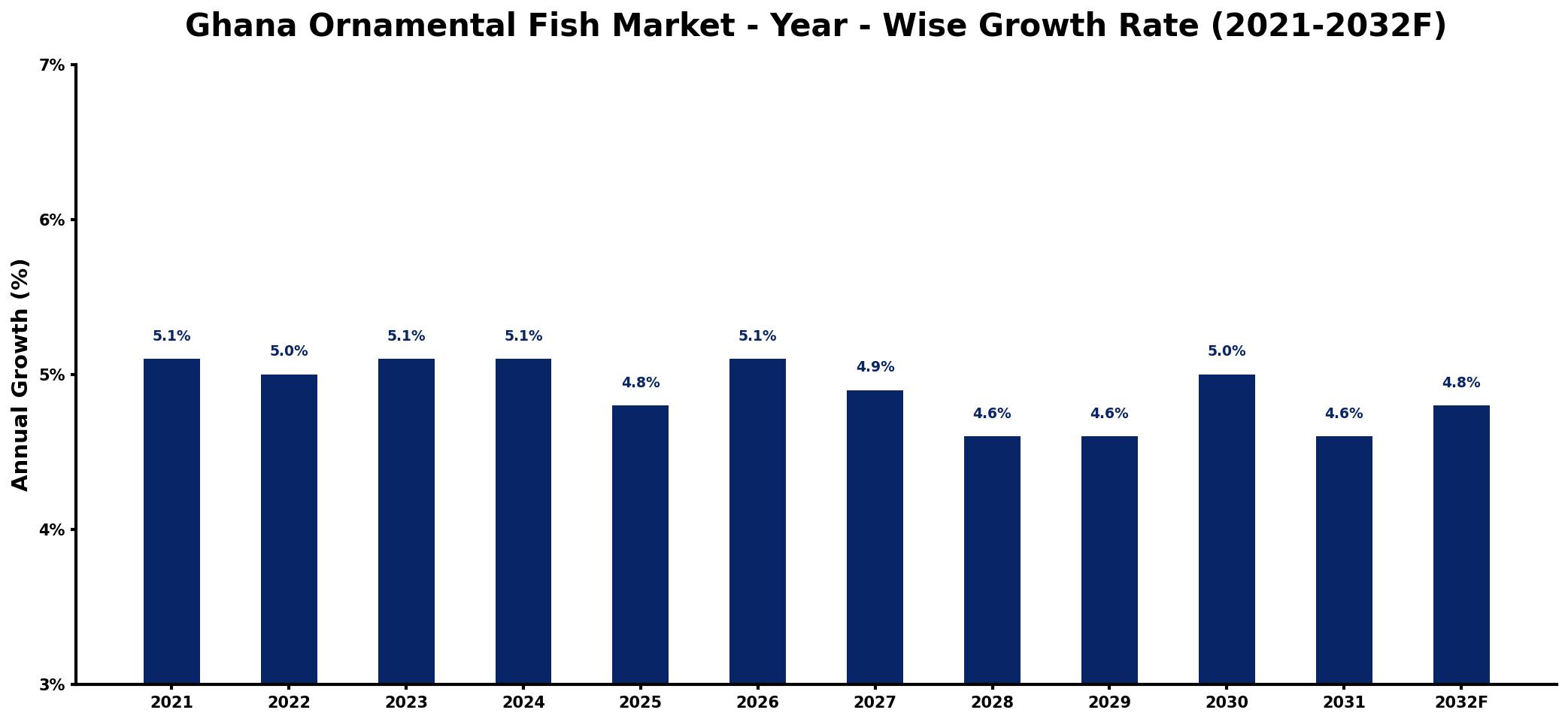
The table below presents the year‑wise growth rates along with the key drivers influencing the market
| Year | Growth Rate | Major Drivers |
| 2021 | 5.1% | Rising consumer interest in aquariums |
| 2022 | 5.0% | Increased investment in local farms |
| 2023 | 5.1% | Growth in home decor trends |
| 2024 | 5.1% | Expanding online retail platforms |
| 2025 | 4.8% | Shifts towards sustainable practices |
| 2026 | 5.1% | Surge in hobbyist communities |
| 2027 | 4.9% | Development of new breeding techniques |
| 2028 | 4.6% | Emergence of eco-friendly suppliers |
| 2029 | 4.6% | Rising popularity of pet ownership |
| 2030 | 5.0% | improved raw material availability |
| 2031 | 4.6% | Increased collaboration among retailers |
| 2032 | 4.8% | Expansion of export opportunities |
Note: Market size estimations and growth projections presented in this report are based on 6Wresearch's proprietary forecasting methodology, utilizing the latest available industry data, government publications, and primary research inputs.
Ghana Ornamental Fish Market Synopsis
The Ghanaian ornamental fish market is characterized by a rich diversity of freshwater and marine species, with guppies, tetras, goldfish, and cichlids being particularly favored by local fishkeepers. This growing interest in ornamental aquariums has led to an increase in both local breeding and importation activities, catering to a wide range of consumer preferences.
In recent years, consumer trends have shifted towards sustainable practices, with many buyers prioritizing ethically sourced fish and local breeders. The rise of online sales platforms has also made it more accessible for hobbyists to acquire their desired species, driving further demand and expanding market reach.
Ghana Ornamental Fish Market Key Takeaways
- The market is driven by increasing disposable income and a growing interest in aquarium keeping.
- Urbanization and a rising middle class are expanding the customer base for ornamental fish.
- There is a significant demand for sustainably sourced and locally bred ornamental species.
- Online platforms are revolutionizing the purchasing process, enhancing accessibility for consumers.
- Investment opportunities are abundant in breeding, supplies, and maintenance services.
Evaluation of Restraints in Ghana Ornamental Fish Market
Despite the market's growth trajectory, several significant restraints impede its full potential. Inadequate infrastructure for breeding and distribution poses challenges for both local breeders and importers. Furthermore, access to quality fish feed and essential equipment remains limited, affecting product quality and sustainability. High import duties and regulatory hurdles can discourage investment, while inconsistent power supply impacts operational efficiency. Finally, a lack of comprehensive education around best practices in fish care hinders the market's overall advancement.
Ghana Ornamental Fish Market Trends
Key trends are emerging in the Ghana Ornamental Fish Market, emphasizing a shift toward sustainable practices. Consumers are increasingly favoring locally bred fish over imported varieties, reflecting a desire for ethically sourced products. The trend of setting up home aquariums is gaining traction, particularly among younger generations, due to the aesthetic appeal and therapeutic benefits associated with fishkeeping. Technological innovations are also playing a role, with online platforms simplifying the purchasing process and providing a wider selection of fish species and accessories.
Ghana Ornamental Fish Market Opportunities
The Ghanaian ornamental fish market is ripe with investment opportunities. With a growing customer base demanding high-quality and exotic fish, there is potential for local breeders to scale operations and introduce new species. Specialized fish stores and maintenance services could cater to the increasing complexity of home aquariums, while online sales platforms present a modern retail channel for reaching a broader audience. Collaborations with local fish farms can ensure sustainable sourcing and help meet rising consumer expectations.
Government Initiatives in the Ghana Ornamental Fish Market
The Ghanaian government is actively involved in regulating and promoting the ornamental fish market. Policies such as the Fisheries Act of 2002 seek to ensure sustainable fishery management practices. The Veterinary Services Directorate plays a crucial role in maintaining health and quality standards, while the Ghana Standards Authority sets necessary benchmarks for safety. Additionally, the government supports industry growth through capacity-building programs and the establishment of fish hatcheries, aimed at fostering local breeding efforts.
Future Insights of the Ghana Ornamental Fish Market
Looking ahead to 2026-2032, the Ghana Ornamental Fish Market is set to continue its positive trajectory, driven by an ever-expanding interest in home aquariums. As awareness about the benefits of fishkeeping grows, more households are likely to adopt ornamental fish as a part of their living spaces. Continued advancements in breeding techniques and improvements in consumer education regarding fish care will contribute to market growth. However, stakeholders will need to address infrastructural challenges and fluctuating import costs to capitalize on these emerging opportunities.
Ghana Ornamental Fish Market Latest Developments (2025 - 2026)
Recent developments in the Ghana Ornamental Fish Market reflect a shift towards greater sustainability and consumer engagement. The introduction of initiatives aimed at raising awareness around proper fishkeeping practices and the establishment of community fish farms have gained traction. Additionally, there has been a notable increase in online platforms facilitating the buying and selling of ornamental fish, which are enhancing market accessibility and customer convenience. These trends point to a vibrant and evolving market landscape.
Ghana Ornamental Fish Market - Key Attractiveness of the Report
- 10 Years of Market Numbers
- Historical Data Starting from 2022 to 2025
- Base Year: 2025
- Forecast Data until 2032
- Key Performance Indicators Impacting the Market
- Major Upcoming Developments and Projects
Key Highlights of the Report:
- Ghana Ornamental Fish Market Outlook
- Market Size of Ghana Ornamental Fish Market, 2025
- Forecast of Ghana Ornamental Fish Market, 2032
- Historical Data and Forecast of Ghana Ornamental Fish Revenues & Volume for the Period 2022-2032F
- Ghana Ornamental Fish Market Trend Evolution
- Ghana Ornamental Fish Market Drivers and Challenges
- Ghana Ornamental Fish Price Trends
- Ghana Ornamental Fish Porter's Five Forces
- Ghana Ornamental Fish Industry Life Cycle
- Historical Data and Forecast of Ghana Ornamental Fish Market Revenues & Volume By Product for the Period 2022-2032F
- Historical Data and Forecast of Ghana Ornamental Fish Market Revenues & Volume By Tropical Freshwater for the Period 2022-2032F
- Historical Data and Forecast of Ghana Ornamental Fish Market Revenues & Volume By Temperate for the Period 2022-2032F
- Historical Data and Forecast of Ghana Ornamental Fish Market Revenues & Volume By Marine for the Period 2022-2032F
- Historical Data and Forecast of Ghana Ornamental Fish Market Revenues & Volume By Application for the Period 2022-2032F
- Historical Data and Forecast of Ghana Ornamental Fish Market Revenues & Volume By Commercial for the Period 2022-2032F
- Historical Data and Forecast of Ghana Ornamental Fish Market Revenues & Volume By Household for the Period 2022-2032F
- Ghana Ornamental Fish Import Export Trade Statistics
- Market Opportunity Assessment By Product
- Market Opportunity Assessment By Application
- Ghana Ornamental Fish Top Companies Market Share
- Ghana Ornamental Fish Competitive Benchmarking By Technical and Operational Parameters
- Ghana Ornamental Fish Company Profiles
- Ghana Ornamental Fish Key Strategic Recommendations






































