Ghana Photo Printing And Merchandise Market Size, Share & Growth Rate
The Ghana Photo Printing And Merchandise Market was estimated at USD 177 Million in 2025 and is projected to reach USD 237 Million by 2032, growing at a CAGR of 4.3% from 2026 to 2032. This positive growth trajectory is driven by the increasing consumer demand for personalized and customized products, which aligns with a cultural appreciation for unique and meaningful gifts. Furthermore, the rise of digital photography and social media is fueling a desire among consumers to transform their digital memories into physical keepsakes.
Ghana Photo Printing And Merchandise Market Year-wise Growth Rate and Key Drivers
This graph highlights how the Ghana Photo Printing And Merchandise Market has steadily grown over the years, supported by major growth factors.
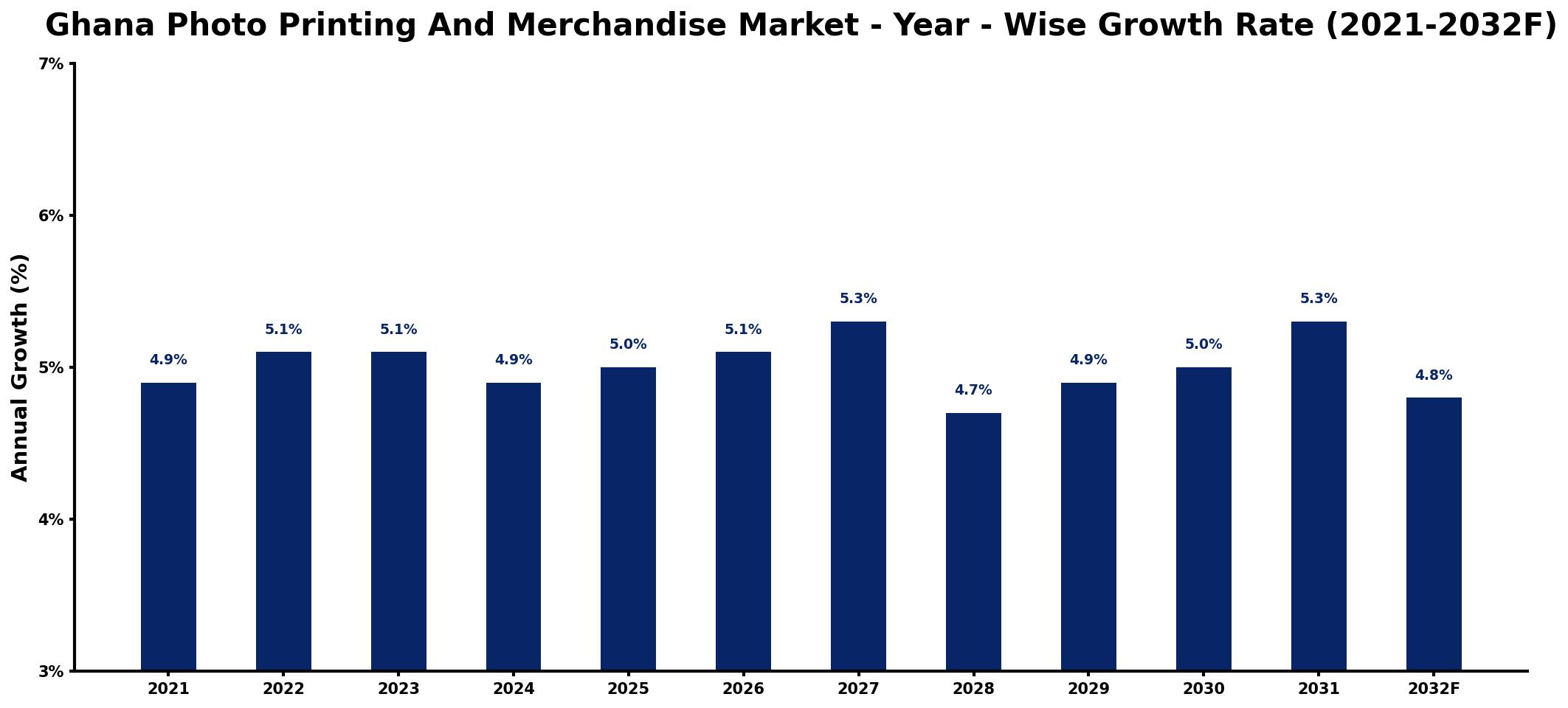
The table below presents the year‑wise growth rates along with the key drivers influencing the market
| Year | Growth Rate | Major Drivers |
| 2021 | 4.9% | growing regional consumption patterns |
| 2022 | 5.1% | Rising social media engagement levels |
| 2023 | 5.1% | Growth in online shopping platforms |
| 2024 | 4.9% | Expansion of digital content creation |
| 2025 | 5.0% | Higher disposable income for consumers |
| 2026 | 5.1% | Surge in event celebration activities |
| 2027 | 5.3% | Emergence of new creative trends |
| 2028 | 4.7% | Shift towards personalized gifting options |
| 2029 | 4.9% | Increased demand for home decor |
| 2030 | 5.0% | rising infrastructure development spending |
| 2031 | 5.3% | growing downstream application demand |
| 2032 | 4.8% | Rising popularity of experiential marketing |
Note: Market size estimations and growth projections presented in this report are based on 6Wresearch's proprietary forecasting methodology, utilizing the latest available industry data, government publications, and primary research inputs.
Ghana Photo Printing And Merchandise Market Synopsis
At the forefront of the Ghana Photo Printing And Merchandise Market is the demand for personalized and customized offerings. Consumers are increasingly seeking products that not only capture their memories but also express their individuality, making personalized photo prints, photo books, and merchandise highly sought after.
The market is notably diverse, with a blend of traditional photo printing shops and modern online platforms. This duality allows for a comprehensive range of services, catering to both older generations familiar with in-store experiences and tech-savvy younger consumers who prefer the convenience of online shopping.
Ghana Photo Printing And Merchandise Market Key Takeaways
- The market is experiencing steady growth driven by rising disposable incomes and an increasing appetite for personalized products.
- Traditional stores and online platforms coexist, providing a range of services to different consumer demographics.
- Advancements in digital printing technology are enhancing the quality and variety of available photo merchandise.
- Collaboration with local artists and influencers is a growing trend, catering to niche markets and enhancing brand differentiation.
- Consumer awareness of eco-friendly printing options is increasing, driving demand for sustainable product choices.
Evaluation of Restraints in Ghana Photo Printing And Merchandise Market
Despite the promising growth, the Ghana Photo Printing And Merchandise Market faces several challenges. High import duties on printing equipment and materials place a financial burden on local businesses, limiting access to advanced technology. Additionally, the inconsistent power supply hampers production reliability, leading to disruptions. Consumer awareness and demand for personalized photo products remain relatively low compared to global standards, which limits market penetration. Lastly, informal sector competitors offering lower-quality services complicate the landscape, making it difficult for established businesses to maintain quality and standardization.
Ghana Photo Printing And Merchandise Market Trends
Current trends in the Ghana Photo Printing And Merchandise Market indicate a strong shift towards personalization and customization. Consumers are increasingly interested in high-quality photo products that reflect their unique personalities. Additionally, the emergence of eco-friendly printing practices is gaining traction as environmentally conscious consumers seek sustainable options. The proliferation of online platforms and mobile applications for ordering photo products offers greater convenience, enhancing customer engagement and accessibility. Furthermore, collaborations with local artists and influencers are becoming a popular method for brands to differentiate their offerings in a competitive market.
Ghana Photo Printing And Merchandise Market Opportunities
The Ghana Photo Printing And Merchandise Market presents significant investment opportunities, particularly in personalized products and gifts. The increasing utilization of social media and smartphones fuels demand for transforming digital images into tangible keepsakes, including high-quality prints, canvas products, and custom merchandise like mugs and t-shirts. Targeting special occasions such as weddings and birthdays can further boost sales. Forming partnerships with event planners and photographers is another strategic avenue for expanding market reach and capitalizing on niche segments.
Government Initiatives in the Ghana Photo Printing And Merchandise Market
The Ghanaian government has implemented various initiatives aimed at promoting local businesses within the photo printing and merchandise market. Regulatory frameworks are in place to support small businesses and entrepreneurs, fostering a conducive environment for industry growth. Intellectual property rights are actively enforced to safeguard the creativity of photographers and designers, ensuring a level playing field. Additionally, the government is focused on infrastructure development and investment incentives that aim to attract both domestic and foreign investments in this sector, enhancing overall market viability.
Future Insights of the Ghana Photo Printing And Merchandise Market
Looking forward to the years 2026-2032, the Ghana Photo Printing And Merchandise Market is expected to continue its upward trajectory. The increasing popularity of personalized gifting, coupled with rising disposable incomes, will further strengthen demand for customized photo products. The integration of innovative technologies, such as augmented reality and artificial intelligence in the printing process, will enhance customer experiences, making the market more dynamic. As consumer preferences evolve towards unique and meaningful products, businesses will have ample opportunity to expand their offerings and digital presence to meet these changing demands.
Ghana Photo Printing And Merchandise Market Latest Developments (2025 - 2026)
In recent months, the Ghana Photo Printing And Merchandise Market has seen a surge in technological advancements aimed at enhancing user experience. Innovative printing techniques have been introduced, allowing for higher-quality and faster turnaround times. Moreover, online platforms are adapting their services to cater more effectively to the burgeoning demand for personalized items, with improved user interfaces and product customization features. Collaborations between local artists and brands are becoming increasingly common, aiming to introduce exclusive lines that resonate with consumers seeking unique artistic expressions in their photo merchandise.
Ghana Photo Printing And Merchandise Market - Key Attractiveness of the Report
- 10 Years of Market Numbers
- Historical Data Starting from 2022 to 2025
- Base Year: 2025
- Forecast Data until 2032
- Key Performance Indicators Impacting the Market
- Major Upcoming Developments and Projects
Key Highlights of the Report:
- Ghana Photo Printing And Merchandise Market Outlook
- Market Size of Ghana Photo Printing And Merchandise Market, 2025
- Forecast of Ghana Photo Printing And Merchandise Market, 2032
- Historical Data and Forecast of Ghana Photo Printing And Merchandise Revenues & Volume for the Period 2022-2032F
- Ghana Photo Printing And Merchandise Market Trend Evolution
- Ghana Photo Printing And Merchandise Market Drivers and Challenges
- Ghana Photo Printing And Merchandise Price Trends
- Ghana Photo Printing And Merchandise Porter's Five Forces
- Ghana Photo Printing And Merchandise Industry Life Cycle
- Historical Data and Forecast of Ghana Photo Printing And Merchandise Market Revenues & Volume By Distribution Channel for the Period 2022-2032F
- Historical Data and Forecast of Ghana Photo Printing And Merchandise Market Revenues & Volume By Instant kiosks for the Period 2022-2032F
- Historical Data and Forecast of Ghana Photo Printing And Merchandise Market Revenues & Volume By Online stores for the Period 2022-2032F
- Historical Data and Forecast of Ghana Photo Printing And Merchandise Market Revenues & Volume By Retail stores for the Period 2022-2032F
- Historical Data and Forecast of Ghana Photo Printing And Merchandise Market Revenues & Volume By Other categories for the Period 2022-2032F
- Ghana Photo Printing And Merchandise Import Export Trade Statistics
- Market Opportunity Assessment By Distribution Channel
- Ghana Photo Printing And Merchandise Top Companies Market Share
- Ghana Photo Printing And Merchandise Competitive Benchmarking By Technical and Operational Parameters
- Ghana Photo Printing And Merchandise Company Profiles
- Ghana Photo Printing And Merchandise Key Strategic Recommendations






































