Ghana Physical Security Market Size & Growth Rate (2026-2032)
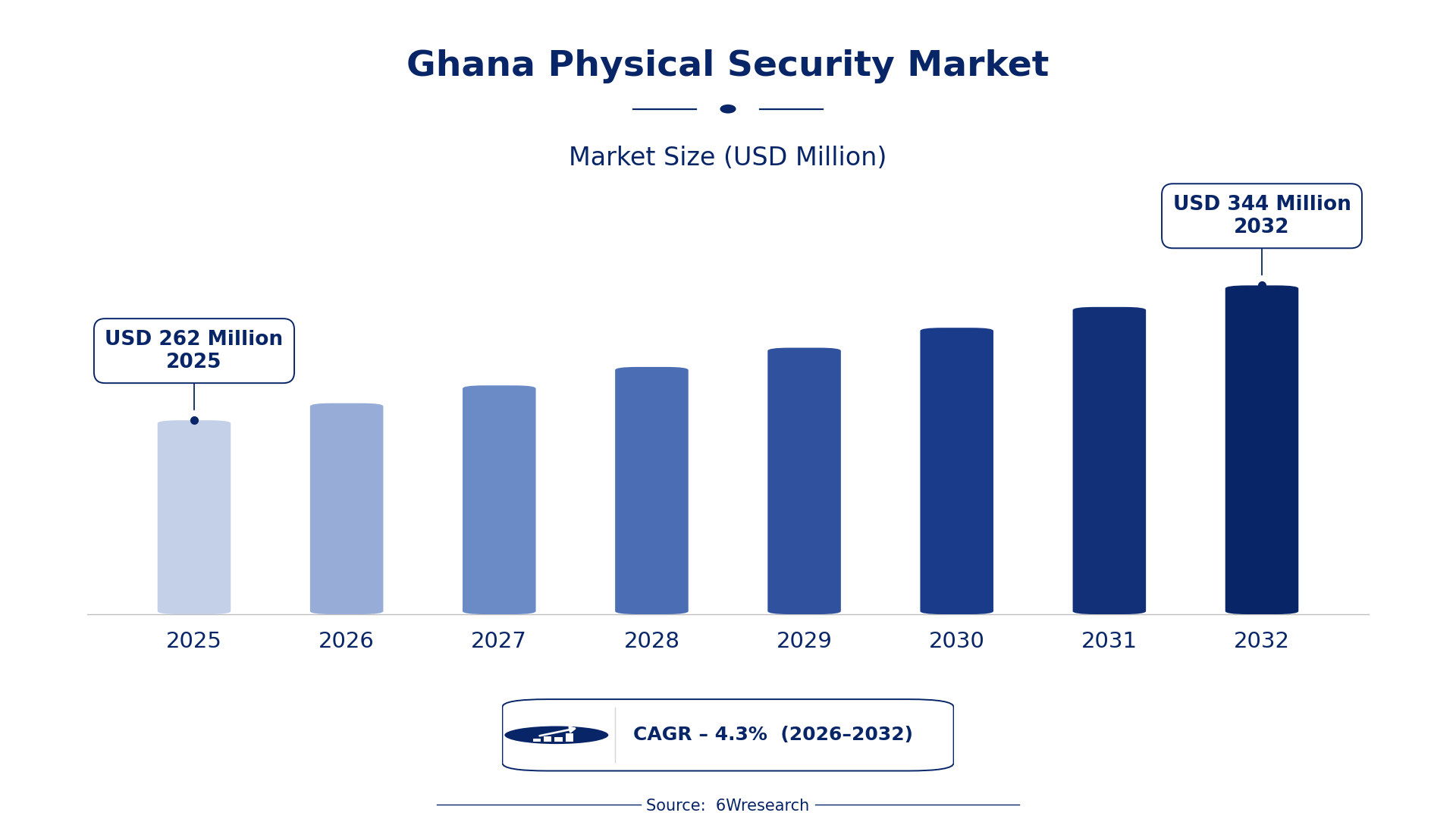
The Ghana Physical Security Market was estimated at USD 262 Million in 2025 and is projected to reach USD 344 Million by 2032, growing at a CAGR of 4.3% from 2026 to 2032.
Ghana Physical Security Market Synopsis
In Ghana, heightened awareness about security needs is becoming a driving force across various sectors, including residential, commercial, and governmental. The rapid rise in crime rates has forced both individuals and organizations to rethink their security strategies and invest heavily in robust physical security solutions.
Recent advancements in technology are redefining the market. As businesses and government entities increasingly turn to integrated security systems—featuring real-time monitoring and cloud-based solutions—the market is responding with a more diverse range of offerings. This trend indicates a solid commitment to improving security measures in Ghana.
Ghana Physical Security Market Year-wise Growth Rate and Key Drivers
This graph illustrates the annual growth rates of the Ghana Physical Security Market from 2021 to 2032, highlighting a steady upward trajectory and projected expansion over the forecast period.
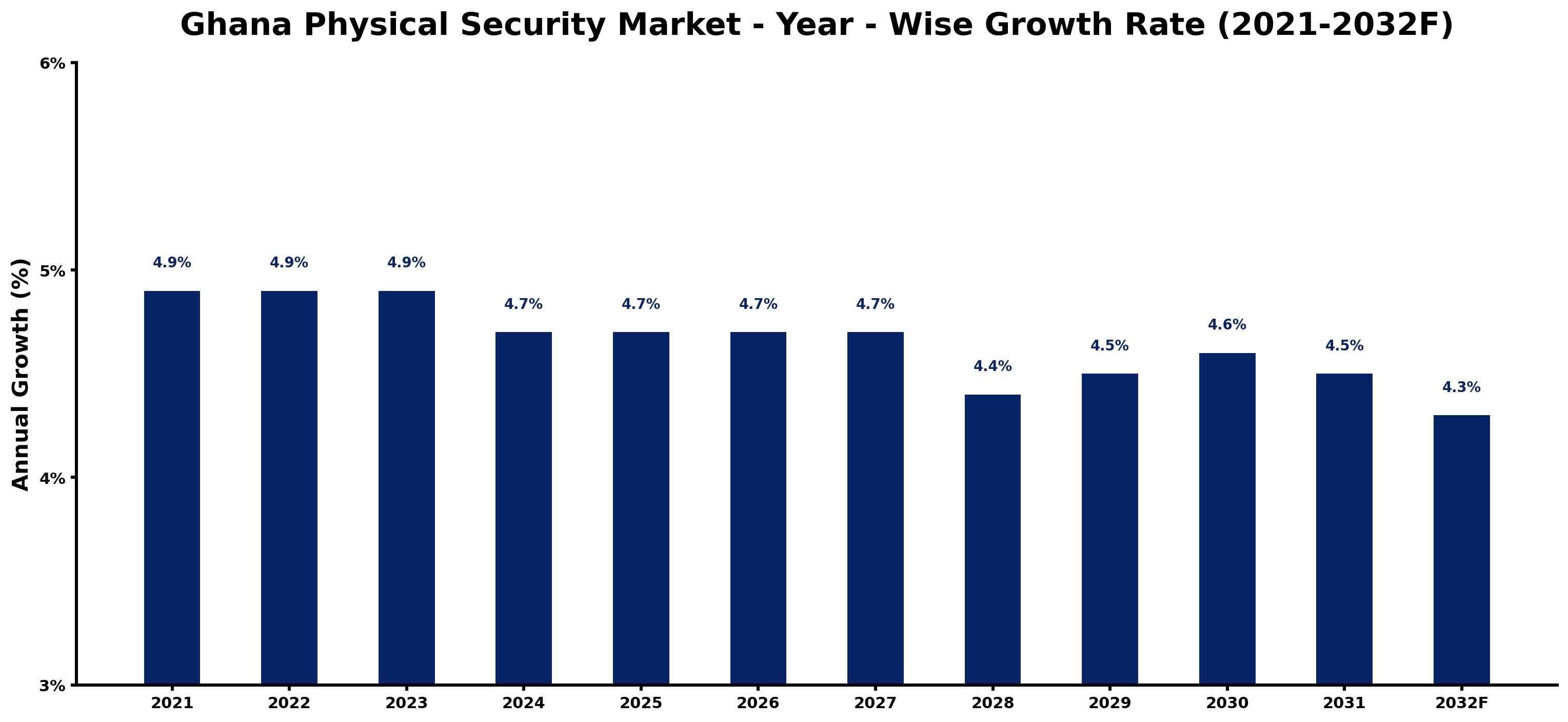
The table below presents the year‑wise growth rates along with the key drivers influencing the market
| Year | Growth Rate | Major Drivers |
| 2021 | 4.9% | Ghana's increasing urban crime rates drive security investments. |
| 2022 | 4.9% | Government's focus on investor protection boosts security demand. |
| 2023 | 4.9% | Local businesses adopting biometric systems for employee safety. |
| 2024 | 4.7% | Growing expatriate community heightens demand for physical security. |
| 2025 | 4.7% | Emergence of local security startups enhancing service offerings. |
| 2026 | 4.7% | Regulatory push for stricter safety compliance among businesses. |
| 2027 | 4.7% | Corporate events surge prompting demand for event security. |
| 2028 | 4.4% | Increased government contracts for infrastructure security solutions. |
| 2029 | 4.5% | Rising insurance requirements necessitating enhanced physical security. |
| 2030 | 4.6% | Advancements in surveillance technology boosting local security systems. |
| 2031 | 4.5% | Consistent power outages increasing reliance on physical security. |
| 2032 | 4.3% | Growing popularity of smart homes elevating security system needs. |
Note: Market size estimations and growth projections presented in this report are based on 6Wresearch's proprietary forecasting methodology, utilizing the latest available industry data, government publications, and primary research inputs.
Ghana Physical Security Market Key Takeaways
Below are some of the specific key takeaways from the market, including:
- The market is driven by rising crime rates and a need for better security solutions across all sectors.
- Technological advancements are reshaping the market, with a focus on integrated systems and real-time analytics.
- Government initiatives aimed at enhancing public safety are positively impacting market growth.
- Investment opportunities are emerging due to an increasing demand for advanced security measures.
- Challenges such as inadequate infrastructure and budget constraints persist but can be mitigated through collaboration.
Evaluation of Restraints in Ghana Physical Security Market
Despite its promising growth trajectory, the Ghana Physical Security Market faces a number of obstacles. Inadequate infrastructure remains a critical challenge; many areas still rely on outdated security systems that fail to meet modern demands. on top of that, budget constraints restrict smaller organizations from implementing comprehensive security measures. The overall lack of awareness regarding the importance of physical security can prevent necessary investments, and a limited pool of skilled professionals exacerbates the situation.
Ghana Physical Security Market Trends
The market is currently witnessing a shift towards advanced technologies. Video surveillance, access control systems, and biometric solutions are gaining traction, reflecting increasing concerns about safety and security. Notably, integrated security systems offering real-time monitoring and analytics are in high demand. Additionally, cloud-based solutions for remote monitoring and management are on the rise, driven by the ongoing urbanization and industrialization of the country.
Ghana Physical Security Market Opportunities
Numerous growth avenues exist within the Ghana Physical Security Market, particularly as demand escalates for security solutions across various sectors. Government initiatives aimed at improving public safety further fuel interest in security technologies. Investors should explore opportunities in areas such as access control, surveillance systems, and perimeter security solutions, which are increasingly necessary for safeguarding assets in the country.
Government Initiatives in the Ghana Physical Security Market
Government policy plays a critical role in shaping the Ghana Physical Security Market. Recent initiatives focus on enhancing public safety through improved infrastructure and effective regulations. Collaboration between public and private sectors is emphasized to address security challenges comprehensively. These initiatives are essential for creating an environment conducive to business growth and citizen safety.
- A national surveillance camera installation program was recently completed to enhance public safety in urban areas.
- Current efforts include increasing the presence of security personnel in high-risk zones to deter crime.
- Upcoming regulations are planned to ensure private security companies adhere to stringent standards and licensing requirements.
- Ongoing collaborations between government agencies and private firms aim to develop cost-effective security solutions for local businesses.
- A public-private initiative expected to commence in early 2026 focuses on upgrading digital infrastructure for better security management.
Future Insights of the Ghana Physical Security Market
Looking ahead to 2026-2032, the Ghana Physical Security Market is set to flourish. Continued economic growth and urbanization will drive demand for advanced security solutions. Increased crime rates and security threats will necessitate the adoption of more sophisticated technologies. on top of that, as government initiatives continue to strengthen regulations and public safety measures, the overall market outlook remains optimistic.
Ghana Physical Security Market Latest Developments
In the past year, the Ghana Physical Security Market has seen notable developments aimed at addressing security concerns. Companies are actively launching new technologies and forming partnerships to enhance service delivery. These advancements reflect a growing commitment to improving security frameworks across various sectors.
- A major technology vendor launched an innovative cloud-based security platform in Q2 2025, enhancing remote monitoring capabilities.
- In mid-2025, a partnership between a security firm and a telecommunications company was initiated to deliver integrated security solutions.
- An ongoing project began in late 2025 to upgrade perimeter security measures for critical infrastructures across urban centers.
- A service upgrade, currently underway, aims to improve intrusion detection systems for residential and commercial properties.
- By early 2026, a rollout is expected to introduce new biometric access control systems across key government facilities.
Ghana Physical Security Market - Key Attractiveness of the Report
- 10 Years of Market Numbers
- Historical Data Starting from 2022 to 2025
- Base Year: 2025
- Forecast Data until 2032
- Key Performance Indicators Impacting the Market
- Major Upcoming Developments and Projects
Key Highlights of the Report:
- Ghana Physical Security Market Outlook
- Market Size of Ghana Physical Security Market, 2025
- Forecast of Ghana Physical Security Market, 2032
- Historical Data and Forecast of Ghana Physical Security Revenues & Volume for the Period 2022-2032F
- Ghana Physical Security Market Trend Evolution
- Ghana Physical Security Market Drivers and Challenges
- Ghana Physical Security Price Trends
- Ghana Physical Security Porter's Five Forces
- Ghana Physical Security Industry Life Cycle
- Historical Data and Forecast of Ghana Physical Security Market Revenues & Volume By Component for the Period 2022-2032F
- Historical Data and Forecast of Ghana Physical Security Market Revenues & Volume By Systems (PACS, PSIM, PIAM, Video Surveillance, Fire and Life Safety) for the Period 2022-2032F
- Historical Data and Forecast of Ghana Physical Security Market Revenues & Volume By Services for the Period 2022-2032F
- Historical Data and Forecast of Ghana Physical Security Market Revenues & Volume By Vertical for the Period 2022-2032F
- Historical Data and Forecast of Ghana Physical Security Market Revenues & Volume By BFSI for the Period 2022-2032F
- Historical Data and Forecast of Ghana Physical Security Market Revenues & Volume By Government for the Period 2022-2032F
- Historical Data and Forecast of Ghana Physical Security Market Revenues & Volume By Retail for the Period 2022-2032F
- Historical Data and Forecast of Ghana Physical Security Market Revenues & Volume By Transportation for the Period 2022-2032F
- Historical Data and Forecast of Ghana Physical Security Market Revenues & Volume By Residential for the Period 2022-2032F
- Historical Data and Forecast of Ghana Physical Security Market Revenues & Volume By Telecom and IT for the Period 2022-2032F
- Historical Data and Forecast of Ghana Physical Security Market Revenues & Volume By Other Verticals (Healthcare, Manufacturing, Energy and Utilities, and Education). for the Period 2022-2032F
- Historical Data and Forecast of Ghana Physical Security Market Revenues & Volume By Organization Size for the Period 2022-2032F
- Historical Data and Forecast of Ghana Physical Security Market Revenues & Volume By SMEs for the Period 2022-2032F
- Historical Data and Forecast of Ghana Physical Security Market Revenues & Volume By Large Enterprises for the Period 2022-2032F
- Ghana Physical Security Import Export Trade Statistics
- Market Opportunity Assessment By Component
- Market Opportunity Assessment By Vertical
- Market Opportunity Assessment By Organization Size
- Ghana Physical Security Top Companies Market Share
- Ghana Physical Security Competitive Benchmarking By Technical and Operational Parameters
- Ghana Physical Security Company Profiles
- Ghana Physical Security Key Strategic Recommendations






































