Ghana Playground Equipment Market Size, Share & Growth Rate
The Ghana Playground Equipment Market was estimated at USD 482 Million in 2025 and is projected to reach USD 649 Million by 2032, growing at a CAGR of 4.3% from 2026 to 2032. This anticipated growth trajectory is driven by increasing investments in infrastructure development, particularly within educational institutions and public recreational spaces. As urbanization accelerates and disposable incomes rise, the demand for safe and innovative playground equipment is expected to expand significantly, reflecting society's heightened focus on children's health and well-being.
Ghana Playground Equipment Market Year-wise Growth Rate and Key Drivers
This graph highlights how the Ghana Playground Equipment Market has steadily grown over the years, supported by major growth factors.
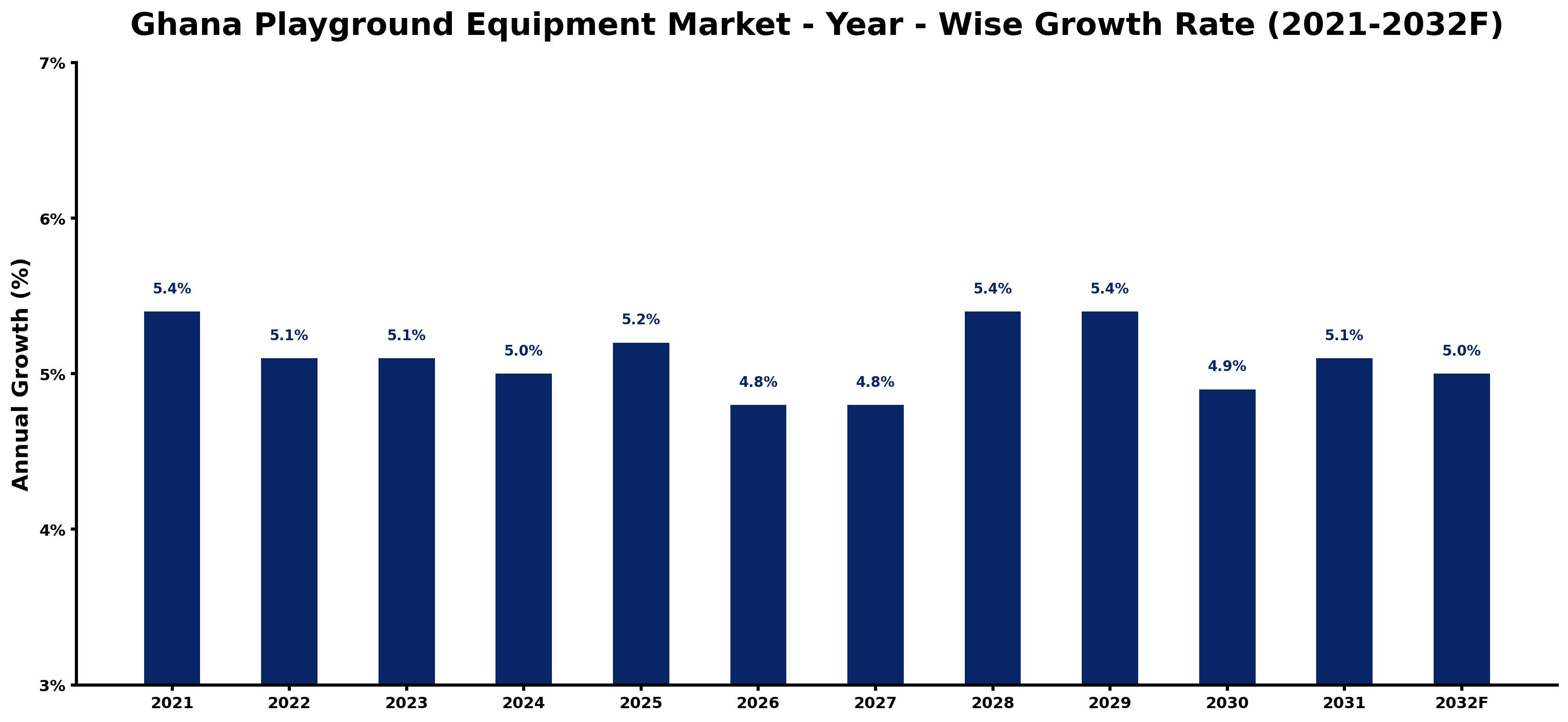
The table below presents the year‑wise growth rates along with the key drivers influencing the market
| Year | Growth Rate | Major Drivers |
| 2021 | 5.4% | Expansion of transportation and logistics networks |
| 2022 | 5.1% | Rising electricity demand across industries |
| 2023 | 5.1% | Increasing smart city development projects |
| 2024 | 5.0% | Expansion of commercial construction activities |
| 2025 | 5.2% | Increasing adoption of advanced technologies |
| 2026 | 4.8% | Increasing industrial infrastructure investments |
| 2027 | 4.8% | Expansion of manufacturing activities |
| 2028 | 5.4% | Increasing adoption of advanced technologies |
| 2029 | 5.4% | Increasing smart city development projects |
| 2030 | 4.9% | Increasing adoption of advanced technologies |
| 2031 | 5.1% | Rising electricity demand across industries |
| 2032 | 5.0% | Increasing smart city development projects |
Note - Market size estimations and growth projections presented in this report are based on 6Wresearch's advanced forecasting approach, validated with industry datasets as of June 2026.
Ghana Playground Equipment Market Synopsis
Currently, the Ghana Playground Equipment Market is evolving rapidly, underpinned by a blend of urban development and a societal shift towards promoting outdoor play. Parents and educators alike are increasingly recognizing the critical role that safe, engaging playground environments play in children's physical and cognitive development.
As governmental initiatives continue to promote the importance of recreational spaces, the market is becoming increasingly competitive, with local manufacturers and international firms striving to cater to the diverse preferences of consumers. This competitive landscape is bolstered by innovation and a rising demand for environmentally-friendly solutions.
Ghana Playground Equipment Market Key Takeaways
- The market is forecasted to grow steadily due to urbanization and increasing focus on children's well-being.
- Government policies are favoring local manufacturing and stringent safety standards.
- There is a rising trend toward eco-friendly materials and sustainable production practices.
- Customization and themed playground designs are gaining traction among consumers.
- Educational elements integrated into playground equipment are enhancing children's learning experiences.
Evaluation of Restraints in Ghana Playground Equipment Market
Despite its growth potential, the Ghana Playground Equipment Market faces several challenges that hinder its expansion. Access to quality materials remains limited, which can compromise the durability and safety of the equipment produced. Additionally, high import duties and taxes can inflate costs, making high-quality playground solutions less accessible for schools and communities. Furthermore, the absence of standardized safety regulations can lead to the presence of subpar products in the market, which poses a significant risk to children's safety and well-being.
Ghana Playground Equipment Market Trends
A prominent trend shaping the Ghana Playground Equipment Market is the increasing demand for eco-friendly solutions. Consumers are becoming more conscientious of environmental issues, prompting manufacturers to invest in durable and sustainable materials, such as recycled plastics and metals. Safety is also a critical concern, driving the market towards products that meet international safety standards. Moreover, the popularity of customizable playgrounds and equipment that incorporates educational components is on the rise, ensuring children not only play but learn through their experiences.
Ghana Playground Equipment Market Opportunities
The Ghana Playground Equipment Market is ripe with opportunities for investors and manufacturers alike. The growing urban population, along with a shift in societal attitudes towards outdoor play, opens doors for the supply of a diverse range of equipment including swings, slides, and interactive play structures. Additionally, the demand for maintenance and installation services offers further avenues for business development. Capitalizing on government initiatives that encourage outdoor activities will also bolster the market, creating a comprehensive environment for investment and growth.
Government Initiatives in the Ghana Playground Equipment Market
The government of Ghana is taking proactive measures to regulate and promote the playground equipment market. Policies set forth by the Ghana Standards Authority are focused on ensuring that playground equipment adheres to safety and quality standards. Additionally, governmental support for local manufacturing seeks to stimulate economic growth and reduce the dependency on imported equipment. These efforts aim to guarantee that schools and public playgrounds are equipped with safe and appropriate apparatus for children, reinforcing the government's commitment to fostering a vibrant and secure play environment.
Future Insights of the Ghana Playground Equipment Market
Looking ahead to the period from 2026 to 2032, the Ghana Playground Equipment Market is set to undergo significant transformations. The continuing emphasis on urbanization, coupled with rising income levels, will likely propel demand for modern playground solutions. Furthermore, as the public sector invests in enhancing recreational facilities, new market opportunities will emerge, particularly within commercial sectors like shopping malls and recreational parks. As innovation in design and sustainability remains at the forefront, manufacturers are expected to respond dynamically to the evolving needs of consumers, ensuring a robust and competitive market landscape.
Ghana Playground Equipment Market Latest Developments (May 2025 - June 2026)
Recent months have seen a variety of developments within the Ghana Playground Equipment Market. Stakeholders are increasingly focusing on incorporating advanced safety features and technology into playground designs. There is also a noticeable uptick in initiatives aimed at community awareness about the importance of playgrounds for child development. Local manufacturers are beginning to collaborate with international firms to enhance their product offerings and adopt best practices in safety and sustainability. These trends suggest a progressive shift towards a more innovative and responsible market.
Ghana Playground Equipment Market - Key Attractiveness of the Report
- 10 Years of Market Numbers
- Historical Data Starting from 2022 to 2025
- Base Year: 2025
- Forecast Data until 2032
- Key Performance Indicators Impacting the Market
- Major Upcoming Developments and Projects
Key Highlights of the Report:
- Ghana Playground Equipment Market Outlook
- Market Size of Ghana Playground Equipment Market, 2025
- Forecast of Ghana Playground Equipment Market, 2032
- Historical Data and Forecast of Ghana Playground Equipment Revenues & Volume for the Period 2022-2032F
- Ghana Playground Equipment Market Trend Evolution
- Ghana Playground Equipment Market Drivers and Challenges
- Ghana Playground Equipment Price Trends
- Ghana Playground Equipment Porter's Five Forces
- Ghana Playground Equipment Industry Life Cycle
- Historical Data and Forecast of Ghana Playground Equipment Market Revenues & Volume By Product for the Period 2022-2032F
- Historical Data and Forecast of Ghana Playground Equipment Market Revenues & Volume By Monkey Bars for the Period 2022-2032F
- Historical Data and Forecast of Ghana Playground Equipment Market Revenues & Volume By Sandbox for the Period 2022-2032F
- Historical Data and Forecast of Ghana Playground Equipment Market Revenues & Volume By Climbing Equipment for the Period 2022-2032F
- Historical Data and Forecast of Ghana Playground Equipment Market Revenues & Volume By Swings and Slides for the Period 2022-2032F
- Historical Data and Forecast of Ghana Playground Equipment Market Revenues & Volume By Balance Equipment for the Period 2022-2032F
- Historical Data and Forecast of Ghana Playground Equipment Market Revenues & Volume By Motion and Spinning for the Period 2022-2032F
- Historical Data and Forecast of Ghana Playground Equipment Market Revenues & Volume By Others for the Period 2022-2032F
- Historical Data and Forecast of Ghana Playground Equipment Market Revenues & Volume By Application for the Period 2022-2032F
- Historical Data and Forecast of Ghana Playground Equipment Market Revenues & Volume By Commercial Playgrounds for the Period 2022-2032F
- Historical Data and Forecast of Ghana Playground Equipment Market Revenues & Volume By Adult Outdoor Fitness Equipment for the Period 2022-2032F
- Historical Data and Forecast of Ghana Playground Equipment Market Revenues & Volume By Theme Play Systems for the Period 2022-2032F
- Historical Data and Forecast of Ghana Playground Equipment Market Revenues & Volume By Others for the Period 2022-2032F
- Ghana Playground Equipment Import Export Trade Statistics
- Market Opportunity Assessment By Product
- Market Opportunity Assessment By Application
- Ghana Playground Equipment Top Companies Market Share
- Ghana Playground Equipment Competitive Benchmarking By Technical and Operational Parameters
- Ghana Playground Equipment Company Profiles
- Ghana Playground Equipment Key Strategic Recommendations






































