Ghana Ploughing and Cultivating Machinery Market Size, Share & Growth Rate
The Ghana Ploughing and Cultivating Machinery Market was estimated at USD 323 Million in 2025 and is projected to reach USD 436 Million by 2032, growing at a CAGR of 4.4% from 2026 to 2032. This trajectory is primarily driven by a concerted push towards mechanized farming to boost agricultural productivity and a growing recognition among smallholder farmers of the efficiency advantages that modern machinery offers. Furthermore, supportive government initiatives are expected to enhance accessibility and affordability of agricultural equipment.
Ghana Ploughing and Cultivating Machinery Market Year-wise Growth Rate and Key Drivers
This graph highlights how the Ghana Ploughing and Cultivating Machinery Market has steadily grown over the years, supported by major growth factors.
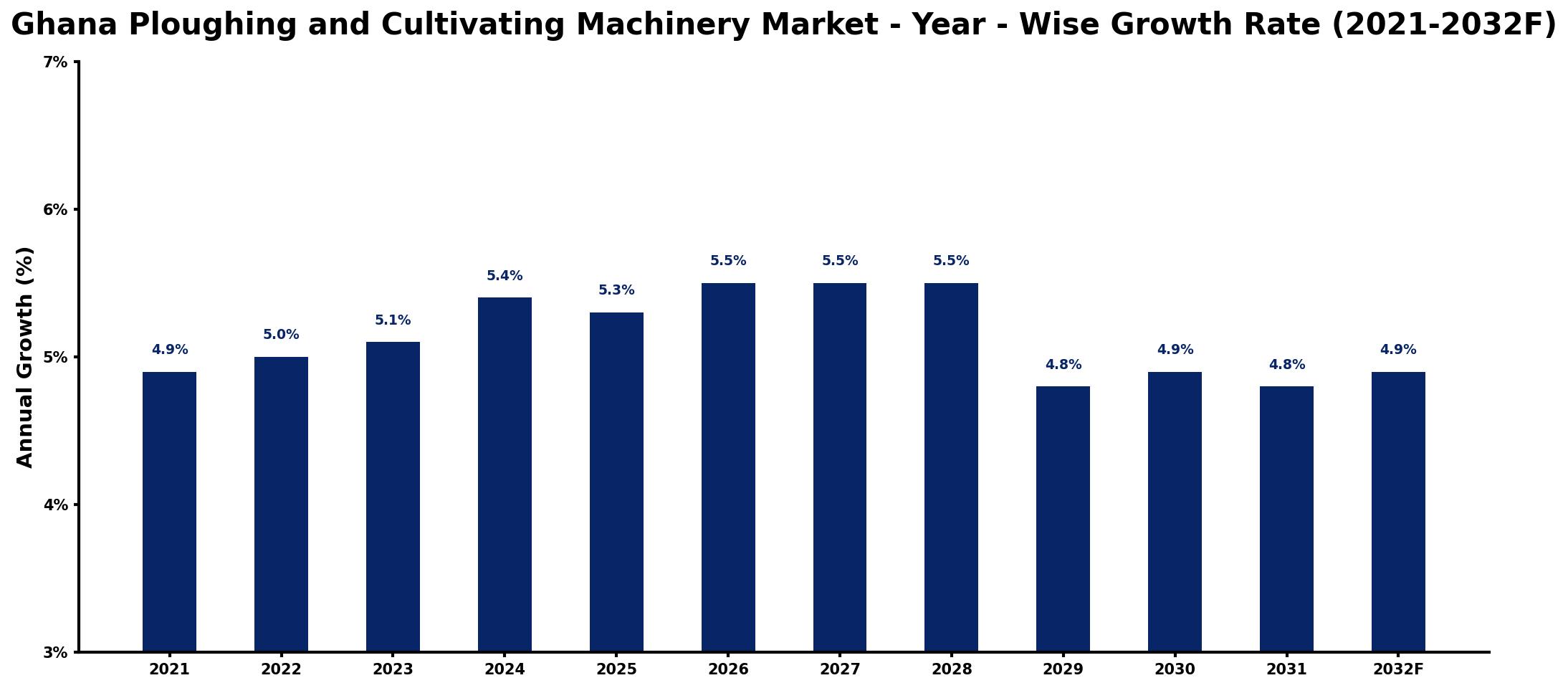
The table below presents the year‑wise growth rates along with the key drivers influencing the market
| Year | Growth Rate | Major Drivers |
| 2021 | 4.9% | Rising agricultural investment levels |
| 2022 | 5.0% | Increased mechanization adoption rates |
| 2023 | 5.1% | Expansion of export markets demand |
| 2024 | 5.4% | Growing government support initiatives |
| 2025 | 5.3% | Enhanced agricultural technology integration |
| 2026 | 5.5% | Surge in rural development projects |
| 2027 | 5.5% | Rising consumer food demand trends |
| 2028 | 5.5% | Increased access to financing options |
| 2029 | 4.8% | Emerging sustainable farming practices |
| 2030 | 4.9% | Development of cooperative farming models |
| 2031 | 4.8% | Strengthening agricultural education programs |
| 2032 | 4.9% | Growing interest in precision agriculture |
Note: Market size estimations and growth projections presented in this report are based on 6Wresearch's proprietary forecasting methodology, utilizing the latest available industry data, government publications, and primary research inputs.
Ghana Ploughing and Cultivating Machinery Market Synopsis
The Ghana Ploughing and Cultivating Machinery Market has recently gained momentum, driven by the urgent need for increased food production in response to a growing population. As farmers transition from traditional methods to mechanized solutions, the market is poised for significant growth. This shift presents exciting opportunities for manufacturers and suppliers looking to cater to the evolving demands of the agricultural sector.
Looking ahead, the market is expected to evolve further with an increasing focus on sophisticated machinery equipped with advanced technologies. Notably, features such as GPS guidance systems and precision farming capabilities are becoming essential as farmers seek to maximize productivity and sustainability in their agricultural practices.
Ghana Ploughing and Cultivating Machinery Market Key Takeaways
- The market is driven by a rising demand for mechanization among smallholder farmers.
- Government policies are actively promoting the adoption of modern agricultural techniques.
- There is a marked shift towards equipment that emphasizes efficiency and environmental sustainability.
- Challenges such as initial investment costs and access to technical support remain significant.
- Investment opportunities exist in innovative machinery solutions and after-sales services.
Evaluation of Restraints in Ghana Ploughing and Cultivating Machinery Market
Despite the optimistic growth outlook, several critical restraints are hindering market advancement. Access to financing continues to be a significant barrier for small-scale farmers who may struggle to afford modern machinery. Additionally, high import tariffs on agricultural equipment limit market options. The prevalence of counterfeit machinery poses risks to farmers, who may inadvertently invest in substandard products. Moreover, rural areas often lack adequate technical support and maintenance services, further complicating the adoption of advanced equipment.
Ghana Ploughing and Cultivating Machinery Market Trends
Current trends in the Ghana Ploughing and Cultivating Machinery Market are characterized by an increasing emphasis on efficiency-enhancing technologies. Farmers are seeking out machinery that reduces labor costs and maximizes yield, leading to a growing interest in innovations like precision agriculture tools and energy-efficient designs. Moreover, there is a notable shift towards sustainable farming practices, prompting demand for machinery that minimizes environmental impact while improving operational efficiency.
Ghana Ploughing and Cultivating Machinery Market Opportunities
Investment opportunities in the Ghana Ploughing and Cultivating Machinery Market are abundant, particularly for companies that can offer high-quality, tailored machinery solutions that meet local needs. Collaborations with local distributors can enhance market penetration, while providing robust after-sales support can build trust and customer loyalty. Furthermore, as agricultural modernization efforts intensify, there is room for innovation in product development, particularly in areas addressing the challenges faced by smallholder farmers.
Government Initiatives in the Ghana Ploughing and Cultivating Machinery Market
The Ghanaian government has established various initiatives to bolster the ploughing and cultivating machinery market. Key measures include import duty waivers on agricultural machinery and subsidies aimed at local manufacturing. Additionally, financial support programs are being implemented to assist farmers in purchasing modern equipment. The government is also focused on training programs to educate farmers about the advantages of mechanization, creating a favorable environment for market growth.
Future Insights of the Ghana Ploughing and Cultivating Machinery Market
Looking towards 2026-2032, the Ghana Ploughing and Cultivating Machinery Market is on track for continuous expansion. With increasing investment in modern farming techniques and a commitment from the government to enhance agricultural productivity, the landscape will likely become more competitive. The adoption of new technologies, coupled with a rising awareness among farmers about the benefits of mechanized farming, will further stimulate market growth, leading to increased efficiencies and sustainable practices in agriculture.
Ghana Ploughing and Cultivating Machinery Market Latest Developments (2025 - 2026)
Recent developments in the Ghana Ploughing and Cultivating Machinery Market reflect a significant shift towards innovation and efficiency. Manufacturers are beginning to introduce advanced machinery designed to meet the evolving needs of farmers, including options that integrate modern technology for precision agriculture. Furthermore, there has been an increase in collaborations between local businesses and international suppliers, aiming to enhance the accessibility and affordability of modern equipment for smallholder farmers.
Ghana Ploughing and Cultivating Machinery Market - Key Attractiveness of the Report
- 10 Years of Market Numbers
- Historical Data Starting from 2022 to 2025
- Base Year: 2025
- Forecast Data until 2032
- Key Performance Indicators Impacting the Market
- Major Upcoming Developments and Projects
Key Highlights of the Report:
- Ghana Ploughing and Cultivating Machinery Market Outlook
- Market Size of Ghana Ploughing and Cultivating Machinery Market, 2025
- Forecast of Ghana Ploughing and Cultivating Machinery Market, 2032
- Historical Data and Forecast of Ghana Ploughing and Cultivating Machinery Revenues & Volume for the Period 2022-2032F
- Ghana Ploughing and Cultivating Machinery Market Trend Evolution
- Ghana Ploughing and Cultivating Machinery Market Drivers and Challenges
- Ghana Ploughing and Cultivating Machinery Price Trends
- Ghana Ploughing and Cultivating Machinery Porter's Five Forces
- Ghana Ploughing and Cultivating Machinery Industry Life Cycle
- Historical Data and Forecast of Ghana Ploughing and Cultivating Machinery Market Revenues & Volume By Type for the Period 2022-2032F
- Historical Data and Forecast of Ghana Ploughing and Cultivating Machinery Market Revenues & Volume By Ploughs for the Period 2022-2032F
- Historical Data and Forecast of Ghana Ploughing and Cultivating Machinery Market Revenues & Volume By Harrows for the Period 2022-2032F
- Historical Data and Forecast of Ghana Ploughing and Cultivating Machinery Market Revenues & Volume By Others for the Period 2022-2032F
- Historical Data and Forecast of Ghana Ploughing and Cultivating Machinery Market Revenues & Volume By Application for the Period 2022-2032F
- Historical Data and Forecast of Ghana Ploughing and Cultivating Machinery Market Revenues & Volume By Soil Loosening for the Period 2022-2032F
- Historical Data and Forecast of Ghana Ploughing and Cultivating Machinery Market Revenues & Volume By Clod Size Reduction for the Period 2022-2032F
- Historical Data and Forecast of Ghana Ploughing and Cultivating Machinery Market Revenues & Volume By Clod Sorting for the Period 2022-2032F
- Historical Data and Forecast of Ghana Ploughing and Cultivating Machinery Market Revenues & Volume By Others for the Period 2022-2032F
- Ghana Ploughing and Cultivating Machinery Import Export Trade Statistics
- Market Opportunity Assessment By Type
- Market Opportunity Assessment By Application
- Ghana Ploughing and Cultivating Machinery Top Companies Market Share
- Ghana Ploughing and Cultivating Machinery Competitive Benchmarking By Technical and Operational Parameters
- Ghana Ploughing and Cultivating Machinery Company Profiles
- Ghana Ploughing and Cultivating Machinery Key Strategic Recommendations






































