Ghana Policy Management in Telecom Market Size & Growth Rate (2026-2032)
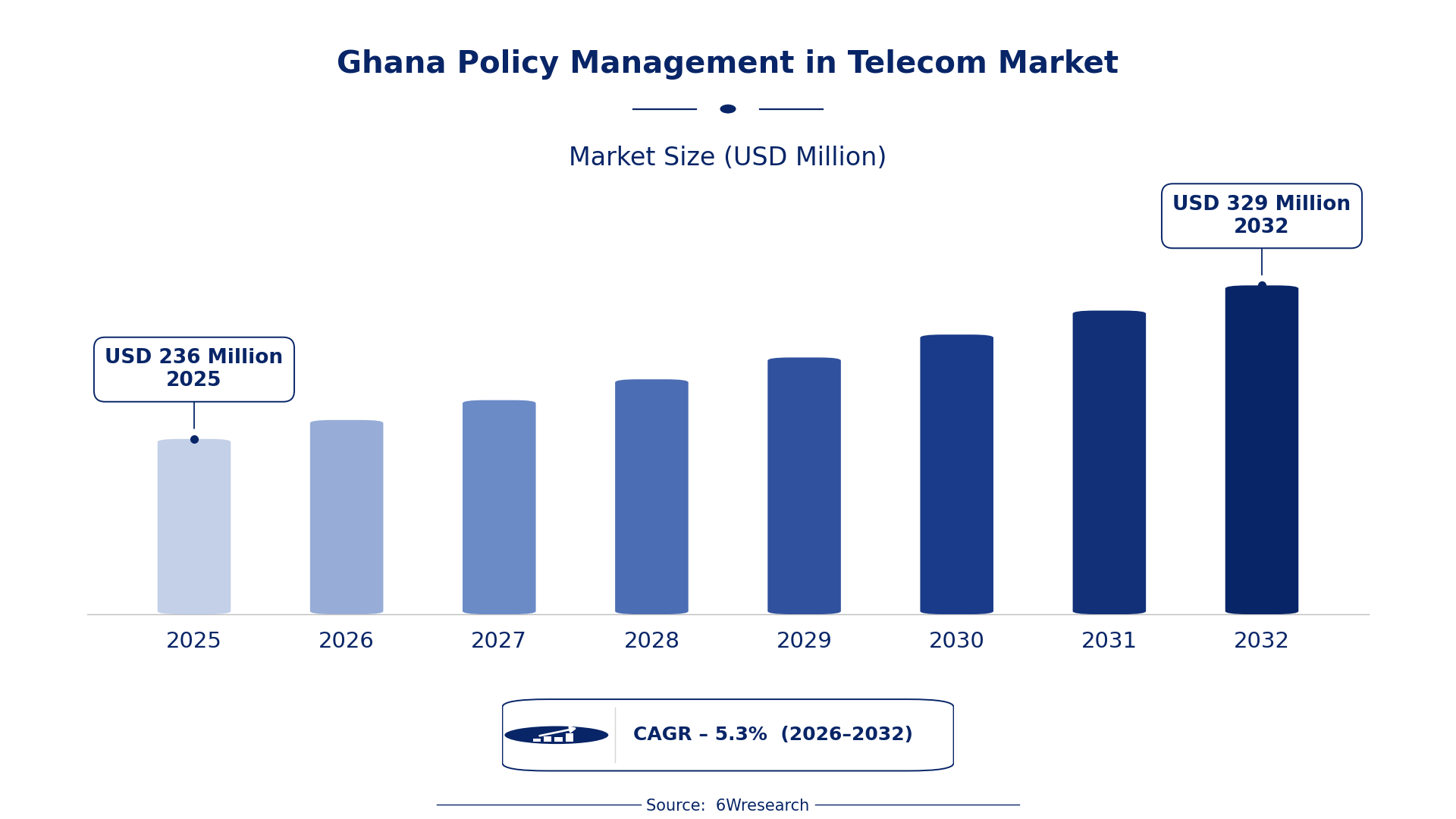
The Ghana Policy Management in Telecom Market was estimated at USD 236 Million in 2025 and is projected to reach USD 329 Million by 2032, growing at a CAGR of 5.3% from 2026 to 2032.
Ghana Policy Management in Telecom Market Synopsis
The intricate framework of regulatory compliance stands as the most powerful force shaping the Ghana Policy Management in Telecom Market today. As telecom operators wrestle with the rapid expansion of mobile services and data traffic, they must align with evolving government policies and market dynamics.
In Ghana, the intersection of digital transformation initiatives and regulatory reforms is driving demand for efficient policy management solutions. These tools enable telecom companies to better manage network resources while ensuring compliance and enhancing service quality for consumers.
Ghana Policy Management in Telecom Market Year-wise Growth Rate and Key Drivers
This graph illustrates the annual growth rates of the Ghana Policy Management in Telecom Market from 2021 to 2032, highlighting a steady upward trajectory and projected expansion over the forecast period.
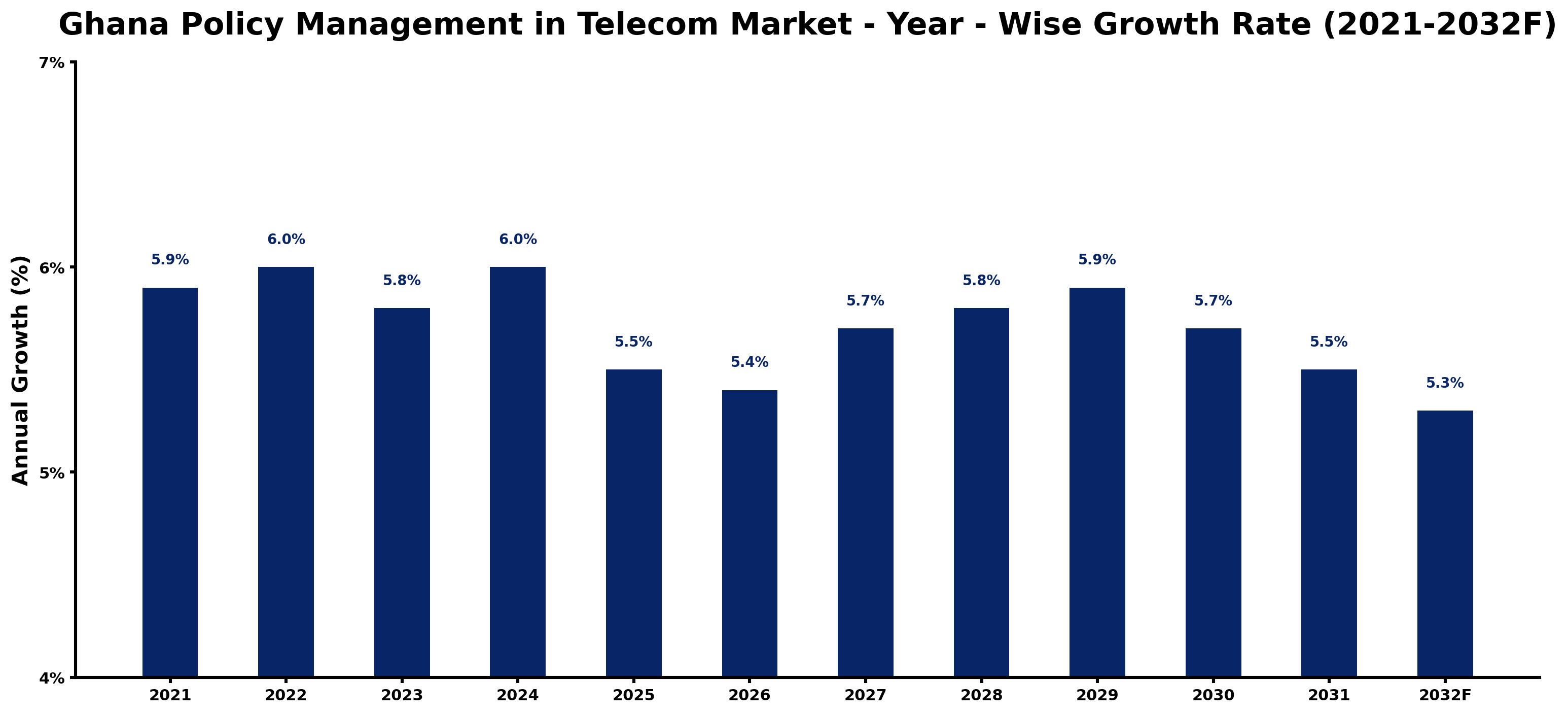
The table below presents the year‑wise growth rates along with the key drivers influencing the market
| Year | Growth Rate | Major Drivers |
| 2021 | 5.9% | National Communications Authority promotes digital inclusion policies. |
| 2022 | 6.0% | Ghana's Vision 2023 enhances telecom infrastructure investments. |
| 2023 | 5.8% | Increased mobile penetration drives demand for policy frameworks. |
| 2024 | 6.0% | Regulatory body improves compliance for telecom service providers. |
| 2025 | 5.5% | Rising smartphone adoption accelerates policy management needs. |
| 2026 | 5.4% | Government implements new data privacy regulations for telecoms. |
| 2027 | 5.7% | Growth in mobile banking fosters regulatory innovations in telecom. |
| 2028 | 5.8% | Youthful population demands cutting-edge telecom services policies. |
| 2029 | 5.9% | Increasing internet access prompts localized policy adjustments. |
| 2030 | 5.7% | Emerging tech hubs incentivize telecom regulatory improvements. |
| 2031 | 5.5% | Collaboration with international bodies enhances local telecom standards. |
| 2032 | 5.3% | Public-private partnerships boost telecom policy effectiveness. |
Note: Market size estimations and growth projections presented in this report are based on 6Wresearch's proprietary forecasting methodology, utilizing the latest available industry data, government publications, and primary research inputs.
Ghana Policy Management in Telecom Market Key Takeaways
Below are some of the specific key takeaways from the market, including:
- The telecom market is increasingly influenced by the need for regulatory compliance as a primary growth driver.
- Investment in telecommunications infrastructure development is vital for fostering market expansion.
- The demand for personalized services is pushing telecom operators to adopt advanced policy management solutions.
- Real-time policy enforcement remains a critical challenge for operators as they seek to enhance operational efficiency.
- Government initiatives are pivotal in creating a conducive environment for the growth of policy management in the telecom sector.
Evaluation of Restraints in Ghana Policy Management in Telecom Market
The Ghana Policy Management in Telecom Market faces notable constraints that hinder growth. Complexity in policy enforcement is a primary issue; telecom operators struggle to implement and adapt policies effectively across their networks. This is compounded by the need for continuous, real-time updates that match the fast-paced technological advancements in the sector. Furthermore, interoperability challenges among various telecom systems create additional barriers, making it hard for operators to ensure seamless compliance across platforms.
Ghana Policy Management in Telecom Market Trends
Several trends are shaping the Ghana Policy Management in Telecom Market. First, the rapid increase in mobile penetration is demanding a shift towards more sophisticated policy management systems. Additionally, the rise in data traffic requires telecom companies to implement more refined service policies. There's a growing emphasis on consumer protection, leading operators to adopt frameworks that enhance transparency and service quality.
Ghana Policy Management in Telecom Market Opportunities
There is substantial room for growth in the Ghana Policy Management in Telecom Market. Operators can capitalize on advancements in digital technologies to streamline policy management processes. The ongoing push towards digital inclusion provides investment opportunities in developing scalable solutions. Furthermore, building partnerships with technology vendors could enhance operational capabilities and service delivery.
Government Initiatives in the Ghana Policy Management in Telecom Market
The Ghanaian government plays a crucial role in shaping the policy environment for the telecom sector. By prioritizing regulatory reforms and fostering collaborative stakeholder engagements, the government aims to enhance governance in policy management. This approach not only encourages investment but also drives innovation and competition within the industry.
- A recent initiative included a national consultation program to gather insights from industry stakeholders on regulatory needs, launched in early 2023.
- Currently, there’s an ongoing effort to implement a comprehensive capacity building program for regulatory authorities to strengthen oversight capabilities.
- Plans are underway to introduce a new regulatory framework by 2026 that aims to simplify licensing processes for telecom operators.
- The government is also promoting a public-private partnership initiative, aimed at expanding digital infrastructure access across rural communities by 2028.
Future Insights of the Ghana Policy Management in Telecom Market
Looking ahead to 2026-2032, the Ghana Policy Management in Telecom Market is set to experience significant transformation driven by continuous technological advancement and regulatory evolution. With mobile services expected to expand, operators will increasingly need to adopt flexible and dynamic policy management solutions. Additionally, the government’s commitment to fostering a transparent regulatory environment will be key in ensuring that the sector thrives and meets the needs of its consumers.
Ghana Policy Management in Telecom Market Latest Developments
Recent activity in the Ghana Policy Management in Telecom Market indicates a shift towards greater integration of technology in policy enforcement and compliance monitoring. Over the past year, operators have been focusing on enhancing their systems to better manage network policies and consumer protections.
- In early 2023, a major technology vendor completed the rollout of a new policy management software solution for a leading telecom operator.
- An ongoing initiative started in mid-2023 aims to establish a national data protection framework that will standardize compliance measures across the industry.
- Plans for a comprehensive network upgrade are expected to commence in late 2025, focusing on increasing bandwidth to support the growing demand for data services.
- A collaborative project between telecom operators is set to launch in Q2 2026, focusing on consumer education initiatives to enhance service transparency.
Ghana Policy Management in Telecom Market - Key Attractiveness of the Report
- 10 Years of Market Numbers
- Historical Data Starting from 2022 to 2025
- Base Year: 2025
- Forecast Data until 2032
- Key Performance Indicators Impacting the Market
- Major Upcoming Developments and Projects
Key Highlights of the Report:
- Ghana Policy Management in Telecom Market Outlook
- Market Size of Ghana Policy Management in Telecom Market, 2025
- Forecast of Ghana Policy Management in Telecom Market, 2032
- Historical Data and Forecast of Ghana Policy Management in Telecom Revenues & Volume for the Period 2022-2032F
- Ghana Policy Management in Telecom Market Trend Evolution
- Ghana Policy Management in Telecom Market Drivers and Challenges
- Ghana Policy Management in Telecom Price Trends
- Ghana Policy Management in Telecom Porter's Five Forces
- Ghana Policy Management in Telecom Industry Life Cycle
- Historical Data and Forecast of Ghana Policy Management in Telecom Market Revenues & Volume By Network for the Period 2022-2032F
- Historical Data and Forecast of Ghana Policy Management in Telecom Market Revenues & Volume By Fixed for the Period 2022-2032F
- Historical Data and Forecast of Ghana Policy Management in Telecom Market Revenues & Volume By Wireless for the Period 2022-2032F
- Historical Data and Forecast of Ghana Policy Management in Telecom Market Revenues & Volume By Component for the Period 2022-2032F
- Historical Data and Forecast of Ghana Policy Management in Telecom Market Revenues & Volume By Solutions for the Period 2022-2032F
- Historical Data and Forecast of Ghana Policy Management in Telecom Market Revenues & Volume By Services for the Period 2022-2032F
- Historical Data and Forecast of Ghana Policy Management in Telecom Market Revenues & Volume By Deployment for the Period 2022-2032F
- Historical Data and Forecast of Ghana Policy Management in Telecom Market Revenues & Volume By Cloud for the Period 2022-2032F
- Historical Data and Forecast of Ghana Policy Management in Telecom Market Revenues & Volume By On-Premises for the Period 2022-2032F
- Ghana Policy Management in Telecom Import Export Trade Statistics
- Market Opportunity Assessment By Network
- Market Opportunity Assessment By Component
- Market Opportunity Assessment By Deployment
- Ghana Policy Management in Telecom Top Companies Market Share
- Ghana Policy Management in Telecom Competitive Benchmarking By Technical and Operational Parameters
- Ghana Policy Management in Telecom Company Profiles
- Ghana Policy Management in Telecom Key Strategic Recommendations






































